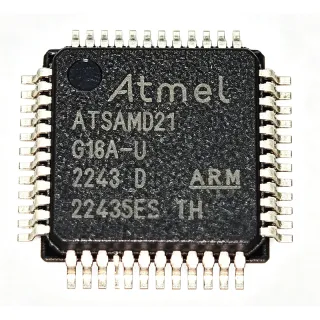
ATSAMD20G15B-AUT - 48MHz Cortex-M0+ MCU, 32KB Flash | Microchip
MPN: ATSAMD20G15B-AUT ✓ Active| Qty | Unit Price | Extended |
|---|---|---|
| 1 | $3.42 | $3.42 |
| 10 | $3.08 | $30.80 |
| 100 | $2.74 | $274.00 |
| 500 | $2.41 | $1,205.00 |
| 1,000 | $2.13 | $2,130.00 |
ATSAMD20G15B-AUT Overview
A microcontroller (MCU) is a single-chip computer that integrates a CPU core, program and data memory, peripherals, and I/O onto one silicon die. The ARM Cortex-M0+ is the smallest and most energy-efficient member of the ARM Cortex-M family, optimized for deterministic 32-bit performance at minimum power and code density. The ATSAMD20G15B-AUT sits within the broader hierarchy: Cortex-M0+ -> ARM 32-bit core -> embedded MCU -> semiconductor. Microchip's SAM D20 family further specializes this core for low-power, mixed-signal IoT endpoints with the company's proprietary SleepWalking peripherals and event system.
Key features of the ATSAMD20G15B-AUT include six SERCOM modules (each software-configurable as USART, I2C, or SPI), up to 38 general-purpose I/O pins, a 12-channel 350 ksps 12-bit ADC with hardware oversampling, a 10-bit 350 ksps DAC, two analog comparators, and a Peripheral Touch Controller (PTC) supporting capacitive touch sensing. The device integrates a full-speed USB 2.0 device port with on-chip transceiver, a Real-Time Clock (RTC) with calendar mode, and a 32 kHz oscillator plus 8 MHz and 48 MHz internal oscillators for flexible clocking without external crystals.
At the architecture level, the ATSAMD20G15B-AUT leverages the Cortex-M0+ v6-M instruction set with a single-cycle I/O port and a low-latency interrupt controller (NVIC) supporting 32 IRQ lines. The Microchip Atmel Studio / MPLAB X ecosystem provides a mature toolchain via ARM GCC, and the part is supported by Atmel START code generation and ASF (Advanced Software Framework) drivers. A 2KB independent Flash read/write region is reserved for EEPROM emulation via the NVM controller, simplifying parameter storage.
Typical applications include home automation nodes, smart metering endpoints, consumer appliances (washing machines, coffee machines), low-cost sensor hubs, capacitive touch user interfaces, and industrial control peripherals. The combination of USB device, multiple SERCOM, and ADC/DAC in a small TQFP-48 footprint makes it a strong fit for sensor reading + wired connectivity in a single chip. The -AUT suffix denotes industrial temperature range (-40C to +85C) and tape-and-reel packaging.
When designing with this part, allocate PCB area for a 32.768 kHz watch crystal if RTC accuracy below 1% is required, and provide a 1uF + 100nF decoupling network within 3 mm of each supply pair. Take care that the USB DM/DP trace impedance is 90 ohms differential and that the VBUS pin uses the correct divider when self-powered, per the Microchip datasheet. This page synthesizes distributor pricing, drop-in alternatives, and practical design notes not found in the manufacturer datasheet.
Drop-in alternatives for ATSAMD20G15B-AUT — same package, pin-to-pin compatible. Different-package parts requiring PCB rework are excluded.
Variants in this series
Same-series models that are drop-in compatible with ATSAMD20G15B-AUT (same form factor and footprint) — differing in Core, Package, ADC, DAC, Mounting Type.
Quick Comparison Tool — Select alternative parts for side-by-side comparison:
ATSAMD20G15B-AU
✅ Drop-In📋 Reference alternative (not in catalog)
ATSAMD20G15A-AU
✅ Drop-In✓ In Stock
$2.49 / Unit
View Datasheet →STM32F042C6T6
✅ Drop-In📋 Reference alternative (not in catalog)
STM32F072C8T6
✅ Drop-In📋 Reference alternative (not in catalog)
ATSAMD20G15B-AUT Maximum Ratings & Electrical Characteristics
| Core | ARM Cortex-M0+ (32-bit, v6-M) |
| Core Frequency | Up to 48 MHz |
| Flash Memory | 32 KB (32K x 8) |
| SRAM | 4 KB |
| Operating Voltage (VDD) | 1.62 V to 3.63 V |
| Package | 48-pin TQFP (7x7 mm) |
| GPIO Count | Up to 38 |
| SERCOM Modules | 6 (each USART/I2C/SPI) |
| ADC | 12-bit, up to 350 ksps, 12 channels |
| DAC | 10-bit, 350 ksps, 1 channel |
| Analog Comparators | 2 |
| USB | USB 2.0 Full-Speed Device |
| Peripheral Touch Controller (PTC) | Yes (capacitive touch) |
| Operating Temperature Range | -40 C to +85 C (industrial) |
| Mounting Type | Surface Mount (TQFP) |
| MSL Level | MSL3 (per JEDEC J-STD-020) |
| RoHS Status | Compliant |
| Series | SAM D20G |
ATSAMD20G15B-AUT Pin Configuration
| Pin 1 | PA00 — GPIO / SERCOM0 PAD[0] |
| Pin 2 | PA01 — GPIO / SERCOM0 PAD[1] |
| Pin 3 | PA02 — GPIO / Analog input (AIN0) |
| Pin 4 | PA03 — GPIO / Analog input (AIN1) / VREFA |
| Pin 5 | PA04 — GPIO / Analog input (AIN4) / VREFB |
| Pin 6 | PA05 — GPIO / Analog input (AIN5) |
| Pin 7 | PA06 — GPIO / Analog input (AIN6) |
| Pin 8 | PA07 — GPIO / Analog input (AIN7) |
| Pin 9 | VDDIO — I/O supply voltage |
| Pin 10 | GND — Ground |
| Pin 11 | PA08 — GPIO / SERCOM0 / I2S |
| Pin 12 | PA09 — GPIO / SERCOM0 / I2S |
| Pin 13 | PA10 — GPIO / SERCOM2 / I2S |
| Pin 14 | PA11 — GPIO / SERCOM2 / I2S |
| Pin 15 | VDDIN — Voltage regulator input |
| Pin 16 | GND — Ground |
| Pin 17 | PA12 — GPIO / SERCOM2 / I2S |
| Pin 18 | PA13 — GPIO / SERCOM2 / I2S |
| Pin 19 | PA14 — GPIO / SERCOM4 / I2S / XCLK |
| Pin 20 | PA15 — GPIO / SERCOM4 / I2S |
| Pin 21 | PA16 — GPIO / SERCOM1 / I2S |
| Pin 22 | PA17 — GPIO / SERCOM1 / I2S |
| Pin 23 | PA18 — GPIO / SERCOM1 / I2S |
| Pin 24 | PA19 — GPIO / SERCOM1 / I2S |
| Pin 25 | PA20 — GPIO / SERCOM5 / I2S / GCLK |
| Pin 26 | PA21 — GPIO / SERCOM5 / I2S / GCLK |
| Pin 27 | PA22 — GPIO / SERCOM3 / I2S |
| Pin 28 | PA23 — GPIO / SERCOM3 / I2S / USB SOF |
| Pin 29 | PA24 — GPIO / USB D- |
| Pin 30 | PA25 — GPIO / USB D+ |
| Pin 31 | GND — Ground |
| Pin 32 | VDDIO — I/O supply voltage |
| Pin 33 | VDD — Core logic supply |
| Pin 34 | PA27 — GPIO |
| Pin 35 | RESETn — Active-low reset input |
| Pin 36 | PB02 — GPIO / SERCOM5 |
| Pin 37 | PB03 — GPIO / SERCOM5 |
| Pin 38 | PA28 — GPIO |
| Pin 39 | PA29 — GPIO |
| Pin 40 | PA30 — GPIO / SERCOM1 |
| Pin 41 | PA31 — GPIO / SERCOM1 |
| Pin 42 | PB00 — GPIO |
| Pin 43 | PB01 — GPIO |
| Pin 44 | XIN32 — 32.768 kHz crystal input |
| Pin 45 | XOUT32 — 32.768 kHz crystal output |
| Pin 46 | VBUS — USB bus voltage detect |
| Pin 47 | AVDD — Analog supply voltage |
| Pin 48 | AGND — Analog ground |
Typical Applications
ATSAMD20G15B-AUT is suitable for 6 applications: Home Automation Sensor Hubs, Smart Metering Endpoints, Consumer Appliances (Washing Machines, Coffee Makers), Industrial Sensor Transmitters (4-20 mA / Modbus), Capacitive Touch User Interfaces, USB-Enabled Data Loggers.
Home Automation Sensor Hubs
The ATSAMD20G15B-AUT is well suited to home automation sensor hubs because it integrates 6 SERCOM ports (USART/I2C/SPI configurable), a 12-bit ADC with hardware oversampling, and USB 2.0 Full-Speed device in a 48-pin TQFP. Engineers wire temperature, humidity, and PIR sensors via I2C to two SERCOMs, while a third SERCOM drives an SPI LoRa or BLE module; the USB port serves as a CDC bridge for firmware updates and commissioning. The Cortex-M0+ at 48 MHz executes FreeRTOS sensor fusion with sub-mA active current and SleepWalking down to a few uA in standby. The 32 KB Flash holds ZHA/Zigbee or Matter-over-Thread reference designs for cost-optimized smart home products.
Recommended
Smart Metering Endpoints
The ATSAMD20G15B-AUT fits smart electricity/water meter endpoints because of its Cortex-M0+ determinism, 12-bit ADC with hardware oversampling, and RTC with calendar mode plus 32 kHz crystal drive. The 12-bit ADC samples current transformers with 16x oversampling to deliver 16-bit effective resolution for energy calculation. The 6 SERCOMs drive M-Bus, RS-485, optical port (IEC 62056-21), and a wireless M-Bus interface simultaneously. The 32 KB Flash supports DLMS/COSEM or IEC 62056 protocol stacks with secure boot via BOOTPROT. Industrial -40 C to +85 C temperature range meets outdoor meter installation requirements.
Recommended
Consumer Appliances (Washing Machines, Coffee Makers)
The ATSAMD20G15B-AUT serves consumer appliances well because it provides a USB port for service/diagnostic connectivity, a Peripheral Touch Controller (PTC) for capacitive keypad replacement, and 38 GPIO to drive motor relay matrices, valve TRIACs, and 7-segment or TFT displays. The 10-bit DAC plus 2 analog comparators close the loop on temperature and water-level sensors with no external op-amps. The Cortex-M0+ runs a 32 KB Flash appliance control loop with FreeRTOS, while SleepWalking reduces standby power below 50 uA for ErP Lot 6 / Energy Star compliance. The TQFP-48 footprint simplifies hand-solder rework on white-goods production lines.
Recommended
Industrial Sensor Transmitters (4-20 mA / Modbus)
The ATSAMD20G15B-AUT powers industrial 4-20 mA / Modbus sensor transmitters because of its 12-bit ADC with 16-bit hardware oversampling, 2 analog comparators for sensor excitation, and 6 SERCOM ports that drive RS-485 transceivers for Modbus RTU. The 32 KB Flash holds IEC 61131-3 style measurement functions plus Modbus slave stacks. The -40 C to +85 C industrial temperature range and 4 KB SRAM support 100 Hz strain-gauge or 1 kHz pressure sensor sampling without jitter. The USB port allows factory calibration without a separate UART interface, reducing BOM cost.
Recommended
Capacitive Touch User Interfaces
The ATSAMD20G15B-AUT supports capacitive touch user interfaces via its on-chip Peripheral Touch Controller (PTC), which scans up to 16 self-cap or mutual-cap channels with hardware-driven charge transfer. Combined with the 12-bit ADC for slider/wheel position, the device replaces mechanical keypads and rotary encoders. The 32 KB Flash holds Microchip QTouch or third-party touch libraries with surface acoustic immunity, while the 48 MHz Cortex-M0+ runs gesture decoding in real time. The USB port provides a HID touchscreen interface to host computers, simplifying operator HMI on laboratory instruments and medical devices.
Recommended
USB-Enabled Data Loggers
The ATSAMD20G15B-AUT is a strong fit for USB data loggers because it integrates a USB 2.0 Full-Speed device controller with on-chip transceiver and 1.5 kbps / 12 Mbps signaling, eliminating an external FTDI or CP210x bridge. The 32 KB Flash holds Microchip's USB stack plus FAT12/16 file system for USB mass storage class, while the 4 KB SRAM buffers sectors during write-back. Up to 6 SERCOM ports allow simultaneous connection of SPI Flash, I2C sensors, and UART GPS modules. The -40 C to +85 C industrial grade suits automotive road test and environmental logger applications.
Recommended
Recommended Products Summary
Engineering reference data for ATSAMD20G15B-AUT — comparison, design guidance, and compliance information.
Selection Guide
Comparison with Alternatives
| Parameter | This Product | ATSAMD20G15B-AU | ATSAMD20G15A-MU | ATSAMD20G15A-AU | STM32F042C6T6 | STM32F072C8T6 |
|---|---|---|---|---|---|---|
| Package | 48-TQFP (7x7 mm) | 48-TQFP (7x7 mm) | 48-QFN (6x6 mm) - different | 48-TQFP (7x7 mm) | 48-LQFP (7x7 mm) | 48-LQFP (7x7 mm) |
| Brand | Microchip Technology | Microchip Technology | Microchip Technology | Microchip Technology | STMicroelectronics | STMicroelectronics |
| Core | ARM Cortex-M0+ | ARM Cortex-M0+ | ARM Cortex-M0+ | ARM Cortex-M0 | ARM Cortex-M0 | |
| Max Clock Speed | 48 MHz | 48 MHz | 48 MHz | 48 MHz | ||
| Flash Memory | 32 KB | 32 KB | 16 KB | 32 KB | 64 KB | |
| SRAM | 4 KB | 4 KB | 4 KB | 6 KB | 8 KB | |
| Operating Voltage | 1.62 V to 3.63 V | 1.62 V to 3.63 V | 2.0 V to 3.6 V | 2.0 V to 3.6 V | ||
| Operating Temperature | -40 C to +85 C | -40 C to +125 C | -40 C to +85 C | -40 C to +85 C | ||
| SERCOM / USART Count | 6 SERCOM | 6 SERCOM | 2 USART + 2 I2C + 2 SPI | 4 USART + 2 I2C + 2 SPI + USB + CAN | ||
| USB | USB 2.0 FS Device | USB 2.0 FS Device | USB 2.0 FS Device | USB 2.0 FS + CAN |
Key Differentiators
- Industrial temperature grade with full USB 2.0 FS device on-chip (vs ATSAMD20G15A-AU)
- Higher SRAM and Flash headroom versus ATSAMD20G14B (vs ATSAMD20G14B-MUT)
- More configurable SERCOM ports than STM32F0 family (vs STM32F042C6T6)
- Built-in Peripheral Touch Controller (PTC) eliminates external touch IC (vs STM32F072C8T6)
Design Notes
Place a 1 uF X7R ceramic capacitor within 3 mm of every VDD/VDDIO pin pair, plus a 100 nF NP0 bypass cap adjacent to AVDD. The ATSAMD20G15B-AUT internal 1.2 V LDO drives the core; never back-feed the core. Use a separate ferrite bead between VDDIO and AVDD when ADC noise exceeds 1 LSB, and ensure AVDD tracks VDDIO within 0.3 V per the Microchip datasheet.
Route the USB DM/DP pair as a 90 ohm differential with length matching under 2 mm mismatch, per USB 2.0 Full-Speed specification. Keep the trace away from switching nodes (TRIAC, motor drive) by at least 5 mm or shield with a ground pour. Place the VBUS decoupling capacitor (4.7 uF) near the VBUS pin; an improperly placed VBUS cap is the most common cause of USB enumeration failure on SAM D20 hardware.
The 32.768 kHz crystal on XIN32/XOUT32 requires a load capacitor matching the crystal's CL specification (typically 7-12 pF). Estimated: for an Abracon ABS07 crystal (CL=12.5 pF), each external load capacitor should be 25 pF accounting for pin and PCB stray capacitance. Excessive crystal drive level (>1 uW) accelerates aging; configure CTRL.AMPGCNT register bit 0 to control gain.
Do not enable the Peripheral Touch Controller (PTC) on pins that are also configured as ADC inputs without disabling the analog input first - simultaneous operation on the same channel can corrupt ADC readings. When migrating from revision A to revision B silicon (ATSAMD20G15A-AU to ATSAMD20G15B-AUT), check Microchip errata DS80000746 for fixed ADC offset drift and updated BOD threshold values; existing firmware may need BOD33 register tweaks.
The ATSAMD20G15B-AUT in TQFP-48 (7x7 mm) has theta_JA of approximately 56 C/W on a 4-layer JEDEC test PCB, allowing operation up to 700 mW at 85 C ambient. In typical sensor-hub designs where the MCU draws 15 mA active / 5 uA standby, total dissipation stays under 50 mW and no thermal relief is required. For sealed enclosures with no airflow, add copper pours to the TQFP package bottom side to reduce junction temperature.
Compliance Information
RoHS and REACH compliant per Microchip product page. MSL3 moisture sensitivity per JEDEC J-STD-020. Industrial temperature grade -40 C to +85 C per -AUT suffix. Not AEC-Q100 qualified; for automotive applications choose ATSAMx automotive-qualified variants.