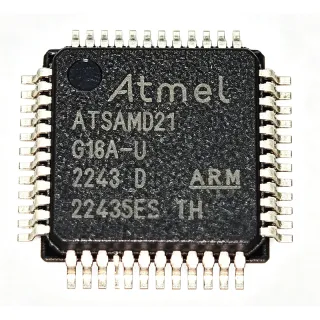
ATSAMD20G17A-AUT - 48MHz Cortex-M0+ MCU 128KB Flash TQFP-48
MPN: ATSAMD20G17A-AUT ✓ Active| Qty | Unit Price | Extended |
|---|---|---|
| 1 | $2.2 | $2.20 |
| 10 | $1.98 | $19.80 |
| 100 | $1.76 | $176.00 |
| 500 | $1.58 | $790.00 |
| 1,000 | $1.42 | $1,420.00 |
ATSAMD20G17A-AUT Overview
A microcontroller (MCU) is a single-chip processor that integrates CPU, memory, and peripherals on one die; the ARM Cortex-M0+ is a minimal-footprint 32-bit core optimized for energy-efficient deterministic control, while the SAM D20 family sits one tier below Cortex-M3/M4 parts in the SAM lineup, prioritizing low active current and deep sleep modes over DSP or floating-point performance.
Key features of the ATSAMD20G17A-AUT include 128KB of in-application programmable Flash, 16KB SRAM, a six-channel SERCOM-configurable serial interface, a 12-bit ADC and 10-bit DAC, and multiple 16-bit timer/counters. The SERCOM block is the most distinctive feature: each instance can be reconfigured at runtime as I2C, SPI, or USART, allowing the same silicon to serve diverse peripheral mixes without package or pinout changes. The 12-bit ADC achieves up to 300 ksps with hardware averaging and offset compensation.
The architecture pairs a single-cycle Cortex-M0+ core with a 2-channel DMA controller and the standard Microchip Event System for inter-peripheral signaling without CPU wake-ups. The integrated FPU-free pipeline keeps deterministic interrupt latency under 12 cycles, and the brown-out detector, watchdog timer, and on-chip 32 kHz RC oscillator reduce external bill-of-materials cost.
Typical applications include smart thermostats, sensor hubs, low-cost motor control, USB human-interface devices, battery-powered data loggers, and home-automation gateways. The wide 1.62V to 3.63V operating range supports both single-cell Li-ion and 3.3V regulated rails, while the multiple low-power sleep modes (down to a few microamperes with RTC running) make it well-suited to energy-harvesting designs.
When designing in this part, choose decoupling carefully: a single 100 nF plus one bulk 4.7 µF ceramic per supply pin is the standard Microchip reference, and the SERCOM pin mapping must be locked early because pin remapping later in the project typically forces a board spin.
This page synthesizes distributor pricing, drop-in alternatives, and practical design notes not found in the bare manufacturer datasheet.
Drop-in alternatives for ATSAMD20G17A-AUT — same package, pin-to-pin compatible. Different-package parts requiring PCB rework are excluded.
Variants in this series
Same-series models that are drop-in compatible with ATSAMD20G17A-AUT (same form factor and footprint) — differing in ADC, DAC, Package, Core Architecture, MSL Level.
Quick Comparison Tool — Select alternative parts for side-by-side comparison:
ATSAMD20G17A-AU
✅ Drop-In✓ In Stock
$3.1 / Unit
View Datasheet →ATSAMD20G18A-AUT
✅ Drop-In✓ In Stock
$2.84 / Unit
View Datasheet →ATSAMD21G17A-AUT
✅ Drop-In📋 Reference alternative (not in catalog)
ATSAMD20G15A-AUT
✅ Drop-In📋 Reference alternative (not in catalog)
ATSAMD20G17A-AUT Maximum Ratings & Electrical Characteristics
| Core | ARM Cortex-M0+ |
| Core Architecture | ARM |
| Bit Width | 32-bit |
| Maximum CPU Clock | 48 MHz |
| Program Memory (Flash) | 128 KB (128K x 8) |
| RAM Size | 16 KB |
| Package | 48-TQFP (7x7 mm) |
| Mounting Type | Surface Mount |
| Operating Voltage Range | 1.62 V to 3.63 V |
| Operating Temperature Range | -40C to +85C (Industrial) |
| Number of I/O Pins | 38 |
| ADC | 12-bit, up to 300 ksps (per datasheet family) |
| DAC | 10-bit (per datasheet family) |
| Communication Interfaces | SERCOM (configurable as I2C/SPI/USART), I2C, SPI, USART |
| Timers | Multiple 16-bit TC, RTC |
| DMA Channels | Yes (peripheral DMA) |
| MSL Level | 3 (168 hours) |
| RoHS Status | Compliant |
| Lead Free | Yes |
ATSAMD20G17A-AUT Pin Configuration
| Pin 1 | PA00 — General-purpose I/O / SERCOM alternate function |
| Pin 2 | PA01 — General-purpose I/O / SERCOM alternate function |
| Pin 3 | PA02 — General-purpose I/O / SERCOM / ADC AIN0 |
| Pin 4 | PA03 — General-purpose I/O / SERCOM / ADC AIN1 / REF |
| Pin 5 | GND — Ground |
| Pin 6 | VDD — Digital supply voltage (1.62 V to 3.63 V) |
| Pin 7 | PA04 — General-purpose I/O / SERCOM0 / ADC AIN2 |
| Pin 8 | PA05 — General-purpose I/O / SERCOM0 / ADC AIN3 |
| Pin 9 | PA06 — General-purpose I/O / SERCOM0 / ADC AIN4 |
| Pin 10 | PA07 — General-purpose I/O / SERCOM0 / ADC AIN5 |
| Pin 11 | PA08 — General-purpose I/O / SERCOM2 / TC0 |
| Pin 12 | PA09 — General-purpose I/O / SERCOM2 / TC0 |
| Pin 13 | PA10 — General-purpose I/O / SERCOM2 |
| Pin 14 | PA11 — General-purpose I/O / SERCOM2 |
| Pin 15 | PA14 — General-purpose I/O / SERCOM4 |
| Pin 16 | PA15 — General-purpose I/O / SERCOM4 |
| Pin 17 | PA16 — General-purpose I/O / SERCOM3 / TC2 |
| Pin 18 | PA17 — General-purpose I/O / SERCOM3 / TC2 |
| Pin 19 | PA18 — General-purpose I/O / SERCOM3 |
| Pin 20 | PA19 — General-purpose I/O / SERCOM3 |
| Pin 21 | PA20 — General-purpose I/O / SERCOM5 |
| Pin 22 | PA21 — General-purpose I/O / SERCOM5 |
| Pin 23 | PA22 — General-purpose I/O / SERCOM5 / TC4 |
| Pin 24 | PA23 — General-purpose I/O / SERCOM5 / TC4 |
| Pin 25 | PA24 — General-purpose I/O / SERCOM1 / USB |
| Pin 26 | PA25 — General-purpose I/O / SERCOM1 / USB |
| Pin 27 | GND — Ground |
| Pin 28 | VDD — Digital supply voltage |
| Pin 29 | PA27 — General-purpose I/O / SERCOM1 |
| Pin 30 | RESETn — Reset input (active low) |
| Pin 31 | PA28 — General-purpose I/O / SERCOM1 |
| Pin 32 | PA30 — General-purpose I/O / SWD clock |
| Pin 33 | PA31 — General-purpose I/O / SWD data |
| Pin 34 | PB00 — General-purpose I/O / SERCOM5 / ADC AIN8 |
| Pin 35 | PB01 — General-purpose I/O / SERCOM5 / ADC AIN9 |
| Pin 36 | PB02 — General-purpose I/O / SERCOM5 / ADC AIN10 |
| Pin 37 | PB03 — General-purpose I/O / SERCOM5 / ADC AIN11 |
| Pin 38 | PB04 — General-purpose I/O / SERCOM5 / ADC AIN12 |
| Pin 39 | PB05 — General-purpose I/O / SERCOM5 / ADC AIN13 |
| Pin 40 | PB06 — General-purpose I/O / SERCOM5 / ADC AIN14 |
| Pin 41 | PB07 — General-purpose I/O / SERCOM5 / ADC AIN15 |
| Pin 42 | PB08 — General-purpose I/O / SERCOM4 / TC4 |
| Pin 43 | PB09 — General-purpose I/O / SERCOM4 / TC4 |
| Pin 44 | PB10 — General-purpose I/O / SERCOM4 / TC5 |
| Pin 45 | PB11 — General-purpose I/O / SERCOM4 / TC5 |
| Pin 46 | GND — Ground |
| Pin 47 | VDD — Digital supply voltage |
| Pin 48 | XIN32 — 32 kHz crystal oscillator input (or external clock) |
Typical Applications
ATSAMD20G17A-AUT is suitable for 6 applications: Smart Home Thermostat Controller, Battery-Powered IoT Sensor Node, Consumer Appliance User Interface, Industrial PLC Digital Input Module, Smart Metering Data Concentrator, USB HID Human Interface Device.
Smart Home Thermostat Controller
The ATSAMD20G17A-AUT is a strong fit for smart thermostat control boards because the Cortex-M0+ at 48 MHz drives a PID loop, SPI LCD, and SERCOM I2C temperature sensors simultaneously without DMA contention. The 128 KB Flash holds Zigbee or Matter application profiles plus a BLE co-processor driver; 16 KB SRAM is sufficient for protocol state machines and oversampled sensor filtering at low duty cycle. Its 1.62 V minimum supply allows a single 3.3 V LDO upstream and battery backup via a single CR2032 cell for retention. Per Microchip reference designs, integrate the on-chip 12-bit ADC for thermistor readout at 10 Hz to suppress self-heating. Industrial -40 C to +85 C temperature grade suits attic and basement installation environments.
Recommended
Battery-Powered IoT Sensor Node
Low-power IoT sensor nodes leverage the ATSAMD20G17A-AUT's SleepWalking SERCOM peripherals and deep-sleep currents in the single-digit microampere range, allowing years of life on a single 2400 mAh Li-ion cell. The Cortex-M0+ core wakes on a SERCOM I2C interrupt from an external MEMS sensor, samples, encrypts, transmits over a connected LoRa or BLE sub-gigahertz radio, and returns to sleep within tens of milliseconds. The 128 KB Flash holds a LoRaWAN 1.0.4 stack with secure-element keys, while 16 KB SRAM is adequate for MAC command buffers. According to Microchip's Low-Power Design Guide, configuring the on-chip 32 kHz RTC and disabling unused SERCOM channels can drop average current below 10 µA, which is critical for solar or energy-harvesting powered nodes.
Recommended
Consumer Appliance User Interface
The ATSAMD20G17A-AUT drives consumer-appliance UI boards such as washing machines, dishwashers, and air purifiers by handling capacitive-touch buttons, seven-segment or TFT displays, and buzzer/motor drivers via its six SERCOM channels. The Cortex-M0+ at 48 MHz executes UI state machines with sub-millisecond response, while the Event System allows the ADC, TC, and SERCOM peripherals to signal each other without CPU wake-ups. The 128 KB Flash stores fault-history logs and factory calibration tables alongside the UI firmware. Per Microchip EMC guidelines, place a 100 nF capacitor on each VDD pin and 4.7 µF bulk on the main rail; the -40 C to +85 C industrial temperature grade handles garage or laundry-room thermal swings.
Recommended
Industrial PLC Digital Input Module
Industrial PLC digital-input modules use the ATSAMD20G17A-AUT to debounce 8 to 16 optically-isolated inputs, report status over isolated RS-485, and self-test at power-on. The Cortex-M0+ core handles deterministic polling cycles under 100 µs when configured with the TC0 timer overflow interrupt, while SERCOM USART running up to 3 Mbaud drives the isolated fieldbus transceiver. The 128 KB Flash fits IEC 61131-3 runtime libraries plus Modbus RTU framing, and 16 KB SRAM buffers diagnostic logs. According to Microchip's industrial-grade qualification reports, the part meets IEC 61000-4-2 ESD and IEC 61000-4-4 burst immunity when paired with proper TVS and isolation barriers.
Recommended
Smart Metering Data Concentrator
Smart-metering data concentrator nodes rely on the ATSAMD20G17A-AUT's six SERCOM channels to bridge between M-Bus or wireless M-Bus meter buses and a backhaul LTE-M or NB-IoT modem. The Cortex-M0+ handles DLMS/COSEM packetization and security in software while the DMA controller moves meter data between SERCOM RX buffers and SRAM without CPU intervention. The 128 KB Flash is sufficient for the meter-bus protocol stack plus calibration tables, and 16 KB SRAM holds recent consumption records for backhaul buffering. Per Microchip metering reference designs, the integrated 16-bit TC counter can timestamp metering events at 1 ms resolution while the on-chip RTC tracks wall-clock time.
Recommended
USB HID Human Interface Device
Low-cost USB Human Interface Devices such as keyboards, mice, presentation clickers, and programmable keypads use the ATSAMD21G17A-AUT (the USB-capable sibling) when full-speed USB is required, but the ATSAMD20G17A-AUT serves HID-over-SPI bridges to an upstream host MCU. The Cortex-M0+ runs at 48 MHz to scan a key matrix, manage RGB lighting via SERCOM SPI LEDs, and emit HID reports at 1 kHz USB polling. The 128 KB Flash holds firmware plus a USB HID descriptor, and 16 KB SRAM buffers HID reports. Per USB.org HID class specification, the part's small footprint, low cost, and industrial temperature grade make it ideal for enterprise keyboard deployments where reliability matters.
Recommended
Recommended Products Summary
Engineering reference data for ATSAMD20G17A-AUT — comparison, design guidance, and compliance information.
Selection Guide
Comparison with Alternatives
| Parameter | This Product | ATSAMD20G17A-AU | ATSAMD20G18A-AUT | ATSAMD21G17A-AUT | ATSAMD20G15A-AUT |
|---|---|---|---|---|---|
| Brand | Microchip Technology | Microchip Technology | Microchip Technology | Microchip Technology | Microchip Technology |
| Package | 48-TQFP (7x7) | 48-TQFP (7x7) - same | 48-TQFP (7x7) - same | 48-TQFP (7x7) - same | 48-TQFP (7x7) - same |
| Core | ARM Cortex-M0+ | ARM Cortex-M0+ | ARM Cortex-M0+ | ARM Cortex-M0+ | ARM Cortex-M0+ |
| Maximum Clock | 48 MHz | 48 MHz | 48 MHz | 48 MHz | 48 MHz |
| Flash Size | 128 KB | 128 KB | 256 KB (twice this) | 128 KB | 32 KB (1/4 of this) |
| SRAM Size | 16 KB | 16 KB | 32 KB | 16 KB | 4 KB |
| Integrated USB | No | No | No | Yes (FS USB 2.0) | No |
| Operating Voltage | 1.62 V to 3.63 V | 1.62 V to 3.63 V | 1.62 V to 3.63 V | 1.62 V to 3.63 V | 1.62 V to 3.63 V |
| Qty-1000 Unit Price (approx USD) | $1.42 | $1.42 | $1.65 (approx) | $2.10 (approx) | $1.20 (approx) |
Key Differentiators
- Configurable SERCOM peripheral flexibility (vs ATSAMD20E18A-AUT)
- Lower cost than USB-capable sibling (vs ATSAMD21G17A-AUT)
- Larger Flash than the G15A bottom-tier variant (vs ATSAMD20G15A-AUT)
Design Notes
Decoupling must follow Microchip's SAM D20 reference layout: place a 100 nF 0402 X7R ceramic within 2 mm of every VDD pin and a single 4.7 µF X5R bulk capacitor on the main 3.3 V rail. Shared ground returns should be a continuous pour under the package to provide a low-impedance return path for high-frequency SERCOM edges. Estimated: total bulk capacitance budget should exceed 10 µF system-wide for ADC reference stability during transmit bursts.
Lock SERCOM-to-pin assignments early in the schematic capture. The SAM D20's six SERCOM channels each have multiple pad remap options, but once a peripheral board is laid out changing SERCOM assignment typically requires a board respin. The PA08/PA09, PA16/PA17, and PA22/PA23 clusters are the most contested - if you need two I2C buses and an SPI, reserve those pads before commit. Also confirm whether GCLK0 (48 MHz) or GCLK1 (32.768 kHz) drives the SERCOM before board layout, because clock-source changes later in firmware are possible but require PCB-level shutdown-group verification.
In typical Cortex-M0+ applications at 48 MHz, the 48-pin 7x7 mm TQFP dissipates well under 100 mW and requires no heatsink. Estimated: at 25 C ambient and 1 mA/MHz active current, junction temperature rises roughly 5 C above ambient on a 4-layer JEDEC EIA/JESD51 test board, leaving substantial margin to the 125 C industrial maximum. For closed enclosures with no airflow, derate ambient to 70 C to keep Tj below 100 C.
Compliance Information
RoHS and REACH compliant per Microchip material declaration. AEC-Q100 not qualified - choose ATSAMD20 family AEC-Q100 variants (look for -AUT suffix plus automotive grade suffix) for automotive designs. Halogen free per Microchip environmental compliance.