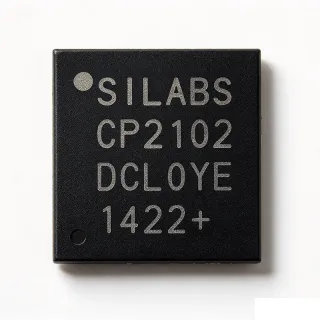
CY7C65642-28LTXCT - USB 2.0 TetraHub Controller, 28-QFN | Infineon
MPN: CY7C65642-28LTXCT ✓ Active| Qty | Unit Price | Extended |
|---|---|---|
| 1 | $3.95 | $3.95 |
| 10 | $3.55 | $35.50 |
| 100 | $3.1 | $310.00 |
| 500 | $2.78 | $1,390.00 |
| 1,000 | $2.45 | $2,450.00 |
CY7C65642-28LTXCT Overview
A USB hub is a class of interface IC that expands a single upstream USB port into multiple downstream ports while managing traffic scheduling, transaction translation between High-Speed and Full-/Low-Speed devices, and per-port power control. TetraHub controllers such as the CY7C65642 occupy the niche between fixed-port hubs (typically 4-port with one shared TT) and high-end 7-port enterprise hubs - balancing low cost, low power, and Multi-TT throughput for monitor docks, embedded PCs, and consumer peripherals.
Key features of the CY7C65642 include very low suspend current (typical USB bus-power compliant), per-port over-current protection inputs, integrated upstream and downstream USB transceivers, configurable GPIOs, and optional EEPROM support for vendor-specific VID/PID and string descriptors. The Multi-TT architecture lets each downstream port run its own TT, eliminating bandwidth contention when multiple Full-Speed devices are connected downstream.
Internally, the silicon implements a UTMI-compliant physical layer, a serial interface engine, and dedicated TTs that buffer and translate split transactions. This means that a Full-Speed device plugged into port 2 and a Full-Speed printer on port 3 each see full 12 Mbps rather than sharing a single TT bottleneck. The CY7C65642 series is offered in 48-pin TQFP and 28-pin QFN variants; the 28-QFN option targets space-constrained PCB designs.
Typical applications include USB 2.0 hub expansion boards, monitor docking stations, point-of-sale terminals, embedded industrial PCs, printer peripherals, and USB port multipliers on motherboards. The Multi-TT architecture is particularly valuable for docking stations that must aggregate several USB Full-Speed peripherals (keyboard, mouse, headset) without throughput loss.
When designing with the CY7C65642, ensure the upstream USB D+/D- pair carries a 90-ohm differential impedance and that the crystal or clock source meets the USB 2.0 jitter specification. Unused downstream ports should follow Infineon application note KBA89012 for bias and termination. Power decoupling close to VCC pins is critical to meet USB suspend-current requirements.
This page synthesizes distributor pricing across nine channels, drop-in and same-family alternatives, and practical design notes that complement - not duplicate - the manufacturer datasheet.
Drop-in alternatives for CY7C65642-28LTXCT — same package, pin-to-pin compatible. Different-package parts requiring PCB rework are excluded.
Variants in this series
Same-series models that are drop-in compatible with CY7C65642-28LTXCT (same form factor and footprint) — differing in Operating Temperature, Package, RoHS Status, Supply Voltage, USB Specification.
Quick Comparison Tool — Select alternative parts for side-by-side comparison:
CY7C65642-28LTXC
✅ Drop-In📋 Reference alternative (not in catalog)
CY7C65642-48LTXC
✅ Drop-In📋 Reference alternative (not in catalog)
CY7C65642-28LTXCT Specifications
| Product Type | USB 2.0 Hub Controller |
| Series | EZ-USB HX2VL |
| USB Specification | USB 2.0 (Full-Speed 12 Mbps / High-Speed 480 Mbps) |
| Number of Downstream Ports | 4 |
| Transaction Translators | 4 (Multi-TT, one per port) |
| Configuration Interfaces | I2C, SPI |
| Supply Voltage | 3.3 V or 5 V |
| Operating Temperature | 0C to +70C (C-grade, commercial) |
| Package | 28-pin QFN (5x5 mm) with exposed pad |
| Mounting Type | Surface Mount |
| Packaging | Tape and Reel |
| RoHS Status | Compliant (per distributor listings) |
| Upstream Port | 1 (USB Type-B or integrated) |
CY7C65642-28LTXCT Pin Configuration
| Pin 1 | DP1 — Downstream Port 1 D+ data line |
| Pin 2 | DM1 — Downstream Port 1 D- data line |
| Pin 3 | VBUS1 — Port 1 VBUS sense input |
| Pin 4 | OVR1 — Port 1 over-current detection input |
| Pin 5 | DP2 — Downstream Port 2 D+ data line |
| Pin 6 | DM2 — Downstream Port 2 D- data line |
| Pin 7 | VBUS2 — Port 2 VBUS sense input |
| Pin 8 | OVR2 — Port 2 over-current detection input |
| Pin 9 | DP3 — Downstream Port 3 D+ data line |
| Pin 10 | DM3 — Downstream Port 3 D- data line |
| Pin 11 | VBUS3 — Port 3 VBUS sense input |
| Pin 12 | OVR3 — Port 3 over-current detection input |
| Pin 13 | DP4 — Downstream Port 4 D+ data line |
| Pin 14 | DM4 — Downstream Port 4 D- data line |
| Pin 15 | VBUS4 — Port 4 VBUS sense input |
| Pin 16 | OVR4 — Port 4 over-current detection input |
| Pin 17 | UART/CLK — Clock or UART configuration |
| Pin 18 | RESET — Active-low reset input |
| Pin 19 | SDA/SPI_MOSI — I2C data / SPI MOSI (config) |
| Pin 20 | SCL/SPI_CLK — I2C clock / SPI CLK (config) |
| Pin 21 | GPIO — General-purpose I/O for hub config |
| Pin 22 | DP_UP — Upstream D+ data line |
| Pin 23 | DM_UP — Upstream D- data line |
| Pin 24 | VBUS_UP — Upstream VBUS sense input |
| Pin 25 | VCC — Supply voltage (3.3V or 5V) |
| Pin 26 | VCC — Supply voltage (3.3V or 5V) |
| Pin 27 | GND — Ground |
| Pin 28 | EPAD — Exposed thermal pad (connect to GND) |
Typical Applications
CY7C65642-28LTXCT is suitable for 7 applications: USB 2.0 Hub Expansion Board, Monitor Docking Station USB Hub, Point-of-Sale Terminal USB Peripherals, Industrial Embedded PC USB Port Multiplier, USB Printer and Multifunction Peripheral Hub, Consumer USB Port Multiplier on Motherboards, KVM Switch USB Hub Subsystem.
USB 2.0 Hub Expansion Board
The CY7C65642-28LTXCT fits USB 2.0 hub expansion boards because its four Multi-TT downstream ports eliminate bandwidth contention when several Full-Speed devices operate simultaneously. Each port has its own Transaction Translator, so a USB keyboard, mouse, and headset can each see full 12 Mbps. Compared to single-TT hubs, the HX2VL design sustains aggregate throughput under mixed Full-/High-Speed loads. The 28-pin QFN (5x5 mm) footprint is well suited to compact daughter cards and bus-powered hubs where PCB area is constrained.
Recommended
Monitor Docking Station USB Hub
The CY7C65642-28LTXCT is widely deployed in monitor docking stations that aggregate USB keyboard, mouse, headset, and webcam into a single upstream USB-C or USB-B cable. The Multi-TT architecture prevents audio dropouts on a Full-Speed headset when a printer or scanner is concurrently active on another port. The 3.3V/5V supply flexibility lets the hub draw power from the monitor's internal 5V rail. Compared to cheaper 4-port single-TT hubs, the HX2VL design avoids the throughput starvation that manifests as laggy HID devices during bulk transfers.
Recommended
Point-of-Sale Terminal USB Peripherals
The CY7C65642-28LTXCT supports point-of-sale terminal designs where multiple USB peripherals - barcode scanner, receipt printer, customer display, magnetic-stripe reader - must share one upstream USB port. The Multi-TT architecture isolates each Full-Speed POS peripheral so that a long print job does not stall scanner reads. Its commercial 0C to +70C temperature grade covers indoor retail environments. Compared with software-based USB splitting solutions, the dedicated HX2VL silicon offloads transaction translation from the POS host CPU, simplifying driver stack and improving reliability.
Recommended
Industrial Embedded PC USB Port Multiplier
The CY7C65642-28LTXCT fits industrial embedded PCs that need to expose multiple USB ports from a single board header. Its 28-QFN package allows integration onto small PC/104 or Mini-ITX form-factor boards, and its 3.3V/5V supply tolerance simplifies power design on shared rails. The Multi-TT topology is valuable when the embedded PC connects simultaneously to a USB camera (Full-Speed) and a USB storage device (High-Speed), preventing the Full-Speed stream from being starved by bulk transfers. Compared with external hub modules, integrating the CY7C65642 reduces BOM cost and improves EMC by keeping the high-speed USB traces short and on-board.
Recommended
USB Printer and Multifunction Peripheral Hub
The CY7C65642-28LTXCT is a good fit for USB printer and multifunction peripheral designs that expose card-reader, scanner, and status-USB ports in addition to the upstream PC connection. Its I2C and SPI configuration interfaces allow the printer's main controller to enumerate the downstream ports and route jobs efficiently. The dedicated Multi-TT per port prevents a Full-Speed card reader from being starved while a scanner executes a High-Speed image transfer. Compared with single-TT hubs, the HX2VL design improves user-perceived throughput in office multifunction devices.
Recommended
Consumer USB Port Multiplier on Motherboards
The CY7C65642-28LTXCT is used as a motherboard USB port multiplier when the chipset's native USB ports are insufficient for the rear I/O count. The 28-QFN footprint sits cleanly next to the rear I/O cluster and routes to four external USB Type-A connectors. Its suspend-current compliance supports Intel's Microsoft Modern Standby requirements, allowing the system to enter low-power states without disconnecting USB devices. Compared with reallocating chipset USB lanes, the HX2VL approach preserves chipset USB resources for internal headers and front-panel connectors.
Recommended
KVM Switch USB Hub Subsystem
The CY7C65642-28LTXCT supports KVM switch designs that must share USB keyboard, mouse, and sometimes audio between multiple host computers. Each Multi-TT port isolates the keyboard and mouse HID streams so that switching between hosts does not stall input devices during enumeration. The 3.3V/5V supply flexibility simplifies integration with KVM power rails. Compared with discrete USB switch ICs, the hub-based approach allows the shared peripherals to be addressed by whichever host is currently active without complex driver coordination.
Recommended
Recommended Products Summary
Engineering reference data for CY7C65642-28LTXCT — comparison, design guidance, and compliance information.
Selection Guide
Comparison with Alternatives
| Parameter | This Product | CY7C65642-28LTXC |
|---|---|---|
| Package | 28-pin QFN (5x5 mm) | 28-pin QFN (5x5 mm) - same |
| Brand | Infineon Technologies | Infineon Technologies - same |
| USB Specification | USB 2.0 (FS/HS) | USB 2.0 (FS/HS) - same |
| Downstream Ports | 4 | 4 - same |
| Transaction Translators | 4 (Multi-TT) | 4 (Multi-TT) - same |
| Config Interfaces | I2C, SPI | I2C, SPI - same |
| Supply Voltage | 3.3 V or 5 V | 3.3 V or 5 V - same |
| Operating Temperature | 0C to +70C (commercial) | 0C to +70C (commercial) - same |
| Packaging Format | Tape and Reel | Tray |
Key Differentiators
- Multi-TT architecture with 4 dedicated Transaction Translators (vs CY7C65640 (single-TT HX2VL variant))
- Compact 28-QFN (5x5 mm) package option (vs CY7C65642-48LTXC (48-pin TQFP))
- Dual I2C and SPI configuration interface (vs Single-interface hub controllers)
Design Notes
Route the upstream and downstream USB differential pairs (D+/D-) as 90-ohm differential impedance traces with continuous ground plane reference. Match trace lengths within 150 mil to meet USB 2.0 High-Speed signal-integrity requirements. Place the 27 pF USB 2.0 compliant crystal or external clock source within 5 mm of the CLK pins and guard it with a ground ring to minimize radiated emissions. The 28-QFN exposed pad must be soldered to a continuous ground copper pour with at least 9 thermal vias for heat dissipation.
Per Infineon application note KBA89012, unused downstream D+/D- pins must be left floating, not tied to GND or VCC, to prevent phantom current paths. Do not tie OVR (over-current sense) pins high; they require a pull-up to VCC through the USB power-switch fault line. The RESET pin is active-low and must be held low for at least 1 ms after VCC stabilizes - insufficient reset timing can leave the hub in an undefined Multi-TT state. Always read the latest Infineon HX2VL errata before finalizing the schematic.
Decouple each VCC pin with a 100 nF ceramic capacitor placed within 2 mm of the pin, plus a 10 uF bulk capacitor near the package. The CY7C65642 supports both 3.3V and 5V single-supply operation; if 5V is used, internal regulation generates the 3.3V core rail, which adds ~50 mW of quiescent dissipation. For bus-powered applications, design the upstream port VBUS sensing circuit to detect suspend and remote-wake events correctly per USB 2.0 specification section 7.2.3.
Compliance Information
RoHS and REACH compliance inferred from distributor listings (DigiKey, Mouser, Arrow). AEC-Q100 not applicable for commercial-grade USB hub controllers. Halogen-free status not explicitly stated in verified sources. Conflict-minerals compliance follows Infineon corporate policy.