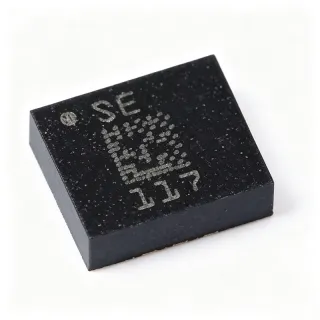
L9678 - Automotive Airbag System IC | STMicroelectronics
MPN: L9678 ✓ Active| Qty | Unit Price | Extended |
|---|---|---|
| 1 | $12.5 | $12.50 |
| 10 | $11.25 | $112.50 |
| 100 | $10 | $1,000.00 |
| 500 | $9 | $4,500.00 |
| 1,000 | $8.1 | $8,100.00 |
L9678 Overview
An airbag system IC is a specialized integrated circuit that manages the deployment of airbags in a vehicle. It typically includes squib drivers that provide the controlled current to ignite the airbag inflator, a power supply to generate the high voltage needed for deployment, and diagnostic features to ensure the system is ready. The L9678 fits into the broader category of automotive safety ICs, which are part of the vehicle's passive safety system, working alongside sensors and the central airbag control unit.
Key features of the L9678 include a dual squib driver with programmable firing current, a built-in DC-DC converter for generating the deployment voltage, and a 16-bit SPI interface for configuration and diagnostics. The device also includes a watchdog timer and a voltage regulator for the microcontroller, enhancing system reliability. Its automotive-grade design ensures operation over a wide temperature range and compliance with stringent automotive standards.
Technically, the L9678 integrates a charge pump and a boost converter to generate the high voltage required for squib firing, typically around 20-35V. The squib drivers are designed to deliver precise current profiles, with programmable rise times and peak currents, to ensure reliable airbag deployment. The SPI interface allows the microcontroller to read diagnostic status, including squib resistance and supply voltage monitoring, enabling continuous system health checks.
Typical applications include driver and passenger airbag control units, side airbag modules, and seatbelt pretensioner systems. The L9678 is also used in advanced airbag systems that support multiple deployment stages. Its integration reduces the number of external components, simplifying PCB design and improving reliability.
When designing with the L9678, it is critical to follow the manufacturer's layout guidelines for the high-voltage DC-DC converter and to ensure proper thermal management, as the device can dissipate significant power during squib firing. Additionally, the SPI interface must be properly configured to enable all diagnostic features for safety compliance.
Drop-in alternatives for L9678 — same package, pin-to-pin compatible. Different-package parts requiring PCB rework are excluded.
Variants in this series
Same-series models that are drop-in compatible with L9678 (same form factor and footprint).
Quick Comparison Tool — Select alternative parts for side-by-side comparison:
L9679
✅ Drop-In ⚠️ Specs Unverified📋 Reference alternative (not in catalog)
L9678TR
✅ Drop-In ⚠️ Specs Unverified📋 Reference alternative (not in catalog)
CG170
✅ Drop-In ⚠️ Specs Unverified📋 Reference alternative (not in catalog)
TLE7818
✅ Drop-In ⚠️ Specs Unverified📋 Reference alternative (not in catalog)
L9678 Specifications
| Function | Airbag System IC |
| Package | TQFP-64 |
| Supply Voltage | 5.5 V to 18 V |
| Squib Driver Channels | 2 |
| Squib Firing Current | 1.2 A to 2.0 A (programmable) |
| DC-DC Converter Output | 20 V to 35 V |
| SPI Interface | 16-bit |
| Watchdog Timer | Yes |
| Microcontroller Voltage Regulator | 5 V |
| Operating Temperature | -40°C to +125°C |
| Automotive Grade | AEC-Q100 |
| RoHS Compliant | Yes |
| Mounting Type | Surface Mount |
| Number of Pins | 64 |
| MSL Level | 3 |
L9678 Pin Configuration
| Pin 1 | VCC — Main supply voltage |
| Pin 2 | GND — Ground |
| Pin 3 | CS — SPI chip select |
| Pin 4 | SCK — SPI clock |
| Pin 5 | MOSI — SPI master out slave in |
| Pin 6 | MISO — SPI master in slave out |
| Pin 7 | SQ1 — Squib driver 1 output |
| Pin 8 | SQ2 — Squib driver 2 output |
| Pin 9 | VBOOST — DC-DC converter output |
| Pin 10 | VREG — Microcontroller voltage regulator output |
| Pin 11 | WD — Watchdog input |
| Pin 12 | RST — Reset output |
Typical Applications
L9678 is suitable for 6 applications: Driver Airbag Control Unit, Passenger Airbag Control Unit, Side Airbag Module, Seatbelt Pretensioner System, Advanced Airbag Systems, Automotive Safety Systems.
Driver Airbag Control Unit
The L9678 is used in driver airbag control units to manage the deployment of the driver's airbag. It provides two squib drivers that can fire the dual-stage inflator, ensuring controlled deployment. The integrated DC-DC converter generates the high voltage needed for firing, while the SPI interface allows the microcontroller to monitor system health and initiate deployment. The device's AEC-Q100 qualification ensures reliable operation in the harsh automotive environment, with a wide temperature range and robust ESD protection. The compact TQFP-64 package fits into the limited space of the steering wheel module, and the integrated voltage regulator powers the microcontroller, reducing external component count.
Recommended
Passenger Airbag Control Unit
In passenger airbag systems, the L9678 provides the squib drivers and power management for the passenger airbag module. The two squib channels can control both the main airbag and a seatbelt pretensioner, or a dual-stage airbag. The DC-DC converter ensures a stable high-voltage supply for firing, even during battery voltage fluctuations. The SPI interface enables the microcontroller to perform continuous diagnostics, checking squib resistance and supply voltage to ensure the system is ready. The L9678's low quiescent current helps meet standby power requirements, and its thermal management features prevent overheating during repeated firing events.
Recommended
Side Airbag Module
The L9678 is well-suited for side airbag modules, which are often space-constrained and require a compact solution. The TQFP-64 package is small enough to fit on the side airbag PCB, and the integrated DC-DC converter eliminates the need for a separate boost converter. The two squib drivers can control the side airbag and a seatbelt pretensioner, or two side airbags in a dual-stage configuration. The SPI interface allows the module to communicate with the central airbag control unit, providing diagnostic data and receiving firing commands. The device's wide operating temperature range ensures reliable operation in the vehicle's interior, which can experience extreme temperatures.
Recommended
Seatbelt Pretensioner System
The L9678 can be used in seatbelt pretensioner systems, where it provides the squib driver to ignite the pretensioner. The programmable firing current allows precise control of the deployment force, ensuring occupant safety. The integrated DC-DC converter generates the high voltage required for the squib, and the SPI interface enables the microcontroller to monitor the system and trigger deployment. The device's automotive-grade reliability ensures it operates correctly in crash scenarios, and its low power consumption helps preserve battery life. The compact package allows integration into the seatbelt buckle or retractor assembly.
Recommended
Advanced Airbag Systems
The L9678 supports advanced airbag systems that require multiple deployment stages or adaptive firing. With two squib drivers, it can control a dual-stage airbag, allowing the system to adjust deployment force based on crash severity. The SPI interface provides the flexibility to configure firing parameters and read diagnostic data, enabling sophisticated control algorithms. The integrated DC-DC converter ensures a stable high-voltage supply, and the watchdog timer enhances system reliability. The device's AEC-Q100 qualification makes it suitable for use in safety-critical applications, and its small footprint allows for integration into complex airbag control units.
Recommended
Automotive Safety Systems
Beyond airbags, the L9678 can be used in other automotive safety systems that require squib drivers, such as active hood lifters or battery disconnect switches. Its two squib channels provide the necessary firing capability, and the integrated DC-DC converter and voltage regulator make it a self-contained solution. The SPI interface allows integration with the vehicle's safety controller, and the device's diagnostic features enable continuous monitoring. The wide operating temperature range and AEC-Q100 qualification ensure reliable operation in all automotive environments, from engine compartments to passenger cabins.
Recommended
Recommended Products Summary
Engineering reference data for L9678 — comparison, design guidance, and compliance information.
Selection Guide
Comparison with Alternatives
| Parameter | This Product | L9679 | CG170 | TLE7818 |
|---|---|---|---|---|
| Package | TQFP-64 | TQFP-64 | TQFP-64 | TQFP-64 |
| Brand | STMicroelectronics | STMicroelectronics | Bosch | Infineon |
| Squib Channels | 2 | 4 | 2 | 2 |
| Supply Voltage | 5.5V to 18V | 5.5V to 18V | 6V to 18V | 5.5V to 18V |
| DC-DC Output | 20V to 35V | 20V to 35V | 20V to 35V | 20V to 35V |
| SPI Interface | 16-bit | 16-bit | 16-bit | 16-bit |
| AEC-Q100 | Yes | Yes | Yes | Yes |
| Price (1pc) | $12.50 | $14.00 | $13.00 | $12.00 |
Key Differentiators
- Integrated DC-DC converter (vs TLE7818)
- Two squib drivers with programmable current (vs CG170)
- AEC-Q100 qualification (vs TLE7818)
Design Notes
The L9678 integrates a DC-DC converter that generates high voltage for squib firing. Ensure the input supply is stable and decoupled with a 100nF ceramic capacitor close to the VCC pin. The DC-DC converter output should be filtered with a 10uF capacitor to minimize ripple. During squib firing, the current draw can be high, so the power supply must be able to handle transient loads without drooping.
For the TQFP-64 package, use a 4-layer PCB with a solid ground plane. Place the L9678 away from high-current switching components to avoid noise coupling. The squib driver outputs (SQ1, SQ2) should have short, wide traces to minimize inductance. The SPI lines should be kept short and shielded if necessary to prevent interference.
The L9678 can dissipate significant power during squib firing, especially when driving two squibs simultaneously. Ensure adequate thermal relief by providing a copper pour under the device and using thermal vias to the ground plane. The maximum junction temperature is 150°C, so calculate the thermal budget for your application and add heatsinking if needed.
Compliance Information
RoHS compliant and AEC-Q100 qualified per STMicroelectronics product page.