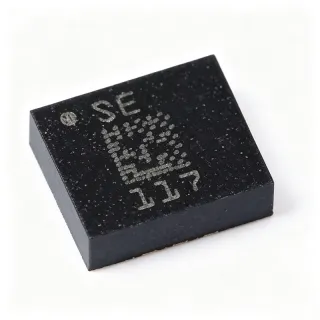
L9966 - Automotive FlexInput Sensor Interface IC | STMicroelectronics
MPN: L9966 ✓ Active| Qty | Unit Price | Extended |
|---|---|---|
| 1 | $8.5 | $8.50 |
| 10 | $7.65 | $76.50 |
| 100 | $6.8 | $680.00 |
| 500 | $6.12 | $3,060.00 |
| 1,000 | $5.44 | $5,440.00 |
L9966 Overview
A FlexInput IC is a specialized automotive sensor interface that consolidates multiple discrete components (such as op-amps, comparators, and protection circuits) into a single programmable device. It belongs to the broader family of automotive analog and power ICs, serving as the analog front-end between sensors and the microcontroller. By replacing discrete components, the L9966 reduces PCB area, improves reliability, and allows sensor changes across applications without hardware redesign.
Key features include 15 configurable input channels, SPI communication for configuration and diagnostics, and compatibility with 12V and 24V battery systems. The device integrates protection features such as overcurrent, overvoltage, and thermal shutdown, ensuring robust operation in automotive environments. Its programmable nature allows the same PCB to support different sensor types, reducing inventory and design effort.
The L9966 is built on STMicroelectronics' BCD (Bipolar-CMOS-DMOS) technology, enabling high-voltage operation with low-power digital control. This architecture provides excellent EMC performance and efficient power handling. The device is available in a 48-pin TQFP-EP (7x7) package, which offers a compact footprint with an exposed pad for thermal management.
Typical applications include engine control units, body control modules, and chassis systems. In an ECU, the L9966 interfaces with various sensors, converting analog signals to digital via SPI for the microcontroller. Its flexibility allows designers to standardize on one IC across multiple vehicle platforms, simplifying supply chain and design validation.
When designing with the L9966, ensure proper decoupling on the battery supply pin and adequate thermal connection to the exposed pad. The SPI interface should be routed with controlled impedance to minimize noise. Refer to the datasheet for detailed configuration of each input channel to match the specific sensor requirements.
Drop-in alternatives for L9966 — same package, pin-to-pin compatible. Different-package parts requiring PCB rework are excluded.
Variants in this series
Same-series models that are drop-in compatible with L9966 (same form factor and footprint) — differing in Package, ADC Resolution.
Quick Comparison Tool — Select alternative parts for side-by-side comparison:
L9966CB-TR
✅ Drop-In📋 Reference alternative (not in catalog)
L9966T
✅ Drop-In ⚠️ Specs Unverified📋 Reference alternative (not in catalog)
MC33975
⚡ Same Package ⚠️ Specs Unverified📋 Reference alternative (not in catalog)
L9966 Maximum Ratings & Electrical Characteristics
| Number of Input Channels | 15 |
| Operating Battery Supply Voltage | 5.5 V to 36 V |
| System Compatibility | 12 V and 24 V systems |
| Interface Type | SPI |
| Package | 48-TQFP-EP (7x7) |
| Mounting Type | Surface Mount |
| Qualification | AEC-Q100 |
| Sensor Types Supported | Analog, resistance, digital (temperature, lambda, pressure, position) |
| RoHS Status | Compliant |
| REACH Status | Compliant |
L9966 Pin Configuration
| Pin 1 | VCC — Battery supply voltage |
| Pin 2 | GND — Ground |
| Pin 3 | SPI_CS — SPI chip select |
| Pin 4 | SPI_CLK — SPI clock |
| Pin 5 | SPI_MOSI — SPI master out slave in |
| Pin 6 | SPI_MISO — SPI master in slave out |
| Pin 7 | CH1 — Input channel 1 |
| Pin 8 | CH2 — Input channel 2 |
| Pin 9 | CH3 — Input channel 3 |
| Pin 10 | CH4 — Input channel 4 |
| Pin 11 | CH5 — Input channel 5 |
| Pin 12 | CH6 — Input channel 6 |
| Pin 13 | CH7 — Input channel 7 |
| Pin 14 | CH8 — Input channel 8 |
| Pin 15 | CH9 — Input channel 9 |
| Pin 16 | CH10 — Input channel 10 |
| Pin 17 | CH11 — Input channel 11 |
| Pin 18 | CH12 — Input channel 12 |
| Pin 19 | CH13 — Input channel 13 |
| Pin 20 | CH14 — Input channel 14 |
| Pin 21 | CH15 — Input channel 15 |
| Pin 22 | TEST — Test pin |
| Pin 23 | NC — No connect |
| Pin 24 | NC — No connect |
Typical Applications
L9966 is suitable for 6 applications: Engine Control Unit (ECU), Body Control Module (BCM), Chassis Systems, Transmission Control Unit (TCU), Battery Management System (BMS), Lighting Control Module.
Engine Control Unit (ECU)
The L9966 interfaces with engine sensors such as temperature, pressure, and position sensors. Its 15 programmable channels allow direct connection to various analog and digital sensors, converting signals to SPI for the microcontroller. The wide 5.5V-36V input range ensures operation during cranking and load dump conditions. Compared to discrete solutions, the L9966 reduces component count and PCB area, improving reliability in the harsh engine bay environment.
Recommended
Body Control Module (BCM)
In a BCM, the L9966 manages inputs from switches, sensors, and loads. Its programmable channels can be configured for resistance measurement (e.g., switch states) or digital sensing (e.g., door position). The SPI interface allows the BCM microcontroller to read all inputs and perform diagnostics. The L9966's AEC-Q100 qualification ensures reliable operation across the vehicle's temperature range. Its flexibility enables a single PCB design to support multiple vehicle variants.
Recommended
Chassis Systems
The L9966 is suitable for chassis applications such as suspension control and braking systems. It can interface with position sensors for ride height and pressure sensors for hydraulic systems. The wide input voltage range and automotive qualification make it robust for these safety-critical applications. The device's diagnostic capabilities via SPI allow the system to detect sensor faults and take appropriate action.
Recommended
Transmission Control Unit (TCU)
The L9966 can be used in TCUs to interface with speed sensors, temperature sensors, and pressure sensors. Its programmable channels accommodate different sensor types, and the SPI interface provides data to the transmission controller. The device's 12V/24V compatibility supports various vehicle architectures. The integrated protection features help ensure reliable operation in the transmission environment.
Recommended
Battery Management System (BMS)
In a BMS, the L9966 can monitor cell temperatures and voltages. Its analog channels can measure temperature sensors, while its digital channels can interface with cell monitoring ICs. The wide input range allows direct connection to the battery pack. The SPI interface enables the BMS controller to read all data and perform diagnostics. The L9966's automotive grade ensures reliable operation in the battery environment.
Recommended
Lighting Control Module
The L9966 can be used in lighting control modules to interface with ambient light sensors and switch inputs. Its programmable channels can be configured for analog light sensors or digital switches. The SPI interface allows the module to control lighting functions and perform diagnostics. The device's small package and low power consumption make it suitable for space-constrained lighting modules.
Recommended
Recommended Products Summary
Engineering reference data for L9966 — comparison, design guidance, and compliance information.
Selection Guide
Comparison with Alternatives
| Parameter | This Product | L9966CB-TR | L9966T | MC33975 |
|---|---|---|---|---|
| Package | 48-TQFP-EP (7x7) | 48-TQFP-EP (7x7) - same | 48-TQFP-EP (7x7) - same | 48-TQFP-EP (7x7) - same |
| Brand | STMicroelectronics | STMicroelectronics | STMicroelectronics | NXP Semiconductors |
| Number of Input Channels | 15 | 15 | 15 | 22 |
| Operating Voltage Range | 5.5V to 36V | 5.5V to 36V | 5.5V to 36V | 5.5V to 36V |
| Interface | SPI | SPI | SPI | SPI |
| Qualification | AEC-Q100 | AEC-Q100 | AEC-Q100 | AEC-Q100 |
| Sensor Types | Analog, resistance, digital | Analog, resistance, digital | Analog, resistance, digital | Analog, digital |
Key Differentiators
- 15 programmable input channels (vs MC33975)
- Same-brand drop-in availability (vs L9966CB-TR)
- AEC-Q100 qualification (vs Generic sensor ICs)
Design Notes
The L9966 operates from 5.5V to 36V, so ensure the battery supply is properly decoupled with a 100nF capacitor close to the VCC pin and a 10uF bulk capacitor. This prevents voltage transients from affecting the internal circuitry.
The 48-TQFP-EP package has an exposed pad that must be soldered to a large copper area for thermal dissipation. Use multiple vias to connect the pad to the ground plane. This is essential for reliable operation at high ambient temperatures.
Route the SPI lines (CS, CLK, MOSI, MISO) with controlled impedance and keep them short to minimize noise. Avoid routing them near high-current switching traces. Add series resistors (e.g., 22Ω) if needed to reduce ringing.
Compliance Information
AEC-Q100 qualified per DigChip datasheet. RoHS and REACH compliant per STMicroelectronics standard compliance.