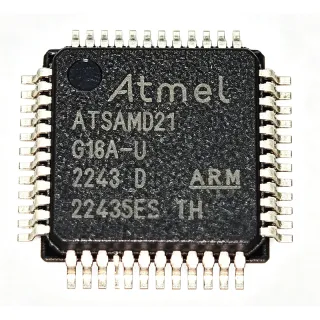
DSPIC30F2010-30I/SOG - 16-bit DSC 30 MIPS 12KB Flash | Microchip
MPN: DSPIC30F2010-30I/SOG ✓ Active| Qty | Unit Price | Extended |
|---|---|---|
| 1 | $6.2 | $6.20 |
| 10 | $5.58 | $55.80 |
| 100 | $4.96 | $496.00 |
| 500 | $4.46 | $2,230.00 |
| 1,000 | $3.95 | $3,950.00 |
DSPIC30F2010-30I/SOG Overview
A digital signal controller blends the features of a microcontroller unit (MCU) and a digital signal processor (DSP) into a single-chip solution, enabling designers to add DSP features such as multiply-accumulate (MAC) operations and fast interrupt handling to embedded applications. Within the power management hierarchy, DSCs sit between general-purpose microcontrollers and dedicated DSPs, making them the de facto choice for closed-loop motor control where both C-code flexibility and deterministic DSP math are needed.
Key differentiating features include the dsPIC30F core capable of 30 MIPs at 40 MHz input clock, motor-control-oriented peripherals such as the motor control PWM (MCPWM) module and quadrature encoder interface support, plus a high-speed 10-bit ADC for current and position sensing. According to Microchip product documentation, the device offers 12KB of FLASH program memory with 4K x 24 word organization and 1KB of on-chip EEPROM for parameter storage.
Architecturally, the dsPIC30F devices contain extensive Digital Signal Processor functionality within a high-performance 16-bit microcontroller architecture, per the dsPIC30F2010 Data Sheet (document 70118G). The modified Harvard architecture with 24-bit instruction words supports two operand fetches per cycle, enabling single-cycle MAC operations critical for field-oriented control (FOC) and PID loops.
Typical applications include Brushless DC (BLDC) and permanent magnet synchronous motor (PMSM) drives, industrial embedded automation and metering, IoT and low-power board designs, and switch-mode power supplies where the MCPWM module and ADC are used together for closed-loop regulation.
Design consideration: the 5V-tolerant dsPIC30F family favors industrial 5V rails; ensure adequate decoupling on VDD/VSS pairs and verify PWM dead-time settings in firmware before first spin.
This page synthesizes distributor pricing, drop-in alternatives, and practical motor-control design notes not found in the manufacturer datasheet.
Drop-in alternatives for DSPIC30F2010-30I/SOG — same package, pin-to-pin compatible. Different-package parts requiring PCB rework are excluded.
Variants in this series
Same-series models that are drop-in compatible with DSPIC30F2010-30I/SOG (same form factor and footprint) — differing in Core Architecture, Package, Program Memory (Flash), Programming Interface.
Quick Comparison Tool — Select alternative parts for side-by-side comparison:
DSPIC30F2010AT-30I/SOG
✅ Drop-In📋 Reference alternative (not in catalog)
DSPIC30F2010-30E/SOG
✅ Drop-In ⚠️ Specs Unverified📋 Reference alternative (not in catalog)
DSPIC30F2010-20I/SOG
✅ Drop-In ⚠️ Specs Unverified📋 Reference alternative (not in catalog)
DSPIC30F2010-10I/SOG
✅ Drop-In ⚠️ Specs Unverified📋 Reference alternative (not in catalog)
DSPIC30F2010AT-30E/SOG
✅ Drop-In ⚠️ Specs Unverified📋 Reference alternative (not in catalog)
DSPIC30F2010-30I/SOG Maximum Ratings & Electrical Characteristics
| Core Architecture | 16-bit dsPIC30F Digital Signal Controller |
| Maximum Operating Frequency | 40 MHz |
| Performance | 30 MIPS |
| Program Memory (Flash) | 12 KB (4K x 24 word) |
| EEPROM | 1 KB |
| Package | 28-SOIC (SOG) |
| Temperature Range | -40C to +85C (Industrial, I suffix) |
| Mounting Type | Surface Mount |
| Motor Control PWM | Yes (MCPWM module) |
| ADC | 10-bit high-speed ADC |
| Migration Path | Seamless migration to dsPIC33F, PIC24H or PIC24F in similar packages |
| Application Domain | Motor control, industrial automation, metering, IoT |
| Programming Interface | In-Circuit Serial Programming (ICSP) |
DSPIC30F2010-30I/SOG 28-soic (sog) Pin Configuration Guide
Pin configuration for DSPIC30F2010-30I/SOG (28-soic (sog) package). This digital IC includes GPIO, communication interfaces (UART, SPI, I2C), and power pins. Refer to the manufacturer datasheet for alternate pin functions and configuration options. Essential for embedded system design and PCB layout.

No detailed pinout data available for DSPIC30F2010-30I/SOG.
Refer to the datasheet for full pin configuration.
Typical Applications
DSPIC30F2010-30I/SOG is suitable for 6 applications: BLDC Motor Control, Industrial Automation and Embedded Control, Electronic Metering, Switch-Mode Power Supplies, IoT and Low-Power Embedded Nodes, Appliance and Consumer Motor Drives.
BLDC Motor Control
The DSPIC30F2010-30I/SOG fits BLDC motor control because its dedicated motor control PWM (MCPWM) module generates three complementary PWM pairs with programmable dead time, while the 30 MIPS 16-bit core executes commutation and PI current-loop math with single-cycle multiply-accumulate instructions. The integrated high-speed 10-bit ADC samples phase currents synchronized to the PWM period, enabling closed-loop control at switching frequencies of 20 kHz or more without an external DSP. Placed as the sole controller between Hall/encoder inputs and gate drivers, it replaces separate MCU-plus-DSP two-chip solutions, reducing BOM cost and board area. Designers should budget Flash carefully: the 12KB (4K x 24) program space accommodates six-step trapezoidal and basic sensorless FOC algorithms when written efficiently.
Recommended
Industrial Automation and Embedded Control
In industrial embedded automation, the DSPIC30F2010-30I/SOG provides deterministic 30 MIPS control with 5V-tolerant I/O that interfaces directly with legacy PLC-level sensors and actuators, avoiding level-shifting circuitry required by 3.3V-only controllers. The industrial -40C to +85C temperature rating of the 'I' grade covers unconditioned factory-floor enclosures. The on-chip 1KB EEPROM stores calibration constants and counters that must survive power cycles without external non-volatile memory. Typical roles include conveyor sequencing, pump control, and closed-loop actuator positioning, where the motor control PWM module drives motors and timers handle process scheduling. The seamless migration path to dsPIC33F and PIC24H devices noted by Microchip lets designers scale performance later without re-architecting the control strategy.
Recommended
Electronic Metering
Metering applications benefit from the DSPIC30F2010-30I/SOG because its 10-bit high-speed ADC plus DSP multiply-accumulate capability can compute RMS voltage, RMS current, and power factors in firmware, replacing dedicated metering front-ends in cost-sensitive designs. The 30 MIPS core provides headroom for fixed-point DSP filtering over multiple channels, while the 1KB on-chip EEPROM retains cumulative energy registers and calibration data through power outages without external EEPROM ICs. The 28-SOIC (SOG) package offers sufficient I/O for relay control, LED indication, and pulse outputs. Industrial -40C to +85C operation matches utility cabinet environments. Designers should implement periodic self-check routines within the 12KB Flash budget, since watchdog supervision and calibration verification are essential for revenue-grade accuracy.
Recommended
Switch-Mode Power Supplies
The DSPIC30F2010-30I/SOG serves as a digital power-supply controller because its MCPWM module generates adjustable-frequency PWM with complementary outputs and dead time for half-bridge and full-bridge topologies, and its 30 MIPS DSP core closes voltage and current loops in firmware with proportional-integral compensation executed each switching cycle. The high-speed 10-bit ADC, triggered synchronously with the PWM period, samples output voltage and inductor current at consistent instants, minimizing switching-noise aliasing. Digital control enables nonlinear gain scheduling and adaptive soft-start impossible with fixed analog compensators. At switching frequencies up to roughly 100 kHz, the 30 MIPS core sustains update rates with ample margin. Its 5V operation simplifies isolated gate-driver interfacing on industrial 5V rails common in offline converter designs.
Recommended
IoT and Low-Power Embedded Nodes
For industrial IoT edge nodes that include local actuation, the DSPIC30F2010-30I/SOG provides a single-chip blend of control and signal processing: a UART or SPI link to a network controller handles cloud connectivity while the on-chip core manages motors, valves, or sensors locally, ensuring the node keeps operating when the network is down. The 1KB EEPROM stores device identity and provisioning data, and the industrial temperature grade suits outdoor and unconditioned enclosures. Although the dsPIC30F is not the lowest-power family member, its 5V tolerance and robust I/O make it reliable in electrically noisy IoT installations such as smart agriculture and building automation. Firmware protocols like Modbus RTU fit comfortably within the 12KB Flash with room for the application layer.
Recommended
Appliance and Consumer Motor Drives
Home appliances such as fans, pumps, blenders, and power tools use the DSPIC30F2010-30I/SOG as a compact single-chip drive controller: the MCPWM module with dead-time control drives the inverter stage, and the 10-bit ADC reads shunt or Hall feedback for speed regulation and stall protection in firmware. The 30 MIPS core supports sensorless back-EMF commutation algorithms within the 12KB Flash budget, removing Hall sensors from the BOM and reducing motor cost and failure points. Its 5V-tolerant inputs tolerate noisy appliance environments where 3.3V-only controllers need extra protection. The 28-SOIC (SOG) wide-body package eases high-voltage creepage clearance routing to gate drivers, and the industrial temperature rating accommodates hot motor compartments near heat-producing loads.
Recommended
Recommended Products Summary
Engineering reference data for DSPIC30F2010-30I/SOG — comparison, design guidance, and compliance information.
Selection Guide
Comparison with Alternatives
| Parameter | This Product | DSPIC30F2010AT-30I/SOG | DSPIC30F2010-30E/SOG | DSPIC30F2010-20I/SOG | DSPIC30F2010-10I/SOG | DSPIC30F2010AT-30E/SOG |
|---|---|---|---|---|---|---|
| Package | 28-SOIC (SOG) | 28-SOIC (SOG) - same | 28-SOIC (SOG) - same | 28-SOIC (SOG) - same | 28-SOIC (SOG) - same | 28-SOIC (SOG) - same |
| Brand | Microchip Technology | Microchip Technology | Microchip Technology | Microchip Technology | Microchip Technology | Microchip Technology |
| Performance | 30 MIPS | 30 MIPS | 30 MIPS | 20 MIPS | 10 MIPS | 30 MIPS |
| Flash Program Memory | 12 KB (4K x 24) | 12 KB (4K x 24) | 12 KB (4K x 24) | 12 KB (4K x 24) | 12 KB (4K x 24) | 12 KB (4K x 24) |
| EEPROM | 1 KB | 1 KB | 1 KB | 1 KB | 1 KB | 1 KB |
| Temperature Range | -40C to +85C (Industrial) | -40C to +85C (Industrial) | -40C to +125C (Extended) | -40C to +85C (Industrial) | -40C to +85C (Industrial) | -40C to +125C (Extended) |
| Silicon Revision | Base die | Revised ('AT') die | Base die | Base die | Base die | Revised ('AT') die |
| Motor Control PWM + 10-bit ADC | Yes | Yes | Yes | Yes | Yes | Yes |
Key Differentiators
- Same-footprint revised-silicon availability (vs DSPIC30F2010AT-30I/SOG)
- Extended temperature option at identical performance (vs DSPIC30F2010-30E/SOG)
- Full 30 MIPS performance at industrial grade (vs DSPIC30F2010-20I/SOG)
Design Notes
The dsPIC30F family is designed for 5V operation, which is central to its industrial fit. Decouple every VDD/VSS pair with 100 nF ceramic capacitors placed within 5 mm of the pins, plus a 4.7-10 uF bulk capacitor near the package. On boards with large motor drivers, separate the analog supply feeding VDDCORE/ADC domains from the noisy inverter rail using an RC or ferrite filter, and tie VREF+/VREF- to clean rails if ADC accuracy below 1 LSB drift matters.
Verify the silicon revision errata before production: the base dsPIC30F2010 and the 'AT' revised-silicon variant (DSPIC30F2010AT-30I/SOG) have documented differences in errata sheets. Configure PWM dead time in the MCPWM module conservatively at first power-up - too little dead time with complementary outputs can shoot through the external half-bridge and destroy MOSFETs instantly. Also confirm configuration-word settings (oscillator mode, watchdog, code protection) before flashing, since incorrect oscillator config is the most common bring-up failure on dsPIC30F devices.
Keep the PWM output traces short and routed away from the analog sensor lines feeding the 10-bit ADC; on the 28-SOIC (SOG) wide-body package, allocate at least 6.4 mm body width footprint per Microchip SOIC-28 300-mil land patterns. Star-ground the power stage return to the controller ground at a single point to prevent ground bounce from corrupting ADC readings. In-Circuit Serial Programming (ICSP) pins should be brought to a 5-pin header for field firmware updates.
Estimated: a 28-SOIC controller dissipating on the order of 100-200 mV-class logic power (roughly 50-150 mW at 30 MHz) yields negligible junction rise (~1-5 C/W multiplied by 0.1 W) and needs no heatsink; the primary thermal constraint is the ambient rating of the temperature grade chosen (-85C for 'I', +125C for 'E'). Ensure enclosure airflow so local ambient stays within the grade, since motor-drive PCBs heat the controller from adjacent power stages.
Compliance Information
RoHS/REACH status not stated in the provided Verified Web Data; verify on the Microchip product page or distributor environmental datasheet. Non-automotive industrial grade product.