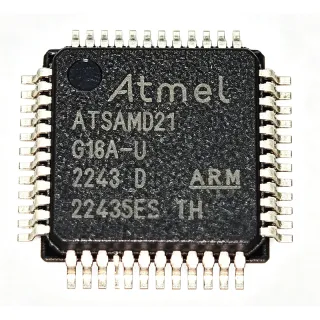
DSPIC30F2011-20E/P - 16-bit DSC 20 MIPS 12KB Flash | Microchip
MPN: DSPIC30F2011-20E/P ✓ Active| Qty | Unit Price | Extended |
|---|---|---|
| 1 | $2.05 | $2.05 |
| 10 | $1.95 | $19.50 |
| 100 | $1.8 | $180.00 |
| 500 | $1.68 | $840.00 |
| 1,000 | $1.55 | $1,550.00 |
DSPIC30F2011-20E/P Overview
A Digital Signal Controller combines the computational power of a DSP engine with the peripheral set and ease of use of a microcontroller. In the product hierarchy, the dsPIC30F2011 sits within the 16-bit DSC category, bridging general-purpose MCUs such as the PIC24 family and full DSPs, making it a power management and sensing workhorse for mixed signal-control designs. According to Microchip, the dsPIC30F Sensor Family offers seamless migration options to dsPIC33F, PIC24H, or PIC24F devices in similar packages.
Key features include the 16-bit modified Harvard architecture with a dedicated DSP engine executing DSP instructions alongside MCU instructions, 20 MIPS throughput at the 20E extended-temperature speed grade, and 12 KB of self-programmable Flash with in-circuit serial programming (ICSP) support. The device integrates motor-control and sensor-oriented peripherals including multiple PWM outputs, a 10-bit ADC, UART, SPI, and I2C interfaces, plus 21 general-purpose I/O lines per the family datasheet.
Architecturally, the dsPIC30F core pairs a 16-bit MCU pipeline with a 16-bit x 16-bit multiplier, 40-bit accumulator, and dual addressing supporting DSP MAC operations. The wide 2.5 V to 5.5 V operating range allows direct connection to 5 V industrial rails, simplifying interface to legacy sensors and actuators without level shifting.
Typical applications include switch-mode power supply (SMPS) control, sensor signal conditioning and acquisition nodes, brushless DC and induction motor control, lighting ballasts, and industrial instrumentation where DSP-grade math is needed at low cost.
When designing with this device, plan for the extended-temperature 20E grading if your application exceeds -40 C to +85 C, and budget Flash carefully since 12 KB (4K x 24 instructions) is fixed and non-expandable in this package.
This page synthesizes distributor pricing, drop-in alternatives, pinout guidance, and practical design notes not found in the manufacturer datasheet, with data verified as of 2026-09-20.
Drop-in alternatives for DSPIC30F2011-20E/P — same package, pin-to-pin compatible. Different-package parts requiring PCB rework are excluded.
Variants in this series
Same-series models that are drop-in compatible with DSPIC30F2011-20E/P (same form factor and footprint) — differing in Core Architecture, Package.
Quick Comparison Tool — Select alternative parts for side-by-side comparison:
DSPIC30F3012-20E/P
✅ Drop-In ⚠️ Specs Unverified📋 Reference alternative (not in catalog)
DSPIC30F2012-20E/P
✅ Drop-In ⚠️ Specs Unverified📋 Reference alternative (not in catalog)
DSPIC30F2011-20I/P
✅ Drop-In ⚠️ Specs Unverified✓ In Stock
$3.6 / Unit
View Datasheet →DSPIC30F2011-20E/P Maximum Ratings & Electrical Characteristics
| Core Architecture | 16-bit dsPIC30F Digital Signal Controller |
| Maximum CPU Speed | 20 MIPS |
| Program Memory | 12 KB (4K x 24) Flash |
| Supply Voltage Range | 2.5 V to 5.5 V |
| Operating Temperature | -40 C to +125 C (E grade, extended) |
| Package | 18-PDIP (0.300 in, 7.62 mm) |
| Mounting Type | Through Hole |
| I/O Ports | 21 (device total; fewer exposed in 18-pin package) |
| Memory Type | Flash |
| Product Family | dsPIC30F Sensor Family |
| Migration Path | dsPIC33F, PIC24H, PIC24F in similar packages |
| Programming Interface | ICSP (In-Circuit Serial Programming) |
| On-Chip Peripherals | 10-bit ADC, PWM, UART, SPI, I2C |
| RoHS Status | Compliant |
| Life Cycle Stage | ACTIVE |
| ADC Resolution | 10-bit |
| Package Weight / Dimensions | 18-pin DIP, 0.300 in (7.62 mm) row spacing |
DSPIC30F2011-20E/P 18-pin dip, 0.300 in (7.62 mm) row spacing Pin Configuration Guide
Pin configuration for DSPIC30F2011-20E/P (18-pin dip, 0.300 in (7.62 mm) row spacing package). This digital IC includes GPIO, communication interfaces (UART, SPI, I2C), and power pins. Refer to the manufacturer datasheet for alternate pin functions and configuration options. Essential for embedded system design and PCB layout.

No detailed pinout data available for DSPIC30F2011-20E/P.
Refer to the datasheet for full pin configuration.
Typical Applications
DSPIC30F2011-20E/P is suitable for 6 applications: Switch-Mode Power Supply (SMPS) Digital Control, Sensor Signal Conditioning and Acquisition, Industrial Motor Control, Lighting Ballasts and LED Drivers, Embedded Power Conversion and UPS, Test, Measurement, and Instrumentation.
Switch-Mode Power Supply (SMPS) Digital Control
The DSPIC30F2011-20E/P was architected specifically as a switch-mode power supply digital signal controller - archived datasheet specifications describe the 28/44-pin family members as 'High-Performance Switch Mode Power Supply Digital Signal Controllers'. Its 20 MIPS core provides the computation speed required for voltage-mode or current-mode digital loop closure at switching frequencies in the tens to hundreds of kHz, while the on-chip 10-bit ADC samples feedback rails without an external converter. Dedicated PWM outputs drive buck, boost, or flyaway power stages directly through a gate driver. The 2.5 V to 5.5 V supply range and extended -40 C to +125 C grade tolerate industrial power-supply environments. In a typical topology, the ADC samples the output divider each switching cycle, the DSP core executes the compensator, and the PWM module updates its duty cycle - a deterministic digital control loop with no external analog compensator components.
Recommended
Sensor Signal Conditioning and Acquisition
As a member of Microchip's dsPIC30F Sensor Family, the DSPIC30F2011-20E/P is designed to sit close to analog sensors and perform real-time filtering, calibration, and linearization. The integrated 10-bit ADC digitizes sensor outputs from pressure, temperature, or position transducers, while the DSP engine's 16-bit x 16-bit MAC with 40-bit accumulator executes FIR/IIR filtering efficiently at 20 MIPS. UART, SPI, and I2C interfaces stream processed results to a host controller or HMI. The wide 2.5 V to 5.5 V supply supports direct connection to 5 V bridge sensors and 3.3 V logic alike, and the extended -40 C to +125 C temperature range permits mounting inside enclosures near motors or heat sources. Because it blends MCU peripherals with DSP math in one 18-pin through-hole package, designers replace discrete amplifier-filter-ADC chains with a single controller, reducing BOM count in industrial sensor nodes and portable instruments.
Recommended
Industrial Motor Control
The dsPIC30F core's DSP engine makes the DSPIC30F2011-20E/P well suited to controlling small brushless DC, permanent-magnet, or single-phase induction motors in industrial equipment. Its PWM module generates the complementary or independent drive waveforms needed for inverter legs, and the 10-bit ADC samples current-shunt and back-EMF feedback for commutation and closed-loop speed control. At 20 MIPS, the controller executes field-oriented or trapezoidal commutation algorithms within tight loop deadlines. The extended -40 C to +125 C operating range and 5.5 V maximum supply match industrial cabinet environments, and the 18-pin PDIP through-hole package simplifies prototyping and rework on breadboard-style control boards. The 12 KB Flash is sufficient for trapezoidal sensor-based BLDC control and basic PI speed loops; larger firmware (sensorless FOC) may warrant the pin-compatible DSPIC30F3012-20E/P with 24 KB Flash.
Recommended
Lighting Ballasts and LED Drivers
Digital control of fluorescent ballasts and high-power LED drivers benefits directly from the DSPIC30F2011-20E/P's parameter set. The PWM outputs generate the fixed-frequency drive signals for half-bridge or resonant stages, while the 10-bit ADC monitors lamp current, bus voltage, and temperature for closed-loop regulation and protection. At 20 MIPS, the controller can implement ignition sequencing, dimming profiles, and fault shutdowns deterministically. The wide 2.5 V to 5.5 V supply range allows the controller to share a rail with gate-driver logic, and the extended -40 C to +125 C grade survives luminaire thermal environments. The 18-pin PDIP through-hole package eases low-volume and serviceable luminaire designs where SMD rework is impractical. Designers should budget Flash carefully - ignition state machines plus soft-start ramps fit within the 12 KB (4K x 24) program space with headroom for communication if kept lean.
Recommended
Embedded Power Conversion and UPS
Uninterruptible power supplies, inverters, and battery chargers require deterministic real-time control that the DSPIC30F2011-20E/P delivers in a low-cost 18-pin through-hole package. Its 20 MIPS DSP core runs the phase/frequency tracking and inverter modulation math, the 10-bit ADC samples AC output and DC bus feedback, and dedicated PWM outputs drive the power stage through isolation. The extended -40 C to +125 C temperature rating and 2.5 V to 5.5 V supply tolerance accommodate the electrical noise and thermal stress typical of power-conversion enclosures. ICSP in-circuit programming allows field firmware updates without desoldering - a practical benefit for through-hole PDIP designs serviced in the field. The 12 KB Flash accommodates core control loops and housekeeping; applications adding communication stacks (Modbus over UART, for instance) should evaluate the pin-compatible DSPIC30F3012-20E/P with 24 KB Flash to avoid space pressure.
Recommended
Test, Measurement, and Instrumentation
Bench instruments, data loggers, and industrial meters exploit the DSPIC30F2011-20E/P's combination of DSP throughput and MCU-style peripherals. The 10-bit ADC digitizes measurement channels, the DSP engine performs averaging, RMS computation, and digital filtering at 20 MIPS, and the UART streams formatted results to a PC or display controller over RS-232/RS-485. The 18-pin PDIP through-hole package is a major advantage for prototype instrumentation and educational/lab equipment, where sockets allow firmware iteration without soldering. Operating from 2.5 V to 5.5 V, the device interfaces with both 3.3 V and 5 V analog front ends without level translation, and the -40 C to +125 C range supports outdoor and industrial panel instruments. The seamless Microchip migration path to PIC24H/dsPIC33F devices in similar packages provides an upgrade route if higher resolution or speed is needed later in the product life cycle.
Recommended
Recommended Products Summary
Engineering reference data for DSPIC30F2011-20E/P — comparison, design guidance, and compliance information.
Selection Guide
Comparison with Alternatives
| Parameter | This Product | DSPIC30F3012-20E/P | DSPIC30F2012-20E/P | DSPIC30F2011-20I/P | DSPIC30F2011-20E/SO |
|---|---|---|---|---|---|
| Package | 18-PDIP (0.300 in) | 18-PDIP (0.300 in) - same | 18-PDIP (0.300 in) - same | 18-PDIP (0.300 in) - same | SOIC-18 (300 mil) |
| Brand | Microchip Technology | Microchip Technology | Microchip Technology | Microchip Technology | Microchip Technology |
| Max CPU Speed | 20 MIPS | 20 MIPS | 20 MIPS | 20 MIPS | 20 MIPS |
| Flash Program Memory | 12 KB (4K x 24) | 24 KB (8K x 24) | 12 KB (4K x 24) | 12 KB (4K x 24) | 12 KB (4K x 24) |
| Supply Voltage Range | 2.5 V to 5.5 V | 2.5 V to 5.5 V | 2.5 V to 5.5 V | 2.5 V to 5.5 V | 2.5 V to 5.5 V |
| Operating Temperature | -40 C to +125 C (E grade) | -40 C to +125 C (E grade) | -40 C to +125 C (E grade) | -40 C to +85 C (I grade) | -40 C to +125 C (E grade) |
| Mounting Type | Through Hole (PDIP) | Through Hole (PDIP) | Through Hole (PDIP) | Through Hole (PDIP) | Surface Mount (SOIC) |
| Typical Applications Focus | SMPS digital control, sensor, motor control | Same family; larger Flash for bigger firmware | Sensor-family peripheral mix | Identical, cost-optimized temp grade | Identical, surface-mount assembly |
Key Differentiators
- SMPS-oriented peripheral mix in the smallest package (vs DSPIC30F2012-20E/P)
- Extended -40 C to +125 C temperature grade (vs DSPIC30F2011-20I/P)
- Through-hole 18-PDIP for prototyping and serviceability (vs DSPIC30F2011-20E/SO)
- Honest limitation: fixed 12 KB Flash (vs DSPIC30F3012-20E/P)
Design Notes
The DSPIC30F2011-20E/P accepts 2.5 V to 5.5 V, but full 20 MIPS performance should be verified against VDD in the Microchip data sheet (document 70139), as dsPIC30F speed grades can derate at reduced supply voltage. Decouple VDD with a 0.1 uF ceramic capacitor placed within a few millimeters of the pin, plus a 4.7 uF to 10 uF bulk capacitor per board. Keep MCLR pulled up through a 10 kOhm resistor with an ICSP-compatible programming header (VPP, PGD, PGC) for in-circuit Flash programming.
As a through-hole 18-PDIP part, layout is forgiving, but analog performance still depends on grounding. Use a solid ground plane under the ADC input traces, keep high-current PWM/SMPS switching nodes physically separated from the ADC and VREF pins, and add a small RC filter (e.g., 100 Ohm + 1 nF, sized per your source impedance) on analog inputs before sampling. Assign analog functions to the pins Microchip designates as ANx on the 18-pin map to preserve best ADC routing.
The 12 KB (4K x 24 instruction) Flash is non-expandable in this fixed part; complex sensorless motor algorithms, RTOS kernels, or full communication stacks can overflow quickly - estimate code size early and consider the pin-compatible DSPIC30F3012-20E/P (24 KB) if headroom is marginal. Also, confirm the -E extended grade (-40 C to +125 C) is genuinely required before design lock: the -20I/P industrial grade (to +85 C) is typically cheaper and easier to source, though verify current lifecycle status per variant.
Estimated: an 18-pin PDIP DSC running at 20 MIPS with typical 5 V supply dissipates on the order of tens of milliwatts to roughly 100 mW of core/I-O power, far below the PDIP thermal capability; no heatsink is required. Thermal concern arises only when heavy I/O source/sink current is driven continuously - keep total pin current within the data sheet absolute maximum ratings and budget per-port limits as specified in document 70139.
Compliance Information
RoHS compliant and lead-free per DigiKey/Mouser product listings. REACH, halogen-free, and conflict-minerals declarations should be confirmed in Microchip's official environmental compliance documentation for this exact part number.