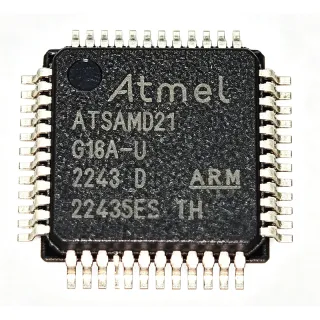
DSPIC30F2011T-20E/SO - 16-bit DSC 20MIPS 12KB Flash | Microchip
MPN: DSPIC30F2011T-20E/SO ✓ Active| Qty | Unit Price | Extended |
|---|---|---|
| 1 | $5.62 | $5.62 |
| 10 | $5.12 | $51.20 |
| 100 | $4.65 | $465.00 |
| 500 | $4.2 | $2,100.00 |
| 1,000 | $3.85 | $3,850.00 |
DSPIC30F2011T-20E/SO Overview
A digital signal controller combines the computational capability of a digital signal processor with the peripheral set and ease of use of a microcontroller. Within the embedded hierarchy, the dsPIC30F2011 sits in the digital signal controller class, which itself bridges microcontrollers (MCU) and digital signal processors (DSP). DSCs are used where real-time math-intensive control loops - such as PID regulation, sensor fusion, or motor commutation - must run deterministically on a low-cost single-chip device.
Key features of the DSPIC30F2011T-20E/SO include a 16-bit modified Harvard RISC architecture executing up to 20 MIPS at 5V, an 8-channel 12-bit analog-to-digital converter (up to 500 ksps) for high-resolution sensor acquisition, three 16-bit timers, and general-purpose I/O with 12 usable I/O pins. The device operates from a 2.5V to 5.5V supply range (3.3V/5V systems supported) and the -E temperature suffix denotes the extended operating range. In-circuit serial programming (ICSP) and in-circuit emulation support simplify development and field updates.
Architecturally, the dsPIC30F core pairs a 16-bit datapath with DSP-class instructions (multiply-accumulate, modulo and bit-reversed addressing) and dual operands fetched in a single cycle, allowing filtering and control algorithms to execute far faster than on a conventional 8-bit MCU. Program memory is 12 KB FLASH organized as 4K x 24 instruction words, with 1 KB of static RAM for data.
Typical applications include sensor signal conditioning and transducer excitation, AC-DC and DC-DC power supply digital control, battery charging, and basic motor control (BLDC/PMSM) in cost-sensitive industrial and appliance products. The 18-SOIC footprint and seamless migration path to dsPIC33F, PIC24H, or PIC24F devices in similar packages protect long-term product roadmaps.
Design consideration: at 20 MIPS with an 8-channel ADC scanning, budget conversion time and interrupt latency carefully - sampling multiple channels at full speed can consume significant CPU headroom, so prioritize ADC channel sequencing in firmware.
This page synthesizes distributor pricing, same-family drop-in alternatives, and practical design guidance not found in the manufacturer datasheet alone.
Drop-in alternatives for DSPIC30F2011T-20E/SO — same package, pin-to-pin compatible. Different-package parts requiring PCB rework are excluded.
Variants in this series
Same-series models that are drop-in compatible with DSPIC30F2011T-20E/SO (same form factor and footprint) — differing in Package.
Quick Comparison Tool — Select alternative parts for side-by-side comparison:
DSPIC30F2011-20E/SO
✅ Drop-In📋 Reference alternative (not in catalog)
DSPIC30F2011T-20I/SO
✅ Drop-In ⚠️ 参数待验证✓ In Stock
$2.98 / Unit
View Datasheet →DSPIC30F2011-20I/SO
✅ Drop-In ⚠️ 参数待验证📋 Reference alternative (not in catalog)
DSPIC30F2012T-20E/SO
✅ Drop-In ⚠️ 参数待验证✓ In Stock
$4.18 / Unit
View Datasheet →DSPIC30F3012T-20E/SO
✅ Drop-In ⚠️ 参数待验证📋 Reference alternative (not in catalog)
DSPIC30F2011T-20E/SO Maximum Ratings & Electrical Characteristics
| Core Architecture | 16-bit dsPIC30F RISC (modified Harvard) |
| Maximum CPU Speed | 20 MIPS |
| Program Memory (FLASH) | 12 KB (4K x 24 instruction words) |
| Data RAM | 1 KB (1K x 8) |
| ADC Resolution | 12-bit |
| ADC Channels | 8 channels |
| Operating Voltage Range | 2.5 V to 5.5 V |
| Timers | 3 x 16-bit |
| General-Purpose I/O | 12 I/O pins |
| Package | 18-pin SOIC Wide (SO) |
| Mounting Type | Surface Mount |
| Temperature Range | -40C to +125C (E, extended) |
| Packaging | Tape & Reel (T) |
| Programming Interface | ICSP (In-Circuit Serial Programming) |
| Product Family | dsPIC30F Sensor Family |
| Migration Path | dsPIC33F / PIC24H / PIC24F in similar packages |
| RoHS Status | Compliant |
DSPIC30F2011T-20E/SO 18-pin soic wide (so) Pin Configuration Guide
Pin configuration for DSPIC30F2011T-20E/SO (18-pin soic wide (so) package). This digital IC includes GPIO, communication interfaces (UART, SPI, I2C), and power pins. Refer to the manufacturer datasheet for alternate pin functions and configuration options. Essential for embedded system design and PCB layout.

No detailed pinout data available for DSPIC30F2011T-20E/SO.
Refer to the datasheet for full pin configuration.
Typical Applications
DSPIC30F2011T-20E/SO is suitable for 6 applications: Sensor Signal Conditioning, Digital Power Supply Control, Battery Chargers, Basic Motor Control (BLDC/DC), Industrial Sensing Nodes, Appliance and Consumer Control.
Sensor Signal Conditioning
The DSPIC30F2011T-20E/SO is purpose-built for the dsPIC30F Sensor Family role: conditioning raw transducer outputs into calibrated digital values. Its 8-channel 12-bit ADC converts multiple sensor inputs (pressure bridges, thermistors, strain gauges) with 4.88 mV/LSB resolution at a 5V reference, while the 20 MIPS DSP core applies digital filtering and linearization in firmware. In a typical topology the sensor front end feeds the ADC through an RC anti-alias filter, and corrected readings are output via UART or I/O. The dual 3.3V/5V supply range (2.5V-5.5V) lets the same design serve both low-power and industrial sensor nodes.
Recommended
Digital Power Supply Control
For AC-DC and DC-DC converters, the DSPIC30F2011T-20E/SO closes the digital control loop around a switching stage. The 20 MIPS core executes a PID or compensator loop in well under 20 microseconds per iteration, and the 12-bit ADC samples output voltage and current feedback fast enough for kHz-class loops. Three 16-bit timers time PWM gating and cycle-by-cycle limiting. Unlike analog compensators, firmware control allows soft-start profiling and adaptive gain. The trade-off versus a dedicated analog PWM controller is added firmware effort, but the -E extended temperature rating (-40C to +125C) supports rugged industrial power hardware.
Recommended
Battery Chargers
Battery charging algorithms (CC/CV, taper termination, temperature-qualified fast charge) map naturally onto the DSPIC30F2011T-20E/SO. The 8-channel 12-bit ADC monitors pack voltage, charge current, and NTC thermistor temperature simultaneously - 4.88 mV/LSB resolution at 5V reference detects terminal-voltage knee points precisely. Firmware implements charge-profile state machines with hysteresis and fault timeouts that analog chargers cannot match, and three 16-bit timers manage trickle/top-off timing. Operating from 2.5V to 5.5V, the controller runs directly from a 5V auxiliary supply, and the SOIC-18 footprint keeps charger PCB cost minimal in consumer and light-industrial chargers.
Recommended
Basic Motor Control (BLDC/DC)
The DSPIC30F2011T-20E/SO executes commutation and speed-control loops for brushed-DC and sensorless BLDC motors. Its 20 MIPS core handles back-EMF zero-cross detection and PI speed regulation in real time, the 12-bit ADC samples phase voltages and bus current, and the 16-bit timers generate PWM timing bases. The dsPIC30F DSP instruction set (single-cycle MAC) accelerates digital filtering of noisy back-EMF signals, a key advantage over 8-bit MCUs at similar cost. The -E extended temperature range suits appliance and pump environments. For motors needing dedicated complementary PWM peripherals, Microchip's migration path to dsPIC33F motor-control parts preserves firmware investment.
Recommended
Industrial Sensing Nodes
In factory monitoring and process instrumentation, the DSPIC30F2011T-20E/SO serves as the local acquisition controller. Twelve I/O pins drive status outputs and switches, the 12-bit ADC digitizes 4-20 mA-derived or 0-5V process signals, and the 20 MIPS core runs scaling, alarm thresholds, and communication framing in firmware. The -40C to +125C extended temperature qualification tolerates enclosure heat near drives and power cabinets, and the wide 2.5V-5.5V supply range rides through brownouts better than fixed-3.3V-only MCUs. The SOIC-18 package suits low-cost, two-layer industrial PCBs, and ICSP allows firmware updates in the field without desoldering the controller.
Recommended
Appliance and Consumer Control
Cost-sensitive appliance products - fan controllers, small pumps, thermostat heads, and simple cooktop interfaces - use the DSPIC30F2011T-20E/SO where a few buttons, a 12-bit sensor input, and deterministic control loops must coexist under a dollar-conscious BOM. The 16-bit 20 MIPS core outperforms typical 8-bit parts in the same price band, while 12 KB FLASH holds complete application firmware with headroom. The Tape & Reel (T) format supports high-volume automated placement, and the seamless migration path to PIC24/dsPIC33F parts protects the product roadmap when features grow. The 5V capability also simplifies interfacing with legacy appliance electronics.
Recommended
Recommended Products Summary
Engineering reference data for DSPIC30F2011T-20E/SO — comparison, design guidance, and compliance information.
Selection Guide
Comparison with Alternatives
| Parameter | This Product | DSPIC30F2011-20E/SO | DSPIC30F2011T-20I/SO | DSPIC30F2011T-20E/ML | DSPIC30F3012T-20E/SO |
|---|---|---|---|---|---|
| Package | 18-SOIC Wide | 18-SOIC Wide - same | 18-SOIC Wide - same | QFN (ML) - different footprint | 18-SOIC Wide - same |
| Brand | Microchip Technology | Microchip Technology | Microchip Technology | Microchip Technology | Microchip Technology |
| CPU Speed | 20 MIPS | 20 MIPS | 20 MIPS | 20 MIPS | 20 MIPS |
| FLASH Program Memory | 12 KB (4K x 24) | 12 KB (4K x 24) | 12 KB (4K x 24) | 12 KB (4K x 24) | Larger (upgrade) - see family datasheet |
| Data RAM | 1 KB | 1 KB | 1 KB | 1 KB | 1 KB |
| ADC | 8-ch 12-bit | 8-ch 12-bit | 8-ch 12-bit | 8-ch 12-bit | 8-ch 12-bit (enhanced front end) |
| Temperature Range | -40C to +125C (E) | -40C to +125C (E) | -40C to +85C (I) | -40C to +125C (E) | -40C to +125C (E) |
| Packaging Format | Tape & Reel | Tube / Tray | Tape & Reel | Tape & Reel | Tape & Reel |
Key Differentiators
- Extended -40C to +125C temperature qualification (vs DSPIC30F2011T-20I/SO)
- Tape & Reel for high-volume automated assembly (vs DSPIC30F2011-20E/SO)
- Gull-wing SOIC for simple assembly and rework (vs DSPIC30F2011T-20E/ML)
Design Notes
Decouple VDD with a 0.1 uF ceramic capacitor placed within 5 mm of the pin, plus 4.7-10 uF of bulk capacitance per power rail. The dsPIC30F core draws supply current proportional to clock frequency; at 20 MIPS and 5V, budget tens of milliamps for the core plus I/O load current. The device permits 2.5V-5.5V operation, but ADC accuracy is specified against VREF/AVDD - if analog accuracy matters, provide a clean analog supply and separate the AVDD path with an RC or ferrite filter.
Reserve the ICSP programming pins (MCLR, VDD, VSS, PGD, PGC) on a standard 5-pin header so MPLAB X with a PICkit-class programmer can reflash the board in-circuit. Keep MCLR pull-up (4.7-10 kohm to VDD) close to the pin and add series resistance on PGD/PGC traces if they run near noise sources. Connect OSC1/OSC2 crystal layout with short traces and ground guard rings; the 20 MIPS clock budget leaves little timing margin for a noisy oscillator start-up.
Do not assume the /SO and /ML package variants are foot-print interchangeable: DSPIC30F2011T-20E/ML is a leadless QFN-style package with a completely different land pattern despite identical silicon. Also verify temperature suffix needs at design time - the -I industrial grade stops at +85C while the -E extended grade reaches +125C; substituting -I for -E in a hot enclosure is a silent field-failure risk. Finally, with 8 ADC channels scanning, sequence conversions deliberately: full-speed sampling of all channels can consume significant CPU headroom at 20 MIPS.
The 12 I/O lines and 12-bit ADC share package pins, so analog channels adjacent to fast-switching digital outputs pick up crosstalk. Estimated rule of thumb: keep at least one grounded pin or trace between an ADC input and any PWM or clock line on two-layer boards. Use the on-chip digital filtering and oversampling (averaging 4-16 samples adds roughly 1 effective bit) to clean residual noise instead of chasing hardware fixes late in layout.
Compliance Information
RoHS compliant and lead-free per Microchip standard current-production dsPIC30F family status. Obtain REACH/halogen/conflict-minerals declarations from Microchip's compliance portal for specific lots.