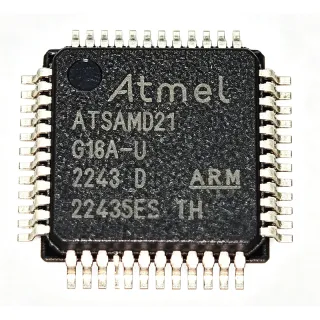
DSPIC33CK512MP608-I/PT - 100MHz 16-bit DSC 512KB Flash | Microchip
MPN: DSPIC33CK512MP608-I/PT ✓ Active| Qty | Unit Price | Extended |
|---|---|---|
| 1 | $4.11 | $4.11 |
| 10 | $3.9 | $39.00 |
| 100 | $3.62 | $362.00 |
| 500 | $3.38 | $1,690.00 |
| 1,000 | $3.12 | $3,120.00 |
DSPIC33CK512MP608-I/PT Overview
A digital signal controller combines the computational throughput of a digital signal processor with the peripheral integration and deterministic control of a microcontroller. Within the power-management hierarchy, the DSC sits between general-purpose MCUs and dedicated DSP ICs, making it the standard controller class for closed-loop power conversion and precision motor control where fast interrupt latency and hardware DSP multiply-accumulate operations are required.
Key features of the dsPIC33CK512MP608 include the 100 MHz dsPIC33C core with DSP engine, 512 KB flash organized in dual panels supporting live firmware updates with ECC protection, 64 KB RAM, CAN Flexible Data-Rate (CAN FD) for automotive and industrial networks, fast 12-bit ADCs for multi-channel current and voltage sensing, and on-chip operational amplifiers that reduce external component count in motor phase-current sensing.
Architecturally, the dsPIC33CK family pairs a high-performance 16-bit MCU pipeline with enhanced peripherals and extensive DSP functionality, as documented in the dsPIC33CK512MP608 Family Data Sheet. The dual-panel flash architecture allows execution from one panel while erasing or programming the other, enabling seamless field firmware upgrades in products that cannot tolerate downtime.
Typical applications include brushless DC and PMSM motor control (supported by Microchip motor-control development boards such as the MCLV-2 and MCHV-3 via the EV33R40A PIM), digital power supplies and PFC stages, and industrial automation nodes using CAN FD communication.
A key design consideration is power-supply decoupling: place low-ESR ceramic capacitors directly on every VDD/VSS pair and follow the datasheet guidelines for MCLR and AVDD/OPA reference filtering to achieve the full ADC accuracy.
This page synthesizes distributor pricing, drop-in alternatives, and practical design notes not found in the manufacturer datasheet.
Drop-in alternatives for DSPIC33CK512MP608-I/PT — same package, pin-to-pin compatible. Different-package parts requiring PCB rework are excluded.
Variants in this series
Same-series models that are drop-in compatible with DSPIC33CK512MP608-I/PT (same form factor and footprint) — differing in Package, Operating Temperature, CAN Interface, Core, Core Speed.
Quick Comparison Tool — Select alternative parts for side-by-side comparison:
DSPIC33CK512MP608-E/PT
✅ Drop-In✓ In Stock
$4.9 / Unit
View Datasheet →DSPIC33CK256MP608-I/PT
✅ Drop-In ⚠️ Specs Unverified✓ In Stock
$1.57 / Unit
View Datasheet →DSPIC33CK64MP608-I/PT
✅ Drop-In ⚠️ Specs Unverified📋 Reference alternative (not in catalog)
DSPIC33CK32MP608-I/PT
✅ Drop-In ⚠️ Specs Unverified📋 Reference alternative (not in catalog)
DSPIC33CK512MP608-I/PT Maximum Ratings & Electrical Characteristics
| Core | dsPIC33C 16-bit DSC core |
| Maximum Clock Frequency | 100 MHz |
| Program Memory Size | 512 KB flash (dual panel, with ECC) |
| Data RAM Size | 64 KB |
| Data Bus Width | 16 bit |
| CAN Interface | CAN FD (Flexible Data-Rate) |
| ADC Resolution | 12 bit |
| Integrated Peripherals | OpAmps, 12-bit ADCs, high-resolution PWM |
| DMA Channels | 8 |
| Package | 80-pin TQFP (PT), 12x12 mm, 0.5 mm pitch |
| Mounting Type | Surface Mount |
| Operating Temperature | -40C to +85C (I grade) |
| RoHS Status | Compliant |
| ECC on Flash | Yes (Error Correction Code) |
DSPIC33CK512MP608-I/PT 80-pin tqfp (pt), 12x12 mm, 0.5 mm pitch Pin Configuration Guide
Pin configuration for DSPIC33CK512MP608-I/PT (80-pin tqfp (pt), 12x12 mm, 0.5 mm pitch package). This digital IC includes GPIO, communication interfaces (UART, SPI, I2C), and power pins. Refer to the manufacturer datasheet for alternate pin functions and configuration options. Essential for embedded system design and PCB layout.

No detailed pinout data available for DSPIC33CK512MP608-I/PT.
Refer to the datasheet for full pin configuration.
Typical Applications
DSPIC33CK512MP608-I/PT is suitable for 6 applications: BLDC/PMSM Precision Motor Control, Digital Power Supplies and PFC, Industrial CAN FD Automation Nodes, Battery Management and Charging Systems, Robotics and Servo Drives, Solar Inverters and Energy Conversion.
BLDC/PMSM Precision Motor Control
The DSPIC33CK512MP608 fits sensorless field-oriented control (FOC) for brushless DC and permanent-magnet synchronous motors because its 100 MHz dsPIC33C core executes current-loop mathematics with DSP multiply-accumulate instructions, while the high-resolution PWM module provides sub-nanosecond duty-cycle resolution for low-torque-ripple commutation. The internal operational amplifiers amplify shunt-resistor phase currents before the fast 12-bit ADCs sample them, removing external amplifier ICs from the BOM. Microchip's EV33R40A PIM pairs this exact 80-pin TQFP device with MCLV-2, MCHV-2, and MCHV-3 development boards, giving a proven reference path from evaluation to production. The main trade-off versus analog-based control is firmware complexity, offset by Microchip's motor-control libraries and MRA toolchain.
Recommended
Digital Power Supplies and PFC
Switch-mode power supplies, totem-pole PFC stages, and LLC converters benefit from the DSPIC33CK512MP608's combination of high-resolution PWM, fast 12-bit ADCs, and a deterministic 100 MHz control core. The controller samples input/output voltage and inductor current within one PWM period and adjusts duty cycle in closed loop, achieving transient response that analog compensation cannot match across wide load ranges. The 8-channel DMA offloads ADC result transfer from the CPU, keeping interrupt latency low during bursts. Dual-panel flash with ECC allows firmware updates in fielded power hardware without downtime. Compared with dedicated digital-power ASICs, the DSC offers design flexibility; the trade-off is that the designer owns loop tuning and safety-firmware certification.
Recommended
Industrial CAN FD Automation Nodes
The integrated CAN Flexible Data-Rate controller makes the DSPIC33CK512MP608 a strong node controller for industrial automation networks. CAN FD supports data-phase bit rates up to 8 Mbit/s and 64-byte payloads, letting one bus carry both real-time motion commands and diagnostic telemetry. The 100 MHz core runs the local control loop (motor, actuator, or sensor fusion) while the CAN FD peripheral buffers traffic through the 8-channel DMA, minimizing CPU intervention. Peripheral Pin Select (PPS) allows UART, SPI, and I2C functions to route to whichever pins the PCB layout favors, easing board design. Compared with a generic MCU plus external CAN FD transceiver-controller combo, integration reduces component count, board area, and firmware-layer latency.
Recommended
Battery Management and Charging Systems
Battery packs and chargers require simultaneous, accurate monitoring of cell voltages, current, and temperature - tasks matched to the DSPIC33CK512MP608's fast 12-bit ADCs and internal op-amps, which condition shunt-based current measurements without external amplifiers. The 100 MHz core executes coulomb counting, state-of-charge estimation, and protection state machines with headroom for future algorithm updates. The 512 KB dual-panel flash stores logging data structures and supports firmware field updates in deployed packs, a growing serviceability requirement. The I-grade -40C to +85C temperature range covers typical industrial and light-vehicle environments; for under-hood automotive positions, the E-grade variant rated to +125C should be selected instead.
Recommended
Robotics and Servo Drives
Multi-axis robotic joints demand tightly synchronized PWM generation, current sensing, and communications - capabilities the DSPIC33CK512MP608 delivers with high-resolution PWM outputs, fast ADCs, internal op-amps for shunt conditioning, and CAN FD for deterministic inter-axis communication. The 100 MHz DSP core closes current loops in the tens-of-microseconds range required for smooth low-speed torque in collaborative robots, while 512 KB of flash holds trajectory planning and multi-axis coordination code without external memory. Peripheral Pin Select lets designers place encoder interfaces (QEI via pins) and communication where routing allows. The 8-channel DMA keeps sensor sampling and PWM updates jitter-free under communication load, which is essential for stable servo behavior.
Recommended
Solar Inverters and Energy Conversion
Grid-tied solar microinverters and string optimizers use the DSPIC33CK512MP608 to run MPPT algorithms, grid-synchronization (PLL) software, and multi-phase PWM modulation concurrently on the 100 MHz core. The fast 12-bit ADCs sample DC-link voltage, PV current, and grid waveforms, and the high-resolution PWM drives half-bridges with the fine duty resolution needed to reduce output distortion and switching loss. Dual-panel flash with ECC protects firmware integrity in long-life fielded products and enables remote updates. The device's DSP engine accelerates the multiply-intensive MPPT and filtering math. Designers must budget CPU load carefully at high switching frequencies, as interrupt-driven control at 100 kHz+ consumes significant core time.
Recommended
Recommended Products Summary
Engineering reference data for DSPIC33CK512MP608-I/PT — comparison, design guidance, and compliance information.
Selection Guide
Comparison with Alternatives
| Parameter | This Product | DSPIC33CK512MP608-E/PT | DSPIC33CK256MP608-I/PT | DSPIC33CK64MP608-I/PT | DSPIC33CK32MP608-I/PT |
|---|---|---|---|---|---|
| Package | TQFP-80 (12x12 mm) | TQFP-80 (12x12 mm) - same | TQFP-80 (12x12 mm) - same | TQFP-80 (12x12 mm) - same | TQFP-80 (12x12 mm) - same |
| Brand | Microchip Technology | Microchip Technology | Microchip Technology | Microchip Technology | Microchip Technology |
| Core Clock | 100 MHz | 100 MHz | 100 MHz | 100 MHz | 100 MHz |
| Program Flash | 512 KB (dual panel, ECC) | 512 KB (dual panel, ECC) | 256 KB (dual panel, ECC) | 64 KB (dual panel, ECC) | 32 KB (dual panel, ECC) |
| Data RAM | 64 KB | 64 KB | 64 KB | 64 KB | 64 KB |
| Operating Temperature | -40C to +85C (I grade) | -40C to +125C (E grade) | -40C to +85C (I grade) | -40C to +85C (I grade) | -40C to +85C (I grade) |
| CAN FD | Yes | Yes | Yes | Yes | Yes |
| ADC / OpAmps / PWM | 12-bit ADC, internal OpAmps, high-res PWM | 12-bit ADC, internal OpAmps, high-res PWM | 12-bit ADC, internal OpAmps, high-res PWM | 12-bit ADC, internal OpAmps, high-res PWM | 12-bit ADC, internal OpAmps, high-res PWM |
Key Differentiators
- Largest flash in the same 80-pin TQFP footprint (vs DSPIC33CK256MP608-I/PT)
- Extended temperature variant available (vs DSPIC33CK512MP608-E/PT)
- Same peripherals across all flash densities (vs DSPIC33CK32MP608-I/PT)
Design Notes
Follow the dsPIC33CK512MP608 Family Data Sheet (DS70005452C) 'Basic Connection Requirements' section: decouple every VDD pin with a 0.1 uF ceramic capacitor placed within 2 mm of the pin, add a bulk 4.7-10 uF capacitor near the device, and tie all VSS pins to a solid ground plane. Keep the AVDD rail isolated with an RC or ferrite filter to preserve 12-bit ADC accuracy when internal op-amps amplify small shunt signals. Use a low-ESR capacitor on the internal regulator output pin as specified in the datasheet.
The MCLR pin must not be left floating - use the recommended pull-up resistor (typically 10 kohm) and, if in-circuit programming is required, reserve the PGD/PGC programming pins and keep series resistors on ICSP lines so attached programming hardware cannot load application circuitry. Also note that many GPIO on this device default to analog; firmware must explicitly clear ANSEL bits before digital reads, a common bring-up bug that reads as 'stuck inputs' during first board test.
For motor-control layouts, route high-resolution PWM outputs to gate drivers with short, matched traces and keep shunt-sense op-amp input traces as a tight differential pair away from switching nodes. The Peripheral Pin Select (PPS) feature offers routing freedom, but once pins are assigned, keep analog-assigned pins (op-amp inverting/non-inverting inputs, ADC channels) on an isolated analog island on the PCB. Thermal performance of the 80-pin TQFP is adequate for typical DSC power levels, but verify junction temperature with a 2x2 via array under the center ground area for -E grade operation near +125C ambient.
Compliance Information
RoHS compliance per standard Microchip active-product policy reflected in distributor listings; obtain formal certificates from the Microchip product page. AEC-Q100 status for this exact ordering code not stated in provided data.