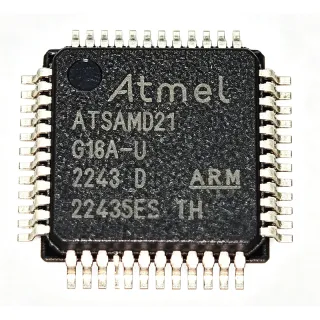
DSPIC33CH64MP508-I/PT - Dual-Core 16-bit DSC, CAN FD | Microchip
MPN: DSPIC33CH64MP508-I/PT ✓ Active| Qty | Unit Price | Extended |
|---|---|---|
| 1 | $6.85 | $6.85 |
| 10 | $6.2 | $62.00 |
| 100 | $5.55 | $555.00 |
| 500 | $4.98 | $2,490.00 |
| 1,000 | $4.49 | $4,490.00 |
DSPIC33CH64MP508-I/PT Overview
A Digital Signal Controller combines the computational throughput of a DSP with the peripheral integration and deterministic control of a microcontroller. Within the power-management hierarchy, a DSC sits above a standard MCU for closed-loop control tasks: it executes control-loop mathematics (PID, compensators, transforms) at kHz rates while simultaneously servicing fast analog peripherals. The dsPIC33CH extends this concept by placing two independent dsPIC cores in one chip, partitioning system management from hard real-time control.
The dsPIC33CH architecture assigns distinct roles to each core. The Master core handles system supervision, communication stacks and user interface tasks, while the Slave core is dedicated to time-critical loops such as power-conversion or motor-control algorithms. This partitioning lets developers tune the Slave core independently for loop latency while the Master manages CAN FD networking, diagnostics and housekeeping. The tightly coupled 16-bit DSP engine with hardware multiply-accumulate, plus eight DMA channels, sustains high-throughput data movement without CPU intervention.
Key peripheral resources include multiple high-resolution PWM modules with nanosecond-class resolution for switching converters, serial peripherals for multi-protocol connectivity, and CAN FD for automotive and industrial networking. DigiKey lists the family as Functional Safety (FuSa) supported, relevant to safety-oriented designs.
Typical applications are high-performance digital power supplies, wireless charging, server power, motor control inverters, drones and automotive sensors, where dual-core partitioning isolates the control loop from communication overhead.
A key design consideration is power supply quality: the 3.3V core and I/O rails require proper decoupling, and the high-resolution PWM outputs demand clean grounding to avoid switching-noise coupling into ADC readings.
This page synthesizes distributor pricing, same-family drop-in alternatives, and practical design guidance not found on a single manufacturer or distributor page.
Drop-in alternatives for DSPIC33CH64MP508-I/PT — same package, pin-to-pin compatible. Different-package parts requiring PCB rework are excluded.
Variants in this series
Same-series models that are drop-in compatible with DSPIC33CH64MP508-I/PT (same form factor and footprint) — differing in Operating Temperature, Package, Core Architecture, High-Resolution PWM, ADC.
Quick Comparison Tool — Select alternative parts for side-by-side comparison:
DSPIC33CH128MP508-E/PT
✅ Drop-In✓ In Stock
$3.4 / Unit
View Datasheet →DSPIC33CH256MP508-I/PT
✅ Drop-In✓ In Stock
$5.84 / Unit
View Datasheet →DSPIC33CH512MP508T-I/PT
✅ Drop-In✓ In Stock
$4.22 / Unit
View Datasheet →DSPIC33CH64MP508-E/PT
✅ Drop-In✓ In Stock
Contact for price
View Datasheet →DSPIC33CH64MP508-I/PT Maximum Ratings & Electrical Characteristics
| Core | dsPIC33CH dual-core 16-bit |
| Program Memory Size | 64 KB (20,480 words x 24-bit) |
| Data RAM Size | 20 KB |
| Supply Voltage | 3.3 V |
| Operating Temperature | -40C to +85C (I grade, industrial) |
| Package | 80-pin TQFP (PT), 12x12 mm, 0.5 mm pitch |
| Mounting Type | Surface Mount |
| DMA Channels | 8 |
| CAN | CAN FD (Flexible Data) |
| PWM | High-Resolution PWM |
| Core Architecture | Master core + Slave core (dsPIC DSC) |
| Max Master Core Speed | 180 MHz / 200 MHz (per DigiKey listing) |
| Product Family | dsPIC33CH64MP508 (28/36/48/64/80-pin dual-core 16-bit DSC) |
| Instruction Set | 16-bit Harvard DSP with MAC |
DSPIC33CH64MP508-I/PT 80-pin tqfp (pt), 12x12 mm, 0.5 mm pitch Pin Configuration Guide
Pin configuration for DSPIC33CH64MP508-I/PT (80-pin tqfp (pt), 12x12 mm, 0.5 mm pitch package). This digital IC includes GPIO, communication interfaces (UART, SPI, I2C), and power pins. Refer to the manufacturer datasheet for alternate pin functions and configuration options. Essential for embedded system design and PCB layout.

No detailed pinout data available for DSPIC33CH64MP508-I/PT.
Refer to the datasheet for full pin configuration.
Typical Applications
DSPIC33CH64MP508-I/PT is suitable for 6 applications: Digital Power Supplies, Wireless Power Transfer, Server Power Supplies, Motor Control Inverters, Automotive Sensors, Drones and UAV Systems.
Digital Power Supplies
The DSPIC33CH64MP508-I/PT fits high-performance digital power supplies because its dual-core dsPIC33CH architecture pairs a Master core for supervisory logic with a Slave core dedicated to the fast voltage/current compensation loop. The high-resolution PWM delivers fine duty-cycle resolution for tight output regulation in LLC, totem-pole PFC and buck stages, while 8 DMA channels stream ADC samples without CPU overhead. Placed as the sole controller, it replaces analog compensators with firmware, enabling adaptive control across load ranges. The trade-off versus a single-core DSC is firmware partitioning complexity, repaid by lower loop latency and clean isolation of the control loop from CAN FD telemetry tasks.
Recommended
Wireless Power Transfer
Wireless power transmitters demand precise, high-frequency PWM drive of the inverter bridge plus fast fault interruption, which aligns directly with the DSPIC33CH64MP508-I/PT's high-resolution PWM and dual-core partitioning. The Slave core runs the frequency-tracking and power-regulation loop for resonance control, while the Master core manages foreign-object detection, Qi-style protocol messaging and status indication. According to Microchip, wireless power is a primary dsPIC33CH target market. The 3.3V industrial-grade (-40C to +85C) 80-TQFP part integrates CAN FD for system-level communication in multi-coil charging furniture, removing the need for an external communication MCU.
Recommended
Server Power Supplies
Server PSUs require digital control plus a communication interface to the BMC, and the DSPIC33CH64MP508-I/PT covers both roles in one chip. Microchip explicitly lists server power supplies as a dsPIC33CH application. The Slave core closes the fast feedback loop against the high-resolution PWM for the PFC and DC-DC stages, while the Master core implements PMBus-style telemetry and fault reporting; CAN FD can substitute in rack architectures that favor CAN. Using one dual-core DSC instead of a separate control MCU and communication MCU reduces BOM count and ensures deterministic loop timing, though engineers must budget Flash carefully at 64 KB for combined control plus protocol stacks.
Recommended
Motor Control Inverters
Field-oriented control of PMSM and BLDC motors benefits from the DSPIC33CH64MP508-I/PT's 16-bit DSP MAC engine, high-resolution PWM with programmable dead-time, and ADC triggering synchronized to the PWM carrier. The Slave core executes the FOC current loops at carrier rate while the Master core handles speed ramps, field weakening, CAN FD commands and safety monitoring. Drones and industrial drives are named dsPIC33CH applications by Microchip. The 80-pin TQFP exposes enough PWM and ADC channels for three-phase inverters with dual-shunt or three-shunt sensing. A key benefit is deterministic interrupt latency on the control core, unaffected by communication stack activity on the Master core.
Recommended
Automotive Sensors
Microchip lists automotive sensors among dsPIC33CH applications, and the CAN FD interface on the DSPIC33CH64MP508-I/PT is the key enabler, providing the higher payload and bit rates that modern sensor nodes (radar power, lidar supplies, camera modules) need. The Master core manages CAN FD framing, diagnostics (UDS-style services) and sensor fusion math, while the Slave core runs real-time acquisition loops over the DMA-connected ADC. Note that this /I part is industrial grade; for in-vehicle environments, evaluate the family's qualified temperature variants. DigiKey's FuSa designation supports safety-oriented design flows, though final automotive qualification requirements must be confirmed with Microchip.
Recommended
Drones and UAV Systems
Drone flight controllers and electronic speed controllers exploit the DSPIC33CH64MP508-I/PT's combination of DSP compute and high-resolution PWM. Microchip names drones as a target application. The Slave core can run motor commutation or active damping loops while the Master core handles sensor fusion, telemetry and failsafe logic, an architecture that shortens ESC response time compared to single-core designs. The compact 12x12 mm 80-TQFP suits weight- and space-constrained airframes, and the -40C to +85C industrial range covers high-altitude temperature excursions. Power budget matters in UAVs, so leverage DMA-driven ADC sampling to keep CPU load, and thus current draw, minimal during loiter phases.
Recommended
Recommended Products Summary
Engineering reference data for DSPIC33CH64MP508-I/PT — comparison, design guidance, and compliance information.
Selection Guide
Comparison with Alternatives
| Parameter | This Product | DSPIC33CH128MP508-E/PT | DSPIC33CH256MP508-I/PT | DSPIC33CH512MP508T-I/PT | DSPIC33CH64MP508-E/PT |
|---|---|---|---|---|---|
| Package | 80-TQFP (12x12, 0.5 mm pitch) | 80-TQFP (12x12) - same | 80-TQFP (12x12) - same | 80-TQFP (12x12) - same | 80-TQFP (12x12) - same |
| Brand | Microchip Technology | Microchip Technology | Microchip Technology | Microchip Technology | Microchip Technology |
| Program Flash | 64 KB | 128 KB | 256 KB | 512 KB | 64 KB |
| Core Architecture | Dual-core dsPIC33CH (Master + Slave) | Dual-core dsPIC33CH | Dual-core dsPIC33CH | Dual-core dsPIC33CH | Dual-core dsPIC33CH |
| Operating Temperature | -40C to +85C (I grade) | -40C to +125C (E grade) | -40C to +85C (I grade) | -40C to +85C (I grade) | -40C to +125C (E grade) |
| CAN FD | Yes | Yes | Yes | Yes | Yes |
| High-Resolution PWM | Yes | Yes | Yes | Yes | Yes |
Key Differentiators
- Lowest-cost entry into the 80-pin dual-core dsPIC33CH family (vs DSPIC33CH256MP508-I/PT)
- Identical footprint across all Flash densities enables late memory decisions (vs DSPIC33CH512MP508T-I/PT)
- Extended-temperature pin-compatible sibling exists (vs DSPIC33CH64MP508-E/PT)
Design Notes
The DSPIC33CH64MP508-I/PT runs from a single 3.3V supply per Arrow and SnapEDA data. Decouple every VDD pin with 0.1 uF ceramics placed within about 2 mm of the pin, plus at least one 10 uF bulk capacitor per side of the 12x12 mm package. If the family datasheet specifies an internal regulator capacitor pin, fit it exactly as recommended - omitting it is a common cause of erratic reset. Estimated: at 100 MHz master-core operation, core current is in the tens of mA range, so rail droop during PWM bursts must be verified with an oscilloscope at the pin, not assumed from the budget.
Route the high-resolution PWM outputs as short, matched pairs to the gate drivers, since nanosecond-class PWM resolution is wasted if board layout adds asymmetric propagation delay. Keep the crystal/oscillator traces short and guarded by ground. Separate the analog ground region under the ADC input pins from the power-ground plane and join at one point near the bulk capacitor. SnapEDA provides a verified 80-TQFP footprint; always use the exact 0.5 mm pitch land pattern and check paste segmentation on the center thermal area to prevent tombstoning during reflow.
Do not confuse the /I and /E temperature grades when qualifying builds - the /I part is limited to +85C ambient and will fail extended-temperature validation even though the pinout is identical. Also confirm Flash headroom early: 64 KB (20,480 x 24-bit words) fills quickly once CAN FD stacks and control compensators coexist; designs that later migrate to the pin-compatible DSPIC33CH128MP508 or 256MP508 avoid respins, but linker scripts and device selection in MPLAB X must be updated and re-verified.
Compliance Information
SnapEDA lists the part as automotive-category 3.3V MCU but explicit RoHS/REACH/AEC-Q100 qualification statements were not present in the provided web data; verify on the Microchip product page. DigiKey notes Functional Safety (FuSa) support for the dsPIC33CH family.