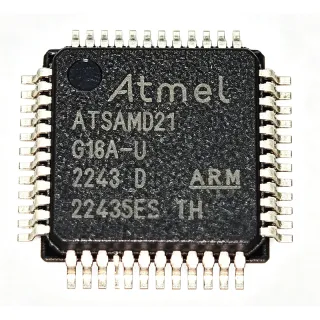
DSPIC33EP128GM710-E/PF - 16-bit 60 MIPS DSC, 128KB Flash | Microchip
MPN: DSPIC33EP128GM710-E/PF ✓ Active| Qty | Unit Price | Extended |
|---|---|---|
| 1 | $8.21 | $8.21 |
| 10 | $7.8 | $78.00 |
| 100 | $7.2 | $720.00 |
| 500 | $6.8 | $3,400.00 |
| 1,000 | $6.4 | $6,400.00 |
DSPIC33EP128GM710-E/PF Overview
A digital signal controller combines the computational strengths of a microcontroller with the DSP engine of a digital signal processor in a single chip. Within the embedded-systems hierarchy, the dsPIC33EP sits above general-purpose MCUs for math-intensive tasks and below full DSP-plus-MCU two-chip solutions, offering deterministic single-cycle MAC instructions, hardware divide, and DSP-style addressing modes alongside familiar MCU peripherals.
Key features of this device include an operating voltage range of 3.0V to 3.6V, 12 channels of motor-control PWM suitable for three-phase inverter drives, 8 input capture and 8 output compare channels, 2 quadrature encoder interfaces, an integrated CAN module for industrial and automotive networking, and 4 on-chip operational amplifiers that reduce external analog component count in current-sensing and signal-conditioning chains.
The -E suffix designates the extended automotive temperature range of -40C to +125C and AEC-Q100 qualification, making the part suitable for under-hood and other harsh environments where industrial-grade -I suffix parts are not qualified. The 100-pin TQFP footprint provides abundant general-purpose I/O for complex designs requiring many peripherals active simultaneously.
Typical applications include brushless DC and PMSM motor control, digital power conversion (PFC, LLC), automotive body and powertrain auxiliary systems, and industrial drives requiring CAN connectivity and encoder feedback.
Design consideration: all VDD and VSS pins must be connected, and PGECx/PGEDx pins must be used as matched pairs for in-circuit programming, per the Microchip family datasheet.
This page adds value beyond the datasheet by consolidating distributor pricing, drop-in family alternatives, comparison tables, and practical design notes in one place.
Drop-in alternatives for DSPIC33EP128GM710-E/PF — same package, pin-to-pin compatible. Different-package parts requiring PCB rework are excluded.
Variants in this series
Same-series models that are drop-in compatible with DSPIC33EP128GM710-E/PF (same form factor and footprint) — differing in Core Architecture, Package, RAM, Supply Voltage.
Quick Comparison Tool — Select alternative parts for side-by-side comparison:
DSPIC33EP128GM710-I/PF
✅ Drop-In📋 Reference alternative (not in catalog)
DSPIC33EP256GM710-E/PF
✅ Drop-In ⚠️ Specs Unverified✓ In Stock
$5.75 / Unit
View Datasheet →DSPIC33EP64GM710-E/PF
✅ Drop-In ⚠️ Specs Unverified📋 Reference alternative (not in catalog)
DSPIC33EP128GM610-E/PF
✅ Drop-In ⚠️ Specs Unverified📋 Reference alternative (not in catalog)
DSPIC33EP128GM710-E/PF Maximum Ratings & Electrical Characteristics
| Core Architecture | 16-bit dsPIC DSC (Harvard) |
| Maximum CPU Speed | 60 MIPS |
| Program Memory (Flash) | 128KB (43K x 24) |
| RAM | 16KB |
| Supply Voltage | 3V to 3.6V |
| Package | 100-TQFP (14x14 mm) |
| Operating Temperature | -40C to +125C (E grade) |
| Qualification | AEC-Q100, Automotive |
| Motor Control PWM Channels | 12 |
| Input Capture / Output Compare | 8 / 8 |
| Quadrature Encoder Interfaces | 2 |
| On-chip Operational Amplifiers | 4 |
| Communication Interfaces | CAN, UART, SPI, I2C |
| Mounting Type | Surface Mount |
| MSL Level | 1 (Unlimited) |
| Packaging | Tray |
DSPIC33EP128GM710-E/PF 100-tqfp (14x14 mm) Pin Configuration Guide
Pin configuration for DSPIC33EP128GM710-E/PF (100-tqfp (14x14 mm) package). This digital IC includes GPIO, communication interfaces (UART, SPI, I2C), and power pins. Refer to the manufacturer datasheet for alternate pin functions and configuration options. Essential for embedded system design and PCB layout.

No detailed pinout data available for DSPIC33EP128GM710-E/PF.
Refer to the datasheet for full pin configuration.
Typical Applications
DSPIC33EP128GM710-E/PF is suitable for 6 applications: Three-Phase BLDC/PMSM Motor Control, Automotive Auxiliary Systems, Digital Power Conversion, Industrial Drives and Automation, Sensor Signal Conditioning and Data Acquisition, Embedded Control with CAN Networking.
Three-Phase BLDC/PMSM Motor Control
The DSPIC33EP128GM710-E/PF fits motor-control designs because its 12 motor-control PWM channels support complementary outputs with hardware dead-time insertion for three-phase bridges, while 2 QEI modules read encoder position feedback and 4 on-chip op amps amplify shunt current-sense signals before the ADC. In a typical FOC drive, the DSC executes the current loop at 60 MIPS with single-cycle MAC instructions, closing control loops at 10-20 kHz. Using the integrated op amps eliminates external amplifier ICs, reducing BOM cost. Placing the PWM outputs through gate drivers to the inverter stage, the AEC-Q100 -40C to +125C rating supports automotive pump, fan, and traction-auxiliary motor applications directly.
Recommended
Automotive Auxiliary Systems
The -E/PF variant is AEC-Q100 qualified and rated -40C to +125C, making it directly suitable for automotive auxiliary loads such as electronic water pumps, turbocharger actuators, HVAC blowers, and throttle-position drives. Its CAN interface integrates with in-vehicle networks for diagnostic and control messaging, while the 12 PWM channels drive the associated power stages. Operating from a regulated 3.0V to 3.6V rail derived from the automotive 12V battery via a buck converter, the DSC provides deterministic 60 MIPS processing for sensor fusion and safety logic. Designers should implement LIN/CAN transceivers meeting the vehicle OEM specification and apply functional-safety review where the actuation is safety-relevant.
Recommended
Digital Power Conversion
In digital power supplies such as PFC stages, LLC resonant converters, and solar micro-inverters, the DSPIC33EP128GM710-E/PF provides the high-resolution PWM update rates and fast ADC sampling needed for voltage- and current-mode control loops. The 60 MIPS core with DSP multiply-accumulate executes compensator calculations within single switching-period budgets at 100-500 kHz switching frequencies. Eight output compare channels supplement the 12 motor-control PWMs for auxiliary timing tasks, and the on-chip op amps condition current-shunt feedback without external amplifiers. The extended -40C to +125C temperature range suits industrial power supplies in unventilated enclosures, though thermal design must keep junction temperature below the rated maximum.
Recommended
Industrial Drives and Automation
For factory-automation drives, conveyors, robotics, and CNC axes, this DSC combines CAN networking, quadrature encoder interfaces, and high-count PWM in one chip, allowing a single controller to close servo loops and communicate on the industrial bus simultaneously. The 2 QEI modules decode incremental encoder feedback from two axes, the 12 PWM channels drive power stages, and 8 input capture channels timestamp hall-sensor or limit-switch events with hardware precision. The 128KB Flash accommodates field-oriented control firmware plus protocol stacks, and in-system programming via PGED/PGEC pairs enables field firmware updates over the production line. Robust -40C to +85C operation covers typical industrial cabinets with margin.
Recommended
Sensor Signal Conditioning and Data Acquisition
The four on-chip operational amplifiers of the DSPIC33EP128GM710-E/PF make it a compact analog front end for multi-channel sensing systems: they can be configured as non-inverting amplifiers for thermocouples, RTDs, pressure bridges, or current shunts, feeding the internal ADC directly. The 16-bit core with DSP instructions then applies digital filtering and calibration math at 60 MIPS, while UART/SPI/I2C interfaces stream processed results to a host or gateway. With 100 pins of GPIO, one DSC can multiplex many sensor channels with external analog switches. This integration removes discrete op-amp ICs and their tolerance-induced offsets, improving channel-to-channel matching and reducing board area in condition-monitoring nodes.
Recommended
Embedded Control with CAN Networking
Any node that must join a CAN bus - gateways, junction boxes, battery-management satellite units, HVAC controllers - benefits from this part's integrated CAN module and abundant I/O. The 100-pin TQFP provides enough GPIO to read switches, drive indicators, and control relays while the 60 MIPS core runs the application and protocol handling concurrently. The 128KB Flash leaves room for a bootloader supporting CAN-based field firmware updates, a common automotive and industrial requirement. Because the CAN peripheral is on-chip, only an external transceiver is needed at the physical layer. The AEC-Q100 -E grade extends these networking designs into vehicle environments without component requalification.
Recommended
Recommended Products Summary
Engineering reference data for DSPIC33EP128GM710-E/PF — comparison, design guidance, and compliance information.
Selection Guide
Comparison with Alternatives
| Parameter | This Product | DSPIC33EP128GM710-I/PF | DSPIC33EP256GM710-E/PF | DSPIC33EP64GM710-E/PF | DSPIC33EP128GM610-E/PF |
|---|---|---|---|---|---|
| Package | 100-TQFP (14x14 mm) | 100-TQFP (14x14 mm) - same | 100-TQFP (14x14 mm) - same | 100-TQFP (14x14 mm) - same | 100-TQFP (14x14 mm) - same |
| Brand | Microchip Technology | Microchip Technology | Microchip Technology | Microchip Technology | Microchip Technology |
| Flash Memory | 128KB (43K x 24) | 128KB (43K x 24) | 256KB (86K x 24) | 64KB (21K x 24) | 128KB (43K x 24) |
| CPU Speed | 60 MIPS | 70 MIPS | 60 MIPS | 60 MIPS | 60 MIPS |
| RAM | 16KB | 16KB | 32KB | 8KB | 16KB |
| Temperature Range | -40C to +125C | -40C to +85C | -40C to +125C | -40C to +125C | -40C to +125C |
| AEC-Q100 Automotive Qualification | Qualified | Not qualified (industrial) | Qualified | Qualified | Qualified |
| Supply Voltage | 3.0V to 3.6V | 3.0V to 3.6V | 3.0V to 3.6V | 3.0V to 3.6V | 3.0V to 3.6V |
Key Differentiators
- AEC-Q100 automotive qualification with -40C to +125C range (vs DSPIC33EP128GM710-I/PF)
- Field-proven upgrade path to double program memory (vs DSPIC33EP256GM710-E/PF)
- Full peripheral set including 4 on-chip op amps and CAN (vs DSPIC33EP128GM610-E/PF)
Design Notes
Connect every VDD and VSS pin pair on the 100-pin TQFP; Microchip documentation explicitly warns that even one floating supply pin can cause programming or brown-out failures. Place a 0.1uF ceramic decoupling capacitor at each VDD/VSS pair as close to the pins as possible, plus one bulk 4.7uF to 10uF capacitor per supply domain. Use solid ground planes under the device to minimize ground bounce when all 12 PWM channels switch simultaneously.
The dsPIC33EP family offers multiple PGECx/PGEDx programming pairs, but they must be used as matched pairs: if PGEC2 carries ICSPCLK, ICSPDAT must route to PGED2. Mismatched pairing is a frequent cause of failed ICSP programming. Reserve your chosen pair on a standard 5-pin programming header (MCLR, VDD, GND, PGECx, PGEDx) in the layout, and avoid loading these pins with strong pull-ups that fight the programmer.
Supply the device from a clean 3.0V to 3.6V rail; in automotive designs derive it from the 12V battery through a buck regulator with load-dump transient protection. When ADC accuracy matters for current sensing through the on-chip op amps, consider powering VDDCORE/VDD with an LC filter or dedicated low-noise regulator, and perform ADC calibrations with the PWM bridge disabled to avoid switching-noise corruption of samples.
Route PWM outputs away from analog op-amp inputs and the oscillator traces. For motor drives, keep the shunt-resistor Kelvin sense traces to the op-amp inputs short and differential. If CAN is used, place the transceiver near the MCU CAN TX/RX pins with a stub-free route to the connector and proper common-mode choke placement at the bus side.
Compliance Information
Distributor data identifies the -E/PF as Automotive, AEC-Q100 qualified with MSL 1 (Unlimited). RoHS status per standard Microchip E-grade production; REACH and halogen-free status not stated in provided data.