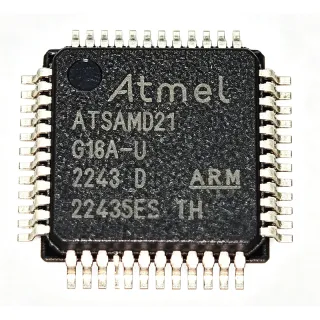
DSPIC33EP128GP502T-E/MM 16-bit DSC 128KB Flash 70MIPS | Microchip
MPN: DSPIC33EP128GP502T-E/MM ✓ Active| Qty | Unit Price | Extended |
|---|---|---|
| 1 | $5.12 | $5.12 |
| 10 | $4.61 | $46.10 |
| 100 | $4.15 | $415.00 |
| 500 | $3.74 | $1,870.00 |
| 1,000 | $3.36 | $3,360.00 |
DSPIC33EP128GP502T-E/MM Overview
A digital signal controller combines the compute capability of a microcontroller with the math acceleration of a DSP. Within the power-management hierarchy of embedded systems, a DSC sits above general-purpose MCUs for real-time control loops: it executes deterministic, cycle-accurate interrupt handling and single-cycle MAC (multiply-accumulate) DSP instructions, making the dsPIC33E family a standard choice for closed-loop motor control, digital power conversion and sensor signal conditioning.
Key features of this device include the dsPIC33E 16-bit core running at up to 70 MIPS from a 3.3V supply, 128 KB of 43K x 24 instruction-word Flash, 16 KB of RAM, an ECAN (Controller Area Network) module for automotive and industrial networks, and a Charge Time Measurement Unit (CTMU) for capacitive touch and precise time measurement. According to Microchip, the dsPIC33EP GP family also offers superior ADC performance and a Peripheral Trigger Generator (PTG) for autonomous peripheral sequencing.
The -E suffix specifies an extended operating temperature range of -40C to +125C, and the part is AEC-Q100 qualified for automotive use. The 28-VQFN exposed-pad package suits high-density board designs while the exposed die pad provides a low-impedance ground path and improved thermal dissipation.
Typical applications include automotive body and powertrain ancillary control, industrial automation, motor control (BLDC, PMSM, stepper), power management and digital power supplies, and capacitive-touch human interface panels.
Design consideration: the 70 MIPS core frequency requires careful supply decoupling - place 0.1 uF ceramics at each VDD pin and a solid ground connection to the exposed pad; also budget Flash headroom since the 128 KB array is shared with self-write bootloader code.
This page synthesizes distributor pricing, verified drop-in alternatives, AEO-optimized FAQs and practical design notes not found in a single manufacturer or distributor page.
Drop-in alternatives for DSPIC33EP128GP502T-E/MM — same package, pin-to-pin compatible. Different-package parts requiring PCB rework are excluded.
Variants in this series
Same-series models that are drop-in compatible with DSPIC33EP128GP502T-E/MM (same form factor and footprint) — differing in Operating Temperature, Package, Packaging, Analog Peripherals, CAN.
Quick Comparison Tool — Select alternative parts for side-by-side comparison:
DSPIC33EP128GP502T-I/MM
✅ Drop-In✓ In Stock
$2.68 / Unit
View Datasheet →DSPIC33EP64GP502T-E/MM
✅ Drop-In ⚠️ Specs Unverified📋 Reference alternative (not in catalog)
DSPIC33EP256GP502T-E/MM
✅ Drop-In ⚠️ Specs Unverified✓ In Stock
$3.55 / Unit
View Datasheet →DSPIC33EP128GP502-E/MM
✅ Drop-In ⚠️ Specs Unverified📋 Reference alternative (not in catalog)
DSPIC33EP128GM602-E/MM
✅ Drop-In ⚠️ Specs Unverified📋 Reference alternative (not in catalog)
DSPIC33EP128GP502T-E/MM Maximum Ratings & Electrical Characteristics
| Core Architecture | 16-bit dsPIC33E DSC |
| Core Speed | 70 MIPS (up to) |
| Program Memory (Flash) | 128 KB (43K x 24 instructions) |
| SRAM | 16 KB |
| Supply Voltage | 3.3 V |
| Operating Temperature | -40C to +125C (extended, -E) |
| Package | 28-VQFN with Exposed Pad (MM) |
| Mounting Type | Surface Mount |
| Qualification | AEC-Q100 (Automotive) |
| Series | dsPIC33EP128GP502 (dsPIC33EP GP) |
| CAN | ECAN module supported |
| CTMU | Charge Time Measurement Unit included |
| Peripheral Trigger Generator | PTG supported |
| Internal Oscillator | Yes |
| Packaging | Tape and Reel (T suffix) |
| RoHS Status | unknown |
DSPIC33EP128GP502T-E/MM 28-vqfn with exposed pad (mm) Pin Configuration Guide
Pin configuration for DSPIC33EP128GP502T-E/MM (28-vqfn with exposed pad (mm) package). This digital IC includes GPIO, communication interfaces (UART, SPI, I2C), and power pins. Refer to the manufacturer datasheet for alternate pin functions and configuration options. Essential for embedded system design and PCB layout.

No detailed pinout data available for DSPIC33EP128GP502T-E/MM.
Refer to the datasheet for full pin configuration.
Typical Applications
DSPIC33EP128GP502T-E/MM is suitable for 6 applications: Automotive Body and Network Control, BLDC and PMSM Motor Control, Digital Power Supplies, Industrial Automation and Sensing Nodes, Capacitive Touch Human Interface, Portable and Battery-Powered Instruments.
Automotive Body and Network Control
The AEC-Q100 qualification and -40C to +125C extended temperature range make the DSPIC33EP128GP502T-E/MM a natural fit for automotive body electronics such as lighting modules, pump and fan controllers, and CAN-connected ECU nodes. Its integrated ECAN module implements CAN 2.0B with hardware acceptance filters, offloading bus traffic from the 70 MIPS core. The CTMU supports precise capacitive touch for user panels that must survive automotive environments. Placed on a 3.3V rail with load-dump-protected front-end conditioning, the DSC handles deterministic interrupt-driven control loops while the ECAN hardware manages network retransmission, reducing CPU latency jitter in safety-relevant body functions.
Recommended
BLDC and PMSM Motor Control
Field-oriented control of brushless DC and permanent-magnet synchronous motors demands fast, deterministic math - exactly what the 70 MIPS dsPIC33E core with single-cycle MAC DSP instructions delivers. The DSC executes FOC current loops at PWM frequency while high-speed PWM outputs with hardware dead-time insertion drive the three-phase inverter. According to Lisleapex's series overview, this family explicitly targets motor control and industrial automation. The Peripheral Trigger Generator can chain ADC sampling to PWM events autonomously, keeping loop latency constant across operating conditions. Firmware headroom in the 128 KB Flash accommodates sensorless observers (SLFO, back-EMF estimation) alongside the control stack.
Recommended
Digital Power Supplies
Switching power converters (LLC, buck, PFC stages) benefit from the deterministic control capability of the dsPIC33EP128GP502T-E/MM. The high-speed PWM peripheral supports complementary outputs, dead-time control and per-cycle current-limit triggering, while the ADC samples output voltage and inductor current synchronized to the PWM period via the PTG. The 70 MIPS core closes voltage-mode or average-current-mode loops with cycle-accurate timing, achieving transient response comparable to dedicated digital-power ICs while retaining firmware flexibility for soft-start, sequencing and fault logging. The extended temperature grade suits power stages in harsh industrial and automotive 12V/48V environments.
Recommended
Industrial Automation and Sensing Nodes
Factory-floor sensor nodes and actuator controllers use the DSPIC33EP128GP502T-E/MM for its combination of DSP math, ECAN industrial networking and robust -40C to +125C operation. Signal conditioning of bridge sensors (pressure, load cells) benefits from the dsPIC33E family's ADC performance highlighted by Microchip, with the 70 MIPS core executing digital filtering and linearization in real time. The CTMU measures capacitance or time intervals with sub-ns resolution for proximity and flow sensing. The 28-VQFN exposed-pad package saves board area on dense I/O modules, and the exposed pad anchors a low-impedance ground that improves analog noise performance near motor drives and relays.
Recommended
Capacitive Touch Human Interface
The integrated Charge Time Measurement Unit (CTMU) turns the DSPIC33EP128GP502T-E/MM into a self-contained capacitive-touch controller, scanning buttons, sliders and wheels without a dedicated touch IC. The 70 MIPS core runs acquisition and debounce algorithms across multiple channels while remaining responsive to application tasks, and the 128 KB Flash leaves generous space for gesture libraries and haptic feedback logic. Operating over -40C to +125C allows touch panels in automotive center consoles and outdoor industrial HMI panels where consumer-grade touch chips would fall outside their temperature window. Microchip's touch-sensing software libraries target the dsPIC33E family directly, shortening development time.
Recommended
Portable and Battery-Powered Instruments
Hand-held measurement and diagnostic instruments exploit the dsPIC33EP128GP502T-E/MM's DSP instructions for FFT spectral analysis, digital filtering and waveform math at 70 MIPS, while the internal oscillator removes the need for an external crystal in cost-sensitive designs. The 3.3V single-supply operation and available low-power management modes support battery operation, and the compact 28-VQFN-EP package keeps the main board small. The 128 KB Flash accommodates menus, logging and USB/UART stacks alongside the DSP kernel. Instruments using this DSC include battery analyzers, HVAC service tools, and educational signal generators where computation and peripheral integration matter more than raw clock speed.
Recommended
Recommended Products Summary
Engineering reference data for DSPIC33EP128GP502T-E/MM — comparison, design guidance, and compliance information.
Selection Guide
Comparison with Alternatives
| Parameter | This Product | DSPIC33EP128GP502T-I/MM | DSPIC33EP64GP502T-E/MM | DSPIC33EP256GP502T-E/MM | DSPIC33EP128GP502-E/MM | DSPIC33EP128GM602-E/MM |
|---|---|---|---|---|---|---|
| Package | 28-VQFN-EP (MM) | 28-VQFN-EP (MM) - same | 28-VQFN-EP (MM) - same | 28-VQFN-EP (MM) - same | 28-VQFN-EP (MM) - same | 28-VQFN-EP (MM) - same |
| Brand | Microchip Technology | Microchip Technology | Microchip Technology | Microchip Technology | Microchip Technology | Microchip Technology |
| Core Speed | 70 MIPS | 70 MIPS | 70 MIPS | 70 MIPS | 70 MIPS | 70 MIPS |
| Flash Memory | 128 KB | 128 KB | 64 KB | 256 KB | 128 KB | 128 KB |
| Temperature Range | -40C to +125C (E) | -40C to +85C (I) | -40C to +125C (E) | -40C to +125C (E) | -40C to +125C (E) | -40C to +125C (E) |
| Packaging | Tape & Reel (T) | Tape & Reel (T) | Tape & Reel (T) | Tape & Reel (T) | Tube / Tray (no T suffix) | Tape & Reel (T) |
Key Differentiators
- AEC-Q100 automotive qualification with +125C operation (vs DSPIC33EP128GP502T-I/MM)
- 128 KB Flash with identical footprint to larger/smaller variants (vs DSPIC33EP256GP502T-E/MM)
- Full GP peripheral set (ECAN, CTMU, PTG) vs GM variant (vs DSPIC33EP128GM602-E/MM)
Design Notes
Solder the exposed die pad of the 28-VQFN (MM) package to a solid ground pour - do not leave it floating. The exposed pad is the primary ground return for the core and analog peripherals; a floating or poorly wetted pad causes erratic brownout resets and degraded ADC accuracy. Use a thermal-relief via array (4-6 vias) under the pad to the internal ground plane. Per Microchip layout guidance for QFN-S parts, avoid routing switching traces under the die area to preserve analog performance.
Decouple every VDD pin with a 0.1 uF X7R ceramic placed within 2 mm of the pin, plus one bulk 10 uF per board section. The dsPIC33E core draws transient current spikes at 70 MIPS execution, and flash erase/write operations add supply noise. If the ECAN transceiver or motor gate drivers share the 3.3V rail, isolate the DSC supply with an LC filter or ferrite bead to prevent communication errors during inverter switching events.
Do not run MCLR unconnected: it is also the programming/debug pin (ICSP) and needs a 10k pull-up for reliable operation in noisy automotive environments. When using the PTG to auto-trigger ADC sampling from the PWM module, verify trigger priority in datasheet DS70000657J - misconfigured triggers silently fall back to software polling, causing loop-timing jitter that appears only at high load. Finally, confirm the 16 KB SRAM budget early; DMA buffers for ECAN and ADC can exhaust RAM unexpectedly.
Estimated: at full-speed execution the dsPIC33EP128GP502T-E/MM dissipates on the order of tens of milliwatts to ~150 mW (3.3V, typical core and I/O current per family datasheet), so no heatsink is required. However, in -E automotive applications with +125C ambient, junction margin shrinks; keep nearby power components (LEDs, regulators, gate drivers) physically separated and verify board-level thermal rise on the ground pour feeding the exposed pad.
Compliance Information
AEC-Q100 automotive qualification confirmed by Hotenda distributor listing ('Automotive, AEC-Q100'). RoHS/REACH/lead-free status not stated in the provided web data - confirm on the official Microchip product page.