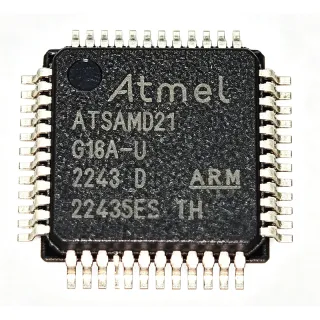
DSPIC33EP128MU204T-I/PT - 16-bit DSC 128KB Flash USB | Microchip
MPN: DSPIC33EP128MU204T-I/PT ✓ Active| Qty | Unit Price | Extended |
|---|---|---|
| 1 | $5.2 | $5.20 |
| 10 | $4.68 | $46.80 |
| 100 | $4.16 | $416.00 |
| 500 | $3.74 | $1,870.00 |
| 1,000 | $3.32 | $3,320.00 |
DSPIC33EP128MU204T-I/PT Overview
A Digital Signal Controller combines the deterministic control of a microcontroller with the mathematical throughput of a DSP. Within the power-management hierarchy of embedded systems, the DSC sits between general-purpose MCUs and dedicated DSPs, making it a common choice for closed-loop control loops that require both fast multiply-accumulate operations and rich peripheral integration on a single chip.
Key features include the 70 MIPS dsPIC33E core with DSP instruction extensions, 128 KB of self-programmable Flash with ECC, 16 KB of RAM, USB 2.0 On-The-Go capability, and up to two CAN 2.0B modules. The 12-bit ADC supports high-speed sampling for current-loop and sensor-capture tasks, while multiple communication ports allow simultaneous connectivity to hosts and field buses.
Architecturally, the dsPIC33E core uses a modified Harvard pipeline with hardware multiply-accumulate, barrel shifter, and dual operand fetch, enabling single-cycle MAC execution for filter and transform algorithms. Code and data buses are separated, and DMA channels offload the CPU during high-bandwidth ADC and UART transfers, reducing jitter in real-time control loops.
Typical applications include digital power supplies, brushless and PMSM motor control, industrial sensing nodes, and USB-connected instrumentation where a 16-bit controller with DSP math and 12-bit ADC accuracy is required.
When designing with this device, budget the 3.0 V to 3.6 V supply rail carefully and place the USB PHY decoupling per the reference design; also verify Flash endurance limits if the application performs frequent self-programming.
This page synthesizes distributor pricing, pin-compatible family alternatives, and practical design guidance not found in the manufacturer datasheet, as of 2026-09-24.
Drop-in alternatives for DSPIC33EP128MU204T-I/PT — same package, pin-to-pin compatible. Different-package parts requiring PCB rework are excluded.
Variants in this series
Same-series models that are drop-in compatible with DSPIC33EP128MU204T-I/PT (same form factor and footprint) — differing in Operating Temperature, Package.
Quick Comparison Tool — Select alternative parts for side-by-side comparison:
DSPIC33EP128MU204-I/PT
✅ Drop-In📋 Reference alternative (not in catalog)
DSPIC33EP256MU204-I/PT
✅ Drop-In ⚠️ 参数待验证📋 Reference alternative (not in catalog)
DSPIC33EP64MU204-I/PT
✅ Drop-In ⚠️ 参数待验证📋 Reference alternative (not in catalog)
DSPIC33EP128MC204-I/PT
✅ Drop-In ⚠️ 参数待验证📋 Reference alternative (not in catalog)
DSPIC33EP256MC204-I/PT
✅ Drop-In ⚠️ 参数待验证📋 Reference alternative (not in catalog)
DSPIC33EP128MU204T-I/PT Maximum Ratings & Electrical Characteristics
| Core Architecture | 16-bit dsPIC33E DSC core |
| Maximum CPU Speed | 70 MIPS |
| Flash Memory | 128 KB |
| SRAM | 16 KB |
| ADC Resolution | 12-bit |
| Supply Voltage Range | 3.0 V to 3.6 V |
| Operating Temperature | -40C to +85C (I grade) |
| Package | TQFP-44 (PT) |
| USB Interface | USB 2.0 OTG |
| CAN Modules | 2 x CAN 2.0B |
| UART Modules | 4 x UART |
| SPI Modules | 3 x SPI |
| I2C Modules | 2 x I2C |
| Mounting Type | Surface Mount |
| Packaging Suffix | T = Tape and Reel |
| Product Series | dsPIC33EP128MU204 family |
| RoHS Status | Compliant |
DSPIC33EP128MU204T-I/PT tqfp-44 (pt) Pin Configuration Guide
Pin configuration for DSPIC33EP128MU204T-I/PT (tqfp-44 (pt) package). This digital IC includes GPIO, communication interfaces (UART, SPI, I2C), and power pins. Refer to the manufacturer datasheet for alternate pin functions and configuration options. Essential for embedded system design and PCB layout.

No detailed pinout data available for DSPIC33EP128MU204T-I/PT.
Refer to the datasheet for full pin configuration.
Typical Applications
DSPIC33EP128MU204T-I/PT is suitable for 6 applications: Digital Power Supplies, Brushless and PMSM Motor Control, USB-Connected Industrial Instruments, CAN-Based Automation Nodes, Sensor Acquisition and Data Logging, Audio and Signal Processing Embedded Systems.
Digital Power Supplies
The DSPIC33EP128MU204T-I/PT fits digital power supply control because its 70 MIPS core with single-cycle multiply-accumulate executes voltage- and current-loop compensation at switching frequencies up to hundreds of kHz, while the 12-bit ADC captures feedback signals with sufficient resolution for tight regulation. In a typical topology the controller runs the compensation algorithm in an ADC interrupt, drives PWM outputs through the motor-control PWM module, and reports telemetry over UART or CAN. Unlike analog controllers, firmware-based control allows soft-start profiles, adaptive limiting, and field updates. The trade-off is that firmware latency must be budgeted carefully; keeping the control ISR short and using DMA for ADC transfers preserves phase margin at high switching frequencies.
Recommended
Brushless and PMSM Motor Control
The DSPIC33EP128MU204T-I/PT is well suited to BLDC and PMSM field-oriented control (FOC): the 70 MIPS dsPIC33E core computes Clarke/Park transforms and PI current loops within a single PWM period, and the 12-bit ADC supports dual-shunt or single-shunt current sampling synchronized to the PWM carrier. Microchip explicitly positions the dsPIC33E family for high-performance precision motor control systems, and reference firmware such as motor-control libraries targets this class of device. USB OTG additionally allows in-field tuning via a PC tool without a separate debug interface. Designers should budget CPU load for the control ISR and use hardware DMA to stream ADC samples, keeping jitter low for smooth torque at high speeds.
Recommended
USB-Connected Industrial Instruments
With its integrated USB 2.0 OTG module, the DSPIC33EP128MU204T-I/PT serves as the main controller for handheld and bench instruments that connect to a PC for configuration, logging, or firmware update. The MU family's USB peripheral can enumerate as a CDC/COM or HID device, eliminating a separate USB interface chip, while four UARTs and two CAN ports bridge to downstream field devices. The 128 KB Flash holds both the application and a USB bootloader for field upgrades. Designers should follow the reference design for the 3.3 V USB PHY supply and crystal configuration to meet USB eye-diagram requirements; a well-filtered 3.3 V rail and correct series resistors on D+/D- are essential for reliable enumeration.
Recommended
CAN-Based Automation Nodes
The dual CAN 2.0B modules of the DSPIC33EP128MU204T-I/PT make it a strong fit for industrial automation and building-control nodes that exchange data on CAN bus. One CAN port can handle the process fieldbus while the second serves diagnostics or a redundant channel, and the 70 MIPS core runs protocol stacks concurrently with control tasks. Combined with UART and I2C peripherals, the node can aggregate local sensors and actuators and present them to the network. The 16 KB RAM accommodates message buffers and stack usage typical of CANopen-style applications. Place a 120-ohm termination strategy per the network design and use the CAN module's hardware filters to reduce interrupt load on the CPU.
Recommended
Sensor Acquisition and Data Logging
For multi-channel sensor acquisition, the DSPIC33EP128MU204T-I/PT combines a 12-bit ADC with DMA channels so continuous sample streams are stored to RAM without CPU intervention, freeing the 70 MIPS core for filtering, scaling, and communication. Multiple UART and SPI ports connect to external ADCs, SD-card interfaces, and radios, enabling standalone data-logger products for industrial monitoring and test equipment. The 128 KB Flash retains calibration constants through self-programming with ECC protection. Performance consideration: the ADC throughput and RAM budget determine the maximum sustained sample rate; design the DMA ring buffers to match the logging medium's write latency to avoid data loss during bursts.
Recommended
Audio and Signal Processing Embedded Systems
The DSP math capability of the DSPIC33EP128MU204T-I/PT - single-cycle MAC, dual operand fetch, and DSP addressing modes - suits embedded audio processing tasks such as filtering, tone generation, and modest FFT-based analysis. The 12-bit ADC digitizes microphone or sensor inputs, while SPI links to external audio codecs or DACs when higher resolution is required; USB OTG can stream processed data to a host. At 70 MIPS the device handles moderate sample-rate filtering but is not a replacement for dedicated audio DSPs at high sample counts. Engineers should implement circular-buffered FIR/IIR routines from Microchip's DSP library to maximize MAC throughput and keep interrupt overhead below a small fraction of the sample period.
Recommended
Recommended Products Summary
Engineering reference data for DSPIC33EP128MU204T-I/PT — comparison, design guidance, and compliance information.
Selection Guide
Comparison with Alternatives
| Parameter | This Product | DSPIC33EP128MU204-I/PT | DSPIC33EP256MU204-I/PT | DSPIC33EP64MU204-I/PT | DSPIC33EP128MC204-I/PT |
|---|---|---|---|---|---|
| Package | TQFP-44 (PT) | TQFP-44 (PT) - same | TQFP-44 (PT) - same | TQFP-44 (PT) - same | TQFP-44 (PT) - same |
| Brand | Microchip Technology | Microchip Technology | Microchip Technology | Microchip Technology | Microchip Technology |
| Flash Memory | 128 KB | 128 KB | 256 KB | 64 KB | 128 KB |
| SRAM | 16 KB | 16 KB | 16 KB | 16 KB | 16 KB |
| Max CPU Speed | 70 MIPS | 70 MIPS | 70 MIPS | 70 MIPS | 70 MIPS |
| USB OTG | Yes | Yes | Yes | Yes | No (MC family) |
| ADC Resolution | 12-bit | 12-bit | 12-bit | 12-bit | 12-bit |
| Operating Temperature | -40C to +85C (I) | -40C to +85C (I) | -40C to +85C (I) | -40C to +85C (I) | -40C to +85C (I) |
| Supply Voltage | 3.0 V to 3.6 V | 3.0 V to 3.6 V | 3.0 V to 3.6 V | 3.0 V to 3.6 V | 3.0 V to 3.6 V |
Key Differentiators
- Integrated USB 2.0 OTG eliminates external USB interface chip (vs DSPIC33EP128MC204-I/PT)
- Balanced 128 KB Flash / 16 KB RAM memory profile (vs DSPIC33EP64MU204-I/PT)
- Same-footprint upgrade path to 256 KB Flash (vs DSPIC33EP256MU204-I/PT)
- Tape-and-reel delivery for automated assembly (vs DSPIC33EP128MU204-I/PT)
Design Notes
The DSPIC33EP128MU204T-I/PT requires a regulated 3.0 V to 3.6 V supply with 3.3 V nominal. When the USB OTG module is enabled, ensure the VUSB pin has a clean, well-decoupled 3.3 V rail and follow the Microchip reference design for USB PHY power; noise on this rail directly causes enumeration failures and bit errors. Estimated: at 70 MIPS the device typically draws tens of mA core current, so size the LDO or buck converter with margin above the datasheet IDD figures rather than assuming classic MCU-level consumption.
Place 100 nF ceramic decoupling capacitors at every VDD/VSS pin pair, as close to the pins as possible, plus bulk 4.7 uF to 10 uF near the supply entry. The TQFP-44 thermal pad area is the package body itself, so heat spreading relies on ground plane pours; connect all VSS pins directly to a solid ground plane with multiple vias. Keep the D+/D- USB traces as a matched-length 90-ohm differential pair if USB is used, and route the oscillator traces short and away from switching nodes.
Do not mix up the MU (USB) and MC (motor-control) peripheral sets when substituting within the dsPIC33EP family - pin functions and register maps differ even though the TQFP-44 footprint matches, so verify peripheral assignment before treating MC204 parts as alternates for this MU204 device. Also confirm the oscillator configuration: USB requires an accurate clock source meeting USB tolerance, and the fail-safe clock monitor should be enabled in production code. Finally, the 'I' grade is -40C to +85C; extended-temperature applications require the appropriate suffix variant.
Compliance Information
RoHS compliance inferred from Microchip's active commercial catalog listing and distributor categorization. Obtain formal REACH and conflict-minerals declarations from Microchip compliance documentation.