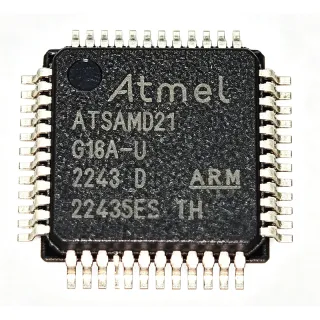
DSPIC33EP256MC506-H/PT - 16-bit 60 MIPS DSC, 256KB Flash | Microchip
MPN: DSPIC33EP256MC506-H/PT ✓ Active| Qty | Unit Price | Extended |
|---|---|---|
| 1 | $0 | $0.00 |
| 10 | $0 | $0.00 |
| 100 | $0 | $0.00 |
| 500 | $0 | $0.00 |
| 1,000 | $0 | $0.00 |
DSPIC33EP256MC506-H/PT Overview
A digital signal controller combines the compute throughput of a digital signal processor with the deterministic control peripherals of a microcontroller, sitting in the product hierarchy between general-purpose 16-bit MCUs (such as the PIC24 family) and full DSPs. Within power management and motion systems, a DSC executes sensorless or sensored control loops, power conversion algorithms, and digital filtering in a single closed loop, which is why the dsPIC33E family is a de facto standard in motor drive and digital power designs.
Key features of the DSPIC33EP256MC506 include its 16-bit dsPIC DSC core with DSP instruction support, up to 256KB of self-programmable Flash and 32KB of SRAM, multiple high-resolution PWM modules for complementary or independent motor control outputs, an integrated analog front end (ADCs, comparators, and on-chip op amps that reduce external BOM cost), four DMA channels for low-CPU-overhead data movement, and five timers. The part operates from a 3.0V to 3.6V supply with a 3.3V nominal rail.
Architecturally, the dsPIC33EP core uses a modified Harvard pipeline with hardware DSP multiply-accumulate, allowing loop rates sufficient for field-oriented control (FOC) of PMSM/BLDC motors and digital power topologies such as LLC or totem-pole PFC. The on-chip op amps can be used as current-sense amplifiers feeding the ADC, shortening the control loop latency versus external signal conditioning.
Typical applications include precision motor control (BLDC, PMSM, ACIM drives), switch-mode power supplies and digital power, industrial automation, and embedded sensing systems. The 64-pin TQFP provides enough I/O for three-phase inverters with encoder or resolver feedback, and the device is supported by Microchip MCLV-2/MCHV-2 development boards via the MA330031 PIM.
Design consideration: verify the operating temperature grade for the -H suffix against the latest Microchip datasheet, and budget the 3.0V-3.6V supply rail early in the design, since the core PLL and ADC accuracy depend on a clean 3.3V rail with adequate decoupling on all VDD/VSS pairs of the 64-pin TQFP.
This page synthesizes distributor data, pin-compatible same-family drop-in alternatives, FAQs, and practical design notes not found in the manufacturer datasheet, as of 2026-09-24.
Drop-in alternatives for DSPIC33EP256MC506-H/PT — same package, pin-to-pin compatible. Different-package parts requiring PCB rework are excluded.
Variants in this series
Same-series models that are drop-in compatible with DSPIC33EP256MC506-H/PT (same form factor and footprint) — differing in Package, Operating Temperature, ADC Resolution, Core, Core Architecture.
Quick Comparison Tool — Select alternative parts for side-by-side comparison:
DSPIC33EP256MC506-I/PT
✅ Drop-In✓ In Stock
$4.65 / Unit
View Datasheet →DSPIC33EP512MC506-I/PT
✅ Drop-In ⚠️ Specs Unverified✓ In Stock
$2.38 / Unit
View Datasheet →DSPIC33EP256MC504-I/PT
✅ Drop-In ⚠️ Specs Unverified✓ In Stock
$4.6 / Unit
View Datasheet →DSPIC33EP128MC506-I/PT
✅ Drop-In ⚠️ Specs Unverified📋 Reference alternative (not in catalog)
DSPIC33EP128MC504-I/PT
✅ Drop-In ⚠️ Specs Unverified📋 Reference alternative (not in catalog)
DSPIC33EP256MC506-H/PT Maximum Ratings & Electrical Characteristics
| Core | 16-bit dsPIC DSC |
| CPU Speed | 60 MIPS |
| Clock Frequency | 60 MHz |
| Program Memory (Flash) | 256 KB |
| RAM | 32 KB |
| Supply Voltage Range | 3.0 V to 3.6 V |
| Nominal Supply Voltage | 3.3 V |
| Maximum Supply Current | 60 mA |
| Package | 64-pin TQFP (10x10 mm), JESD-30 S-PQFP-G64 |
| Terminal Pitch | 0.5 mm |
| Mounting Type | Surface Mount |
| ADC Resolution | 10-bit / 12-bit |
| On-chip Op Amps | Yes |
| DMA Channels | 4 |
| Timers | 5 |
| Peripherals | Motor Control PWM, QEI, Comparators, WDT, DMA |
DSPIC33EP256MC506-H/PT 64-pin tqfp (10x10 mm), jesd-30 s-pqfp-g64 Pin Configuration Guide
Pin configuration for DSPIC33EP256MC506-H/PT (64-pin tqfp (10x10 mm), jesd-30 s-pqfp-g64 package). This digital IC includes GPIO, communication interfaces (UART, SPI, I2C), and power pins. Refer to the manufacturer datasheet for alternate pin functions and configuration options. Essential for embedded system design and PCB layout.

No detailed pinout data available for DSPIC33EP256MC506-H/PT.
Refer to the datasheet for full pin configuration.
Typical Applications
DSPIC33EP256MC506-H/PT is suitable for 6 applications: Precision Motor Control (PMSM/BLDC/ACIM Drives), Digital Power Conversion (SMPS, PFC, LLC), Industrial Automation and Process Control, Embedded Sensing and Signal Acquisition, Automotive-Adjacent Motion Systems (Non-Safety-Critical), Renewable Energy Converters (Solar Micro-Inverters, Battery Chargers).
Precision Motor Control (PMSM/BLDC/ACIM Drives)
The DSPIC33EP256MC506-H/PT is purpose-built for high-performance, precision motor control: its 60 MIPS dsPIC33EP core executes field-oriented control (FOC) inner current loops alongside outer speed/position loops within a single PWM period. The high-speed motor control PWM module provides complementary outputs with hardware dead time, the quadrature encoder interface (QEI) accepts incremental encoder feedback directly, and the on-chip op amps amplify low-level shunt currents before conversion by the 10/12-bit ADCs, reducing external component count and loop latency. The 64-pin TQFP supplies enough PWM outputs and analog inputs for three-phase inverters. Microchip supports this exact device with the MA330031 PIM on MCLV-2 and MCHV-2 boards, including reference FOC firmware, shortening software development time.
Recommended
Digital Power Conversion (SMPS, PFC, LLC)
In switch-mode power supplies and digital power stages, the DSPIC33EP256MC506-H/PT replaces analog control loops with firmware-defined control: its 60 MIPS core and hardware DSP multiply-accumulate run voltage/current compensators for buck, boost, LLC, and power-factor-correction topologies at loop rates unachievable with general-purpose MCUs. The high-resolution PWM outputs drive gate drivers with programmable phase shift and dead time, while the 12-bit ADC with DMA streams sampled rail voltages and currents to RAM without CPU intervention, keeping the interrupt load low. The on-chip comparators provide cycle-by-cycle overcurrent limiting independent of firmware, a critical fault-protection feature in power stages. Designers should budget a clean 3.0V-3.6V supply and account for PWM resolution requirements of the chosen topology when mapping pins.
Recommended
Industrial Automation and Process Control
For industrial automation nodes, the DSPIC33EP256MC506-H/PT combines a rich peripheral set with DSP-class math: five timers sequence machine functions, UART/SPI/I2C serial ports integrate with PLC-style field interfaces, four DMA channels offload sensor streaming, and the 32KB SRAM buffers process data for digital filtering. The 256KB self-programmable Flash supports field firmware updates, important for long-lived factory equipment. The 64-pin TQFP exposes dozens of multiplexed I/O for relays, indicator drives, and analog sensor front ends via the integrated 10/12-bit ADCs and op amps. Machines that previously used separate MCU-plus-DSP two-chip solutions can consolidate onto this single DSC, reducing BOM cost and board area while retaining deterministic real-time behavior demanded by industrial control loops.
Recommended
Embedded Sensing and Signal Acquisition
The DSPIC33EP256MC506-H/PT functions as a compact digital front end: its 10/12-bit ADCs with multiple sample-and-hold channels, on-chip op amps for signal conditioning, comparators for threshold detection, and DMA for autonomous capture form a complete acquisition chain on one chip. The 60 MHz DSP core applies FIR/IIR filters, FFT windows, or demodulation routines in real time - tasks for which the dsPIC33EP's single-cycle MAC and DSP addressing modes are optimized. With 32KB of SRAM, multi-channel capture buffers are practical, and the 256KB Flash stores calibration tables and logging algorithms. Battery- or line-powered instruments benefit from consolidation: signal conditioning, conversion, processing, and communication (UART/SPI/I2C) are all on-die, shrinking analog board area and calibration effort.
Recommended
Automotive-Adjacent Motion Systems (Non-Safety-Critical)
Motion subsystems supplied into non-safety-critical vehicle applications - pumps, fans, actuators, and auxiliary drives - can use the DSPIC33EP256MC506-H/PT's high temperature grade and robust peripheral set. The motor control PWM generates the three-phase drive, the QEI or comparator-based sensorless schemes provide rotor position, and the ADC/op-amp front end measures phase currents for FOC. The 60 MIPS headroom accommodates additional functions such as CAN-style communication stacks (via peripherals available in the family) and diagnostics within the same control loop period. Designers must verify the exact temperature rating of the -H ordering code against the current Microchip datasheet and select AEC-qualified alternatives where the end-application mandates automotive qualification, since this catalog device is not itself an automotive-grade part number.
Recommended
Renewable Energy Converters (Solar Micro-Inverters, Battery Chargers)
Grid-tied and off-grid power conversion benefits from the DSPIC33EP256MC506-H/PT's blend of PWM precision and DSP throughput: maximum power point tracking (MPPT) algorithms, phase-locked loops for grid synchronization, and multi-loop inverter control all execute concurrently on the 60 MIPS core. The high-speed PWM module's complementary outputs with programmable dead time drive half-bridge and full-bridge stages, while the 12-bit ADC simultaneously samples grid voltage, current, and DC-link conditions via DMA. On-chip comparators provide hardware overcurrent trips that protect the power stage faster than firmware can react. The 256KB Flash accommodates protocol stacks (e.g., communication for monitoring) alongside the control firmware, eliminating a second controller in many micro-inverter and smart-charger designs.
Recommended
Recommended Products Summary
Engineering reference data for DSPIC33EP256MC506-H/PT — comparison, design guidance, and compliance information.
Selection Guide
Comparison with Alternatives
| Parameter | This Product | DSPIC33EP256MC506-I/PT | DSPIC33EP512MC506-I/PT | DSPIC33EP256MC504-I/PT | DSPIC33EP128MC506-I/PT |
|---|---|---|---|---|---|
| Brand | Microchip Technology | Microchip Technology | Microchip Technology | Microchip Technology | Microchip Technology |
| Package | 64-TQFP (10x10 mm, 0.5 mm pitch) | 64-TQFP (10x10 mm) - same | 64-TQFP (10x10 mm) - same | 64-TQFP (10x10 mm) - same | 64-TQFP (10x10 mm) - same |
| Core / Performance | 16-bit dsPIC DSC, 60 MIPS / 60 MHz | 16-bit dsPIC DSC, 60 MIPS / 60 MHz | 16-bit dsPIC DSC, 60 MIPS / 60 MHz | 16-bit dsPIC DSC, 60 MIPS / 60 MHz | 16-bit dsPIC DSC, 60 MIPS / 60 MHz |
| Flash Memory | 256 KB | 256 KB | 512 KB | 256 KB | 128 KB |
| RAM | 32 KB | 32 KB | 32 KB | 32 KB | 32 KB |
| Temperature Grade | -H grade (per Microchip ordering code; verify range in datasheet) | Industrial, -40C to +85C | Industrial, -40C to +85C | Industrial, -40C to +85C | Industrial, -40C to +85C |
| On-chip Op Amps / Analog | Yes - op amps, 10/12-bit ADC, comparators | Yes - identical analog set | Yes - identical analog set | Yes - reduced pin routing of analog instances | Yes - identical analog set |
| Typical Use Case | Precision motor control, digital power | Same applications; standard industrial temp | Code-growth headroom for FOC + comms stacks | Cost-reduced 64-pin designs with fewer muxed functions | Cost-reduced option when code fits in 128KB |
Key Differentiators
- Full 256KB Flash / 32KB RAM in the 64-pin MC506 footprint (vs DSPIC33EP128MC506-I/PT)
- On-chip operational amplifiers eliminate external current-sense amplifiers (vs DSPIC33EP256MC504-I/PT)
- Program memory scalability without PCB change (vs DSPIC33EP512MC506-I/PT)
Design Notes
The dsPIC33EP256MC506 operates from a 3.0V to 3.6V supply with 3.3V nominal and a maximum supply current around 60 mA per distributor data. Decouple every VDD/VSS pair of the 64-pin TQFP with 0.1uF ceramics placed within 2 mm of the pins, plus bulk 10uF at the board entry. If the on-chip op amps and ADC are used, a quiet analog supply (ferrite bead or dedicated LDO) measurably improves ADC effective resolution. Estimated: 3.3V x 60 mA = 0.2W typical internal dissipation, well within TQFP-64 limits without a heatsink.
Route PWM outputs to the gate driver with short, matched traces and keep high-di/dt inverter loops (DC-link capacitor to FETs) away from the ADC and op-amp input traces to prevent switching noise corrupting current samples. Place shunt resistors close to the op-amp inputs and use kelvin connections. Microchip's MCLV-2/MCHV-2 reference boards (used with the MA330031 PIM carrying this exact device) provide proven layout templates for FOC-oriented inverters - replicate their analog partitioning for best results.
Confirm the temperature grade and suffix meaning before purchase: Microchip ordering codes (-H vs -I vs -T tape/reel and VAO variants) change packaging and rating, not silicon, but distributors list them as separate MPNs and substitution on a PO can fail incoming inspection. Also note the 32KB vs 16KB RAM discrepancy seen across distributor listings for this family - always validate RAM size (32KB for the MC506 per Mouser and RS listings) against the current official Microchip datasheet before finalizing memory budgets.
Compliance Information
Compliance status for the specific -H/PT ordering code was not explicitly stated in the verified web data. The dsPIC33EP256MC506 family is an active Microchip product; verify RoHS/REACH certificates on the Microchip product page compliance documents. This is a catalog device, not an AEC-Q100-qualified automotive part number.