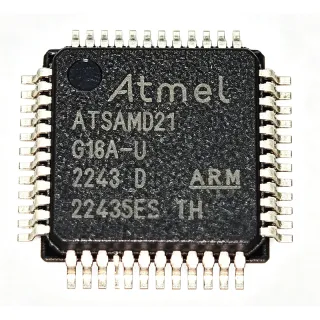
DSPIC33EP512GM710-E/PT - 70 MIPS 16-bit DSC, 512KB Flash | Microchip
MPN: DSPIC33EP512GM710-E/PT ✓ Active| Qty | Unit Price | Extended |
|---|---|---|
| 1 | $9.85 | $9.85 |
| 10 | $8.92 | $89.20 |
| 100 | $7.95 | $795.00 |
| 500 | $7.2 | $3,600.00 |
| 1,000 | $6.55 | $6,550.00 |
DSPIC33EP512GM710-E/PT Overview
A digital signal controller combines the compute architecture of a 16-bit microcontroller with the math acceleration of a DSP, sitting in the device hierarchy as DSC -> 16-bit microcontroller -> microcontroller unit -> semiconductor. The dsPIC33E core executes DSP instructions (MAC, DSP multiply-accumulate) alongside MCU peripherals, making it the standard choice for precision digital power and motor-control systems.
Key features include the 70 MIPS dsPIC DSC core with integrated DSP engine, 512 KB Flash and 16 KB RAM, dual CAN modules, four on-chip operational amplifiers, quadrature encoder interface (QEI), and rich PWM/IC/OC timing resources cited by distributors as 8 input capture / 8 output compare channels. These peripherals directly address field-oriented motor control, sensorless FOC, and industrial networking.
On the analog side, the GM family integrates four op amps and a high-speed 12-bit ADC, allowing current-shunt amplification and sampling without external amplifiers - a major board-area and BOM saving for multi-motor drives. The Single-Dual Motor Control PIM (document 50002216a) from Microchip demonstrates one- and two-motor operation using these internal op amps.
Typical applications include brushless DC and PMSM motor drives, solar inverters and digital power supplies, automotive body and powertrain subsystems (the -E/PT grade is automotive AEC-Q100 qualified per distributor data), and industrial automation with CAN connectivity.
For design, budget the 3.3V supply, use external crystals per the Microchip oscillator guidelines to reach the full 70 MIPS (PLL x4 from a 7.3728 MHz-class crystal family), and verify the 12x12 TQFP land pattern against the Microchip PT footprint drawing.
This page synthesizes distributor pricing context, drop-in alternatives, design notes, and AEO-optimized FAQs not found in the manufacturer datasheet alone.
Drop-in alternatives for DSPIC33EP512GM710-E/PT — same package, pin-to-pin compatible. Different-package parts requiring PCB rework are excluded.
Variants in this series
Same-series models that are drop-in compatible with DSPIC33EP512GM710-E/PT (same form factor and footprint) — differing in Package, Operating Temperature, Qualification, Quadrature Encoder Interfaces, RAM.
Quick Comparison Tool — Select alternative parts for side-by-side comparison:
DSPIC33EP512GM710-I/PT
✅ Drop-In✓ In Stock
$10.21 / Unit
View Datasheet →DSPIC33EP256GM710T-I/PF
✅ Drop-In✓ In Stock
$5.4 / Unit
View Datasheet →DSPIC33EP256GM710-H/PF
✅ Drop-In✓ In Stock
$5.25 / Unit
View Datasheet →DSPIC33EP256MU810T-I/PF
✅ Drop-In✓ In Stock
$4.1 / Unit
View Datasheet →DSPIC33EP512GM710-E/PT Maximum Ratings & Electrical Characteristics
| Core | 16-bit dsPIC33E DSC core |
| Max Core Speed | 70 MIPS |
| Flash Program Memory | 512 KB |
| RAM | 16 KB |
| Supply Voltage | 3.3 V |
| Package | 100-TQFP (12x12 mm), PT |
| Temperature Grade | E: -40C to +125C (automotive) |
| Qualification | AEC-Q100 qualified |
| CAN Modules | 2 |
| On-chip Op Amps | 4 |
| Input Capture / Output Compare | 8 / 8 |
| Quadrature Encoder Interfaces | 2 |
| PWM | Motor Control PWM peripherals |
| Mounting Type | Surface Mount |
| Terminal Pitch | 0.4 mm |
| Packaging | Tray |
DSPIC33EP512GM710-E/PT 100-tqfp (12x12 mm), pt Pin Configuration Guide
Pin configuration for DSPIC33EP512GM710-E/PT (100-tqfp (12x12 mm), pt package). This digital IC includes GPIO, communication interfaces (UART, SPI, I2C), and power pins. Refer to the manufacturer datasheet for alternate pin functions and configuration options. Essential for embedded system design and PCB layout.

No detailed pinout data available for DSPIC33EP512GM710-E/PT.
Refer to the datasheet for full pin configuration.
Typical Applications
DSPIC33EP512GM710-E/PT is suitable for 6 applications: Precision Motor Control (BLDC/PMSM Drives), Automotive Body and Powertrain Electronics, Solar Inverters and Digital Power Supplies, Industrial Automation and CAN Networking Nodes, Power Metering and Instrumentation, Embedded Control and IoT Gateway Front Ends.
Precision Motor Control (BLDC/PMSM Drives)
The DSPIC33EP512GM710-E/PT is purpose-built for high-performance precision motor control: its 70 MIPS dsPIC33E core with DSP multiply-accumulate executes field-oriented control (FOC) loops fast enough for low-inductance PMSM and BLDC motors, while the motor-control PWM peripherals, 8 output compares, and dual quadrature encoder interfaces handle commutation and feedback natively. The four on-chip op amps amplify shunt-resistor phase currents before the ADC, eliminating external amplifier stages - Microchip's Single-Dual Motor Control PIM (document 50002216a) demonstrates driving one or two motors using exactly these internal op amps with passive external networks. With 512 KB Flash, sensorless observer tables, field-weakening maps, and a bootloader all fit in a single image. Typical loop rates of 10-20 kHz PWM are routine at 70 MIPS.
Recommended
Automotive Body and Powertrain Electronics
The -E/PT grade is AEC-Q100 qualified and rated -40C to +125C per distributor parametric data, positioning this DSC for automotive subsystems such as pump controllers, HVAC blowers, throttle actuators, and lighting control units that sit near heat sources. Dual CAN modules interface directly with vehicle networks without external controllers, and the 100-pin TQFP provides enough I/O to drive multiple sensors, H-bridges, and diagnostic lines from one MCU. The 3.3 V core with 5 V-tolerant class input structures and the wide temperature rating remove the derating uncertainty that industrial-grade parts introduce in under-hood or in-cabin-sunload designs. When designing automotive systems, budget Flash for OBD/UDS diagnostic stacks alongside the control algorithm - the 512 KB Flash of the GM710 accommodates both comfortably.
Recommended
Solar Inverters and Digital Power Supplies
Digital power conversion needs fast, deterministic control loops, and the DSPIC33EP512GM710-E/PT's 70 MIPS core plus DSP MAC instructions execute predictive or multi-loop control (voltage outer loop, current inner loop) with cycle-deterministic latency. The rich PWM and 8/8 input-capture/output-compare resources phase-shift multiple converter legs, while the four op amps condition current-shunt signals into the high-speed ADC for cycle-by-cycle current limiting in LLC, totem-pole PFC, or solar micro-inverter stages. Dual CAN enables inverter-to-BMS or string-monitor communication. With 512 KB Flash, MPPT algorithms, grid-compliance code, and a field-updatable bootloader coexist in one device. The extended -40C to +125C rating of the -E grade suits outdoor enclosure installations where ambient temperatures climb above standard industrial limits.
Recommended
Industrial Automation and CAN Networking Nodes
Factory automation nodes benefit from the DSPIC33EP512GM710-E/PT's dual CAN modules, which allow bridging two CAN buses (for example, a machine bus and a diagnostics bus) in one device, plus the 70 MIPS core to run protocol stacks and local control concurrently. The 100-pin TQFP exposes abundant remappable peripheral pins via Peripheral Pin Select, so UART, SPI, and I2C can be routed to match existing PCB layouts without rewiring. Encoder interfaces (2x QEI) read rotary feedback directly for positioning axes, and the on-chip op amps support analog sensor front ends such as strain-gauge or current-loop signal conditioning. The extended temperature grade also covers sealed control cabinets in hot plants where convection cooling is limited.
Recommended
Power Metering and Instrumentation
Energy metering demands simultaneous sampling of voltage and current channels with DSP-class post-processing - exactly the combination the dsPIC33EP512GM710 provides. Its DSP engine computes RMS, FFT, power factor, and harmonic content in fixed point at 70 MIPS, while the internal op amps scale shunt or CT signals into the ADC input range, trimming external component count. The 512 KB Flash stores calibration tables per unit, firmware for multiple metering standards, and a secure bootloader; 16 KB RAM buffers waveform snapshots for event capture. Dual CAN or UART links report data to SCADA gateways. The -E temperature rating matches outdoor meter cabinets, and the AEC-Q100 qualification supports utility-grade reliability requirements in long-life deployments.
Recommended
Embedded Control and IoT Gateway Front Ends
As a general-purpose 16-bit embedded controller, the DSPIC33EP512GM710-E/PT fits signal-chain-centric IoT nodes: the DSP engine filters sensor streams (vibration, acoustic, current signatures) in real time before data is pushed upstream over CAN or UART-to-wireless bridges. The 100 pins support multiple remapped communication ports, and 512 KB Flash holds DSP libraries plus a communication stack simultaneously. Compared with a separate MCU-plus-DSP two-chip solution, this single DSC cuts BOM cost, board area, and inter-chip latency. The extended -40C to +125C range allows deployment in unconditioned outdoor enclosures, rooftop equipment, and cold-chain monitoring, where the AEC-Q100 qualification of the -E grade provides additional long-term reliability confidence.
Recommended
Recommended Products Summary
Engineering reference data for DSPIC33EP512GM710-E/PT — comparison, design guidance, and compliance information.
Selection Guide
Comparison with Alternatives
| Parameter | This Product | DSPIC33EP512GM710-I/PT | DSPIC33EP256GM710T-I/PF | DSPIC33EP256MU810T-I/PF |
|---|---|---|---|---|
| Package | 100-TQFP (12x12, PT) | 100-TQFP (12x12) - same | 100-TQFP - same family | 100-TQFP - same family |
| Brand | Microchip Technology | Microchip Technology | Microchip Technology | Microchip Technology |
| Core Speed | 70 MIPS | 70 MIPS | 70 MIPS | 70 MIPS |
| Flash Memory | 512 KB | 512 KB | 256 KB | 256 KB |
| Temperature Range | -40C to +125C (E, AEC-Q100) | -40C to +85C (I) | -40C to +85C (I) | -40C to +85C (I) |
| CAN Modules | 2 | 2 | 2 | 2 + USB |
| On-chip Op Amps | 4 | 4 | 4 | 4 |
Key Differentiators
- Automotive AEC-Q100 extended temperature grade (vs DSPIC33EP512GM710-I/PT)
- Double the program memory in the same package (vs DSPIC33EP256GM710T-I/PF)
- Integrated analog front end (vs DSPIC33EP256MU810T-I/PF)
Design Notes
Power the DSPIC33EP512GM710-E/PT from a clean 3.3 V rail with a nominal core current in the tens of milliamps at 70 MIPS (per family datasheet; verify exact ICC for your clock configuration). Decouple every VDD/VSS pair on the 100-pin TQFP with 100 nF ceramics placed within 2 mm of the pins, plus bulk 10 uF near the supply entry. If your board has an analog section using the on-chip op amps and ADC, provide a filtered AVDD supply (ferrite bead plus 1 uF) to keep ADC noise floor low.
The PT package is a 12x12 mm, 100-lead TQFP with 0.4 mm lead pitch. Follow Microchip's PT footprint drawing exactly; 0.4 mm pitch requires solder-mask-defined or NSMD pads per IPC-class stencil design. Use a uniform ground plane on layer 2 and keep the crystal/OSC traces short and guarded. Route CAN pairs differentially at 120-ohm characteristic impedance, and place CAN transceivers (e.g., MCP2551/MCP2562) close to the pins with proper split termination.
Three common mistakes with dsPIC33E designs: (1) clocking - reaching the full 70 MIPS requires the PLL configured correctly; verify FOSC against the oscillator section of the family reference manual rather than assuming a crystal frequency, since distributor listings mention both 60 MHz-class and 70 MIPS figures. (2) Peripheral Pin Select - many digital pins are remappable; lock your PPS assignments early to avoid layout churn. (3) Temperature grading - do not substitute the -I/PT industrial part (to +85C) in a design qualified around the -E grade (to +125C, AEC-Q100); the footprint matches but the qualification does not.
Compliance Information
AEC-Q100 automotive qualification and 3.3V automotive-grade classification confirmed via distributor parametric data (datasheets.com, updated 03-JAN-2024). RoHS/REACH/halogen status not stated in the provided data and therefore marked unknown - confirm on the Microchip product page.