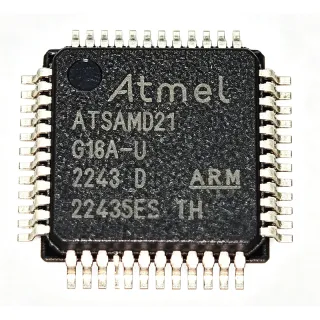
DSPIC33FJ32GP104-I/PT - 16-Bit DSC 16 MIPS 32KB Flash | Microchip
MPN: DSPIC33FJ32GP104-I/PT ✓ Active| Qty | Unit Price | Extended |
|---|---|---|
| 1 | $6.12 | $6.12 |
| 10 | $5.55 | $55.50 |
| 100 | $4.9 | $490.00 |
| 500 | $4.42 | $2,210.00 |
| 1,000 | $3.98 | $3,980.00 |
DSPIC33FJ32GP104-I/PT Overview
A digital signal controller combines the deterministic architecture and peripheral set of a microcontroller with the multiply-accumulate (MAC) DSP engine of a digital signal processor. In the power-management hierarchy, the DSC sits between a general-purpose MCU and a dedicated DSP: it runs C code with fast interrupt context switching while executing single-cycle DSP instructions, which is why the dsPIC33 family dominates cost-sensitive digital power, sensing and motor control designs.
Key features of this part include the 16-bit modified Harvard core with DSP instruction support (MAC, modulo addressing, bit-reversed addressing), 32KB self-programming Flash with ECC-free sector erase, and a General Purpose (GP) peripheral set. Supply voltage is 3.3V (2.97V to 3.63V typical class), and the CMOS process supports low-power idle and sleep modes for battery-conscious designs.
Architecturally, the dsPIC33FJ core pairs a 16-bit CPU with a dedicated 17-bit x 17-bit multiplier and 40-bit accumulator, allowing filter loops and control-law computations to execute in single cycles. Program memory is Flash with 1000 erase/write cycles minimum, and the interrupt controller supports nested vectored interrupts for deterministic control-loop latency. In-circuit serial programming (ICSP) and in-circuit debugging are supported through PGECx/PGEDx pin pairs using MPLAB X IDE with the MPLAB Snap, PICkit or ICD programmers.
Typical applications include digital power supplies and power-factor-correction stages, sensor signal conditioning and industrial automation nodes, plus portable instrumentation where 16 MIPS of DSP headroom and industrial temperature range are required without the cost of a full DSP.
Design-wise, connect all VDD and VSS pin pairs - floating even one pair prevents programming - and keep the PGEC/PGED pin pairs matched during ICSP routing as Microchip support documentation requires.
This page synthesizes distributor inventory data, same-family drop-in alternatives, and practical layout guidance not consolidated in the manufacturer datasheet 70000652f.
Drop-in alternatives for DSPIC33FJ32GP104-I/PT — same package, pin-to-pin compatible. Different-package parts requiring PCB rework are excluded.
Variants in this series
Same-series models that are drop-in compatible with DSPIC33FJ32GP104-I/PT (same form factor and footprint) — differing in Package, Core Architecture, Operating Temperature, Max CPU Speed, RoHS Status.
Quick Comparison Tool — Select alternative parts for side-by-side comparison:
DSPIC33FJ32GP304-I/PT
✅ Drop-In ⚠️ Specs Unverified✓ In Stock
$2.29 / Unit
View Datasheet →DSPIC33FJ32GP104-E/PT
✅ Drop-In✓ In Stock
$3.95 / Unit
View Datasheet →DSPIC33FJ32MC104-I/PT
✅ Drop-In ⚠️ Specs Unverified📋 Reference alternative (not in catalog)
DSPIC33FJ64GP304-I/PT
✅ Drop-In ⚠️ Specs Unverified📋 Reference alternative (not in catalog)
DSPIC33FJ16GP304-I/PT
✅ Drop-In ⚠️ Specs Unverified📋 Reference alternative (not in catalog)
DSPIC33FJ32GP104-I/PT Maximum Ratings & Electrical Characteristics
| Core Architecture | 16-bit dsPIC33FJ RISC with DSP engine |
| Maximum CPU Speed | 16 MIPS |
| Program Memory Size | 32 KB (11K x 24) Flash |
| RAM Size | 2 KB |
| Supply Voltage | 3.3 V |
| Operating Temperature | -40C to +85C (I grade) |
| Package | 44-TQFP (10x10 mm), 0.8 mm terminal pitch |
| Mounting Type | Surface Mount |
| Series | dsPIC33FJ32GP (General Purpose) |
| Technology | CMOS |
| Programming / Debug | ICSP via PGECx/PGEDx pairs (MPLAB X IDE, MPLAB Snap) |
| Low Power Modes | Supported (idle, sleep) |
| RoHS Status | Compliant (per distributor listing) |
| Packaging | Tray (per Future Electronics listing) |
DSPIC33FJ32GP104-I/PT 44-tqfp (10x10 mm), 0.8 mm terminal pitch Pin Configuration Guide
Pin configuration for DSPIC33FJ32GP104-I/PT (44-tqfp (10x10 mm), 0.8 mm terminal pitch package). This digital IC includes GPIO, communication interfaces (UART, SPI, I2C), and power pins. Refer to the manufacturer datasheet for alternate pin functions and configuration options. Essential for embedded system design and PCB layout.

No detailed pinout data available for DSPIC33FJ32GP104-I/PT.
Refer to the datasheet for full pin configuration.
Typical Applications
DSPIC33FJ32GP104-I/PT is suitable for 6 applications: Digital Power Supply Control, Industrial Automation Nodes, Sensor Signal Conditioning, Portable Instrumentation, Motor Control Subsystems, Embedded Communication Interfaces.
Digital Power Supply Control
The DSPIC33FJ32GP104-I/PT is well suited to closing control loops in digital AC-DC and DC-DC converters. Its 16-bit core with a single-cycle DSP multiply-accumulate engine runs compensator and PFC algorithms deterministically at 16 MIPS, while on-chip ADC and PWM peripherals sample and drive the power stage without external controllers. Implemented between the feedback divider and gate-driver inputs with the ICSP pins reserved for field firmware updates, the DSC replaces hardwired analog control with tunable digital control. The trade-off versus analog control is firmware development effort; the benefit is adaptability across output voltages and standards using one PCB. Industrial -40C to +85C operation covers most power-supply environments.
Recommended
Industrial Automation Nodes
In factory automation, the DSPIC33FJ32GP104-I/PT serves as the control element in sensor hubs, actuator drivers and small PLC I/O modules. The 16-bit dsPIC33FJ core processes filtered sensor readings using DSP instructions at 16 MIPS while the GP peripheral set handles serial links to the network layer, and the 32KB Flash accommodates protocol stacks with headroom for field updates. The industrial -40C to +85C rating and 3.3V CMOS operation align with standard control-cabinet conditions, and idle/sleep modes cut power in always-on monitoring nodes. Programming and in-service debugging occur through any PGECx/PGEDx pair via MPLAB X IDE, simplifying maintenance on installed hardware without desoldering the 44-TQFP device.
Recommended
Sensor Signal Conditioning
The DSPIC33FJ32GP104-I/PT fits front-end conditioning of analog sensors such as pressure bridges, thermocouples and current shunts. The DSP engine executes FIR/IIR filters and RMS computation in single-cycle MAC instructions at 16 MIPS, converting noisy raw ADC streams into stable engineering values on-chip, and the GP family ADC integrates the acquisition chain. With 2KB of RAM, the part buffers multiple sensor channels for burst analysis while maintaining a 3.3V single-supply interface to standard analog front ends. Designing the board with the GP304 pin-compatible variant in mind lets you add DMA-driven multi-channel sampling later without PCB change, making this DSC a low-risk choice for evolving sensor platforms.
Recommended
Portable Instrumentation
Handheld and bench instruments benefit from the DSPIC33FJ32GP104-I/PT's balance of computation and power. The 3.3V CMOS core with idle and sleep modes conserves battery between measurements, while 16 MIPS of DSP performance computes FFT-based analysis, calibration curves and display scaling locally, removing dependence on an external processor. The 32KB Flash stores menus, lookup tables and measurement routines, and the 44-TQFP 10x10mm footprint fits compact mainboards. Per Microchip documentation, all VDD/VSS pairs must be connected in the layout for reliable ICSP reprogramming in the field, enabling firmware feature updates across a product's service life without hardware revision.
Recommended
Motor Control Subsystems
Although the MC variant targets motors specifically, the GP104 runs scalar V/f control and DC motor control loops effectively with its 16 MIPS DSP core and PWM-capable peripherals. Single-cycle MAC instructions execute current-loop filters, and the industrial temperature rating suits drive environments. For sensorless FOC with high-resolution PWM, migrate to the pin-compatible DSPIC33FJ32MC104-I/PT, which replaces GP analog blocks with motor-control peripherals on the same 44-TQFP footprint - a zero-rework migration path. Design the board with the MC pin functions documented from the shared datasheet 70000652f pinout so either part can be populated depending on final control algorithm requirements and unit cost targets.
Recommended
Embedded Communication Interfaces
The GP104 serves as a protocol bridge and intelligent node in systems linking UART, SPI and I2C buses - for example translating Modbus RTU on a UART to SPI peripherals, or managing RS-485 field wiring. The 16-bit core at 16 MIPS handles framing, CRC computation and buffering within its 2KB RAM for typical fieldbus message sizes, while 32KB Flash holds multiple protocol stacks with room for updates. Data verification should be modeled on Microchip's CRC-capable peripherals, and the part's deterministic interrupt latency keeps turnaround times predictable in master/slave polling. The ICSP PGEC/PGED pairs should be routed to a header so protocol firmware can be reflashed during commissioning.
Recommended
Recommended Products Summary
Engineering reference data for DSPIC33FJ32GP104-I/PT — comparison, design guidance, and compliance information.
Selection Guide
Comparison with Alternatives
| Parameter | This Product | DSPIC33FJ32GP304-I/PT | DSPIC33FJ32GP104-E/PT | DSPIC33FJ32MC104-I/PT | DSPIC33FJ64GP304-I/PT |
|---|---|---|---|---|---|
| Package | 44-TQFP (10x10 mm) | 44-TQFP (10x10 mm) - same | 44-TQFP (10x10 mm) - same | 44-TQFP (10x10 mm) - same | 44-TQFP (10x10 mm) - same |
| Brand | Microchip Technology | Microchip Technology | Microchip Technology | Microchip Technology | Microchip Technology |
| CPU Performance | 16 MIPS | 16 MIPS | 16 MIPS | 16 MIPS | 16 MIPS |
| Program Flash | 32 KB (11K x 24) | 32 KB | 32 KB | 32 KB | 64 KB (+100%) |
| RAM | 2 KB | 4 KB | 2 KB | 2 KB | 4 KB |
| Peripheral Focus | General Purpose (GP) | General Purpose + DMA | General Purpose (same die) | Motor Control (MC) | General Purpose + DMA |
| Operating Temperature | -40C to +85C | -40C to +85C | -40C to +125C (E grade) | -40C to +85C | -40C to +85C |
| Supply Voltage | 3.3 V | 3.3 V | 3.3 V | 3.3 V | 3.3 V |
Key Differentiators
- Lowest-cost entry into 32KB GP family at 44-TQFP (vs DSPIC33FJ32GP304-I/PT)
- Extended temperature variant available with zero PCB change (vs DSPIC33FJ32GP104-E/PT)
- General-purpose analog/peripheral mix vs motor-control mix (vs DSPIC33FJ32MC104-I/PT)
Design Notes
Connect every VDD and VSS terminal pair on the 44-TQFP. Microchip's ICSP support documentation (northernsoftware.com dsPIC33FJ32GP104 page) states that even one unconnected supply pair prevents programming and debugging. Place 0.1uF ceramic decoupling capacitors directly at each VDD pin with short returns to the ground plane, and reserve space for a bulk 10uF near the regulator.
Route ICSP signals as matched PGECx/PGEDx pairs to a 5- or 6-pin programming header. You must use pins from the same pair (e.g., PGEC2 with ICSPCLK and PGED2 with ICSPDAT) - mixing pairs from different indexes breaks ICSP. Keep these traces short and away from switching-node nets in power applications to avoid corrupted in-circuit debug sessions on the 0.8mm-pitch TQFP.
Run the dsPIC33FJ32GP104 from a clean 3.3V rail; this dsPIC33FJ generation is not wide-voltage and does not tolerate 5V logic directly, so level-shift any 5V signals at the pins. Estimated: a DSC at 16 MIPS draws in the tens-of-mA class from the 3.3V rail, so a 100-200mA LDO or buck output typically suffices - verify against the datasheet electrical characteristics for your peripheral loading before finalizing the supply budget.
Compliance Information
RoHS compliance and lead-free finish inferred from /PT ordering code and distributor RoHS listings. REACH, halogen-free and conflict-minerals declarations should be confirmed via Microchip's product compliance portal.