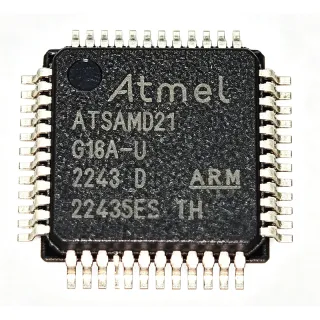
DSPIC33FJ64MC710T-I/PT - 16-bit 40 MIPS DSC, 64KB Flash | Microchip
MPN: DSPIC33FJ64MC710T-I/PT ✓ Active| Qty | Unit Price | Extended |
|---|---|---|
| 1 | $7.12 | $7.12 |
| 10 | $6.55 | $65.50 |
| 100 | $5.85 | $585.00 |
| 500 | $5.42 | $2,710.00 |
| 1,000 | $4.98 | $4,980.00 |
DSPIC33FJ64MC710T-I/PT Overview
A digital signal controller combines the control peripherals of a microcontroller with the multiply-accumulate (MAC) DSP engine of a digital signal processor. In the power-management hierarchy, a DSC sits between a general-purpose MCU and a dedicated DSP: it runs deterministic control loops for power conversion while retaining flexible I/O, timers, and communication peripherals. The dsPIC33F family belongs to Microchip's 16-bit architecture portfolio and offers seamless migration options to PIC24F, PIC24H MCUs, and dsPIC30F DSCs in similar packages.
Key features of this part include the 40 MIPS dsPIC33F core at 3.3V, 69 I/O ports for high pin-count boards, an integrated DSP engine for fast FIR filtering and PID control, and industrial temperature qualification (-40C to +85C). The motor-control subclass (MC) integrates dedicated PWM peripherals designed for inverter and motor-drive applications.
Architecturally, the dsPIC33F core uses a modified Harvard 16-bit pipeline that executes most instructions in a single cycle, with two 40-bit accumulators and a 17-bit x 17-bit single-cycle MAC for DSP math. FLASH program memory allows field reprogramming, and the 3V to 3.6V supply range supports standard 3.3V rails.
Typical applications include sensorless BLDC and PMSM motor drives, digital power supplies (PFC, LLC), industrial automation, and embedded control systems requiring DSP-grade math with MCU-style peripherals.
Design consideration: the 100-TQFP 12 x 12 mm package requires careful decoupling of all VDD/VSS pairs and a solid ground plane to maintain signal integrity at 40 MIPS clock rates.
This page synthesizes distributor pricing, drop-in same-family alternatives, and practical design notes not found in the manufacturer datasheet.
Drop-in alternatives for DSPIC33FJ64MC710T-I/PT — same package, pin-to-pin compatible. Different-package parts requiring PCB rework are excluded.
Variants in this series
Same-series models that are drop-in compatible with DSPIC33FJ64MC710T-I/PT (same form factor and footprint) — differing in Operating Temperature, Package, Supply Voltage, Core, Packaging.
Quick Comparison Tool — Select alternative parts for side-by-side comparison:
DSPIC33FJ128MC710T-I/PT
✅ Drop-In ⚠️ Specs Unverified📋 Reference alternative (not in catalog)
DSPIC33FJ256MC710T-I/PT
✅ Drop-In ⚠️ Specs Unverified📋 Reference alternative (not in catalog)
DSPIC33FJ64GP710T-I/PT
✅ Drop-In ⚠️ Specs Unverified📋 Reference alternative (not in catalog)
DSPIC33FJ128GP710T-I/PT
✅ Drop-In ⚠️ Specs Unverified✓ In Stock
$4.9 / Unit
View Datasheet →DSPIC33FJ64GS610T-I/PT
✅ Drop-In✓ In Stock
$5.5 / Unit
View Datasheet →DSPIC33FJ64MC710T-I/PT Maximum Ratings & Electrical Characteristics
| Core | dsPIC33F 16-bit DSC |
| Performance | 40 MIPS |
| Program Memory | 64KB (64K x 8) FLASH |
| RAM | 16KB |
| Supply Voltage | 3 V to 3.6 V |
| Clock Speed | 40 MHz |
| I/O Ports | 69 |
| Package | 100-TQFP (12 x 12 mm) |
| Package Height | 1 mm |
| Mounting Type | Surface Mount |
| Operating Temperature | -40C to +85C |
| Series | dsPIC 33F (MC motor-control class) |
| Program Memory Type | Flash |
| Life Cycle Stage | ACTIVE |
| Pin Count | 100 |
| Lead Finish | Lead free |
DSPIC33FJ64MC710T-I/PT 1 mm Pin Configuration Guide
Pin configuration for DSPIC33FJ64MC710T-I/PT (1 mm package). This digital IC includes GPIO, communication interfaces (UART, SPI, I2C), and power pins. Refer to the manufacturer datasheet for alternate pin functions and configuration options. Essential for embedded system design and PCB layout.

No detailed pinout data available for DSPIC33FJ64MC710T-I/PT.
Refer to the datasheet for full pin configuration.
Typical Applications
DSPIC33FJ64MC710T-I/PT is suitable for 6 applications: Sensorless BLDC/PMSM Motor Drives, Digital Power Supplies (PFC, LLC), Industrial Automation and PLC I/O, Embedded Audio and Signal Processing, Robotics and Servo Control, Battery-Powered Portable Instruments.
Sensorless BLDC/PMSM Motor Drives
The DSPIC33FJ64MC710T-I/PT fits motor-control designs because its 40 MIPS dsPIC33F core executes field-oriented control (FOC) loops fast enough for high-speed PMSM and sensorless BLDC drives, while the MC subclass integrates dedicated motor-control PWM peripherals. In a typical topology, the DSC reads phase currents through its ADC, runs Clarke/Park transforms and a PI current loop in DSP math, and drives a three-phase inverter bridge with complementary PWM outputs. The 69 I/O lines support gate-enable, fault, and encoder/observer interfaces on one 100-pin TQFP. Performance consideration: at 40 MIPS the device closes current loops in tens of microseconds, but firmware must manage ADC-synchronized PWM triggers to minimize torque ripple and avoid jitter in the inverter switching instants.
Recommended
Digital Power Supplies (PFC, LLC)
The DSPIC33FJ64MC710T-I/PT suits digital power conversion because its high-resolution PWM peripherals and 40 MIPS DSP engine close voltage- and current-mode loops for PFC and LLC stages that discrete analog controllers handle with less flexibility. The part samples input/output voltages and inductor currents with its on-chip ADC, computes compensation in fixed-point math, and adjusts PWM duty per switching cycle. Using the MC710 in a 3.3V domain simplifies interfacing with supervisory logic, and the 64KB FLASH holds full control firmware plus housekeeping. Trade-off: a software-controlled converter demands careful firmware validation and protection-state design (overcurrent, burst mode) that hard-wired controllers provide in silicon, so budget development time for fault-path testing and code safety certification where required.
Recommended
Industrial Automation and PLC I/O
The DSPIC33FJ64MC710T-I/PT is a strong fit for industrial control nodes because the 100-pin TQFP exposes 69 I/O lines for digital inputs, relay drivers, and communications, while the -40C to +85C industrial rating covers cabinet environments. The 40 MIPS core runs PID and sequence logic with headroom for communications protocol stacks, and 64KB FLASH supports field firmware updates. In a distributed I/O module, the DSC processes sensor signals, executes local control, and reports over UART/SPI/I2C to a supervisory PLC. Performance consideration: the DSP MAC engine accelerates digital filtering of noisy industrial sensor inputs (e.g., FIR/IIR on ADC streams), giving cleaner readings than MCU-only solutions without an external filter chip, reducing BOM cost in high-channel-count designs.
Recommended
Embedded Audio and Signal Processing
The DSPIC33FJ64MC710T-I/PT handles demanding embedded DSP tasks such as audio effects, active noise control, and sensor signal conditioning, because the 17-bit x 17-bit single-cycle MAC and two 40-bit accumulators execute FIR/IIR filtering efficiently at 40 MIPS. The 64KB FLASH holds algorithm code and coefficient tables, while the ADC/DAC interfacing runs over codec-supported serial ports. In an effects or measurement unit, incoming audio is sampled, filtered or transformed in the DSP engine, and output through the serial audio interface, all within one 3.3V 100-TQFP device. Consideration: the GP710 variants with the general-purpose peripheral set may suit audio better than the MC motor-control PWM mapping, so evaluate the same-footprint DSPIC33FJ64GP710T-I/PT when PWM-heavy peripherals are unnecessary and codec interfaces take priority.
Recommended
Robotics and Servo Control
The DSPIC33FJ64MC710T-I/PT fits multi-axis servo control because the 40 MIPS core runs concurrent position, velocity, and current loops while the MC-class PWM peripherals drive H-bridges with dead-time control. Its 69 I/O lines read quadrature encoders, limit switches, and communication commands in a single 100-TQFP device, and the -40C to +85C rating covers factory-floor and mobile robot environments. In a joint controller, the DSC receives motion set-points over a serial bus, computes trajectory-following PID corrections in DSP math, and modulates motor voltage with synchronized ADC current feedback. Design consideration: with three or more axes on one device, loop-rate budgeting matters - the 40 MIPS execution ceiling dictates achievable bandwidth, so profile the interrupt nest or partition axes across multiple DSCs for high-dynamics applications.
Recommended
Battery-Powered Portable Instruments
The DSPIC33FJ64MC710T-I/PT serves portable measurement and instrumentation products that need DSP-grade math under battery power. Operating from a 3V to 3.6V 3.3V-class rail, the DSC integrates everything on one die - core, FLASH, RAM, ADC, and peripherals - reducing component count in a 12 x 12 mm 100-TQFP footprint suited to compact handheld PCBs. Typical use: a portable vibration or power-quality analyzer that samples sensor channels, computes FFT and RMS statistics in the DSP engine, and logs results, with the 40 MIPS throughput enabling real-time analysis at meaningful sampling rates. Trade-off: the dsPIC33F family is performance-oriented rather than ultra-low-power, so battery-constrained designs should use the device's low-power management modes aggressively and verify average current in-system rather than relying on active-mode figures alone.
Recommended
Recommended Products Summary
Engineering reference data for DSPIC33FJ64MC710T-I/PT — comparison, design guidance, and compliance information.
Selection Guide
Comparison with Alternatives
| Parameter | This Product | DSPIC33FJ128MC710T-I/PT | DSPIC33FJ256MC710T-I/PT | DSPIC33FJ64GP710T-I/PT | DSPIC33FJ64GS610T-I/PT |
|---|---|---|---|---|---|
| Package | 100-TQFP (12 x 12 mm) | 100-TQFP (12 x 12 mm) - same | 100-TQFP (12 x 12 mm) - same | 100-TQFP (12 x 12 mm) - same | 100-TQFP (12 x 12 mm) - same |
| Brand | Microchip Technology | Microchip Technology | Microchip Technology | Microchip Technology | Microchip Technology |
| Core Performance | 40 MIPS | 40 MIPS | 40 MIPS | 40 MIPS | 40 MIPS class |
| Program Memory | 64KB FLASH | 128KB FLASH | 256KB FLASH | 64KB FLASH | 64KB FLASH |
| Supply Voltage | 3 V to 3.6 V | 3 V to 3.6 V | 3 V to 3.6 V | 3 V to 3.6 V | 3 V to 3.6 V |
| Peripheral Subclass | MC (motor control) | MC (motor control) | MC (motor control) | GP (general purpose) | GS (digital power) |
| Operating Temperature | -40C to +85C | -40C to +85C | -40C to +85C | -40C to +85C | -40C to +85C |
| Best For | Cost-balanced motor control, 64KB firmware | MCU firmware headroom, same drive features | Large protocol stacks + motor control | General-purpose DSP, codec interfaces | Dedicated digital power conversion |
Key Differentiators
- Dedicated MC motor-control peripheral set at cost parity (vs DSPIC33FJ64GP710T-I/PT)
- Pin-compatible FLASH upgrade path on the same PCB (vs DSPIC33FJ256MC710T-I/PT)
- Lower price point than larger-memory siblings (vs DSPIC33FJ128MC710T-I/PT)
Design Notes
The 100-TQFP 12 x 12 mm package places multiple VDD/VSS pairs around the die ring; decouple every VDD pin pair with 100 nF ceramic capacitors placed within 2 mm of the pins, plus bulk 4.7 uF to 10 uF near the corner supplies. Use a solid, unbroken ground plane on layer 2 and connect all VSS pins directly to it via thermal-padded vias. Follow the Microchip dsPIC33F family datasheet layout recommendations for oscillator routing: keep the crystal/ceramic resonator loop short and guard it with ground to minimize jitter at 40 MIPS operation.
The device specifies a 3V to 3.6V supply; design the 3.3V rail with load-dump tolerance in mind, since FLASH write operations raise core supply current transients. In motor-drive boards, separate the DSC 3.3V rail from gate-driver and inverter supplies with an LC filter or dedicated LDO to prevent PWM switching noise from corrupting the ADC reference. Estimated: at 40 MIPS with all peripherals active, core current is on the order of tens of mA (consult the datasheet current tables for your configuration); size the regulator accordingly with margin for I/O sourcing on the 69 I/O lines.
Verify the exact order code suffix when ordering: the /PT suffix is the 100-pin TQFP tape-and-reel variant; the /PF variant is a different package (TQFP thin profile) with a different footprint and is NOT drop-in compatible. Also confirm the temperature suffix -I (-40C to +85C) versus extended grades. When migrating firmware from dsPIC30F devices, note that peripheral register maps differ; Microchip provides migration documentation from dsPIC30F to dsPIC33F. Reserve the ICSP programming pins (PGD/PGC) with connector access for in-circuit debugging with Microchip tools.
Compliance Information
Distributor data describes the TQFP package as lead-free plastic; Microchip standard production is RoHS compliant. REACH/halogen/conflict-minerals status not stated in provided data.