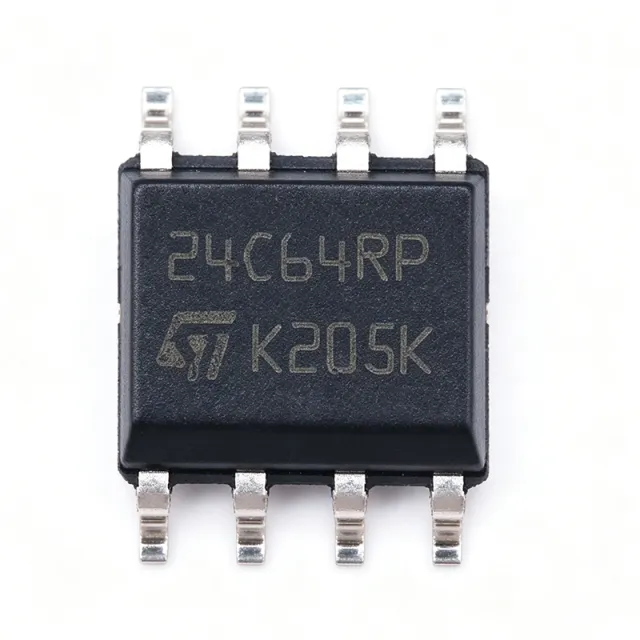
M24C64-RMN6TP - 64Kbit I2C EEPROM | STMicroelectronics
MPN: M24C64-RMN6TP ✓ Active| Qty | Unit Price | Extended |
|---|---|---|
| 1 | $0.22 | $0.22 |
| 10 | $0.152 | $1.52 |
| 100 | $0.093 | $9.30 |
| 500 | $0.086 | $43.00 |
| 1,000 | $0.079 | $79.00 |
| 2,500 | $0.075 | $187.50 |
M24C64-RMN6TP Overview
An EEPROM (Electrically Erasable Programmable Read-Only Memory) is a non-volatile memory that can be electrically erased and reprogrammed. It is a type of memory IC that retains data when power is removed, making it essential for storing configuration parameters, calibration data, and small amounts of firmware in embedded systems. EEPROMs sit within the memory hierarchy as a non-volatile storage layer, distinct from volatile RAM and higher-capacity flash memory, and are commonly used for byte-level read/write operations in applications requiring frequent updates.
Key features include a wide operating voltage range (1.8V to 5.5V), I2C interface with 7-bit device addressing, and a write protect pin for hardware data protection. The device supports sequential read and write operations, and includes a self-timed programming cycle with an internal write cycle time of 5 ms. The SO-8 package is industry-standard, enabling drop-in compatibility with many other 64-Kbit I2C EEPROMs.
The M24C64-RMN6TP uses a floating-gate transistor architecture for non-volatile storage, with a charge pump for internal programming voltage generation. The I2C interface supports standard (100 kHz), fast (400 kHz), and fast-plus (1 MHz) modes, allowing flexible integration with microcontrollers. The device includes a write cycle time of 5 ms, which is typical for EEPROMs, and supports a write protect feature to prevent accidental writes.
Typical applications include parameter storage in industrial sensors, calibration data in medical devices, configuration storage in networking equipment, and firmware updates in consumer electronics. The wide voltage range and low power consumption make it suitable for battery-powered IoT devices, while the high endurance (1 million cycles) supports frequent data logging.
When designing with this device, ensure the I2C bus pull-up resistors are properly sized for the clock frequency and bus capacitance. The write protect pin should be tied to ground if not used, and the device address pins (A0, A1, A2) must be set to avoid conflicts with other I2C devices on the bus.
This page synthesizes distributor pricing, drop-in alternatives, and practical design notes not found in the STMicroelectronics datasheet, providing a comprehensive resource for engineers selecting a 64-Kbit I2C EEPROM.
Drop-in alternatives for M24C64-RMN6TP — same package, pin-to-pin compatible. Different-package parts requiring PCB rework are excluded.
Quick Comparison Tool — Select alternative parts for side-by-side comparison:
AT24C64C-SSHM-B
📋 Reference alternative (not in catalog)
CAT24C64WI-GT3
📋 Reference alternative (not in catalog)
24LC64-I/SN
📋 Reference alternative (not in catalog)
M24C64-RMN6TP Specifications
| Memory Size | 64 Kbit (8K x 8) |
| Interface Type | I2C |
| Supply Voltage - Min | 1.8 V |
| Supply Voltage - Max | 5.5 V |
| Maximum Clock Frequency | 1 MHz (VCC >= 4.5V), 400 kHz (VCC >= 2.5V) |
| Write Cycle Time | 5 ms |
| Endurance | 1,000,000 write cycles |
| Data Retention | 40 years |
| Operating Temperature Range | -40C to +85C |
| Package | SO-8 (N) |
| Mounting Style | SMD/SMT |
| Write Protection | Yes (WC pin) |
| Number of Address Pins | 3 (A0, A1, A2) |
| RoHS | Compliant |
| REACH | Compliant |
M24C64-RMN6TP Pin Configuration
| Pin 1 | A0 — Address input 0 |
| Pin 2 | A1 — Address input 1 |
| Pin 3 | A2 — Address input 2 |
| Pin 4 | VSS — Ground |
| Pin 5 | SDA — Serial data input/output |
| Pin 6 | SCL — Serial clock input |
| Pin 7 | WC — Write control (active high) |
| Pin 8 | VCC — Power supply |
Typical Applications
M24C64-RMN6TP is suitable for 6 applications: Industrial Sensor Calibration, Medical Device Parameter Storage, Networking Equipment Configuration, Consumer Electronics Firmware Storage, IoT Device Data Logging, Automotive Aftermarket Accessories.
Industrial Sensor Calibration
The M24C64-RMN6TP is ideal for storing calibration coefficients and configuration parameters in industrial sensors. Its 64-Kbit capacity provides ample space for calibration tables, and the I2C interface allows easy read/write access from a microcontroller. The wide operating voltage range (1.8V to 5.5V) ensures compatibility with both 3.3V and 5V sensor systems. The high endurance (1 million write cycles) supports frequent recalibration in the field, while the 40-year data retention ensures calibration data remains stable over the sensor's lifetime. In a typical industrial sensor, the EEPROM is connected to the microcontroller's I2C bus, with pull-up resistors on SDA and SCL. The write protect pin can be tied high after calibration to prevent accidental overwrites, enhancing data integrity. Compared to flash memory, EEPROM offers byte-level write granularity, which is essential for updating individual calibration parameters without rewriting entire blocks.
Recommended
Medical Device Parameter Storage
In medical devices, the M24C64-RMN6TP stores device settings, patient data, and calibration parameters. Its low power consumption and wide voltage range make it suitable for battery-powered portable devices. The 64-Kbit capacity is sufficient for storing device configuration and event logs. The I2C interface simplifies integration with medical-grade microcontrollers, and the write protect feature prevents accidental data corruption. The device's 40-year data retention ensures long-term reliability, which is critical for medical applications. In a typical medical device, the EEPROM is used to store calibration data for sensors, device serial numbers, and user preferences. The high endurance allows frequent updates of patient data logs. The SO-8 package is compact and suitable for space-constrained designs. Compared to other memory types, EEPROM provides the non-volatility and byte-level write capability required for medical data integrity.
Recommended
Networking Equipment Configuration
The M24C64-RMN6TP is used in networking equipment such as routers and switches to store MAC addresses, device configuration, and firmware version information. Its 64-Kbit capacity is ideal for storing small configuration files, and the I2C interface allows quick access during boot. The wide voltage range (1.8V to 5.5V) supports various logic levels in networking hardware. The high endurance (1 million cycles) is beneficial for frequent configuration updates. In a typical networking device, the EEPROM is connected to the main processor's I2C bus, and the write protect pin is used to prevent unauthorized writes. The device's 40-year data retention ensures configuration data persists across power cycles. Compared to flash memory, EEPROM offers faster byte-level writes, which is useful for updating individual configuration parameters without wear-leveling concerns.
Recommended
Consumer Electronics Firmware Storage
In consumer electronics, the M24C64-RMN6TP stores firmware update information, user settings, and device serial numbers. Its small footprint and low cost make it ideal for high-volume production. The I2C interface is universally supported by consumer microcontrollers, and the wide voltage range allows use in both 3.3V and 5V systems. The device's 1 million write cycle endurance supports frequent firmware updates, and the 40-year data retention ensures settings are preserved. In a typical consumer device, the EEPROM is used to store user preferences such as volume levels, display settings, and device identifiers. The write protect pin can be used to lock critical data during operation. Compared to other non-volatile memories, EEPROM provides the flexibility of byte-level writes, which is essential for updating individual settings without erasing the entire memory.
Recommended
IoT Device Data Logging
The M24C64-RMN6TP is suitable for IoT devices that require non-volatile data logging, such as environmental sensors and smart home devices. Its low power consumption is critical for battery-powered IoT nodes, and the wide voltage range (1.8V to 5.5V) allows operation from a variety of power sources. The 64-Kbit capacity can store thousands of data points, and the high endurance (1 million cycles) supports frequent logging. The I2C interface is simple and requires only two wires, minimizing pin usage on the microcontroller. In a typical IoT device, the EEPROM logs sensor readings at regular intervals, and the data is periodically transmitted to a gateway. The write protect pin can be used to prevent accidental writes during data transmission. Compared to flash memory, EEPROM offers lower power consumption for small writes, making it ideal for energy-constrained IoT applications.
Recommended
Automotive Aftermarket Accessories
The M24C64-RMN6TP is used in automotive aftermarket accessories such as dashcams, GPS trackers, and infotainment systems to store configuration data and user preferences. While not AEC-Q100 qualified, it can be used in non-safety-critical applications where the operating temperature range (-40C to +85C) is sufficient. The wide voltage range (1.8V to 5.5V) accommodates automotive power rails that may vary during cranking. The 64-Kbit capacity is adequate for storing device settings and calibration data. The I2C interface is widely supported by automotive microcontrollers. In a typical aftermarket device, the EEPROM stores user settings such as language, units, and display preferences. The high endurance supports frequent updates, and the 40-year data retention ensures settings persist. For safety-critical applications, an AEC-Q100 qualified variant should be used.
Recommended
Recommended Products Summary
Engineering reference data for M24C64-RMN6TP — comparison, design guidance, and compliance information.
Selection Guide
Comparison with Alternatives
| Parameter | This Product | AT24C64C-SSHM-B | CAT24C64WI-GT3 | 24LC64-I/SN |
|---|---|---|---|---|
| Package | SO-8 | SO-8 | SO-8 | SO-8 |
| Memory Size | 64 Kbit | 64 Kbit | 64 Kbit | 64 Kbit |
| Interface | I2C | I2C | I2C | I2C |
| Supply Voltage Range | 1.8V to 5.5V | 1.7V to 5.5V | 1.8V to 5.5V | 2.5V to 5.5V |
| Max Clock Frequency | 1 MHz (at 4.5V) | 1 MHz (at 4.5V) | 1 MHz (at 4.5V) | 400 kHz (at 2.5V) |
| Write Cycle Time | 5 ms | 5 ms | 5 ms | 5 ms |
| Endurance | 1,000,000 cycles | 1,000,000 cycles | 1,000,000 cycles | 1,000,000 cycles |
| Data Retention | 40 years | 100 years | 100 years | 200 years |
| Operating Temperature Range | -40C to +85C | -40C to +85C | -40C to +85C | -40C to +85C |
Key Differentiators
- Wider operating voltage range (1.8V to 5.5V) compared to 24LC64-I/SN (2.5V to 5.5V) (vs 24LC64-I/SN)
- Higher maximum clock frequency (1 MHz) compared to 24LC64-I/SN (400 kHz) (vs 24LC64-I/SN)
- Lower cost compared to AT24C64C-SSHM-B (vs AT24C64C-SSHM-B)
Design Notes
Place 0.1uF decoupling capacitor close to VCC pin (pin 8) and ground. For I2C bus, use pull-up resistors (typically 4.7k ohm for 100 kHz, 2.2k ohm for 400 kHz, 1k ohm for 1 MHz) on SDA and SCL lines. Keep traces short to minimize bus capacitance.
Ensure the write protect (WC) pin is tied to ground if write protection is not needed. If left floating, it may cause unpredictable write protection. Also, verify that the device address pins (A0, A1, A2) are set correctly to avoid I2C address conflicts with other devices on the bus.
The M24C64-RMN6TP operates from 1.8V to 5.5V. Ensure the supply voltage is stable and within this range during write operations. A sudden voltage drop below 1.8V during a write cycle can cause data corruption. Use a low-dropout regulator if the supply is noisy.
Compliance Information
RoHS and REACH compliant per STMicroelectronics product page. Not AEC-Q100 qualified.