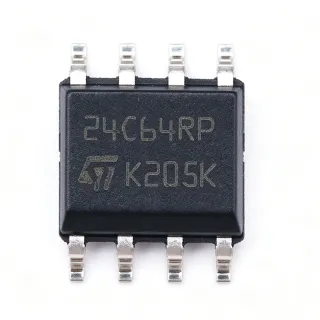
M24C128-RMN6TP - 128Kbit I2C EEPROM, SO-8 | STMicroelectronics
MPN: M24C128-RMN6TP ✓ Active| Qty | Unit Price | Extended |
|---|---|---|
| 1 | $0.45 | $0.45 |
| 10 | $0.4 | $4.00 |
| 100 | $0.35 | $35.00 |
| 500 | $0.3 | $150.00 |
| 1,000 | $0.25 | $250.00 |
M24C128-RMN6TP Overview
An EEPROM (Electrically Erasable Programmable Read-Only Memory) is a non-volatile memory that retains data when power is removed, and can be electrically erased and reprogrammed. It is a type of non-volatile memory (NVM) that sits within the broader memory hierarchy, often used for storing configuration parameters, calibration data, device settings, and small amounts of firmware. EEPROMs are distinct from flash memory in that they allow byte-level erasure and programming, whereas flash typically operates on larger blocks. In a system, EEPROMs serve as a bridge between volatile RAM and permanent storage, providing a flexible and durable solution for data that must survive power cycles.
Key features of the M24C128-RMN6TP include a wide operating voltage range (1.8V to 5.5V), low power consumption (standby current of 1 uA typical), and high reliability with 1 million write/erase cycles and 40-year data retention. The device also includes a write protect (WC) pin to prevent accidental writes, and supports both byte and page write operations. The I2C interface allows for easy integration with microcontrollers and other digital systems, with device addressing via three hardware pins (E0, E1, E2) to support up to 8 devices on the same bus.
Technically, the M24C128-RMN6TP uses a floating-gate transistor technology for non-volatile storage, with an internal charge pump for programming. The I2C interface is compliant with the I2C bus specification, supporting standard (100 kHz), fast (400 kHz), and fast-mode plus (1 MHz) data rates. The device includes a self-timed write cycle with an internal timer, and an acknowledge polling feature to detect the completion of a write operation. The SO-8 package is a widely used surface-mount package, offering a compact footprint for space-constrained designs.
Typical applications include parameter storage in industrial control systems, calibration data in medical devices, configuration settings in consumer electronics, and identification data in smart meters. The wide voltage range and low power consumption make it ideal for battery-powered IoT devices, where it can store sensor calibration and network credentials. In automotive applications, the AEC-Q100 qualified versions (M24C128-RMN6TP is not AEC-Q100 qualified, but the M24C128-RMN6TP-Q1 variant is) are used for odometer and configuration data.
When designing with this device, ensure proper decoupling on the VCC pin with a 0.1 uF ceramic capacitor placed close to the device. The SDA and SCL lines should have pull-up resistors (typically 4.7 kOhm for standard mode, 2.2 kOhm for fast mode) to VCC. The write protect pin (WC) should be tied to ground for normal operation, or to VCC to protect the memory from accidental writes. For reliable operation, avoid exceeding the absolute maximum ratings, and consider the write cycle time when planning system operations.
Drop-in alternatives for M24C128-RMN6TP — same package, pin-to-pin compatible. Different-package parts requiring PCB rework are excluded.
Quick Comparison Tool — Select alternative parts for side-by-side comparison:
M24C128-RMN6TP-Q1
✅ Drop-In ⚠️ Specs Unverified📋 Reference alternative (not in catalog)
M24C128-WMN6TP
✅ Drop-In ⚠️ Specs Unverified📋 Reference alternative (not in catalog)
M24C128-FMN6TP
✅ Drop-In ⚠️ Specs Unverified📋 Reference alternative (not in catalog)
AT24C128C-SSHM-B
✅ Drop-In ⚠️ Specs Unverified📋 Reference alternative (not in catalog)
CAT24C128LI-G
✅ Drop-In ⚠️ Specs Unverified📋 Reference alternative (not in catalog)
M24C128-RMN6TP Specifications
| Memory Size | 128 Kbit (16K x 8) |
| Interface Type | I2C |
| Supply Voltage - Min | 1.8 V |
| Supply Voltage - Max | 5.5 V |
| Maximum Clock Frequency | 1 MHz |
| Write Cycle Time | 5 ms |
| Page Size | 64 bytes |
| Standby Current | 1 uA (typical) |
| Operating Temperature Range | -40C to +85C |
| Package | SO-8 (N) |
| Mounting Type | Surface Mount |
| Write/Erase Cycles | 1,000,000 |
| Data Retention | 40 years |
| RoHS Status | Compliant |
| Number of Devices on Bus | Up to 8 (via E0, E1, E2) |
M24C128-RMN6TP Pin Configuration
| Pin 1 | A0 — Address input 0 |
| Pin 2 | A1 — Address input 1 |
| Pin 3 | A2 — Address input 2 |
| Pin 4 | GND — Ground |
| Pin 5 | SDA — Serial data input/output |
| Pin 6 | SCL — Serial clock input |
| Pin 7 | WC — Write protect |
| Pin 8 | VCC — Power supply |
Typical Applications
M24C128-RMN6TP is suitable for 6 applications: Industrial Control Systems, Medical Devices, Consumer Electronics, IoT Devices, Automotive Electronics, Smart Meters.
Industrial Control Systems
The M24C128-RMN6TP is used to store configuration parameters, calibration data, and device settings in industrial controllers and PLCs. Its wide operating voltage range (1.8V to 5.5V) and industrial temperature range (-40C to +85C) ensure reliable operation in harsh factory environments. The I2C interface allows easy integration with microcontrollers, and the 128 Kbit capacity provides ample storage for parameter tables. The low standby current (1 uA) is beneficial for energy-efficient designs. In a typical industrial controller, the EEPROM is connected to the MCU via I2C, with pull-up resistors on SDA and SCL. The write protect pin can be used to prevent accidental writes during firmware updates. The 1 million write/erase cycles ensure long-term durability for frequent parameter updates.
Recommended
Medical Devices
In medical devices such as patient monitors and diagnostic equipment, the M24C128-RMN6TP stores calibration data, device settings, and patient records. Its high reliability (1 million write/erase cycles, 40-year data retention) ensures data integrity over the device's lifetime. The wide voltage range allows operation from 3.3V or 5V supplies commonly used in medical electronics. The small SO-8 package fits compact PCB designs. In a patient monitor, the EEPROM can store alarm thresholds and calibration coefficients for sensors. The I2C interface simplifies connection to the main processor. The low power consumption is critical for battery-operated portable devices. The write protect pin can be used to lock critical data during operation.
Recommended
Consumer Electronics
The M24C128-RMN6TP is used in consumer electronics like smart TVs, set-top boxes, and gaming consoles to store user preferences, channel lists, and device configuration. Its 128 Kbit capacity is sufficient for these data, and the I2C interface is universally supported. The wide voltage range (1.8V to 5.5V) makes it compatible with various logic levels. The low standby current helps meet energy efficiency standards. In a smart TV, the EEPROM stores user settings such as picture mode and network credentials. The page write feature (64 bytes) allows fast updates of large data blocks. The device's high endurance ensures reliable operation over years of use. The SO-8 package is easy to assemble in high-volume manufacturing.
Recommended
IoT Devices
In IoT devices such as smart sensors and wearables, the M24C128-RMN6TP stores device credentials, sensor calibration data, and network configuration. Its low power consumption (1 uA standby) is essential for battery-powered devices. The wide voltage range (1.8V to 5.5V) allows operation from a variety of battery chemistries. The I2C interface is simple and requires minimal GPIO pins. In a smart sensor, the EEPROM can store the device's unique ID and calibration coefficients. The write protect pin can be used to prevent unauthorized modification of critical data. The 128 Kbit capacity is sufficient for storing multiple configuration profiles. The small SO-8 package is ideal for space-constrained IoT modules.
Recommended
Automotive Electronics
The M24C128-RMN6TP is used in automotive electronics for storing odometer data, configuration settings, and diagnostic information. While the standard version is not AEC-Q100 qualified, the M24C128-RMN6TP-Q1 variant is available for automotive applications. The wide temperature range (-40C to +85C) and high reliability make it suitable for under-hood environments. The I2C interface is widely used in automotive ECUs. In a car's infotainment system, the EEPROM stores user preferences and radio presets. The write protect pin can be used to prevent tampering with critical data. The 1 million write/erase cycles ensure durability for frequent updates. The SO-8 package is robust and reliable in automotive conditions.
Recommended
Smart Meters
The M24C128-RMN6TP is used in smart meters to store metering data, calibration constants, and tamper detection logs. Its high endurance (1 million write/erase cycles) is essential for frequent data logging. The wide voltage range (1.8V to 5.5V) accommodates various power supply designs. The low standby current helps meet energy consumption regulations. In a smart electricity meter, the EEPROM stores cumulative energy consumption and calibration factors. The I2C interface allows easy connection to the metering IC. The write protect pin can be used to prevent unauthorized changes to calibration data. The 40-year data retention ensures long-term data integrity. The SO-8 package is suitable for compact meter designs.
Recommended
Recommended Products Summary
Engineering reference data for M24C128-RMN6TP — comparison, design guidance, and compliance information.
Selection Guide
Comparison with Alternatives
| Parameter | This Product | M24C128-RMN6TP-Q1 | M24C128-WMN6TP | AT24C128C-SSHM-B | CAT24C128LI-G |
|---|---|---|---|---|---|
| Package | SO-8 (N) | SO-8 (N) - same | SO-8 (N) - same | SO-8 (N) - same | SO-8 (N) - same |
| Brand | STMicroelectronics | STMicroelectronics | STMicroelectronics | Microchip Technology | onsemi |
| Memory Size | 128 Kbit | 128 Kbit | 128 Kbit | 128 Kbit | 128 Kbit |
| Supply Voltage Range | 1.8V to 5.5V | 1.8V to 5.5V | 2.5V to 5.5V | 1.7V to 5.5V | 1.8V to 5.5V |
| Max Clock Frequency | 1 MHz | 1 MHz | 1 MHz | 1 MHz | 1 MHz |
| Write Cycle Time | 5 ms | 5 ms | 5 ms | 5 ms | 5 ms |
| Page Size | 64 bytes | 64 bytes | 64 bytes | 64 bytes | 64 bytes |
| Automotive Grade | No | Yes (AEC-Q100) | No | No | No |
Key Differentiators
- Wide operating voltage range down to 1.8V (vs M24C128-WMN6TP)
- Automotive-grade variant available (vs AT24C128C-SSHM-B)
- Proven STMicroelectronics quality and reliability (vs CAT24C128LI-G)
Design Notes
Place a 0.1 uF ceramic decoupling capacitor as close as possible to the VCC pin (pin 8) and GND (pin 4). For I2C communication, connect pull-up resistors (typically 4.7 kOhm for standard mode, 2.2 kOhm for fast mode) from SDA and SCL to VCC. Ensure the pull-up resistors are sized appropriately for the bus capacitance and clock frequency to meet rise time specifications.
Do not exceed the absolute maximum ratings, especially the supply voltage (7V) and input voltages on SDA/SCL. The write protect pin (WC) must be tied to GND for normal write operations, or to VCC to protect the memory. When writing, ensure the write cycle time (5 ms) is respected; use acknowledge polling to detect completion. Avoid writing to the device during power-up or power-down to prevent data corruption.
The M24C128-RMN6TP has low power dissipation, typically less than 1 mW during operation. In most applications, no special thermal management is required. However, in high-temperature environments (up to 85C), ensure the PCB layout provides adequate heat dissipation through the copper traces and ground plane. The SO-8 package has a thermal resistance (theta_JA) of approximately 150 C/W, which is sufficient for the low power levels involved.
Compliance Information
RoHS compliant per STMicroelectronics product page. Not AEC-Q100 qualified; use M24C128-RMN6TP-Q1 for automotive.