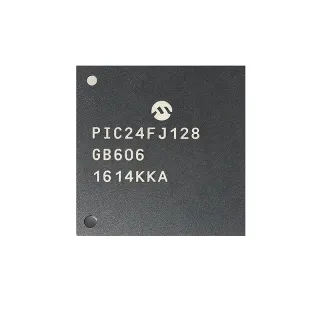
PIC32MX440F128HT-80V/MR - 80MHz 128KB Flash USB-OTG MCU | Microchip
MPN: PIC32MX440F128HT-80V/MR ✓ Active| Qty | Unit Price | Extended |
|---|---|---|
| 1 | $7.2 | $7.20 |
| 10 | $6.48 | $64.80 |
| 100 | $5.69 | $569.00 |
| 500 | $5.1 | $2,550.00 |
| 1,000 | $4.62 | $4,620.00 |
PIC32MX440F128HT-80V/MR Overview
A 32-bit microcontroller (MCU) is a microprocessor-on-a-chip that integrates a CPU core, volatile and non-volatile memory, and programmable peripherals around a single silicon die. PIC32MX devices sit in Microchip's MIPS-based portfolio above 8-bit PIC and 16-bit dsPIC families, targeting applications that need higher throughput (80 MHz core, 1.6 DMIPS/MHz) plus full-speed USB connectivity. Within that hierarchy, the MX4xx sub-family adds USB-OTG alongside standard PIC32 peripherals.
Key features include 80 MHz maximum CPU clock, 128 KB Flash program memory, 32 KB SRAM, 53 usable I/O pins, USB-OTG full-speed controller, 16-channel 10-bit ADC, up to 5 timer/counters, I2C, SPI, and UART peripherals. The 64-pin VQFN (MR) package includes an exposed thermal pad and supports industrial -40C to +105C ambient operation in the -80V speed/temperature grade.
The PIC32MX440 uses the MIPS32 M4K core with 5-stage pipeline and hardware multiply/divide. DMA channels offload data movement between peripherals and memory, freeing the CPU for application code. The USB-OTG controller supports both host and device roles, enabling embedded designs that connect to PCs, hubs, or other USB peripherals without external bridge chips.
Typical applications include USB peripherals (HID, CDC, mass storage), industrial control panels with USB diagnostic ports, medical point-of-care devices, audio interfaces with USB streaming, and consumer products requiring on-the-go connectivity to smartphones or tablets.
Design consideration: route the 9x9 mm exposed pad (EP) to a contiguous ground copper pour with at least 8 thermal vias to dissipate up to ~1 W internal power and lower junction temperature under sustained USB-OTG host traffic.
This page synthesizes distributor pricing, same-package drop-in alternatives, and application design notes not aggregated on the manufacturer datasheet, helping engineers shorten sourcing decisions for PIC32MX440 USB-OTG designs.
Drop-in alternatives for PIC32MX440F128HT-80V/MR — same package, pin-to-pin compatible. Different-package parts requiring PCB rework are excluded.
Variants in this series
Same-series models that are drop-in compatible with PIC32MX440F128HT-80V/MR (same form factor and footprint) — differing in ADC, Core Architecture, Package, Operating Temperature, DMA Channels.
Quick Comparison Tool — Select alternative parts for side-by-side comparison:
PIC32MX440F128HT-80I/MR
✅ Drop-In✓ In Stock
$4.3 / Unit
View Datasheet →PIC32MX440F128H-80V/MR
✅ Drop-In📋 Reference alternative (not in catalog)
PIC32MX340F128HT-80V/MR
✅ Drop-In✓ In Stock
$3.92 / Unit
View Datasheet →PIC32MX350F128HT-V/MR
✅ Drop-In ⚠️ Specs Unverified✓ In Stock
$3.18 / Unit
View Datasheet →PIC32MX270F512HT-V/MR
✅ Drop-In ⚠️ Specs Unverified✓ In Stock
$2.53 / Unit
View Datasheet →PIC32MX340F512HT-80V/MR
✅ Drop-In ⚠️ Specs Unverified✓ In Stock
$4.31 / Unit
View Datasheet →PIC32MX440F128HT-80V/MR Maximum Ratings & Electrical Characteristics
| Core Architecture | MIPS32 M4K (32-bit) |
| Maximum CPU Clock | 80 MHz |
| Performance | 1.6 DMIPS/MHz (MIPS32 M4K) |
| Program Flash Memory | 128 KB (128K x 8) |
| SRAM | 32 KB |
| USB Controller | USB-OTG (full-speed host/device) |
| ADC | 10-bit, up to 16 channels |
| DMA Channels | Yes (channels per data sheet) |
| I/O Pins | 53 |
| Operating Voltage (VDD) | 2.3 V to 3.6 V (typical 3.3 V) |
| Speed Grade / Temperature | -80V: 80 MHz / -40C to +105C |
| Package | 64-pin VQFN (MR) 9x9 mm with exposed pad |
| Mounting Type | Surface Mount |
| RoHS Status | Compliant |
PIC32MX440F128HT-80V/MR Pin Configuration
| Pin 1 | RB0 — I/O port B bit 0 (PGED1 - programming data) |
| Pin 2 | RB1 — I/O port B bit 1 |
| Pin 3 | RB2 — I/O port B bit 2 |
| Pin 4 | RB3 — I/O port B bit 3 |
| Pin 5 | VDD — Core supply (3.3V) |
| Pin 6 | RB4 — I/O port B bit 4 |
| Pin 7 | RB5 — I/O port B bit 5 |
| Pin 8 | RB6 — I/O port B bit 6 (PGEC1 - programming clock) |
| Pin 9 | RB7 — I/O port B bit 7 |
| Pin 10 | RB8 — I/O port B bit 8 |
| Pin 11 | RB9 — I/O port B bit 9 |
| Pin 12 | RB10 — I/O port B bit 10 |
| Pin 13 | RB11 — I/O port B bit 11 |
| Pin 14 | RB12 — I/O port B bit 12 |
| Pin 15 | RB13 — I/O port B bit 13 |
| Pin 16 | RB14 — I/O port B bit 14 |
| Pin 17 | RB15 — I/O port B bit 15 |
| Pin 18 | VSS — Ground |
| Pin 19 | VDD — Core supply (3.3V) |
| Pin 20 | RC1 — I/O port C bit 1 |
| Pin 21 | RC2 — I/O port C bit 2 |
| Pin 22 | RC3 — I/O port C bit 3 |
| Pin 23 | RC4 — I/O port C bit 4 |
| Pin 24 | RC5 — I/O port C bit 5 |
| Pin 25 | RC6 — I/O port C bit 6 |
| Pin 26 | RC7 — I/O port C bit 7 |
| Pin 27 | RC8 — I/O port C bit 8 |
| Pin 28 | RC9 — I/O port C bit 9 |
| Pin 29 | VDD — Core supply (3.3V) |
| Pin 30 | VSS — Ground |
| Pin 31 | RC10 — I/O port C bit 10 |
| Pin 32 | RC11 — I/O port C bit 11 |
| Pin 33 | RC12 — I/O port C bit 12 |
| Pin 34 | RC13 — I/O port C bit 13 |
| Pin 35 | RC14 — I/O port C bit 14 |
| Pin 36 | RC15 — I/O port C bit 15 |
| Pin 37 | RD0 — I/O port D bit 0 |
| Pin 38 | RD1 — I/O port D bit 1 |
| Pin 39 | RD2 — I/O port D bit 2 |
| Pin 40 | RD3 — I/O port D bit 3 |
| Pin 41 | RD4 — I/O port D bit 4 |
| Pin 42 | RD5 — I/O port D bit 5 |
| Pin 43 | RD6 — I/O port D bit 6 |
| Pin 44 | RD7 — I/O port D bit 7 |
| Pin 45 | VSS — Ground |
| Pin 46 | VDD — Core supply (3.3V) |
| Pin 47 | RD8 — I/O port D bit 8 |
| Pin 48 | RD9 — I/O port D bit 9 |
| Pin 49 | RD10 — I/O port D bit 10 |
| Pin 50 | RD11 — I/O port D bit 11 |
| Pin 51 | RD12 — I/O port D bit 12 |
| Pin 52 | RD13 — I/O port D bit 13 |
| Pin 53 | RD14 — I/O port D bit 14 |
| Pin 54 | RD15 — I/O port D bit 15 |
| Pin 55 | RA0 — I/O port A bit 0 |
| Pin 56 | RA1 — I/O port A bit 1 |
| Pin 57 | RA2 — I/O port A bit 2 |
| Pin 58 | RA3 — I/O port A bit 3 |
| Pin 59 | RA4 — I/O port A bit 4 |
| Pin 60 | RA5 — I/O port A bit 5 |
| Pin 61 | RA6 — I/O port A bit 6 |
| Pin 62 | RA7 — I/O port A bit 7 |
| Pin 63 | RA8 — I/O port A bit 8 |
| Pin 64 | RA9 — I/O port A bit 9 |
Typical Applications
PIC32MX440F128HT-80V/MR is suitable for 6 applications: USB Human Interface Device (HID), USB-OTG Industrial Diagnostic Port, Medical Point-of-Care Connectivity, USB Audio Streaming Interface, Connected Consumer Accessories, USB Firmware Update Bootloader Host.
USB Human Interface Device (HID)
The PIC32MX440F128HT-80V/MR is well suited for USB HID peripherals such as keyboards, mice, game controllers, and custom input devices because of its integrated full-speed USB-OTG controller and Microchip's royalty-free MLA USB stack. The 80 MHz MIPS32 M4K core handles HID class parsing plus application logic with comfortable headroom. With 128 KB Flash and 32 KB SRAM it stores HID report tables, debounce logic, and LED/RGB effects firmware. The 53 available I/O pins drive matrix-scanned key grids, encoder inputs, and PWM-controlled backlights without external muxing. Designers can use the on-chip 10-bit ADC for analog triggers or battery telemetry on wireless HID designs. As a drop-in alternative across the PIC32MX340/440 family, scaling HID products from low-cost to high-feature tiers is straightforward.
Recommended
USB-OTG Industrial Diagnostic Port
The PIC32MX440F128HT-80V/MR enables on-the-go diagnostic interfaces on industrial controllers, PLCs, and machine tools because its USB-OTG controller can act as host or device. The 80 MHz M4K core processes Modbus, CAN-bridge, or proprietary protocols while enumerating USB mass-storage loggers from a host port. The 64-pin VQFN (MR) 9x9 mm footprint and exposed thermal pad dissipate continuous USB-host bus power comfortably over the -40C to +105C industrial+ range. The 16-channel 10-bit ADC reads sensor inputs (temperature, pressure, current) and logs them through USB to a service technician's tablet. With 128 KB Flash the firmware includes bootloader, USB stack, and field-update hooks. This makes the part ideal for serviceable equipment needing IP-rated enclosures with USB diagnostic covers.
Recommended
Medical Point-of-Care Connectivity
The PIC32MX440F128HT-80V/MR suits medical point-of-care devices such as handheld analyzers, glucometer docks, and patient monitors that upload readings to a clinic PC. Its integrated USB-OTG supports both device mode (to a PC) and host mode (to a printer or USB drive) on a single connector. The 80 MHz MIPS32 M4K core performs basic DSP-style filtering on ADC channels before transmitting results, while DMA offloads streaming data to USB endpoints without CPU intervention. The 10-bit ADC combined with on-chip comparators handles thermistor, photo-optic, or electrochemical sensor front-ends. The 64-pin VQFN (MR) 9x9 mm exposed-pad package helps compact handheld enclosures. Industrial+ -40C to +105C temperature grade supports field-clinic and ambulance deployment.
Recommended
USB Audio Streaming Interface
The PIC32MX440F128HT-80V/MR is a candidate for USB audio streaming interfaces such as headset adapters, USB DAC dongles, and intercom endpoints because it integrates full-speed USB and DMA-driven data paths. The 80 MHz core with hardware multiply/divide handles S/PDIF-to-USB bridging, volume control, and basic DSP without external CODECs. 128 KB Flash holds USB audio class 1.0 firmware plus firmware-upgrade bootloaders, while 32 KB SRAM buffers stereo 48 kHz audio streams under DMA. The I2S or SPI peripheral interfaces external DACs/ADCs, and PWM outputs can drive class-D amplifier stages. Compared to PIC32MX230/250 parts, the -80V/MR adds more Flash headroom for multi-channel audio products.
Recommended
Connected Consumer Accessories
The PIC32MX440F128HT-80V/MR is appropriate for connected consumer accessories - charging docks, smart-home hubs, smart-card readers - that need USB-OTG to talk to phones and tablets. The OTG role-switch enables accessories that can either accept data from a phone (device mode) or pull data from a USB stick (host mode). The 53 I/O pins and 16 ADC channels support user interfaces with buttons, RGB LEDs, capacitive sense, and battery monitoring. 128 KB Flash stores application code plus optional Wi-Fi/BLE command set libraries. The 64-pin VQFN (MR) 9x9 mm footprint fits into small enclosures, and the exposed pad routes heat through a copper pour for continuous USB-host current draw. Industrial+ -40C to +105C temperature grade suits outdoor or automotive-cabin accessory environments.
Recommended
USB Firmware Update Bootloader Host
The PIC32MX440F128HT-80V/MR acts as a USB host that loads firmware images from a USB mass-storage device to flash an attached microcontroller or field-programmable system. Its USB-OTG host role, 80 MHz M4K core, and 128 KB Flash run a FAT32 parser plus application logic to validate and stream firmware. DMA channels move USB bulk packets into SRAM with minimal CPU overhead, sustaining MS-class throughput. The 64-pin VQFN (MR) 9x9 mm package fits into compact field-update dongles. The 10-bit ADC verifies supply rails before authorizing an update, while 53 I/O pins drive status LEDs and an OLED UI. The -40C to +105C industrial+ grade supports factory-floor and outdoor service environments.
Recommended
Recommended Products Summary
Engineering reference data for PIC32MX440F128HT-80V/MR — comparison, design guidance, and compliance information.
Selection Guide
Comparison with Alternatives
| Parameter | This Product | PIC32MX440F128HT-80I/MR | PIC32MX440F128H-80V/MR | PIC32MX340F128HT-80V/MR | PIC32MX350F128HT-V/MR | PIC32MX270F512HT-V/MR |
|---|---|---|---|---|---|---|
| Package | VQFN-64 (MR) 9x9 | VQFN-64 (MR) 9x9 - same | VQFN-64 (MR) 9x9 - same | VQFN-64 (MR) 9x9 - same | VQFN-64 (MR) 9x9 - same | VQFN-64 (MR) 9x9 - same |
| Brand | Microchip Technology | Microchip Technology | Microchip Technology | Microchip Technology | Microchip Technology | Microchip Technology |
| Maximum CPU Clock | 80 MHz | 80 MHz | 80 MHz | 80 MHz | 50 MHz | 50 MHz |
| Flash Memory | 128 KB | 128 KB | 128 KB | 128 KB | 128 KB | 512 KB |
| SRAM | 32 KB | 32 KB | 32 KB | 32 KB | 32 KB | 64 KB |
| USB Controller | USB-OTG | USB-OTG | USB-OTG | USB (no OTG) | USB (no OTG) | USB (no OTG) |
| Operating Temperature | -40C to +105C | -40C to +85C | -40C to +105C | -40C to +105C | -40C to +105C | -40C to +105C |
| I/O Pins | 53 | 53 | 53 | 53 | 53 | 51 |
| Core | MIPS32 M4K | MIPS32 M4K | MIPS32 M4K | MIPS32 M4K | MIPS32 M4K | MIPS32 M4K |
Key Differentiators
- Full-speed USB-OTG controller integrated (vs PIC32MX340F128HT-80V/MR)
- Industrial+ -40C to +105C temperature grade (vs PIC32MX440F128HT-80I/MR)
- Tape-and-reel shipping media for production lines (vs PIC32MX440F128H-80V/MR)
Design Notes
The 64-pin VQFN (MR) 9x9 mm package relies on the exposed thermal pad (EP) for heat removal. Estimated: with internal core power at ~300 mA on VDD (1.0 W) and ambient at +60C inside a sealed USB dongle, junction temperature may rise 30-40C. Use a contiguous EP copper pour with at least 8 thermal vias to an internal ground plane. This reduces theta_JA and keeps Tj below the 125C absolute maximum during sustained USB-OTG host enumeration with attached bus-powered peripherals.
Place decoupling capacitors (100 nF ceramic) on every VDD/VSS pair within 2 mm of the package pin, plus one bulk 4.7 uF to 10 uF tantalum or ceramic near pin 5/19. The USB D+/D- traces should be 90 ohm differential, length-matched under 25 mm, and routed away from switching signals (PWM, oscillator). The 12 MHz primary crystal load capacitors (typically 15-22 pF) must be placed close to the OSC1/OSC2 pads to maintain USB clock accuracy at +/-0.25% for full-speed signaling.
Do not exceed 3.6 V on any VDD pin; USB-OTG VBUS sensing has its own 5 V-tolerant pin that requires an external resistor divider to the controller input. Programming pins PGEC1/PGED1 (RB6/RB0 in this package) must be accessible for in-circuit serial programming (ICSP); pulling them low at reset can confuse the bootloader. Ensure USB pull-up (D+ for device, D- for host low-speed) is only enabled after firmware initializes the OTG controller, not at reset, or enumeration will fail.
Compliance Information
RoHS and lead-free per Microchip product family declarations. AEC-Q100 not qualified - this is an industrial MCU. Use PIC32MX1xx/2xx automotive-grade variants for AEC-Q100 designs.