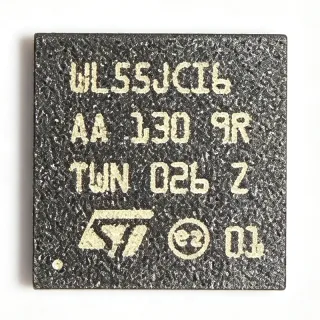
RTL8192FC - 2T2R 300Mbps WiFi USB Controller | Realtek
MPN: RTL8192FC ✓ Active| Qty | Unit Price | Extended |
|---|---|---|
| 1 | $1.08 | $1.08 |
| 10 | $1.03 | $10.30 |
| 100 | $0.97 | $97.00 |
| 500 | $0.92 | $460.00 |
| 1,000 | $0.87 | $870.00 |
RTL8192FC Overview
A WLAN controller IC is the core of any Wi-Fi radio design: it implements the PHY layer modulation (DSSS/CCK for 802.11b, OFDM for 802.11g/n), the MAC protocol engine, and the RF transceiver front end. Within the network silicon hierarchy, it sits above discrete RF front-end components and below host systems such as dongles, set-top boxes, IP cameras, and embedded boards that communicate over USB 2.0.
Key features include 2T2R MIMO for spatial-diversity gain and improved link robustness in multipath environments, 802.11n rates to 300 Mbps at 40 MHz channel width, integrated USB 2.0 host interface for drop-in connectivity to any embedded or x86 host, and single-chip integration that reduces BOM count versus discrete MAC-plus-RF two-chip solutions.
The RTL8192FC belongs to Realtek's well-supported RTL8192 family, which shares a common driver stack (Linux rtl8192cu/rtl8192fu-class drivers, Windows WHQL drivers) across PCIe and USB variants, simplifying software reuse across product lines. Integrated LDO options and a compact QFN-32 footprint allow dense module designs such as the AJMRTC FLink 6192EUC, which is built directly on this chip.
Typical applications include USB Wi-Fi dongles and adapters, smart TV and set-top-box wireless connectivity, IP cameras and NVR wireless links, IoT gateways, and embedded Linux boards requiring 2.4 GHz 2T2R connectivity over USB.
Design consideration: as a 2.4 GHz-only part, the RTL8192FC cannot serve dual-band designs; also, RF layout requires a solid ground plane and 50-ohm impedance control to the antenna match, per standard Realtek reference layouts.
This page synthesizes distributor pricing, family drop-in options, and practical design notes not found in the manufacturer datasheet alone.
Drop-in alternatives for RTL8192FC — same package, pin-to-pin compatible. Different-package parts requiring PCB rework are excluded.
Quick Comparison Tool — Select alternative parts for side-by-side comparison:
RTL8188ETV
✅ Drop-In ⚠️ Specs Unverified📋 Reference alternative (not in catalog)
RTL8188EU
✅ Drop-In ⚠️ Specs Unverified📋 Reference alternative (not in catalog)
RTL8192ES
✅ Drop-In ⚠️ Specs Unverified📋 Reference alternative (not in catalog)
RTL8192CU
✅ Drop-In ⚠️ Specs Unverified📋 Reference alternative (not in catalog)
RTL8192FC Specifications
| Product Type | Single-chip 802.11b/g/n 2T2R WLAN controller |
| Wireless Standard | IEEE 802.11b/g/n |
| Frequency Band | 2.4 GHz |
| Radio Architecture | 2T2R MIMO |
| Maximum PHY Data Rate | 300 Mbps (40 MHz bandwidth) |
| Host Interface | USB 2.0 |
| Package | QFN-32 |
| Mounting Type | Surface Mount |
| Modulation | DSSS/CCK (802.11b), OFDM (802.11g/n) |
| Channel Bandwidth | 20 MHz / 40 MHz |
| Integrated Components | MAC, baseband, RF transceiver |
| RoHS Status | Compliant (per LCSC/JLCPCB listing) |
| Driver Support | Windows, Linux (Realtek rtl8192 family drivers) |
RTL8192FC qfn-32 Pin Configuration Guide
Pin configuration for RTL8192FC (qfn-32 package). Pin numbering, functions, and connection diagrams are defined in the manufacturer datasheet. Refer to it for the exact footprint and soldering guidelines.
No detailed pinout data available for RTL8192FC.
Refer to the datasheet for full pin configuration.
Typical Applications
RTL8192FC is suitable for 6 applications: USB WiFi Adapters and Dongles, Set-Top Boxes and Smart TV Connectivity, IP Cameras and NVR Wireless Links, Embedded Linux Boards and SBCs, IoT Gateways and Smart Home Hubs, Wireless Module Manufacturing (OEM Modules).
USB WiFi Adapters and Dongles
The RTL8192FC is a natural fit for USB Wi-Fi dongles because the USB 2.0 controller is integrated on-chip, eliminating a separate bridge IC and cutting BOM cost to a single main silicon plus RF front-end passives. Its 2T2R MIMO radio delivers up to 300 Mbps PHY throughput at 40 MHz bandwidth - double the 150 Mbps of 1T1R parts like the RTL8188EU - which matters for adapter products marketed as high-speed. The small QFN-32 package fits even slim dongle form factors. Design consideration: two antennas (or a switched diversity antenna) are required to exploit the dual-stream radio; cost-optimized dongles sometimes use a single antenna, forfeiting MIMO gain but retaining fallback compatibility.
Recommended
Set-Top Boxes and Smart TV Connectivity
Smart TV and set-top-box platforms frequently expose USB 2.0 ports for wireless modules, making the RTL8192FC a direct-match solution: no PCIe slot is needed and the Realtek USB driver stack is pre-supported on common STB SoC BSPs. The 300 Mbps 2T2R link provides enough headroom for 1080p video streaming, where a 1T1R 150 Mbps link can become the bottleneck in congested 2.4 GHz environments. Integrated MAC/baseband/RF single-chip construction reduces module height and cost. Performance consideration: because the part is 2.4 GHz-only, designs requiring 5 GHz offload should pair it with a dual-band solution or accept 2.4 GHz congestion limits in dense multi-AP homes.
Recommended
IP Cameras and NVR Wireless Links
Security cameras need reliable uplink throughput for video streams, and the RTL8192FC's dual-stream MIMO improves link robustness in the multipath-rich, wall-dense environments typical of surveillance deployments. With 300 Mbps PHY rate, the effective TCP throughput comfortably carries 1080p H.264 streams with margin for retransmissions. The USB 2.0 interface suits camera SoCs that lack native SDIO/PCIe WLAN support, and the shared Realtek driver stack simplifies firmware integration on embedded Linux camera platforms. Design tip: position both antennas with orthogonal polarization and verify PER (packet error rate) at range during qualification, since 2.4 GHz congestion in residential areas directly affects camera uplink reliability.
Recommended
Embedded Linux Boards and SBCs
Single-board computers and custom embedded Linux boards commonly add Wi-Fi via a USB-connected module, and the RTL8192FC is the silicon inside modules such as the AJMRTC FLink 6192EUC (2T2R, 300 Mbps). Board designers gain from the mature rtl8192-series driver in the Linux kernel ecosystem and Realtek's maintained out-of-tree drivers. The QFN-32 package and integrated LDO options allow a compact two-layer module design placed anywhere a USB host port exists. Performance consideration: USB 2.0's 480 Mbps raw rate is adequate for the 300 Mbps PHY, but shared USB hubs reduce effective throughput - dedicate a host port on bandwidth-critical designs.
Recommended
IoT Gateways and Smart Home Hubs
IoT gateways aggregate traffic from many sensor nodes, and the RTL8192FC's 2T2R antenna diversity improves uplink reliability when the gateway is mounted near metal enclosures or in RF-shadowed corners. Its 300 Mbps capability supports simultaneous cloud uploads plus local streaming from camera nodes. The USB 2.0 interface allows retrofitting wireless capability to gateway reference designs without changing the main SoC. Consideration: the 2.4 GHz-only radio shares spectrum with Zigbee, BLE, and microwave interference sources; gateways with coexistence requirements should implement Realtek's documented coexistence mechanisms or schedule channel plans accordingly.
Recommended
Wireless Module Manufacturing (OEM Modules)
Module makers leverage the RTL8192FC's single-chip integration - MAC, baseband, and RF on one die in QFN-32 - to produce compact, cost-competitive 2T2R modules with minimal external component count (crystal, PA/LNA front-end passives, flash). The AJMRTC FLink 6192EUC demonstrates a shipping design: 2.4 GHz 802.11b/g/n, 2T2R MIMO, 300 Mbps at 40 MHz, USB interface. Family commonality with RTL8192CE/RTL8192ES lets a module vendor reuse firmware, certification test plans (RF spurious emissions, band-edge tests), and driver packages across interface variants, shortening time-to-market for derived SKUs.
Recommended
Recommended Products Summary
Engineering reference data for RTL8192FC — comparison, design guidance, and compliance information.
Selection Guide
Comparison with Alternatives
| Parameter | This Product | RTL8188ETV | RTL8188EU | RTL8192ES | RTL8192CU |
|---|---|---|---|---|---|
| Package | QFN-32 | QFN-32 | QFN-32 | QFN-32 | QFN-48 family |
| Brand | Realtek | Realtek | Realtek | Realtek | Realtek |
| Radio Configuration | 2T2R MIMO | 1T1R | 1T1R | 2T2R | 2T2R |
| Max PHY Data Rate | 300 Mbps | 150 Mbps | 150 Mbps | 300 Mbps | 300 Mbps |
| Host Interface | USB 2.0 | USB 2.0 | USB 2.0 | SDIO | USB 2.0 |
| Wireless Standard | 802.11b/g/n (2.4 GHz) | 802.11b/g/n (2.4 GHz) | 802.11b/g/n (2.4 GHz) | 802.11b/g/n (2.4 GHz) | 802.11b/g/n (2.4 GHz) |
| Antenna Count | 2 | 1 | 1 | 2 | 2 |
| Drop-in Compatibility | Reference | Footprint family match, radio derated 50% | Footprint family match, radio derated 50% | Host bus pins differ (SDIO) | Different package - layout migration required |
Key Differentiators
- Dual-stream MIMO throughput (vs RTL8188EU)
- USB integration without bridge chip (vs RTL8192CE)
- Shared family driver stack (vs RTL8192CU)
Design Notes
The RTL8192FC is a 2.4 GHz RF SoC, so layout quality directly determines radio performance. Follow the Realtek reference design: place the QFN-32 on a continuous ground plane with generous via stitching around the RF traces, keep the 50-ohm transmission lines to the antenna match short and impedance-controlled (coplanar waveguide on two-layer boards, microstrip with ground pour on four-layer), and route the 40 MHz crystal with guard ground and matched load capacitors per the reference BOM. Decouple each supply pin with 100 nF ceramics placed within 2 mm of the pin, plus bulk 10 uF at the module supply entry.
A frequent mistake is treating the RTL8192FC and RTL8192CE as interchangeable: the FC is USB, the CE is PCIe, so a design change between them alters the host bus and the driver stack. Another pitfall is designing a single-antenna layout to save cost - this silently forfeits the 2T2R MIMO gain and halves effective throughput headroom. Finally, firmware is required: the RTL8192 series loads firmware at driver init, so ensure flash firmware version matches the driver release; mismatches cause intermittent adapter enumeration failures on embedded Linux hosts.
USB 2.0 differential pairs (DP/DM) should be length-matched within 5 mil and routed away from the 2.4 GHz RF section to prevent radio desense from USB harmonic noise. Shield the 40 MHz crystal circuit, as its harmonics can land near spurious-emission limits during regulatory testing (FCC/CE). For module certification, test both antenna ports since the 2T2R radio transmits on either chain. Adding a small series ferrite on the USB VBUS line reduces conducted noise back into the host.
Compliance Information
RoHS compliance per LCSC and JLCPCB listings for RTL8192FC-CG. REACH, halogen-free, and conflict-minerals status not stated in provided data.