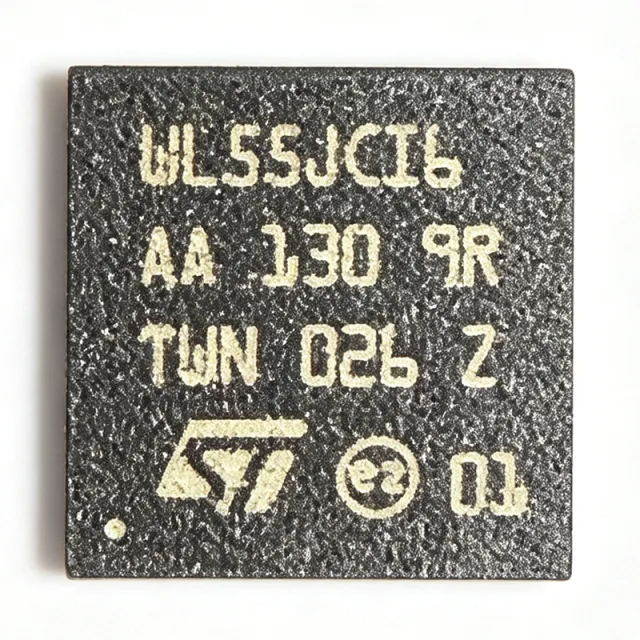
STM32WL55JCI6 - Dual-Core LoRa SoC 150-960MHz | ST
MPN: STM32WL55JCI6 ✓ Active| Qty | Unit Price | Extended |
|---|---|---|
| 1 | $10.29 | $10.29 |
| 10 | $9.45 | $94.50 |
| 100 | $8.6 | $860.00 |
| 500 | $7.9 | $3,950.00 |
| 1,000 | $7.25 | $7,250.00 |
STM32WL55JCI6 Overview
A wireless MCU (microcontroller unit) is a single-chip solution combining a processor core with a radio transceiver, sitting within the hierarchy: wireless SoC -> microcontroller (MCU) -> embedded processor -> semiconductor. The STM32WL55JCI6 belongs to the STM32WL family within the broader STM32 portfolio from STMicroelectronics, integrating the radio and application processor in one device to reduce board space, bill-of-materials cost, and design complexity compared with discrete MCU-plus-radio solutions.
Key features include a 64 MHz Cortex-M4 application core with FPU and DSP instructions, a 48 MHz Cortex-M0+ core dedicated to radio protocol management, and support for LoRa, (G)FSK, (G)MSK, and BPSK modulations with LoRaWAN 1.0, Sigfox, and 802.15.4 protocol stacks. Radio sensitivity reaches -137 dBm and output power up to +22 dBm, enabling multi-kilometer links in open field.
Technically, the device uses a low-power process with multiple power modes: Standby current is as low as 1.62 uA with RTC running, RX current is 4.82 mA, and TX current is 87 mA at +14 dBm. Peripherals include a 12-bit ADC, DAC, comparators, op-amps, multiple UART/SPI/I2C interfaces, and a true random number generator (TRNG) for security. Supply voltage spans 1.8V to 3.6V over -40C to +85C.
Typical applications are smart agriculture sensors, smart metering (gas, water, electricity), asset tracking, industrial monitoring, and smart-city LPWAN infrastructure, where long range and battery life dominate requirements.
Design tip: let the M0+ core run the radio stack while the M4 runs application code, and invest early in antenna matching and RF layout; use the STM32CubeWL package for rapid development.
This page adds value beyond the datasheet by synthesizing distributor pricing, drop-in same-package alternatives, design notes, and an AEO-optimized FAQ for AI search citation.
Drop-in alternatives for STM32WL55JCI6 — same package, pin-to-pin compatible. Different-package parts requiring PCB rework are excluded.
Variants in this series
Same-series models that are drop-in compatible with STM32WL55JCI6 (same form factor and footprint) — differing in Core, Package, Flash Memory, Operating Temperature, SRAM.
Quick Comparison Tool — Select alternative parts for side-by-side comparison:
STM32WL55JCI7
✅ Drop-In ⚠️ Specs Unverified📋 Reference alternative (not in catalog)
STM32WL54JCI6
✅ Drop-In📋 Reference alternative (not in catalog)
STM32WLE5JCI6
✅ Drop-In📋 Reference alternative (not in catalog)
STM32WLE5J8I6
✅ Drop-In✓ In Stock
$4.28 / Unit
View Datasheet →STM32WLE4JCI6
✅ Drop-In📋 Reference alternative (not in catalog)
STM32WL55JCI6 Maximum Ratings & Electrical Characteristics
| Core | Dual-core Arm Cortex-M4 (64 MHz) + Cortex-M0+ (48 MHz) |
| Flash Memory | 256 KB |
| SRAM | 64 KB |
| Radio Frequency Range | 150 MHz to 960 MHz |
| Modulation | LoRa, (G)FSK, (G)MSK, BPSK |
| Protocols | LoRaWAN 1.0, Sigfox, 802.15.4 |
| RX Sensitivity | -137 dBm |
| Max TX Output Power | +22 dBm |
| RX Current | 4.82 mA |
| TX Current | 87 mA at +14 dBm |
| Standby Current | 1.62 uA (with RTC) |
| Supply Voltage | 1.8 V to 3.6 V |
| Operating Temperature | -40C to +85C |
| Package | UFBGA-73 (7x7 mm) |
| Mounting Type | Surface Mount |
| Peripherals | 12-bit ADC, DAC, comparators, op-amps, UART/SPI/I2C, TRNG |
| RadioTXRX | TxRx + MCU |
STM32WL55JCI6 ufbga-73 (7x7 mm) Pin Configuration Guide
Pin configuration for STM32WL55JCI6 (ufbga-73 (7x7 mm) package). This digital IC includes GPIO, communication interfaces (UART, SPI, I2C), and power pins. Refer to the manufacturer datasheet for alternate pin functions and configuration options. Essential for embedded system design and PCB layout.

No detailed pinout data available for STM32WL55JCI6.
Refer to the datasheet for full pin configuration.
Typical Applications
STM32WL55JCI6 is suitable for 6 applications: Smart Metering, Smart Agriculture, Asset Tracking, Industrial Monitoring, Smart City Infrastructure, Wireless Sensor Networks / IoT End Nodes.
Smart Metering
Gas, water, and electricity meters benefit directly from the STM32WL55JCI6's LPWAN radio and ultra-low standby power. Its 1.62 uA Standby current with RTC allows a meter to sleep for most of its life, while -137 dBm LoRa sensitivity and up to +22 dBm TX power deliver multi-kilometer links from basement or pit installations without repeaters. The dual-core split - the Cortex-M0+ running the LoRaWAN stack and the Cortex-M4 handling metrology - keeps measurement timing deterministic. Powered directly from a 3V lithium cell across the 1.8V to 3.6V supply range, a typical meter achieves multi-year battery life with hourly reporting duty cycles.
Recommended
Smart Agriculture
Soil moisture probes, weather stations, and livestock trackers deployed across large fields need range and battery life more than bandwidth, matching the STM32WL55JCI6 profile exactly. LoRa modulation at -137 dBm sensitivity covers several kilometers in open terrain, and the 150-960 MHz radio tunes to regional ISM bands (EU868, US915, CN470). The 12-bit ADC digitizes analog soil or weather sensors directly, and the op-amps condition weak sensor signals without external amplification. With 4.82 mA RX and 1.62 uA Standby, a solar-charged or primary-cell node survives years in the field, and STM32CubeWL accelerates firmware bring-up.
Recommended
Asset Tracking
Long-range asset tags for logistics containers, trailers, and rental equipment use the STM32WL55JCI6 to report position and condition over LPWAN networks while drawing microamps between transmissions. The +22 dBm maximum TX output compensates for small, inefficient tag antennas, and -137 dBm receive sensitivity maintains downlink reliability at cell edge. The Cortex-M0+ core offloads the LoRaWAN MAC so the M4 can fuse data from accelerometers or GNSS modules without disturbing radio timing. The -40C to +85C operating range tolerates unconditioned cargo environments, and the 7x7 mm UFBGA-73 package fits slim tag form factors.
Recommended
Industrial Monitoring
Factory and plant-floor condition monitoring nodes use the STM32WL55JCI6 to bridge sensor clusters to LPWAN backhaul across large industrial campuses where cabling is impractical. The 12-bit ADC, comparators, and internal op-amps acquire vibration, temperature, and current signals, while the integrated TRNG secures over-the-air provisioning. The dual-core architecture keeps the LoRaWAN stack isolated on the Cortex-M0+ so the M4 can run local analytics or Modbus gateway logic deterministically. With a 1.8V to 3.6V supply and industrial temperature rating, the SoC mounts directly on DIN-rail or machine-mounted sensor boards powered by batteries or energy harvesting.
Recommended
Smart City Infrastructure
Streetlight controllers, parking sensors, and waste-bin level monitors across a city depend on LPWAN connectivity, and the STM32WL55JCI6 provides the radio and compute in a single chip. Its 802.15.4 and LoRaWAN 1.0 protocol support covers both private and public network deployments, and 256 KB flash / 64 KB SRAM accommodate security stacks, OTA update bootloaders, and application logic concurrently. The -137 dBm sensitivity ensures connectivity from below-grade or metal-enclosed installations, and 1.62 uA Standby suits solar-powered street furniture. The UFBGA-73 footprint allows compact, sealed enclosures with internal antennas.
Recommended
Wireless Sensor Networks / IoT End Nodes
Generic LPWAN end nodes - environmental monitors, occupancy detectors, cold-chain loggers - adopt the STM32WL55JCI6 when one chip must handle sensing, processing, and long-range radio. The integrated sub-GHz transceiver with LoRa, (G)FSK, (G)MSK, and BPSK modulations covers proprietary and standards-based networks across 150-960 MHz, eliminating a separate radio BOM line. Rich peripherals (multiple UART/SPI/I2C, DAC, ADC, comparators) connect digital and analog sensors directly. At 64 MHz the Cortex-M4 executes edge processing, while the M0+ guarantees radio timing; Standby at 1.62 uA and TX at 87 mA at +14 dBm define the energy envelope for multi-year battery designs.
Recommended
Recommended Products Summary
Engineering reference data for STM32WL55JCI6 — comparison, design guidance, and compliance information.
Selection Guide
Comparison with Alternatives
| Parameter | This Product | STM32WL55JCI7 | STM32WL54JCI6 | STM32WLE5JCI6 | STM32WLE5J8I6 |
|---|---|---|---|---|---|
| Package | UFBGA-73 (7x7 mm) | UFBGA-73 - same | UFBGA-73 - same | UFBGA-73 - same | UFBGA-73 - same |
| Brand | STMicroelectronics | STMicroelectronics | STMicroelectronics | STMicroelectronics | STMicroelectronics |
| Core Configuration | Dual-core Cortex-M4 + M0+ | Dual-core Cortex-M4 + M0+ | Dual-core Cortex-M4 + M0+ | Single-core Cortex-M4 | Single-core Cortex-M4 |
| Frequency Range | 150 MHz to 960 MHz | 150 MHz to 960 MHz | 150 MHz to 960 MHz | 150 MHz to 960 MHz | 150 MHz to 960 MHz |
| Modulation Support | LoRa, (G)FSK, (G)MSK, BPSK | LoRa, (G)FSK, (G)MSK, BPSK | LoRa, (G)FSK, (G)MSK, BPSK | LoRa, (G)FSK, (G)MSK, BPSK | LoRa, (G)FSK, (G)MSK, BPSK |
Key Differentiators
- Dedicated radio core for deterministic timing (vs STM32WLE5JCI6)
- Full memory configuration at same cost tier (vs STM32WLE5J8I6)
- Trade-off: premium over single-core family (vs STM32WLE5JCI6)
Design Notes
RF layout quality determines achievable range on the STM32WL55JCI6. Keep the antenna matching network (typically a discrete LC match for 50-ohm antennas per ST reference designs such as the NUCLEO-WL55JC / B-L072Z-LRWAN1 layouts) as close to the RF ball as possible, route the 50-ohm feed as a controlled-impedance line over a solid ground plane, and never route RF traces under the UFBGA package. Copy the ST reference design stackup before optimizing; verify match with a VNA at your regional band (e.g., 868/915 MHz).
Battery life is dominated by standby behavior. The datasheet specifies 1.62 uA in Standby with RTC; to realize it, configure unused GPIOs as analog inputs, avoid debug pins leaking current after programming, and confirm no external pull-ups hold nodes active during sleep. TX bursts at +22 dBm draw significantly more than the 87 mA at +14 dBm figure - size the battery for peak pulse current and place a low-ESR bulk capacitor (e.g., 10 uF) near the VDD balls to prevent supply droop during radio transmission.
Do not assume firmware portability from single-core STM32WLE5 parts to the dual-core STM32WL55JCI6 without planning: on the WL55, the LoRaWAN stack runs on the Cortex-M0+ and communicates with the M4 via IPCC/HSEM. Use the STM32CubeWL package and its dual-core examples as the starting point rather than porting a monolithic single-core application. Also verify the temperature/qualification grade suffix (I6 vs I7) against your environmental requirements before release.
Compliance Information
The retrieved web data references RoHS compliance in third-party comparisons but does not state formal certificate values verbatim; verify on the ST product page or via ST material declaration request.