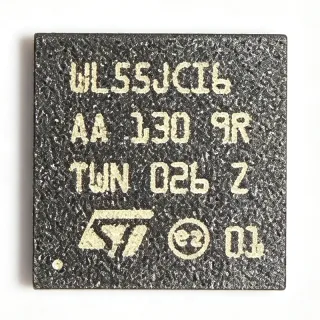
RTL8720DN - Dual-Band WiFi/BLE 5.0 MCU SoC | Realtek | IoT
MPN: RTL8720DN ✓ Active| Qty | Unit Price | Extended |
|---|---|---|
| 1 | $4 | $4.00 |
| 10 | $3.8 | $38.00 |
| 100 | $3.5 | $350.00 |
| 500 | $3.2 | $1,600.00 |
| 1,000 | $3 | $3,000.00 |
RTL8720DN Overview
A wireless SoC of this class integrates a microcontroller, radio transceiver, and network stack on one die, sitting in the product hierarchy: RTL8720DN -> WiFi/BT combo SoC -> wireless microcontroller -> IoT connectivity IC. This removes the need for a separate host MCU plus external radio module, cutting BOM count and board area.
Key features include 802.11 a/b/g/n (Wi-Fi 4) dual-band operation with 20 MHz bandwidth, BLE 5.0 with long-range modes, and a shared antenna path that simplifies RF layout. As part of the Realtek Ameba-D family, it is supported by the Ameba Arduino core and can be programmed in Embedded C/C++ and MicroPython, lowering the software barrier for IoT developers.
Architecturally, the KM4 core runs user applications and the Wi-Fi/BLE protocol stacks, while the KM0 core handles low-power tasks, secure boot, and peripheral supervision in deep-sleep states. Dual-core partitioning lets designers keep wireless housekeeping off the application core, improving worst-case application latency versus single-core WiFi MCUs.
Typical applications are dual-band IoT nodes that must escape the congested 2.4 GHz band, smart-home hubs, wireless sensor networks, and over-the-air-update endpoints where 5 GHz provides cleaner spectrum and higher throughput than ESP8266-class single-band parts.
Design consideration: the RTL8720DN shares one antenna path between Wi-Fi and Bluetooth, so time-division coexistence is managed internally in software; RF front-end matching and antenna placement follow the reference design from Seeed Studio's BW16 module documentation.
This page synthesizes distributor pricing, cross-reference guidance, and practical design notes not found in the manufacturer datasheet. Prices as of 2026-10-19.
Drop-in alternatives for RTL8720DN — same package, pin-to-pin compatible. Different-package parts requiring PCB rework are excluded.
Quick Comparison Tool — Select alternative parts for side-by-side comparison:
RTL8720CF
✅ Drop-In ⚠️ Specs Unverified📋 Reference alternative (not in catalog)
RTL8720DN Maximum Ratings & Electrical Characteristics
| Product Type | Dual-band Wi-Fi + BLE 5.0 combo SoC |
| Wi-Fi Standard | IEEE 802.11 a/b/g/n (Wi-Fi 4), 2.4 GHz and 5 GHz |
| Bluetooth | Bluetooth Low Energy 5.0 |
| Application Processor | ARM Cortex-M4F (KM4) |
| System Management Core | ARM Cortex-M0 (KM0) |
| Product Family | Realtek Ameba-D |
| Package | QFN (sources report QFN-68 and QFN-48; verify with datasheet) |
| Mounting Type | Surface Mount |
| Antenna Path | Shared antenna for Wi-Fi and BT |
| Programming Support | Embedded C/C++, MicroPython, Ameba Arduino core |
| Typical Applications | IoT nodes, smart home, wireless control |
| Unit Price (qty 1) | From $4.00 (as of 2026-10-19) |
RTL8720DN qfn (sources report qfn-68 and qfn-48; verify with datasheet) Pin Configuration Guide
Pin configuration for RTL8720DN (qfn (sources report qfn-68 and qfn-48; verify with datasheet) package). This digital IC includes GPIO, communication interfaces (UART, SPI, I2C), and power pins. Refer to the manufacturer datasheet for alternate pin functions and configuration options. Essential for embedded system design and PCB layout.
No detailed pinout data available for RTL8720DN.
Refer to the datasheet for full pin configuration.
Typical Applications
RTL8720DN is suitable for 6 applications: Dual-Band IoT Sensor Nodes, Smart Home Hubs and Gateways, Wireless Control and OTA Endpoints, Maker and Educational Development, Wireless Audio and Accessory Peripherals, Industrial Monitoring and Wireless Retrofit.
Dual-Band IoT Sensor Nodes
The RTL8720DN fits battery-powered sensor nodes deployed in RF-congested environments where 2.4 GHz-only parts suffer packet loss. Its 802.11a/n 5 GHz radio accesses far cleaner spectrum, improving delivery reliability in apartment buildings and factories with dozens of overlapping networks. The dual-core ARM architecture - Cortex-M4F for application logic, Cortex-M0 for power supervision - lets the node spend most of its life in deep sleep and wake on interrupt, protecting battery life. Programmed in C/C++ or MicroPython via the Ameba Arduino core, nodes publish over MQTT or HTTP with TLS. The trade-off is higher unit cost (about $4.00 vs $2.50 for ESP32) and higher radio current on 5 GHz, so duty-cycling intervals matter for battery sizing.
Recommended
Smart Home Hubs and Gateways
Smart home hubs benefit from the RTL8720DN's simultaneous dual-band Wi-Fi and BLE 5.0: the Wi-Fi side backhauls to the cloud on whichever band is cleanest, while the BLE side talks directly to battery sensors, door locks, and beacons without a separate BLE chip. The shared antenna path between Wi-Fi and Bluetooth removes an external antenna switch, shrinking the RF section of the hub PCB. WPA-era security support and the Cortex-M0 secure-boot supervision improve consumer-device trust chains. Because the hub runs persistent connections, the M4F core running the protocol stacks offloads housekeeping from user firmware. Recommended architecture pairs the RTL8720DN with external flash for OTA image staging, since firmware updates are a hub lifecycle requirement.
Recommended
Wireless Control and OTA Endpoints
For appliances, lighting, and industrial controllers that require field firmware updates, the RTL8720DN provides reliable over-the-air update transport on 5 GHz, where higher available throughput shortens OTA windows and cleaner spectrum reduces failed-update retries - a critical reliability metric for fleet devices. The Ameba-D software platform handles OTA image swap with the M0 core supervising boot integrity, so a failed update does not brick the endpoint. BLE 5.0 offers a local commissioning channel for first-time provisioning onto the customer's Wi-Fi network, a proven UX pattern for white-goods and HVAC controllers. Design in the BW16 module first for certification reuse, then migrate the bare RTL8720DN onto production PCBs once volumes justify it.
Recommended
Maker and Educational Development
The RTL8720DN is a strong teaching and prototyping platform because it exposes dual-band Wi-Fi and BLE 5.0 through the Arduino Ameba-D core and MicroPython, letting students and makers explore 5 GHz networking rarely available on hobbyist parts. The BW16 module (built on the RTL8720DN) connects commonly used pins and adds a PCB antenna, so no RF layout skill is needed to start. Community resources - Arduino forum pinout threads, GitHub BW16 firmware projects, and Seeed Studio documentation - cover flashing over USB-UART and AP/station operation on both bands. Compared with the ESP32, the ecosystem is smaller, so verify library availability for specific sensors before committing a curriculum or project plan.
Recommended
Wireless Audio and Accessory Peripherals
BLE 5.0 on the RTL8720DN supports the 2 Mbps PHY and long-range coded PHY modes relevant to wireless accessories - game controllers, remote controls, and BLE audio-adjacent peripherals. The Cortex-M4F core has headroom for HID stacks plus application logic, and Wi-Fi provides a separate high-bandwidth path for configuration or content sync that BLE alone cannot deliver. Using one chip for both radios reduces BOM versus an MCU plus discrete BLE controller. Power behavior during connected BLE intervals is managed by the M0 core in sleep states. Developers should profile current consumption against the Realtek datasheet tables rather than public summaries, and note the shared antenna means time-division coexistence between Wi-Fi and BLE traffic is software-managed.
Recommended
Industrial Monitoring and Wireless Retrofit
Industrial retrofits often cannot run cable, and plant floors are saturated with 2.4 GHz noise from legacy Wi-Fi, Bluetooth tools, and ISM radios. The RTL8720DN's 5 GHz band provides a survivable link in exactly these conditions, which is the practical reason to select it over single-band wireless MCUs. The dual-core secure-boot architecture supports integrity checking valued in industrial deployments, and MicroPython support enables rapid custom protocol adaptation to legacy Modbus-to-MQTT bridges. Sensor data can be TLS-encrypted end to end from the M4F core. Cost sits above ESP32-class parts, so specify RTL8720DN where link reliability has measurable downtime cost, and use the BW16 module for pilot deployments before bare-chip production.
Recommended
Recommended Products Summary
Engineering reference data for RTL8720DN — comparison, design guidance, and compliance information.
Selection Guide
Comparison with Alternatives
| Parameter | This Product | RTL8720CF |
|---|---|---|
| Package | QFN (QFN-68 per FPGACenter; QFN-48 per Apex - verify with Realtek datasheet) | QFN (Ameba-D family package) |
| Brand | Realtek | Realtek |
| Wi-Fi Bands | 2.4 GHz + 5 GHz (802.11 a/b/g/n) | 2.4 GHz only (802.11 b/g/n) |
| Bluetooth | BLE 5.0 | BLE 5.0 |
| CPU Architecture | ARM Cortex-M4F + Cortex-M0 (dual core) | ARM Cortex-M4F + Cortex-M0 (dual core) |
| Product Family | Realtek Ameba-D | Realtek Ameba-D |
| Drop-in Capability | Reference part | Same Ameba-D package family; verify pinout in Realtek datasheet before swap |
Key Differentiators
- True dual-band Wi-Fi (2.4 GHz + 5 GHz) (vs ESP32)
- Dual-core ARM architecture with dedicated power/security core (vs ESP32)
- Shared Wi-Fi/BT antenna path (vs RTL8720CF)
Design Notes
The RTL8720DN shares a single antenna path between Wi-Fi and Bluetooth per Seeed Studio module documentation. Coexistence is handled by time-division in the Ameba-D software stack, not by an external antenna switch. For bare-chip designs, follow the Realtek reference design for the matching network and keep the antenna feed at 50 ohms with a continuous ground plane beneath; refer to the BW16 module layout as a proven example before committing a custom RF section.
Distributor listings disagree on the package: FPGACenter states QFN-68 while Apex Components states QFN-48 and explicitly says the exact body size requires the Realtek datasheet. A QFN-68 land pattern and a QFN-48 land pattern are not interchangeable, so this must be resolved from the official Realtek datasheet before PCB layout is frozen. Ordering bare chips against an assumed footprint is the most expensive mistake possible on this part.
5 GHz operation draws noticeably more radio current than 2.4 GHz; public product summaries do not publish exact sleep and TX current tables for the RTL8720DN, so battery sizing must use the current-consumption tables in the official Realtek datasheet. Architecturally, the Cortex-M0 core manages sleep states so the M4F application core can be powered down between wake events - structure your firmware to gate the M4F whenever possible to exploit this dual-core power partitioning.
For first-article builds, prototype on the BW16 module (RTL8720DN with PCB antenna and commonly used pins broken out) before moving to a bare-chip design. This validates firmware on the Ameba Arduino core or MicroPython while avoiding RF layout risk. The module route also reuses module certifications, shortening regulatory approval for the pilot build; migrate to the bare SoC only when production volume justifies the added certification and layout effort.
Compliance Information
Compliance data was not present in the verified web data; confirm RoHS/REACH status on Realtek's official product page or via distributor compliance certificates before procurement.