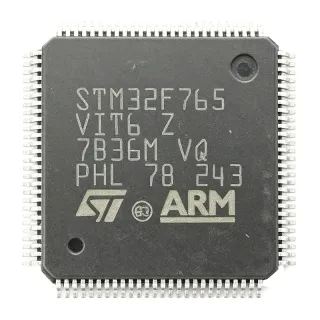
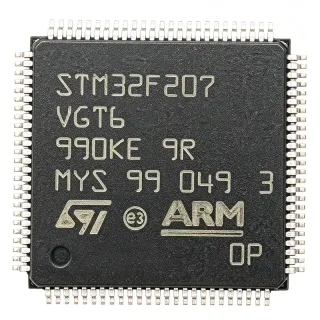
STM32F417VGT6 - 32-bit ARM Cortex-M4F MCU, 1MB Flash | STMicroelectronics
MPN: STM32F417VGT6 ✓ Active| Qty | Unit Price | Extended |
|---|---|---|
| 1 | $8.11 | $8.11 |
STM32F417VGT6 Overview
A microcontroller (MCU) is a compact integrated circuit designed to govern a specific operation in an embedded system. It contains a processor core, memory, and programmable input/output peripherals. The STM32F417VGT6 belongs to the STM32F4 series, which is part of the broader STM32 family of 32-bit flash microcontrollers. This family is widely used in industrial, consumer, and automotive applications due to its balance of performance, power efficiency, and peripheral integration.
Key features of the STM32F417VGT6 include a 168 MHz CPU with DSP instructions and a floating-point unit, 1 MB of flash memory, 192 KB of SRAM, and a comprehensive set of peripherals: 3x 12-bit ADCs, 2x DACs, 12x general-purpose timers, 2x advanced-control timers, and a true random number generator (RNG). It also features a camera interface, crypto/hash processor, and a USB OTG HS/FS, Ethernet MAC, and CAN 2.0B interfaces. The device supports a wide supply voltage range of 1.8V to 3.6V and operates over a temperature range of -40°C to +85°C.
The STM32F417VGT6 is built on a 90nm process technology, enabling high clock speeds with low power consumption. The ART Accelerator™ allows zero-wait-state execution from flash memory, maximizing performance. The FPU accelerates mathematical computations, which is critical for real-time control and signal processing applications. The device also includes a memory protection unit (MPU) and a nested vectored interrupt controller (NVIC) for efficient multitasking.
Typical applications include industrial motor control, medical equipment, consumer electronics, IoT gateways, and audio processing. The combination of high-speed ADC, advanced timers, and communication interfaces makes it ideal for applications requiring precise timing and connectivity. For example, in motor control, the advanced-control timers generate PWM signals with dead-time insertion, while the ADC samples current and voltage feedback for closed-loop control.
When designing with this device, ensure adequate decoupling of the power supply pins and proper layout of the high-speed USB and Ethernet interfaces. The device supports multiple low-power modes, including Sleep, Stop, and Standby, which can be leveraged to reduce power consumption in battery-powered applications. The boot configuration pins must be set correctly to select the desired boot source (flash, SRAM, or system memory).
Drop-in alternatives for STM32F417VGT6 — same package, pin-to-pin compatible. Different-package parts requiring PCB rework are excluded.
Variants in this series
Same-series models that are drop-in compatible with STM32F417VGT6 (same form factor and footprint) — differing in Communication Interfaces, Package, SRAM, Core, Timers.
Quick Comparison Tool — Select alternative parts for side-by-side comparison:
STM32F407VGT6
✅ Drop-In✓ In Stock
$7.55 / Unit
View Datasheet →STM32F417VGT6TR
✅ Drop-In📋 Reference alternative (not in catalog)
STM32F417VGT6J
✅ Drop-In📋 Reference alternative (not in catalog)
STM32F427VGT6
✅ Drop-In ⚠️ 参数待验证📋 Reference alternative (not in catalog)
STM32F437VGT6
✅ Drop-In ⚠️ 参数待验证📋 Reference alternative (not in catalog)
ATSAM4E16EA
✅ Drop-In ⚠️ 参数待验证📋 Reference alternative (not in catalog)
LPC4078FBD100
✅ Drop-In ⚠️ 参数待验证📋 Reference alternative (not in catalog)
STM32F417VGT6 Maximum Ratings & Electrical Characteristics
| Core | ARM Cortex-M4F with FPU |
| Maximum Clock Speed | 168 MHz |
| Flash Memory | 1 MB |
| SRAM | 192 KB |
| Supply Voltage Range | 1.8 V to 3.6 V |
| Operating Temperature | -40C to +85C |
| Package | LQFP100 (14x14 mm) |
| Number of I/O Pins | 82 |
| ADC Resolution | 12-bit |
| Number of ADCs | 3 |
| DAC Resolution | 12-bit |
| Number of DACs | 2 |
| Timers | 12x 16-bit, 2x 32-bit |
| Communication Interfaces | USB OTG HS/FS, Ethernet MAC, CAN 2.0B, USART, SPI, I2C |
| DMA Channels | 16 |
| Crypto/Hash Processor | Yes (AES, DES, 3DES, SHA-1, MD5) |
| Random Number Generator | Yes |
| Camera Interface | Yes (8-bit parallel) |
| RoHS Status | Compliant |
STM32F417VGT6 Pin Configuration
| Pin 1 | PE2 — GPIO / alternate functions |
| Pin 2 | PE3 — GPIO / alternate functions |
| Pin 3 | PE4 — GPIO / alternate functions |
| Pin 4 | PE5 — GPIO / alternate functions |
| Pin 5 | PE6 — GPIO / alternate functions |
| Pin 6 | VBAT — Backup battery supply |
| Pin 7 | PC13 — GPIO / RTC / tamper |
| Pin 8 | PC14 — GPIO / OSC32_IN |
| Pin 9 | PC15 — GPIO / OSC32_OUT |
| Pin 10 | PF0 — GPIO / alternate functions |
| Pin 11 | PF1 — GPIO / alternate functions |
| Pin 12 | PF2 — GPIO / alternate functions |
| Pin 13 | PF3 — GPIO / alternate functions |
| Pin 14 | PF4 — GPIO / alternate functions |
| Pin 15 | PF5 — GPIO / alternate functions |
| Pin 16 | PF6 — GPIO / alternate functions |
| Pin 17 | PF7 — GPIO / alternate functions |
| Pin 18 | PF8 — GPIO / alternate functions |
| Pin 19 | PF9 — GPIO / alternate functions |
| Pin 20 | PF10 — GPIO / alternate functions |
| Pin 21 | VSSA — Analog ground |
| Pin 22 | VDDA — Analog power supply |
| Pin 23 | PA0 — GPIO / ADC / DAC / alternate functions |
| Pin 24 | PA1 — GPIO / ADC / alternate functions |
| Pin 25 | PA2 — GPIO / ADC / alternate functions |
| Pin 26 | PA3 — GPIO / ADC / alternate functions |
| Pin 27 | VSS — Ground |
| Pin 28 | VDD — Power supply |
| Pin 29 | PA4 — GPIO / ADC / DAC / alternate functions |
| Pin 30 | PA5 — GPIO / ADC / alternate functions |
| Pin 31 | PA6 — GPIO / ADC / alternate functions |
| Pin 32 | PA7 — GPIO / ADC / alternate functions |
| Pin 33 | PC4 — GPIO / ADC / alternate functions |
| Pin 34 | PC5 — GPIO / ADC / alternate functions |
| Pin 35 | PB0 — GPIO / ADC / alternate functions |
| Pin 36 | PB1 — GPIO / ADC / alternate functions |
| Pin 37 | PB2 — GPIO / alternate functions |
| Pin 38 | PF11 — GPIO / alternate functions |
| Pin 39 | PF12 — GPIO / alternate functions |
| Pin 40 | PF13 — GPIO / alternate functions |
| Pin 41 | PF14 — GPIO / alternate functions |
| Pin 42 | PF15 — GPIO / alternate functions |
| Pin 43 | PG0 — GPIO / alternate functions |
| Pin 44 | PG1 — GPIO / alternate functions |
| Pin 45 | PE7 — GPIO / alternate functions |
| Pin 46 | PE8 — GPIO / alternate functions |
| Pin 47 | PE9 — GPIO / alternate functions |
| Pin 48 | PE10 — GPIO / alternate functions |
| Pin 49 | PE11 — GPIO / alternate functions |
| Pin 50 | PE12 — GPIO / alternate functions |
| Pin 51 | PE13 — GPIO / alternate functions |
| Pin 52 | PE14 — GPIO / alternate functions |
| Pin 53 | PE15 — GPIO / alternate functions |
| Pin 54 | PB10 — GPIO / I2C / USART / alternate functions |
| Pin 55 | PB11 — GPIO / I2C / USART / alternate functions |
| Pin 56 | VCAP_1 — Internal regulator capacitor |
| Pin 57 | VSS — Ground |
| Pin 58 | VDD — Power supply |
| Pin 59 | PB12 — GPIO / SPI / I2C / alternate functions |
| Pin 60 | PB13 — GPIO / SPI / I2C / alternate functions |
| Pin 61 | PB14 — GPIO / SPI / I2C / alternate functions |
| Pin 62 | PB15 — GPIO / SPI / I2C / alternate functions |
| Pin 63 | PD8 — GPIO / USART / alternate functions |
| Pin 64 | PD9 — GPIO / USART / alternate functions |
| Pin 65 | PD10 — GPIO / USART / alternate functions |
| Pin 66 | PD11 — GPIO / USART / alternate functions |
| Pin 67 | PD12 — GPIO / USART / alternate functions |
| Pin 68 | PD13 — GPIO / USART / alternate functions |
| Pin 69 | PD14 — GPIO / USART / alternate functions |
| Pin 70 | PD15 — GPIO / USART / alternate functions |
| Pin 71 | PC6 — GPIO / SDIO / alternate functions |
| Pin 72 | PC7 — GPIO / SDIO / alternate functions |
| Pin 73 | PC8 — GPIO / SDIO / alternate functions |
| Pin 74 | PC9 — GPIO / SDIO / alternate functions |
| Pin 75 | PA8 — GPIO / MCO / alternate functions |
| Pin 76 | PA9 — GPIO / USB / alternate functions |
| Pin 77 | PA10 — GPIO / USB / alternate functions |
| Pin 78 | PA11 — GPIO / USB / alternate functions |
| Pin 79 | PA12 — GPIO / USB / alternate functions |
| Pin 80 | PA13 — GPIO / SWDIO / alternate functions |
| Pin 81 | VCAP_2 — Internal regulator capacitor |
| Pin 82 | VSS — Ground |
| Pin 83 | VDD — Power supply |
| Pin 84 | PA14 — GPIO / SWCLK / alternate functions |
| Pin 85 | PA15 — GPIO / JTDI / alternate functions |
| Pin 86 | PC10 — GPIO / SDIO / alternate functions |
| Pin 87 | PC11 — GPIO / SDIO / alternate functions |
| Pin 88 | PC12 — GPIO / SDIO / alternate functions |
| Pin 89 | PD0 — GPIO / OSC_IN / alternate functions |
| Pin 90 | PD1 — GPIO / OSC_OUT / alternate functions |
| Pin 91 | PD2 — GPIO / alternate functions |
| Pin 92 | PD3 — GPIO / alternate functions |
| Pin 93 | PD4 — GPIO / alternate functions |
| Pin 94 | PD5 — GPIO / alternate functions |
| Pin 95 | PD6 — GPIO / alternate functions |
| Pin 96 | PD7 — GPIO / alternate functions |
| Pin 97 | PG2 — GPIO / alternate functions |
| Pin 98 | PG3 — GPIO / alternate functions |
| Pin 99 | PG4 — GPIO / alternate functions |
| Pin 100 | PG5 — GPIO / alternate functions |
Typical Applications
STM32F417VGT6 is suitable for 6 applications: Industrial Motor Control, IoT Gateway, Medical Equipment, Consumer Electronics, Audio Processing, Test and Measurement.
Industrial Motor Control
The STM32F417VGT6 is ideal for industrial motor control due to its advanced-control timers (TIM1 and TIM8) that generate PWM signals with dead-time insertion, and its 12-bit ADCs that sample motor current and voltage feedback. The FPU accelerates field-oriented control (FOC) algorithms, enabling efficient and precise motor control. In a typical application, the MCU reads current sensors via the ADC, computes the FOC algorithm, and outputs PWM signals to the inverter. The high clock speed of 168 MHz ensures real-time performance, while the multiple communication interfaces (CAN, UART, SPI) allow integration with industrial networks. The device's robust design and wide temperature range make it suitable for harsh industrial environments.
Recommended
IoT Gateway
The STM32F417VGT6 is well-suited for IoT gateways due to its Ethernet MAC, USB OTG, and multiple communication interfaces. It can handle protocol conversion between different networks, such as Ethernet, Wi-Fi (via external module), and CAN. The crypto/hash processor enables secure communication by accelerating AES encryption and SHA-1 hashing. In a typical IoT gateway, the MCU collects data from sensors via UART or SPI, processes it, and transmits it to the cloud via Ethernet or Wi-Fi. The large flash memory (1 MB) allows storing firmware updates and data logs. The FPU and DSP instructions facilitate efficient data processing, while the low-power modes help reduce energy consumption in always-on gateways.
Recommended
Medical Equipment
The STM32F417VGT6 is used in medical equipment such as patient monitors, infusion pumps, and diagnostic devices. Its high-performance core and FPU enable real-time signal processing for ECG, EEG, and other biosignals. The multiple ADCs can sample multiple analog channels simultaneously, while the DACs can generate analog output for stimulation or control. The device's reliability and wide temperature range make it suitable for medical environments. In a patient monitor, the MCU acquires vital signs from sensors, processes the signals, and displays them on a screen. The USB and Ethernet interfaces allow data transfer to hospital networks. The crypto/hash processor can be used for secure patient data storage and transmission.
Recommended
Consumer Electronics
The STM32F417VGT6 is used in consumer electronics such as smart home hubs, audio equipment, and wearable devices. Its rich peripheral set and high performance enable complex user interfaces, audio processing, and connectivity. The FPU accelerates audio algorithms like filtering and equalization. In a smart home hub, the MCU manages multiple communication protocols (Zigbee, Z-Wave, Wi-Fi) via external modules, processes sensor data, and controls actuators. The USB OTG allows connection to smartphones for configuration. The device's low-power modes are essential for battery-powered wearables, extending battery life. The large flash memory supports over-the-air firmware updates.
Recommended
Audio Processing
The STM32F417VGT6 is suitable for audio processing applications such as audio effects processors, mixers, and voice recognition systems. Its FPU and DSP instructions enable real-time audio algorithms like filtering, reverb, and equalization. The multiple I2S interfaces allow connection to audio codecs and digital amplifiers. In an audio effects processor, the MCU reads digital audio from an I2S input, applies effects, and outputs the processed audio via I2S. The high clock speed ensures low latency, while the large SRAM (192 KB) can buffer audio samples. The device's DMA channels offload data transfer, reducing CPU load. The crypto/hash processor can be used for DRM protection of audio content.
Recommended
Test and Measurement
The STM32F417VGT6 is used in test and measurement equipment such as oscilloscopes, data loggers, and signal generators. Its high-speed ADCs and timers enable precise signal acquisition and generation. The multiple communication interfaces allow data transfer to PCs for analysis. In a data logger, the MCU samples analog signals at high rates, stores data in flash or SRAM, and transfers it via USB or Ethernet. The FPU accelerates signal processing for real-time analysis. The device's wide temperature range and reliability make it suitable for benchtop and portable instruments. The crypto/hash processor can be used for secure data logging.
Recommended
Recommended Products Summary
Engineering reference data for STM32F417VGT6 — comparison, design guidance, and compliance information.
Selection Guide
Comparison with Alternatives
| Parameter | This Product | STM32F407VGT6 | STM32F427VGT6 | ATSAM4E16EA | LPC4078FBD100 |
|---|---|---|---|---|---|
| Package | LQFP100 | LQFP100 - same | LQFP100 - same | LQFP100 - same | LQFP100 - same |
| Brand | STMicroelectronics | STMicroelectronics | STMicroelectronics | Microchip Technology | NXP Semiconductors |
| Core | ARM Cortex-M4F | ARM Cortex-M4F | ARM Cortex-M4F | ARM Cortex-M4F | ARM Cortex-M4F |
| Max Clock Speed | 168 MHz | 168 MHz | 180 MHz | 120 MHz | 120 MHz |
| Flash Memory | 1 MB | 1 MB | 1 MB | 1 MB | 512 KB |
| SRAM | 192 KB | 192 KB | 256 KB | 128 KB | 96 KB |
| Crypto/Hash Processor | Yes | No | Yes | No | No |
| Ethernet MAC | Yes | Yes | Yes | No | Yes |
| USB OTG | HS/FS | HS/FS | HS/FS | HS | HS/FS |
Key Differentiators
- Integrated crypto/hash processor and RNG (vs STM32F407VGT6)
- Higher clock speed and more SRAM than cross-brand alternatives (vs ATSAM4E16EA)
- Ethernet MAC and USB OTG HS/FS (vs LPC4078FBD100)
Design Notes
The STM32F417VGT6 requires a 1.8V to 3.6V supply. Decouple each VDD pin with a 100nF ceramic capacitor and a 4.7uF tantalum capacitor. The VDDA pin should be connected to a clean analog supply, filtered with a ferrite bead and 1uF capacitor. The VCAP pins require a 2.2uF capacitor to ground for internal regulator stability. Ensure the VBAT pin is connected to a backup battery or tied to VDD if not used.
For high-speed interfaces like USB and Ethernet, maintain controlled impedance traces (90 ohms differential for USB, 100 ohms for Ethernet). Place the crystal oscillator close to the OSC_IN/OSC_OUT pins with load capacitors as specified in the datasheet. Keep the analog and digital ground planes separate and connect them at a single point to minimize noise. Use a solid ground plane under the MCU to reduce EMI.
Ensure the boot pins (BOOT0 and BOOT1) are configured correctly to boot from flash. Do not leave the NRST pin floating; connect a 100nF capacitor to ground. When using the crypto/hash processor, ensure the clock is enabled in the RCC register. For low-power modes, configure the PWR registers correctly to avoid unexpected wake-ups. Also, note that the STM32F417VGT6 has a maximum junction temperature of 125°C; ensure adequate thermal management in high-power applications.
Compliance Information
RoHS and REACH compliant per STMicroelectronics. Not AEC-Q100 qualified; for automotive, consider STM32F417VGT6J or other automotive-grade variants.