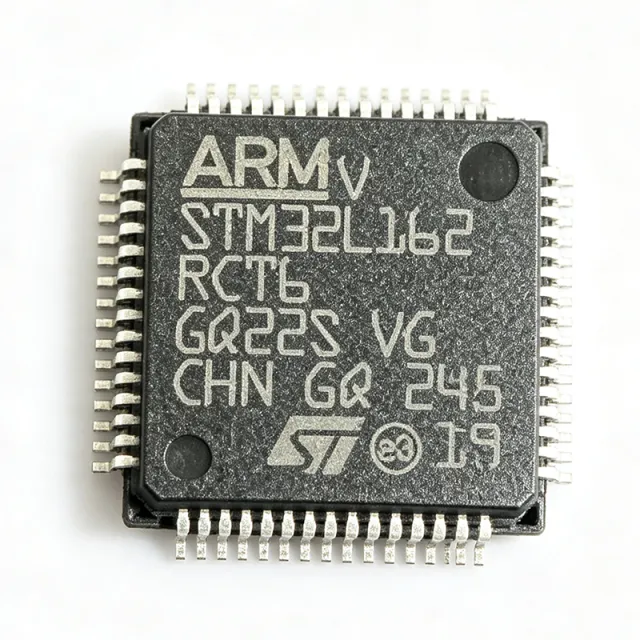
STM32L162RCT6 - Ultra-Low-Power ARM Cortex-M3 MCU | STMicroelectronics
MPN: STM32L162RCT6 ✓ Active| Qty | Unit Price | Extended |
|---|---|---|
| 1 | $4.9091 | $4.91 |
| 10 | $3.5455 | $35.46 |
| 100 | $3.1364 | $313.64 |
| 500 | $3 | $1,500.00 |
| 1,000 | $2.8636 | $2,863.60 |
STM32L162RCT6 Overview
An ultra-low-power microcontroller (MCU) is a system-on-chip that integrates a processor core, memory, and peripherals, designed to minimize energy consumption while maintaining computational capability. The STM32L1 series is STMicroelectronics' flagship low-power family, targeting battery-powered and energy-harvesting applications. It sits within the broader hierarchy of embedded microcontrollers, which are the building blocks of IoT devices, portable medical equipment, and smart sensors.
Key features of the STM32L162RCT6 include multiple low-power modes (Sleep, Low-power Run, Low-power Sleep, Stop with RTC, Standby with RTC), a 12-bit ADC with 1 Msps, a 12-bit DAC, and an embedded AES-128 encryption engine. The device also integrates a real-time clock (RTC) with calendar and alarm functions, and supports a wide supply voltage range from 1.8V to 3.6V. The ultra-low-power design achieves a typical current consumption of 3.4 µA in Stop mode with RTC, and 0.27 µA in Standby mode.
The STM32L162RCT6 is built on a 130nm low-leakage process technology, which is optimized for minimal static power consumption. The architecture includes a flexible clock tree with multiple internal and external oscillators, allowing designers to trade off performance for power. The AES hardware accelerator offloads cryptographic operations from the CPU, reducing energy consumption for secure communication.
Typical applications include smart meters, medical devices (e.g., glucose monitors, hearing aids), industrial sensors, and portable consumer electronics. The integrated LCD controller supports up to 8x40 segments, making it ideal for battery-powered displays. The USB 2.0 full-speed device interface enables direct connectivity to hosts for data logging and firmware updates.
When designing with this device, careful attention should be paid to the power supply decoupling and the selection of low-power modes to maximize battery life. The use of the internal low-speed oscillator (LSI) for the RTC can reduce external component count, but an external 32.768 kHz crystal provides better accuracy for timekeeping applications.
Drop-in alternatives for STM32L162RCT6 — same package, pin-to-pin compatible. Different-package parts requiring PCB rework are excluded.
Variants in this series
Same-series models that are drop-in compatible with STM32L162RCT6 (same form factor and footprint) — differing in Communication Interfaces, Flash Memory, Package, SRAM.
Quick Comparison Tool — Select alternative parts for side-by-side comparison:
STM32L152RCT6
📋 Reference alternative (not in catalog)
STM32L162RDT6
📋 Reference alternative (not in catalog)
STM32L151RCT6
✓ In Stock
$3.85 / Unit
View Datasheet →LPC1768FBD64
📋 Reference alternative (not in catalog)
EFM32LG380F256G-E-QFN64
📋 Reference alternative (not in catalog)
STM32L162RCT6 Maximum Ratings & Electrical Characteristics
| Core | ARM Cortex-M3 |
| Max Clock Frequency | 32 MHz |
| Flash Memory | 256 KB |
| SRAM | 32 KB |
| Supply Voltage Range | 1.8 V to 3.6 V |
| Package | LQFP-64 |
| Operating Temperature | -40C to +85C |
| ADC Resolution | 12-bit |
| ADC Sample Rate | 1 Msps |
| DAC Resolution | 12-bit |
| AES Encryption | 128-bit hardware |
| USB Interface | USB 2.0 Full-speed Device |
| LCD Controller | 8x40 segments |
| RTC | Yes, with calendar and alarm |
| Low-power Mode Current (Stop with RTC) | 3.4 µA |
| Low-power Mode Current (Standby) | 0.27 µA |
| GPIO Pins | 51 |
| Communication Interfaces | USART, SPI, I2C, USB |
| RoHS Status | Compliant |
STM32L162RCT6 Pin Configuration
| Pin 1 | VBAT — Battery backup supply for RTC and backup registers |
| Pin 2 | PC13 — GPIO or RTC tamper detection |
| Pin 3 | PC14 — GPIO or OSC32_IN |
| Pin 4 | PC15 — GPIO or OSC32_OUT |
| Pin 5 | PF0 — GPIO or OSC_IN |
| Pin 6 | PF1 — GPIO or OSC_OUT |
| Pin 7 | NRST — Reset (active low) |
| Pin 8 | VSSA — Analog ground |
| Pin 9 | VDDA — Analog power supply |
| Pin 10 | PA0 — GPIO or ADC input |
| Pin 11 | PA1 — GPIO or ADC input |
| Pin 12 | PA2 — GPIO or USART2_TX |
| Pin 13 | PA3 — GPIO or USART2_RX |
| Pin 14 | PA4 — GPIO or SPI1_NSS |
| Pin 15 | PA5 — GPIO or SPI1_SCK |
| Pin 16 | PA6 — GPIO or SPI1_MISO |
| Pin 17 | PA7 — GPIO or SPI1_MOSI |
| Pin 18 | PB0 — GPIO or ADC input |
| Pin 19 | PB1 — GPIO or ADC input |
| Pin 20 | PB2 — GPIO or BOOT1 |
| Pin 21 | PB10 — GPIO or I2C2_SCL |
| Pin 22 | PB11 — GPIO or I2C2_SDA |
| Pin 23 | PB12 — GPIO or SPI2_NSS |
| Pin 24 | PB13 — GPIO or SPI2_SCK |
| Pin 25 | PB14 — GPIO or SPI2_MISO |
| Pin 26 | PB15 — GPIO or SPI2_MOSI |
| Pin 27 | PC6 — GPIO or USART6_TX |
| Pin 28 | PC7 — GPIO or USART6_RX |
| Pin 29 | PC8 — GPIO or USART6_CK |
| Pin 30 | PC9 — GPIO or USART6_CTS |
| Pin 31 | PA8 — GPIO or USART1_CK |
| Pin 32 | PA9 — GPIO or USART1_TX |
| Pin 33 | PA10 — GPIO or USART1_RX |
| Pin 34 | PA11 — GPIO or USB_DM |
| Pin 35 | PA12 — GPIO or USB_DP |
| Pin 36 | PA13 — GPIO or SWDIO |
| Pin 37 | PA14 — GPIO or SWCLK |
| Pin 38 | PA15 — GPIO or JTDI |
| Pin 39 | PB3 — GPIO or JTDO |
| Pin 40 | PB4 — GPIO or NJTRST |
| Pin 41 | PB5 — GPIO or I2C1_SMBA |
| Pin 42 | PB6 — GPIO or I2C1_SCL |
| Pin 43 | PB7 — GPIO or I2C1_SDA |
| Pin 44 | BOOT0 — Boot mode selection |
| Pin 45 | PB8 — GPIO or I2C1_SCL |
| Pin 46 | PB9 — GPIO or I2C1_SDA |
| Pin 47 | VSS — Ground |
| Pin 48 | VDD — Power supply |
| Pin 49 | PC0 — GPIO or ADC input |
| Pin 50 | PC1 — GPIO or ADC input |
| Pin 51 | PC2 — GPIO or ADC input |
| Pin 52 | PC3 — GPIO or ADC input |
| Pin 53 | PC4 — GPIO or ADC input |
| Pin 54 | PC5 — GPIO or ADC input |
| Pin 55 | PD2 — GPIO or USART5_RX |
| Pin 56 | PD3 — GPIO or USART5_TX |
| Pin 57 | PD4 — GPIO or USART5_CK |
| Pin 58 | PD5 — GPIO or USART5_CTS |
| Pin 59 | PD6 — GPIO or USART5_RTS |
| Pin 60 | PD7 — GPIO or USART5_DE |
| Pin 61 | PE0 — GPIO or TIM4_ETR |
| Pin 62 | PE1 — GPIO or TIM4_CH1 |
| Pin 63 | PE2 — GPIO or TIM4_CH2 |
| Pin 64 | PE3 — GPIO or TIM4_CH3 |
Typical Applications
STM32L162RCT6 is suitable for 6 applications: Smart Meters, Medical Devices, Industrial Sensors, Portable Consumer Electronics, IoT Edge Nodes, Security Systems.
Smart Meters
The STM32L162RCT6 is ideal for smart meters due to its ultra-low-power consumption, integrated AES-128 encryption for secure data transmission, and multiple communication interfaces (USART, SPI, I2C) for connectivity to PLC or RF modules. Its wide voltage range (1.8V-3.6V) allows direct battery operation, and the RTC with calendar ensures accurate time-stamping of consumption data. The 12-bit ADC enables precise measurement of voltage and current, while the LCD controller can drive a local display for user feedback. In a typical smart meter, the MCU wakes periodically from Stop mode to read sensors, process data, and transmit via a wireless module, achieving years of battery life. The AES engine secures communication with the utility network, protecting against tampering. Designers can leverage the low-power modes to minimize energy consumption during idle periods, and the flexible clock system allows optimization between performance and power. The STM32L162RCT6's rich peripheral set reduces external component count, lowering BOM cost and board space.
Recommended
Medical Devices
The STM32L162RCT6 is well-suited for portable medical devices like glucose monitors and hearing aids. Its ultra-low-power modes (3.4 µA in Stop with RTC) extend battery life, critical for wearable devices. The integrated AES-128 encryption ensures secure storage and transmission of patient data, complying with healthcare regulations. The 12-bit ADC with 1 Msps sampling rate captures biosignals accurately, while the DAC can generate analog outputs for stimulation or audio. The device operates from 1.8V to 3.6V, allowing direct coin-cell battery operation. In a glucose monitor, the MCU periodically wakes to read the sensor, process the data, and display results on an LCD, then returns to low-power mode. The RTC maintains time-stamps for logging. The small LQFP-64 package fits compact PCBs, and the wide temperature range (-40C to +85C) ensures reliability in various environments. The AES engine protects patient data, and the multiple communication interfaces enable connectivity to external devices for data transfer.
Recommended
Industrial Sensors
The STM32L162RCT6 is an excellent choice for industrial sensors that require low power and reliable operation. Its wide supply voltage range (1.8V-3.6V) accommodates battery or energy-harvesting power sources, and the ultra-low-power modes enable long deployment periods without maintenance. The 12-bit ADC with 1 Msps sampling rate accurately digitizes sensor outputs, while the multiple USART, SPI, and I2C interfaces allow connection to various sensor modules and industrial networks. The AES-128 encryption secures data communication in critical infrastructure. In a typical industrial sensor node, the MCU wakes periodically to read temperature, pressure, or vibration sensors, processes the data, and transmits it via a wired or wireless interface. The RTC provides time-stamping for event logging. The device's robustness (-40C to +85C) ensures operation in harsh environments. The integrated LCD controller can display local status, and the low-power modes minimize energy consumption, making it ideal for remote monitoring applications.
Recommended
Portable Consumer Electronics
The STM32L162RCT6 is perfect for portable consumer electronics like fitness trackers, smartwatches, and remote controls. Its ultra-low-power consumption (0.27 µA in Standby) ensures long battery life, and the wide voltage range (1.8V-3.6V) supports direct battery operation. The integrated LCD controller can drive small displays, and the USB 2.0 full-speed interface enables charging and data transfer. The AES-128 encryption secures user data and communication. In a fitness tracker, the MCU collects data from accelerometers and heart-rate sensors, processes it, and displays results on an LCD, while periodically syncing via Bluetooth or USB. The device's small LQFP-64 package fits compact designs, and the rich peripheral set reduces external components. The low-power modes allow the device to run for weeks on a single charge. The RTC maintains time and date, and the multiple communication interfaces provide flexibility for connectivity options.
Recommended
IoT Edge Nodes
The STM32L162RCT6 is an ideal MCU for IoT edge nodes that require secure, low-power operation. Its AES-128 hardware encryption ensures secure communication with cloud services, and the ultra-low-power modes enable battery-powered operation for years. The device supports multiple communication interfaces (USART, SPI, I2C, USB) to connect to various wireless modules (Wi-Fi, BLE, LoRa). The 12-bit ADC and DAC allow interfacing with analog sensors and actuators. In a typical IoT edge node, the MCU wakes periodically to read sensors, process data, and transmit it via a wireless module, then returns to low-power mode. The RTC provides time-stamping, and the wide voltage range (1.8V-3.6V) allows direct battery or energy-harvesting power. The integrated LCD controller can display local status, and the rich peripheral set reduces external component count. The device's robustness and long-term availability make it suitable for industrial IoT deployments.
Recommended
Security Systems
The STM32L162RCT6 is well-suited for security systems such as alarm panels, access control, and surveillance cameras. Its AES-128 encryption engine provides secure communication and data storage, protecting against unauthorized access. The ultra-low-power modes allow battery backup operation during power outages. The multiple communication interfaces (USART, SPI, I2C, USB) enable connection to sensors, keypads, and network modules. The 12-bit ADC can monitor analog sensors like motion detectors, and the LCD controller can display system status. In a typical alarm panel, the MCU continuously monitors sensors, processes events, and communicates with a central station via wired or wireless interfaces. The RTC maintains event logs, and the wide voltage range (1.8V-3.6V) supports battery operation. The device's robust design (-40C to +85C) ensures reliable operation in various environments. The AES engine secures communication, and the low-power modes extend battery life during outages.
Recommended
Recommended Products Summary
Engineering reference data for STM32L162RCT6 — comparison, design guidance, and compliance information.
Selection Guide
Comparison with Alternatives
| Parameter | This Product | STM32L152RCT6 | STM32L162RDT6 | STM32L151RCT6 | LPC1768FBD64 |
|---|---|---|---|---|---|
| Package | LQFP-64 | LQFP-64 | LQFP-64 | LQFP-64 | LQFP-64 |
| Brand | STMicroelectronics | STMicroelectronics | STMicroelectronics | STMicroelectronics | NXP Semiconductors |
| Core | ARM Cortex-M3 | ARM Cortex-M3 | ARM Cortex-M3 | ARM Cortex-M3 | ARM Cortex-M3 |
| Max Clock Frequency | 32 MHz | 32 MHz | 32 MHz | 32 MHz | 100 MHz |
| Flash Memory | 256 KB | 256 KB | 384 KB | 256 KB | 512 KB |
| SRAM | 32 KB | 32 KB | 48 KB | 32 KB | 64 KB |
| AES Encryption | Yes (128-bit) | No | Yes (128-bit) | No | No |
| Standby Current | 0.27 µA | 0.27 µA | 0.27 µA | 0.27 µA | 2.5 µA |
| Supply Voltage Range | 1.8V to 3.6V | 1.8V to 3.6V | 1.8V to 3.6V | 1.8V to 3.6V | 2.4V to 3.6V |
Key Differentiators
- Integrated AES-128 hardware encryption (vs STM32L152RCT6)
- Ultra-low standby current of 0.27 µA (vs LPC1768FBD64)
- Wide supply voltage range (1.8V-3.6V) (vs LPC1768FBD64)
Design Notes
Decouple the VDD and VDDA pins with 100 nF ceramic capacitors placed as close to the pins as possible. Additionally, use a 4.7 µF capacitor on VDDA for analog noise filtering. For battery-powered designs, connect VBAT to the battery through a Schottky diode to prevent back-powering when the main supply is off. The wide voltage range (1.8V-3.6V) allows direct battery connection, but ensure the supply is stable and within the absolute maximum ratings.
For the LQFP-64 package, ensure proper solder paste stencil design to avoid bridging between pins. Use a 0.5 mm pitch footprint with appropriate pad sizes. Place the crystal oscillator (if used) close to the OSC_IN/OSC_OUT pins with load capacitors as specified in the datasheet. Keep high-speed signal traces (USB, SPI) short and impedance-controlled. Provide a solid ground plane under the MCU to minimize noise and improve thermal performance.
Do not leave unused GPIO pins floating; configure them as outputs or enable internal pull-ups/pull-downs to reduce leakage current. When using the RTC, ensure the VBAT pin is connected to a backup battery or a capacitor to maintain timekeeping during main power loss. The BOOT0 pin must be tied to ground for normal operation; a pull-down resistor is recommended. Also, verify that the supply voltage does not exceed 3.6V to avoid damage to the device.
Compliance Information
RoHS compliant per STMicroelectronics product page. Not AEC-Q100 qualified; for automotive, consider STM32L162RCT6's automotive-grade variants if available.