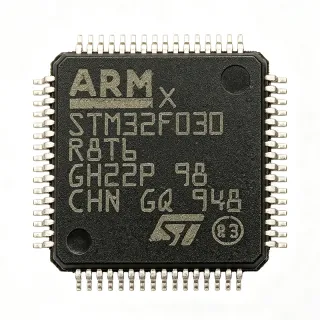
STM32F030RCT6 - 256KB Flash ARM Cortex-M0 MCU | STMicroelectronics
MPN: STM32F030RCT6 ✓ Active| Qty | Unit Price | Extended |
|---|---|---|
| 1 | $5.3543 | $5.35 |
STM32F030RCT6 Overview
What is a microcontroller? A microcontroller (MCU) is a compact integrated circuit designed to govern a specific operation in an embedded system. It contains a processor core, memory (Flash and SRAM), and programmable input/output peripherals on a single chip. The STM32F030RCT6 belongs to the STM32F0 series, which is part of the broader STM32 family of 32-bit ARM Cortex-M microcontrollers. This hierarchy places it within the embedded processing domain, where it serves as the central control unit for applications ranging from industrial automation to consumer electronics.
Key features include a 48 MHz ARM Cortex-M0 core, 256 KB Flash, 32 KB SRAM, and a comprehensive set of peripherals: 5 USARTs, 2 SPIs, 2 I2Cs, 1 12-bit ADC with up to 16 channels, 8 timers, and up to 51 GPIOs. The device supports a wide operating temperature range of -40°C to +85°C and is available in an LQFP-64 package, making it suitable for space-constrained designs.
Technically, the STM32F030RCT6 is built on a 90nm process technology, offering a balance of performance and power efficiency. The ARM Cortex-M0 core is a low-power, high-efficiency processor designed for cost-sensitive applications. The device includes a nested vectored interrupt controller (NVIC), a SysTick timer, and a memory protection unit (MPU) for enhanced reliability. It also features a 12-bit ADC with hardware oversampling, enabling high-resolution analog measurements.
Typical applications include industrial control systems, motor control, consumer electronics, IoT devices, and home automation. The rich peripheral set and large Flash memory make it ideal for applications requiring complex firmware and multiple communication interfaces. For example, in an industrial sensor node, the STM32F030RCT6 can interface with sensors via I2C or SPI, process data, and communicate over USART or CAN.
When designing with this device, ensure proper decoupling of the power supply pins with 100nF capacitors placed close to each VDD pin. The VDDA pin should be connected to a clean analog supply, and the VREF+ pin should be decoupled with a 1uF capacitor for accurate ADC conversions. The BOOT0 pin must be configured correctly to select the boot mode, and the NRST pin should have an external pull-up resistor and a 100nF capacitor for reliable reset.
This page synthesizes distributor pricing, drop-in alternatives, and practical design notes not found in the STMicroelectronics datasheet, providing a comprehensive resource for engineers evaluating the STM32F030RCT6 for their next design.
Drop-in alternatives for STM32F030RCT6 — same package, pin-to-pin compatible. Different-package parts requiring PCB rework are excluded.
Variants in this series
Same-series models that are drop-in compatible with STM32F030RCT6 (same form factor and footprint) — differing in ADC, Flash Memory, SRAM, Timers.
Quick Comparison Tool — Select alternative parts for side-by-side comparison:
STM32F030R8T6
✅ Drop-In✓ In Stock
$0.99 / Unit
View Datasheet →STM32F030RBT6
✅ Drop-In📋 Reference alternative (not in catalog)
STM32F030RCT6TR
✅ Drop-In📋 Reference alternative (not in catalog)
STM32F030RCT6 Maximum Ratings & Electrical Characteristics
| Core | ARM Cortex-M0 |
| Max Clock Speed | 48 MHz |
| Flash Memory | 256 KB |
| SRAM | 32 KB |
| Supply Voltage | 2.4 V to 3.6 V |
| Package | LQFP-64 |
| Operating Temperature | -40°C to +85°C |
| GPIO Pins | 51 |
| ADC | 1x 12-bit, 16 channels |
| Timers | 8 |
| USART | 5 |
| SPI | 2 |
| I2C | 2 |
| DMA Channels | 5 |
| RoHS | Compliant |
STM32F030RCT6 Pin Configuration
| Pin 1 | VBAT — Battery backup supply for RTC |
| Pin 2 | PC13 — GPIO or RTC output |
| Pin 3 | PC14 — GPIO or OSC32_IN |
| Pin 4 | PC15 — GPIO or OSC32_OUT |
| Pin 5 | PF0 — GPIO or OSC_IN |
| Pin 6 | PF1 — GPIO or OSC_OUT |
| Pin 7 | NRST — Reset (active low) |
| Pin 8 | VDD — Digital power supply |
| Pin 9 | VSS — Ground |
| Pin 10 | VDDA — Analog power supply |
| Pin 11 | PA0 — GPIO/ADC_IN0 |
| Pin 12 | PA1 — GPIO/ADC_IN1 |
| Pin 13 | PA2 — GPIO/USART2_TX |
| Pin 14 | PA3 — GPIO/USART2_RX |
| Pin 15 | PA4 — GPIO/SPI1_NSS |
| Pin 16 | PA5 — GPIO/SPI1_SCK |
| Pin 17 | PA6 — GPIO/SPI1_MISO |
| Pin 18 | PA7 — GPIO/SPI1_MOSI |
| Pin 19 | PB0 — GPIO/ADC_IN8 |
| Pin 20 | PB1 — GPIO/ADC_IN9 |
| Pin 21 | PB2 — GPIO/BOOT1 |
| Pin 22 | PB10 — GPIO/I2C2_SCL |
| Pin 23 | PB11 — GPIO/I2C2_SDA |
| Pin 24 | VSS — Ground |
| Pin 25 | VDD — Digital power supply |
| Pin 26 | PB12 — GPIO/SPI2_NSS |
| Pin 27 | PB13 — GPIO/SPI2_SCK |
| Pin 28 | PB14 — GPIO/SPI2_MISO |
| Pin 29 | PB15 — GPIO/SPI2_MOSI |
| Pin 30 | PA8 — GPIO/MCO |
| Pin 31 | PA9 — GPIO/USART1_TX |
| Pin 32 | PA10 — GPIO/USART1_RX |
| Pin 33 | PA11 — GPIO/USART1_CTS |
| Pin 34 | PA12 — GPIO/USART1_RTS |
| Pin 35 | PA13 — GPIO/SWDIO |
| Pin 36 | VSS — Ground |
| Pin 37 | VDD — Digital power supply |
| Pin 38 | PA14 — GPIO/SWCLK |
| Pin 39 | PA15 — GPIO/SPI1_NSS |
| Pin 40 | PB3 — GPIO/SPI1_SCK |
| Pin 41 | PB4 — GPIO/SPI1_MISO |
| Pin 42 | PB5 — GPIO/SPI1_MOSI |
| Pin 43 | PB6 — GPIO/I2C1_SCL |
| Pin 44 | PB7 — GPIO/I2C1_SDA |
| Pin 45 | BOOT0 — Boot mode selection |
| Pin 46 | PB8 — GPIO/CAN_RX |
| Pin 47 | PB9 — GPIO/CAN_TX |
| Pin 48 | VSS — Ground |
| Pin 49 | VDD — Digital power supply |
| Pin 50 | PC0 — GPIO/ADC_IN10 |
| Pin 51 | PC1 — GPIO/ADC_IN11 |
| Pin 52 | PC2 — GPIO/ADC_IN12 |
| Pin 53 | PC3 — GPIO/ADC_IN13 |
| Pin 54 | PC4 — GPIO/ADC_IN14 |
| Pin 55 | PC5 — GPIO/ADC_IN15 |
| Pin 56 | PC6 — GPIO/TIM3_CH1 |
| Pin 57 | PC7 — GPIO/TIM3_CH2 |
| Pin 58 | PC8 — GPIO/TIM3_CH3 |
| Pin 59 | PC9 — GPIO/TIM3_CH4 |
| Pin 60 | VSS — Ground |
| Pin 61 | VDD — Digital power supply |
| Pin 62 | PC10 — GPIO/USART4_TX |
| Pin 63 | PC11 — GPIO/USART4_RX |
| Pin 64 | PC12 — GPIO/USART5_TX |
Typical Applications
STM32F030RCT6 is suitable for 6 applications: Industrial Control, Consumer Electronics, IoT Devices, Motor Control, Home Automation, Medical Devices.
Industrial Control
The STM32F030RCT6 is ideal for industrial control systems such as PLCs, motor drives, and factory automation. Its 48 MHz Cortex-M0 core provides sufficient processing power for real-time control loops, while the 12-bit ADC and advanced timers enable precise analog sensing and PWM generation. The multiple USART, SPI, and I2C interfaces allow seamless integration with sensors, actuators, and communication buses like Modbus. The wide operating temperature range (-40°C to +85°C) ensures reliable operation in harsh industrial environments. Additionally, the 256 KB Flash memory accommodates complex firmware for safety and diagnostic functions. The device's low power consumption in Stop and Standby modes helps reduce energy costs in always-on industrial equipment. With its rich peripheral set and robust design, the STM32F030RCT6 serves as a cost-effective control unit for a wide range of industrial applications.
Recommended
Consumer Electronics
In consumer electronics, the STM32F030RCT6 is used in smart home devices, remote controls, and small appliances. Its low power consumption and multiple low-power modes extend battery life in portable devices. The integrated ADC and timers enable touch sensing and user interface control. The device's 256 KB Flash allows for feature-rich firmware, supporting multiple communication protocols like Bluetooth (via external module) and Wi-Fi. The LQFP-64 package is compact enough for space-constrained designs, while the 51 GPIOs provide ample connectivity for LEDs, buttons, and displays. The STM32F030RCT6's cost-effectiveness makes it a popular choice for high-volume consumer products, balancing performance and price. Its robust design ensures reliable operation in everyday use, and the extensive STM32 ecosystem accelerates development with ready-to-use libraries and examples.
Recommended
IoT Devices
The STM32F030RCT6 is well-suited for IoT edge nodes that require local processing, sensor interfacing, and connectivity. Its 48 MHz core can handle sensor data aggregation and protocol stacks, while the 256 KB Flash stores firmware for over-the-air updates. The device's multiple communication interfaces (USART, SPI, I2C) allow connection to various sensors and wireless modules. The low-power modes are critical for battery-powered IoT devices, enabling years of operation on a single coin cell. The 12-bit ADC with oversampling provides accurate readings from analog sensors. The STM32F030RCT6's small footprint and low cost make it ideal for mass-deployed IoT devices. With support for the STM32Cube ecosystem, developers can quickly prototype and deploy IoT solutions, leveraging the extensive middleware and examples provided by STMicroelectronics.
Recommended
Motor Control
The STM32F030RCT6 is a cost-effective solution for motor control applications, including brushless DC (BLDC) motors, permanent magnet synchronous motors (PMSM), and stepper motors. Its advanced timers can generate multiple PWM signals with dead-time insertion, essential for driving three-phase inverters. The 12-bit ADC with up to 16 channels enables precise current sensing and rotor position detection. The 48 MHz Cortex-M0 core can execute field-oriented control (FOC) algorithms in real-time, providing smooth and efficient motor operation. The device's 256 KB Flash allows for storing complex control algorithms and calibration data. The multiple USART and SPI interfaces facilitate communication with motor drivers and encoders. The STM32F030RCT6's robust design and wide temperature range make it suitable for industrial motor drives, robotics, and automotive applications (non-safety critical).
Recommended
Home Automation
The STM32F030RCT6 is widely used in home automation systems, such as smart thermostats, lighting control, and security systems. Its low power consumption and multiple low-power modes enable battery-powered operation for wireless sensors and actuators. The device's rich peripheral set allows interfacing with temperature sensors, motion detectors, and relay modules. The 256 KB Flash provides ample storage for automation logic and user configurations. The STM32F030RCT6 supports various communication protocols, including Zigbee (via external module) and proprietary RF, enabling seamless integration into smart home ecosystems. The LQFP-64 package is suitable for compact PCB designs, and the 51 GPIOs offer flexibility for connecting multiple sensors and outputs. With its cost-effectiveness and reliability, the STM32F030RCT6 is a popular choice for home automation products.
Recommended
Medical Devices
The STM32F030RCT6 is used in portable medical devices such as glucose meters, pulse oximeters, and blood pressure monitors. Its low power consumption is critical for battery-operated devices, and the 12-bit ADC provides accurate analog measurements for sensor signals. The device's 256 KB Flash allows for storing patient data and firmware updates. The multiple communication interfaces enable data transfer to smartphones or PCs via USB or Bluetooth. The STM32F030RCT6's small footprint and low cost make it suitable for disposable or low-cost medical devices. The wide operating temperature range ensures reliable operation in various environments. While not certified for safety-critical applications, it is suitable for non-critical monitoring devices. The STM32Cube ecosystem provides examples and middleware to accelerate development of medical device firmware.
Recommended
Recommended Products Summary
Engineering reference data for STM32F030RCT6 — comparison, design guidance, and compliance information.
Selection Guide
Comparison with Alternatives
| Parameter | This Product | STM32F030R8T6 | STM32F030RBT6 | STM32F030RCT6TR |
|---|---|---|---|---|
| Package | LQFP-64 | LQFP-64 - same | LQFP-64 - same | LQFP-64 - same |
| Flash Memory | 256 KB | 64 KB | 128 KB | 256 KB |
| SRAM | 32 KB | 8 KB | 16 KB | 32 KB |
| Max Clock Speed | 48 MHz | 48 MHz | 48 MHz | 48 MHz |
| GPIO Pins | 51 | 51 | 51 | 51 |
| ADC Channels | 16 | 16 | 16 | 16 |
| USART | 5 | 5 | 5 | 5 |
| Price (1k) | $2.25 | $1.80 | $2.00 | $2.25 |
Key Differentiators
- Largest Flash memory in STM32F030 series (vs STM32F030R8T6)
- Higher SRAM capacity (vs STM32F030RBT6)
- Tape-and-reel packaging option (vs STM32F030RCT6TR)
Design Notes
Decouple each VDD pin with a 100nF ceramic capacitor placed as close to the pin as possible. Additionally, connect a 4.7uF capacitor to the VDDA pin for analog supply filtering. The VREF+ pin should have a 1uF capacitor to ground for stable ADC reference. Ensure the power supply is clean and within the 2.4V to 3.6V range.
For the LQFP-64 package, use a 4-layer PCB with a solid ground plane. Route the crystal oscillator (if used) with short traces and keep it away from high-speed digital lines. Place the decoupling capacitors on the same side as the IC to minimize inductance. Ensure adequate copper pour for thermal dissipation, especially if the device operates at high clock speeds.
Do not leave the BOOT0 pin floating; connect it to ground through a 10k resistor to select boot from Flash. The NRST pin should have a 100nF capacitor to ground and a 10k pull-up resistor to VDD. Ensure the SWD pins (PA13, PA14) are not used as GPIOs if you need to debug the device. Also, avoid exceeding the absolute maximum ratings on any pin.
Compliance Information
RoHS compliant per STMicroelectronics product page. Not AEC-Q100 qualified; for automotive, consider STM32F0 series with AEC-Q100 qualification.