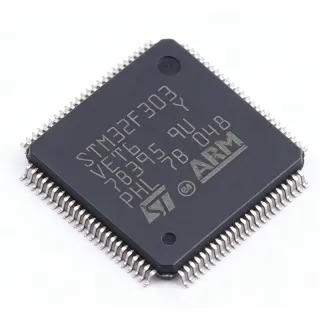
STM32L4S5VIT6 - Ultra-Low-Power ARM Cortex-M4F MCU | STMicroelectronics
MPN: STM32L4S5VIT6 ✓ Active| Qty | Unit Price | Extended |
|---|---|---|
| 1 | $12.5 | $12.50 |
| 10 | $11.25 | $112.50 |
| 100 | $10 | $1,000.00 |
| 500 | $9 | $4,500.00 |
| 1,000 | $8.1 | $8,100.00 |
STM32L4S5VIT6 Overview
What is an ultra-low-power microcontroller? An ultra-low-power microcontroller is a type of embedded processor designed to minimize energy consumption while maintaining computational capability. It typically features multiple low-power modes, such as sleep, stop, and standby, allowing the system to conserve power when idle. In the system hierarchy, an ultra-low-power MCU is a subset of microcontrollers, which are a type of integrated circuit used in embedded systems. The STM32L4 series is specifically optimized for battery-powered and energy-harvesting applications, balancing performance with power efficiency.
Key features of the STM32L4S5VIT6 include a rich set of peripherals: multiple 12-bit ADCs, DACs, timers, communication interfaces (USART, SPI, I2C, CAN, USB OTG), and advanced security features such as a true random number generator (TRNG) and cryptographic acceleration. The device supports a wide supply voltage range from 1.71V to 3.6V, with a typical operating temperature range of -40°C to +85°C. It also features a flexible memory protection unit (MPU) and a memory-mapped external memory interface for expanding storage.
Technically, the STM32L4S5VIT6 leverages ST's proprietary ultra-low-power technology, including a low-power UART, low-power timer, and a real-time clock (RTC) with calendar. The MCU achieves a current consumption as low as 100 nA in standby mode with backup domain, and 3.4 µA in stop mode with RTC. This makes it ideal for always-on sensing applications. The device also includes a high-speed USB OTG controller with PHY, enabling direct connection to USB hosts without external PHY.
Typical applications include industrial sensors, smart meters, wearable devices, medical monitoring equipment, and IoT edge nodes. Its combination of low power, high performance, and rich peripherals allows designers to implement complex algorithms while extending battery life. For example, in a smart meter, the MCU can handle metrology calculations, communication protocols, and display updates while spending most of its time in low-power modes.
When designing with this MCU, pay attention to power supply decoupling: place a 100 nF capacitor close to each VDD pin and a 4.7 µF capacitor on the main supply. Also, configure the clock system carefully to balance performance and power consumption, using the MSI (multi-speed internal) oscillator for low-power operation and the HSE (high-speed external) crystal for precise timing when needed.
Drop-in alternatives for STM32L4S5VIT6 — same package, pin-to-pin compatible. Different-package parts requiring PCB rework are excluded.
Quick Comparison Tool — Select alternative parts for side-by-side comparison:
STM32L4S5VIT6TR
✅ Drop-In📋 Reference alternative (not in catalog)
STM32L4S5VIT6Q
✅ Drop-In ⚠️ Specs Unverified📋 Reference alternative (not in catalog)
STM32L4S5VIT6
✅ Drop-In✓ In Stock
$8.1 / Unit
View Datasheet →STM32L4S5VIT6P
✅ Drop-In ⚠️ Specs Unverified📋 Reference alternative (not in catalog)
STM32L4S5VIT6R
✅ Drop-In ⚠️ Specs Unverified📋 Reference alternative (not in catalog)
STM32L4S5VIT6 Maximum Ratings & Electrical Characteristics
| Core | ARM Cortex-M4 with FPU |
| Maximum Frequency | 120 MHz |
| Flash Memory | 2 MB |
| SRAM | 640 KB |
| Supply Voltage Range | 1.71 V to 3.6 V |
| Operating Temperature Range | -40°C to +85°C |
| Package | LQFP100 (14x14 mm, 0.5 mm pitch) |
| GPIO Pins | 82 |
| ADC | 2x 12-bit, 5 Msps |
| DAC | 2x 12-bit |
| Timers | Multiple 16-bit and 32-bit timers |
| Communication Interfaces | USART, SPI, I2C, CAN, USB OTG |
| Standby Current | 100 nA (with backup domain) |
| Stop Mode Current | 3.4 µA (with RTC) |
| RoHS Status | Compliant |
STM32L4S5VIT6 Pin Configuration
| Pin 1 | VDD — Digital power supply |
| Pin 2 | VSS — Digital ground |
| Pin 3 | PA0 — GPIO/ADC input |
| Pin 4 | PA1 — GPIO/ADC input |
| Pin 5 | PA2 — GPIO/USART2_TX |
| Pin 6 | PA3 — GPIO/USART2_RX |
| Pin 7 | PA4 — GPIO/SPI1_NSS |
| Pin 8 | PA5 — GPIO/SPI1_SCK |
| Pin 9 | PA6 — GPIO/SPI1_MISO |
| Pin 10 | PA7 — GPIO/SPI1_MOSI |
| Pin 11 | VDD — Digital power supply |
| Pin 12 | VSS — Digital ground |
| Pin 13 | PB0 — GPIO/ADC input |
| Pin 14 | PB1 — GPIO/ADC input |
| Pin 15 | PB2 — GPIO/BOOT1 |
| Pin 16 | PB3 — GPIO/JTDO |
| Pin 17 | PB4 — GPIO/NJTRST |
| Pin 18 | PB5 — GPIO/I2C1_SMBA |
| Pin 19 | PB6 — GPIO/I2C1_SCL |
| Pin 20 | PB7 — GPIO/I2C1_SDA |
Typical Applications
STM32L4S5VIT6 is suitable for 6 applications: Industrial Sensors, Wearable Devices, Smart Meters, Medical Monitoring Equipment, IoT Edge Nodes, Audio Processing.
Industrial Sensors
The STM32L4S5VIT6 is ideal for industrial sensors that require high accuracy and low power. Its 12-bit ADCs (up to 5 Msps) enable precise analog signal acquisition, while the 120 MHz Cortex-M4 core handles sensor fusion algorithms. The ultra-low-power modes allow the sensor to run on battery for years, making it suitable for wireless industrial monitoring. In a typical setup, the MCU reads sensor data, processes it, and transmits via a low-power radio, spending most time in stop mode to conserve energy. The large flash memory (2 MB) stores calibration data and firmware updates, and the multiple communication interfaces (SPI, I2C, UART) connect to various sensor modules.
Recommended
Wearable Devices
For wearable devices, the STM32L4S5VIT6 offers a perfect balance of performance and power efficiency. Its 100 nA standby current and 3.4 µA stop mode with RTC enable long battery life, essential for fitness trackers and smartwatches. The MCU can handle real-time health monitoring, including heart rate and activity tracking, using its DSP instructions and FPU. The integrated USB OTG allows direct connection to a host for charging and data transfer. The small LQFP100 package fits into compact PCB designs, and the wide supply voltage range (1.71V to 3.6V) accommodates various battery chemistries. Designers can leverage the low-power UART and timer to wake the system periodically for sensor sampling, minimizing energy consumption.
Recommended
Smart Meters
The STM32L4S5VIT6 is well-suited for smart meters, where accurate measurement and low power are critical. Its multiple 12-bit ADCs can sample voltage and current with high precision, and the 120 MHz core runs metrology algorithms efficiently. The device supports various communication protocols (e.g., PLC, RF) through its USART, SPI, and CAN interfaces. The large flash memory stores tariff tables and historical data, while the RTC maintains timekeeping. In a typical smart meter, the MCU wakes periodically to measure consumption, updates the display, and communicates with the utility network, then returns to low-power mode. The wide operating temperature range (-40°C to +85°C) ensures reliable operation in outdoor environments.
Recommended
Medical Monitoring Equipment
In medical monitoring, the STM32L4S5VIT6 provides the processing power and low-power operation needed for portable devices like glucose monitors and pulse oximeters. Its high-resolution ADCs capture biosignals accurately, and the FPU accelerates signal processing algorithms. The device's security features, including a TRNG and cryptographic acceleration, help protect patient data. The ultra-low-power modes extend battery life, crucial for continuous monitoring. The MCU can interface with various sensors via I2C or SPI, and the USB OTG enables data transfer to a PC or smartphone. The LQFP100 package is suitable for compact medical devices, and the wide temperature range ensures reliable operation in clinical environments.
Recommended
IoT Edge Nodes
The STM32L4S5VIT6 is an excellent choice for IoT edge nodes that require local processing and low power. Its 120 MHz Cortex-M4 core can run machine learning models for anomaly detection, reducing the need for cloud communication. The device supports multiple wireless protocols via external modules (e.g., LoRa, BLE) through its USART or SPI interfaces. The ultra-low-power modes allow the node to run on batteries for years, making it suitable for remote environmental monitoring. The large flash memory stores firmware updates and sensor data, and the security features ensure secure communication. In a typical deployment, the MCU collects sensor data, processes it locally, and transmits only relevant information to the cloud, saving bandwidth and power.
Recommended
Audio Processing
The STM32L4S5VIT6 can handle audio processing tasks such as voice recognition and audio playback. Its 120 MHz Cortex-M4 core with FPU and DSP instructions enables real-time audio filtering and encoding. The device includes multiple I2S interfaces for connecting audio codecs, and the DAC can output analog audio directly. The low-power modes are beneficial for battery-powered audio devices like voice assistants and hearing aids. The large flash memory can store audio samples or voice prompts. In a typical application, the MCU captures audio via a microphone, processes it (e.g., noise reduction), and outputs through a speaker or transmits via Bluetooth. The high-speed USB OTG allows audio streaming to a host.
Recommended
Recommended Products Summary
Engineering reference data for STM32L4S5VIT6 — comparison, design guidance, and compliance information.
Selection Guide
Comparison with Alternatives
| Parameter | This Product | STM32L4S5VIT6TR | STM32L4S5VIT6Q | STM32L4S5VIT6P | STM32L4S5VIT6R |
|---|---|---|---|---|---|
| Package | LQFP100 | LQFP100 - same | LQFP100 - same | LQFP100 - same | LQFP100 - same |
| Brand | STMicroelectronics | STMicroelectronics | STMicroelectronics | STMicroelectronics | STMicroelectronics |
| Core | ARM Cortex-M4 with FPU | ARM Cortex-M4 with FPU | ARM Cortex-M4 with FPU | ARM Cortex-M4 with FPU | ARM Cortex-M4 with FPU |
| Maximum Frequency | 120 MHz | 120 MHz | 120 MHz | 120 MHz | 120 MHz |
| Flash Memory | 2 MB | 2 MB | 2 MB | 2 MB | 2 MB |
| SRAM | 640 KB | 640 KB | 640 KB | 640 KB | 640 KB |
| Standby Current | 100 nA | 100 nA | 100 nA | 100 nA | 100 nA |
Key Differentiators
- Ultra-low standby current of 100 nA (vs STM32L4S5VIT6TR)
- Large 2 MB flash memory (vs STM32L4S5VIT6Q)
- Wide operating temperature range (vs STM32L4S5VIT6Q)
Design Notes
Decouple each VDD pin with a 100 nF ceramic capacitor placed as close as possible to the pin. Additionally, place a 4.7 µF capacitor on the main supply rail. For low-power operation, use the MSI oscillator as the system clock and disable unused peripherals to minimize current consumption.
For the LQFP100 package, ensure proper solder paste stencil design with 0.5 mm pitch. Use a 4-layer PCB with dedicated power and ground planes to reduce noise. Keep high-speed traces (e.g., USB) impedance-controlled and route them away from analog signals.
When using the ADC, ensure the reference voltage is stable and bypassed with a capacitor. For low-power modes, configure the RTC and wake-up sources correctly to avoid unexpected resets. Also, verify the boot configuration pins (BOOT0, BOOT1) to prevent accidental boot from system memory.
Compliance Information
RoHS compliant per STMicroelectronics product page. Not AEC-Q100 qualified.