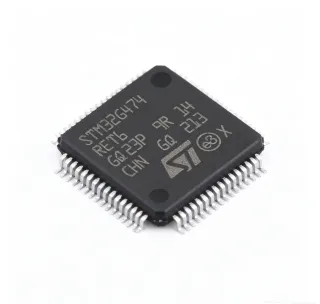
STM32F072RBT6 - 48MHz Cortex-M0 MCU, 128KB Flash | ST
MPN: STM32F072RBT6 ✓ Active| Qty | Unit Price | Extended |
|---|---|---|
| 1 | $3.85 | $3.85 |
| 10 | $3.47 | $34.70 |
| 100 | $3.1 | $310.00 |
| 500 | $2.85 | $1,425.00 |
| 1,000 | $2.6 | $2,600.00 |
STM32F072RBT6 Overview
A microcontroller (MCU) is a single integrated circuit that combines a processor core, memory, and programmable peripherals on one die, forming the lowest level of the embedded-system hierarchy: MCU -> embedded processor -> computing system. The STM32F0 series sits within STMicroelectronics' STM32 family of ARM-based 32-bit MCUs, targeting cost-sensitive designs that still need modern connectivity peripherals.
Key features of the STM32F072RBT6 include a crystal-less USB 2.0 full-speed device interface, which eliminates the external crystal for USB and reduces bill-of-materials cost and PCB area, plus a CAN bus interface and HDMI-CEC support rarely found in entry-level Cortex-M0 devices. It provides up to 51 GPIO pins in the 64-LQFP package, many of them 5V-tolerant, simplifying interfacing with legacy 5V logic.
Architecturally, the device is built around the high-performance ARM Cortex-M0 32-bit RISC core at 48 MHz, with high-speed embedded memories (up to 128 KB Flash and 16 KB SRAM). Peripherals include USART, SPI, I2C, a 12-bit ADC, DAC, timers, and multiple low-power modes, enabling designs spanning consumer, industrial, and IoT applications from a single mainstream platform.
Typical applications include USB device accessories (keyboards, game controllers, USB-C debug tools), CAN-based industrial and automotive-adjacent nodes, motor control and consumer appliances, and smart-home IoT endpoints where the combination of USB, CAN, and rich GPIO density fits well.
A key design consideration: the crystal-less USB relies on a precise internal 48 MHz HSI clock, so USB compliance testing should be planned early; alternatively, an external crystal can still be used when tighter timing accuracy is required.
This page synthesizes distributor pricing context, drop-in alternative analysis, and practical design notes not found in the manufacturer datasheet, providing information gain for engineers comparing STM32F0 options.
Drop-in alternatives for STM32F072RBT6 — same package, pin-to-pin compatible. Different-package parts requiring PCB rework are excluded.
Quick Comparison Tool — Select alternative parts for side-by-side comparison:
STM32F072RBT7
✅ Drop-In ⚠️ 参数待验证📋 Reference alternative (not in catalog)
STM32F070RBT6
✅ Drop-In ⚠️ 参数待验证📋 Reference alternative (not in catalog)
STM32F071RBT6
✅ Drop-In ⚠️ 参数待验证📋 Reference alternative (not in catalog)
HK32F072RBT6
✅ Drop-In📋 Reference alternative (not in catalog)
STM32F072RBT6 Maximum Ratings & Electrical Characteristics
| Core | ARM Cortex-M0 32-bit |
| Max CPU Frequency | 48 MHz |
| Flash Memory | 128 KB |
| SRAM | 16 KB |
| Package | LQFP-64 (10x10 mm) |
| Mounting Type | Surface Mount |
| GPIO Count (LQFP-64) | 51 I/O |
| Supply Voltage Range | 2.0 V to 3.6 V |
| USB | USB 2.0 full-speed device (crystal-less capable) |
| CAN | Yes (bxCAN) |
| Communication Interfaces | USART, SPI, I2C, HDMI-CEC |
| ADC | 12-bit ADC |
| DAC | Yes |
| Operating Temperature | -40C to +85C (suffix 6) |
| Series | STM32F0 (Mainstream) |
| RoHS Status | Compliant |
STM32F072RBT6 lqfp-64 (10x10 mm) Pin Configuration Guide
Pin configuration for STM32F072RBT6 (lqfp-64 (10x10 mm) package). This digital IC includes GPIO, communication interfaces (UART, SPI, I2C), and power pins. Refer to the manufacturer datasheet for alternate pin functions and configuration options. Essential for embedded system design and PCB layout.

No detailed pinout data available for STM32F072RBT6.
Refer to the datasheet for full pin configuration.
Typical Applications
STM32F072RBT6 is suitable for 6 applications: USB Device Accessories, CAN Industrial Nodes, Motor Control and Appliances, IoT and Smart Home Endpoints, HDMI-CEC Consumer Electronics Control, Test and Debug Tooling.
USB Device Accessories
The STM32F072RBT6 is a strong fit for USB HID peripherals such as keyboards, mice, game controllers, and custom USB-C debug accessories because its crystal-less USB 2.0 full-speed device controller derives the 48 MHz clock from USB SOF packets, removing the external crystal and cutting BOM cost and PCB area. The 128 KB Flash accommodates USB stacks, HID descriptors, and application firmware with headroom, while 5V-tolerant GPIOs simplify interface to legacy logic. Placed as the main MCU with direct USB D+/D- connection and 10 kOhm/1.5 kOhm termination per the datasheet reference, it passes full-speed signaling requirements; compliance pre-testing is recommended since timing derives from the internal HSI rather than a crystal.
Recommended
CAN Industrial Nodes
For industrial control nodes, sensor gateways, and actuator modules on CAN networks, the STM32F072RBT6's integrated bxCAN controller provides hardware message filtering and mailboxes without an external CAN controller, which few Cortex-M0 devices at this price offer. The -40C to +85C temperature grade suits cabinet and factory-floor environments, and the 51 GPIOs with multiple timers support local PWM actuation. Typical topology pairs the MCU with a 3.3V CAN transceiver on the TX/RX pins and 120 Ohm bus termination; the bxCAN handles arbitration and error frames in hardware, offloading the 48 MHz Cortex-M0. Firmware portability across the pin-compatible STM32F070RBT6 (no CAN) and STM32F072RBT7 (+105C) simplifies product-family derivative management.
Recommended
Motor Control and Appliances
In fan, pump, and small appliance motor control, the STM32F072RBT6 combines multiple advanced-control timers with complementary PWM outputs, a 12-bit ADC for current and BEMF sensing, and fast Cortex-M0 interrupt response at 48 MHz, enabling sensorless BLDC commutation in the mainstream cost tier. Its 128 KB Flash leaves room for control algorithms plus communication (USART or CAN for status reporting to a host board). The MCU drives a MOSFET gate-driver stage from timer PWM outputs while the ADC samples shunt current with injected conversions synchronized to PWM. For designs needing higher ambient ratings, the pin-compatible STM32F072RBT7 extends the range to +105C without PCB changes.
Recommended
IoT and Smart Home Endpoints
Smart-home nodes such as connected switches, environmental sensors, and actuators leverage the STM32F072RBT6's rich peripheral mix: USART or SPI links to Wi-Fi/BLE modules, I2C for sensor ICs, the 12-bit ADC for analog sensing, and multiple low-power modes that cut current in battery-assisted designs. The 128 KB Flash and 16 KB SRAM comfortably hold a sensor driver stack plus a communication protocol such as MQTT over an external radio module. Operating from 2.0V-3.6V allows direct lithium-cell or 3.3V rail operation. Because the USB and CAN peripherals go unused in many such nodes, the pin-compatible, lower-cost STM32F070RBT6 is a valid derivative option within the same footprint.
Recommended
HDMI-CEC Consumer Electronics Control
The STM32F072RBT6's integrated HDMI-CEC peripheral makes it one of the few entry-level MCUs able to implement consumer-electronics control logic directly, useful in set-top box accessories, HDMI switchgear, TV-attached dongles, and AV remote-control bridges. The hardware CEC block handles bit timing and arbitration per the HDMI CEC physical layer, offloading the 48 MHz Cortex-M0 core, while 128 KB Flash stores protocol handlers and IR/USB bridging code in combo products. Designs typically connect the CEC pin through a level-shifting buffer to the HDMI connector per ST application guidance. Combined with crystal-less USB, the part can bridge USB remote updates to CEC-controlled devices in a single low-cost MCU.
Recommended
Test and Debug Tooling
The STM32F072RBT6 powers low-cost debuggers, USB-CPD sniffers, and data-loggers because ST's own ST-LINK/V2-1 firmware historically runs on STM32F072 devices, and the Nucleo-64 and Discovery kits built around this family provide reference designs. The 12-bit ADC plus DMA captures analog channels while USB full-speed streams data to a host, and 51 GPIOs expose protocol-tapping interfaces (SPI/I2C/UART sniffing). The -40C to +85C grade covers bench and field deployment, and CAN monitoring is supported natively via bxCAN. Flash longevity and ST's long-term STM32F0 availability commitment make the part suitable for instruments intended for multi-year service.
Recommended
Recommended Products Summary
Engineering reference data for STM32F072RBT6 — comparison, design guidance, and compliance information.
Selection Guide
Comparison with Alternatives
| Parameter | This Product | STM32F072RBT7 | STM32F070RBT6 | STM32F071RBT6 | HK32F072RBT6 |
|---|---|---|---|---|---|
| Package | LQFP-64 (10x10 mm) | LQFP-64 (10x10 mm) - same | LQFP-64 (10x10 mm) - same | LQFP-64 (10x10 mm) - same | LQFP-64 (10x10 mm) - same |
| Brand | STMicroelectronics | STMicroelectronics | STMicroelectronics | STMicroelectronics | HK Micro |
| Core / Frequency | Cortex-M0, 48 MHz | Cortex-M0, 48 MHz | Cortex-M0, 48 MHz | Cortex-M0, 48 MHz | Cortex-M0 class, 48 MHz (claimed) |
| Flash / SRAM | 128 KB / 16 KB | 128 KB / 16 KB | 128 KB / 16 KB | 128 KB / 16 KB | 128 KB / 16 KB (claimed) |
| USB | USB 2.0 FS device (crystal-less) | USB 2.0 FS device (crystal-less) | USB 2.0 FS device (crystal-less) | No USB | USB FS device (claimed compatible) |
| CAN | Yes (bxCAN) | Yes (bxCAN) | No | No | Yes (claimed compatible) |
| HDMI-CEC / DAC | Yes / Yes | Yes / Yes | No / No | No / Yes | Yes / Yes (claimed) |
Key Differentiators
- USB plus CAN in an entry-level Cortex-M0 (vs STM32F070RBT6)
- Extended temperature drop-in available (vs STM32F072RBT7)
- Crystal-less USB reduces BOM (vs STM32F071RBT6)
Design Notes
The STM32F072RBT6 operates from a single 2.0V-3.6V supply with internal 1.5V/1.8V regulators for the core. Decouple each VDD pin with 100 nF ceramics placed within 2 mm of the pin, plus a single 4.7-10 uF bulk capacitor per supply rail, and tie VDDA/VSSA to a filtered analog supply (ferrite bead plus 1 uF + 10 nF) when ADC accuracy matters. Estimated: at 48 MHz full-speed execution, typical active current is in the low tens of mA (per datasheet electrical characteristics), so a 3.3V LDO rated at 100 mA or more provides comfortable margin.
For crystal-less USB operation, keep the USB D+/D- traces as a 90-ohm differential pair, matched in length, routed away from switching regulators and clock lines; add series ESD protection such as a USBLC6-2SC6 at the connector. If an HSE crystal is used for tighter timing, place it within 5 mm of the OSC pins with short guard ground. BOOT0 must be pulled to GND through a 10 kOhm resistor to prevent the device booting into the system bootloader at power-up, a common bring-up pitfall on first-turn boards.
Flash programming across the 128 KB array requires the correct wait-state configuration at 48 MHz (zero wait states apply up to 24 MHz; verify against the datasheet latency table). When migrating firmware from an STM32F070RBT6 or STM32F071RBT6, remember the F072 clock tree enables USB clock recovery and additional peripherals - mismatched clock-tree init is a frequent source of USB enumeration failures. Also confirm option-byte configuration (nBOOT0, read-out protection) before mass programming, since incorrect option bytes can lock production units.
Compliance Information
RoHS compliant per STMicroelectronics product listing. REACH, halogen-free and conflict-minerals status not stated in provided data.