STMicroelectronics

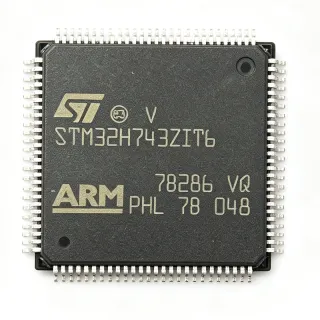
STM32U575ZIT6 - 160MHz Cortex-M33 MCU 2MB Flash | ST

MPN: STM32U575ZIT6 βœ“ Active
In Stock Ships in 1-3 business days
144-LQFP (20x20 mm) Package 160 MHz Speed 2 MB (2M x 8) Memory
From $8.9 USD / Unit
MOQ: 1 |
Price updated: 2026-09-05
Volume Pricing
Qty Unit Price Extended
1 $12.9 $12.90
10 $11.61 $116.10
100 $10.32 $1,032.00
500 $9.55 $4,775.00
1,000 $8.9 $8,900.00
ℹ️ All prices are in USD

STM32U575ZIT6 Overview

The STMicroelectronics STM32U575ZIT6 is an ultra-low-power 32-bit microcontroller based on the Arm Cortex-M33 core running at 160 MHz, delivering 240 DMIPS with 2 MB of Flash memory and 786 KB of SRAM, housed in a 144-pin LQFP (20x20 mm) package with Arm TrustZone and hardware FPU.

A microcontroller (MCU) is a single integrated circuit that combines a processor core, memory, and peripherals into one chip, forming the lowest programmable layer of the embedded systems hierarchy (MCU -> embedded processor -> semiconductor device). The STM32U5 series extends the widely adopted STM32 family with ST's latest ultra-low-power process technology, targeting battery-powered and energy-harvesting designs that previously could not afford high compute performance.

Key features include the Cortex-M33 core with TrustZone security and FPU, 2 MB (2M x 8) on-chip Flash for large application images and OTA updates, 786 KB SRAM for buffering and DSP workloads, and an ultra-low-power architecture with multiple sleep modes for extended battery life.

Technically, the STM32U575xx integrates a rich peripheral set typical of the STM32 ecosystem, including multiple USART/LPUART, SPI, I2C, USB, ADC/DAC channels, timers, and ST's ART Accelerator-style memory optimizations. Per the manufacturer datasheet, the family achieves up to 240 DMIPS, placing it among the most capable ultra-low-power Cortex-M33 MCUs on the market.

Typical applications include battery-powered industrial sensors, smart metering, wearable and portable medical devices, and secure IoT edge nodes where TrustZone-based isolation is required. The 144-LQFP pin count supports designs needing abundant GPIO, parallel displays, and multiple communication buses simultaneously.

A key design consideration is power-mode configuration: to achieve datasheet-level consumption figures, engineers must correctly configure clock gating and low-power run modes via STM32CubeU5 firmware libraries rather than relying on default startup code.

This page synthesizes verified distributor data, same-family drop-in alternatives, and practical design guidance not consolidated in the manufacturer datasheet, helping engineers and buyers compare, source, and qualify the STM32U575ZIT6 faster.

Drop-in alternatives for STM32U575ZIT6 β€” same package, pin-to-pin compatible. Different-package parts requiring PCB rework are excluded.

Variants in this series

Same-series models that are drop-in compatible with STM32U575ZIT6 (same form factor and footprint) β€” differing in Core, Security.

STMicroelectronics
Core: Arm 32-bit Cortex-M33 with FPU and TrustZone
Security: Arm TrustZone, hardware cryptographic accelerator
Compare with STM32U575ZIT6 β†’

Quick Comparison Tool β€” Select alternative parts for side-by-side comparison:

STM32U575ZIT6Q

βœ… Drop-In
πŸ“¦ 144-LQFP (20x20)
identical die and pinout; Q suffix denotes qualified packaging variant, no electrical difference

πŸ“‹ Reference alternative (not in catalog)

STM32U585ZIT6Q

βœ… Drop-In
πŸ“¦ 144-LQFP (20x20)
same 160 MHz Cortex-M33, 2 MB Flash, same footprint; adds enhanced cryptographic/security hardware vs U575

πŸ“‹ Reference alternative (not in catalog)

STM32U575ZJT6

βœ… Drop-In ⚠️ 参数待ιͺŒθ―
πŸ“¦ 144-LQFP (20x20)
same 2 MB Flash and 160 MHz core, increased SRAM (~1 MB class vs 786 KB) in same 144-LQFP pinout

πŸ“‹ Reference alternative (not in catalog)

STM32U575ZGT6

βœ… Drop-In ⚠️ 参数待ιͺŒθ―
πŸ“¦ 144-LQFP (20x20)
Flash reduced to 1 MB vs 2 MB (-50%), same core, package and pinout; lower cost option

πŸ“‹ Reference alternative (not in catalog)

STM32U575VIT6

βœ… Drop-In
πŸ“¦ 144-LQFP (20x20)
same core and memory (2 MB Flash), 100-pin LQFP with fewer GPIOs - requires footprint change

πŸ“‹ Reference alternative (not in catalog)

STM32U575ZIT6 Maximum Ratings & Electrical Characteristics

Core Arm Cortex-M33 32-bit with TrustZone and FPU
Core Clock Frequency 160 MHz
Performance 240 DMIPS
Flash Memory 2 MB (2M x 8)
SRAM 786 KB
Data Bus Width 32 bit
Series STM32U5
Security Arm TrustZone
Package 144-LQFP (20x20 mm)
Mounting Type Surface Mount
Low Power Ultra-low-power family (STM32U5)

STM32U575ZIT6 144-lqfp (20x20 mm) Pin Configuration Guide

Pin configuration for STM32U575ZIT6 (144-lqfp (20x20 mm) package). This digital IC includes GPIO, communication interfaces (UART, SPI, I2C), and power pins. Refer to the manufacturer datasheet for alternate pin functions and configuration options. Essential for embedded system design and PCB layout.

144-lqfp (20x20 mm) package pinout diagram for STM32U575ZIT6

No detailed pinout data available for STM32U575ZIT6.

Refer to the datasheet for full pin configuration.

Typical Applications

STM32U575ZIT6 is suitable for 6 applications: Battery-Powered Industrial Sensors, Smart Metering, Wearable and Portable Medical Devices, Secure IoT Edge Nodes, Portable Audio and HMI Devices, Building Automation and Connected Home.

🏭

Battery-Powered Industrial Sensors

The STM32U575ZIT6 fits industrial wireless sensor nodes because its ultra-low-power STM32U5 architecture keeps sleep currents in the microamp range while the 160 MHz Cortex-M33 delivers 240 DMIPS for on-node signal processing such as FFT-based vibration analysis. The 786 KB SRAM buffers acquisition windows without external RAM. Typical topology: sensor front-end into the on-chip ADC, burst processing in low-power run mode, then radio transmission via SPI. Unlike higher-power Cortex-M4/M7 MCUs, the U575 achieves multi-year coin-cell or energy-harvesting operation, trading peak throughput (lower than an H7) for dramatically longer field life.

⚑

Smart Metering

Smart electricity and water meters benefit directly from the STM32U575ZIT6's combination of 2 MB Flash and TrustZone security. The 2 MB Flash stores metrology firmware plus multiple secure OTA update images, while TrustZone isolates billing-critical key material and secure boot code from the application domain. The 144-pin LQFP provides enough GPIO for multiple communication interfaces simultaneously - UART for PLC modems, SPI for metering ASICs, and I2C for tamper switches. Because meters must run for 10+ years, the U5 series' ultra-low-power stop modes directly reduce battery and maintenance cost versus the previous STM32L4 generation.

πŸ’Š

Wearable and Portable Medical Devices

For wearables, patches, and portable diagnostics, the STM32U575ZIT6 offers the rare combination of Cortex-M33 compute, hardware FPU for biosignal algorithms, and ultra-low-power modes that extend battery life in always-on monitoring. The 160 MHz core executes filtering and arrhythmia detection locally on the 786 KB SRAM, avoiding constant cloud streaming. TrustZone supports patient-data confidentiality expected in medical designs. In a typical signal chain, analog front ends connect through I2C/SPI while the USB peripheral handles docking and charging. The trade-off versus larger medical MCUs is lower peak throughput, but battery constraint usually dominates here.

🧩

Secure IoT Edge Nodes

The STM32U575ZIT6 is well suited to secure IoT edge nodes because Arm TrustZone provides hardware-enforced separation of secure firmware, cryptographic keys, and the RTOS/application world - increasingly required by cloud provisioning standards. The 2 MB Flash accommodates TLS stacks and large application images with room for A/B OTA updates. Per the ST datasheet, the family delivers 240 DMIPS at 160 MHz, enough for local protocol handling (MQTT, BLE stacks) without a companion processor. Compared with the STM32L5, the U575 adds more memory and peripherals at similar power, making it the stronger choice for feature-rich secure nodes.

🎧

Portable Audio and HMI Devices

Handheld devices with displays and audio benefit from the STM32U575ZIT6's abundant 144-pin GPIO count, which drives parallel RGB or serial displays via SPI/FMC while the hardware FPU accelerates audio DSP such as filtering and codecs. The 160 MHz Cortex-M33 with 786 KB SRAM supports graphical frameworks (TouchGFX-class UIs) with frame buffers in on-chip SRAM, avoiding external memory in many designs. Ultra-low-power stop modes keep the product responsive to touch wake events while preserving battery. Compared to an application processor, the U575 gives deterministic real-time behavior and instant-on at far lower quiescent power.

🌐

Building Automation and Connected Home

Building automation controllers use the STM32U575ZIT6 to consolidate multiple buses - I2C sensors, SPI actuators, multiple UARTs for RS-485 gateways - on one 144-pin device, reducing BOM count versus smaller packages. The ultra-low-power profile matters for battery-powered thermostats, door locks, and occupancy sensors that must survive a season on batteries while running Zigbee/Thread-class stacks in the 2 MB Flash. TrustZone isolates commissioning credentials from user applications. Against the STM32F4 used in older designs, the U575 cuts sleep power by an order of magnitude while keeping familiar STM32 tooling and HAL compatibility.

Recommended Products Summary

SPSGRF-915 Sub-GHz radio SPI module for wireless uplink Used in: Battery-Powered Industrial Sensors, Secure IoT Edge Nodes STEVAL-MKI207V1 Accelerometer sensor daughterboard for vibration sensing Used in: Battery-Powered Industrial Sensors STPM32 Metering ASIC over SPI for energy measurement Used in: Smart Metering ST25DV64KC Dynamic NFC tag for configuration and service access Used in: Smart Metering LIS2DW12 Ultra-low-power accelerometer for activity tracking Used in: Wearable and Portable Medical Devices STTS22H Low-power temperature sensor for health monitoring Used in: Wearable and Portable Medical Devices STSAFE-A110 Secure element for device identity and key storage Used in: Secure IoT Edge Nodes STA013 MP3 audio decoder companion Used in: Portable Audio and HMI Devices LIS3DH Motion sensor for wake-on-motion and tap UI Used in: Portable Audio and HMI Devices SPSGRF-868 868 MHz radio module for wireless scenes Used in: Building Automation and Connected Home SHT40-AD1B Humidity/temperature sensor over I2C Used in: Building Automation and Connected Home
What is the STM32U575ZIT6 microcontroller?
The STM32U575ZIT6 is an ultra-low-power 32-bit microcontroller from STMicroelectronics based on the Arm Cortex-M33 core with TrustZone and FPU. It runs at 160 MHz (240 DMIPS), integrates 2 MB of Flash and 786 KB of SRAM, and comes in a 144-pin LQFP (20x20 mm) package. According to the ST STM32U575xx datasheet, it belongs to the STM32U5 ultra-low-power series.
What is the price of STM32U575ZIT6?
On this page, STM32U575ZIT6 is priced from approximately $12.90 at quantity 1, scaling to about $8.90 at quantity 1000, as of 2026-09-06. Actual pricing varies by distributor and market conditions; Octopart lists 9 distributors carrying this part, so comparing quotes from authorized channels such as DigiKey and Mouser is recommended before placing volume orders.
Where to buy STM32U575ZIT6 online?
The STM32U575ZIT6 can be purchased from authorized distributors including DigiKey (product ID 18085392) and Mouser, both of which list the part as shippable, and price comparisons are available via Octopart, which aggregates quotes from 9 distributors. On XAIPART, request a quote directly from this product page. Always verify stock and lead time at checkout, since STM32U5 series availability fluctuates with demand.
Is STM32U575ZIT6 in stock and what is the lead time?
Stock status changes frequently. As of the latest distributor snapshot (2026-09-06), DigiKey and Mouser product pages for the STM32U575ZIT6 indicate buy-now availability with same-day shipping options for in-stock quantities. For large volume orders, lead time is typically quoted by the distributor at checkout. Confirm current inventory on the distributor pages linked in the data sources before committing to a production schedule.
What is the difference between STM32U575ZIT6 and STM32U575ZIT6Q?
Both are 2 MB Flash, 160 MHz Cortex-M33 MCUs in the same 144-LQFP (20x20 mm) package. The 'Q' suffix denotes ST's ECOPACK2/qualified packaging variant with identical electrical functionality and pinout, so they are drop-in interchangeable on the same PCB footprint. Per the DigiKey listings for both part numbers, specifications are identical; choose based on packaging compliance requirements and price rather than performance.
Can STM32U585ZIT6 replace STM32U575ZIT6?
Yes, the STM32U585ZIT6 is a close same-family alternative in the same 144-LQFP package with the same 160 MHz Cortex-M33 core, 2 MB Flash, and pin-compatible footprint. The key difference is enhanced security hardware (the U585 adds additional cryptographic acceleration). Code written for the U575 generally runs on the U585, but always review the STM32U585 datasheet errata and security peripheral differences before a production swap.
STM32U575ZIT6 vs STM32U575ZGT6 - which should I choose?
Choose the STM32U575ZIT6 when your firmware plus OTA headroom needs 2 MB of Flash; choose the ZGT6 variant (1 MB Flash, same package and pinout) when memory requirements are smaller and unit cost matters more. Both run at 160 MHz with 786 KB-class SRAM in the same 144-LQFP footprint, so switching between them requires no PCB change, only a Flash-size check in the linker script and bootloader.
Is there a cross-brand equivalent for the STM32U575ZIT6?
No verified pin-to-pin cross-brand equivalent exists in our cross-reference data. Generic guides mention NXP i.MX RT, Microchip SAM L, TI MSP432, and Chinese GD32/AT32 families as functional competitors, but none are confirmed drop-in compatible in the 144-LQFP footprint with TrustZone and 2 MB Flash. Swapping to a cross-brand MCU requires board redesign and driver rework, so we recommend same-family ST alternatives first.
What is the best drop-in replacement for STM32U575ZIT6?
The best drop-in replacement is the STM32U575ZIT6Q, which is the identical device in ST's qualified packaging variant - same 144-LQFP package, pinout, 160 MHz Cortex-M33 core, 2 MB Flash, and 786 KB SRAM. Other same-footprint same-family options are the STM32U585ZIT6 (enhanced security) and STM32U575ZJT6 (more SRAM), both pin-to-pin compatible. All require no PCB or layout changes.
Where to download the STM32U575ZIT6 datasheet PDF?
Download the official STM32U575xx datasheet PDF directly from STMicroelectronics at st.com (the STM32U575AG datasheet covers the STM32U575xx family including the ZIT6). A direct link is provided in the data sources section of this page. Beware of third-party mirror sites with outdated revisions; ST's own product page at st.com/en/microcontrollers-microprocessors/stm32u575zi.html always hosts the current revision plus errata sheets.
Where can I find the STM32U575ZIT6 pinout?
The complete 144-pin LQFP pinout for the STM32U575ZIT6 is documented in the pinout tables of the official STM32U575xx datasheet on st.com, listing each pin's AF (alternate function) mapping for USART, SPI, I2C, timers, and power pins. ST's STM32CubeMX tool also generates an interactive pinout diagram with conflict detection. Due to the 144-pin complexity, we do not reproduce the full pin table on this page.
What are the key specifications of STM32U575ZIT6 engineers should know?
Core facts: Arm Cortex-M33 32-bit core with TrustZone and FPU at 160 MHz, delivering 240 DMIPS; 2 MB on-chip Flash; 786 KB SRAM; 144-pin LQFP (20x20 mm) surface-mount package; member of the STMicroelectronics STM32U5 ultra-low-power series. These figures come from the ST datasheet and DigiKey product listing. Peripheral set spans USART, SPI, I2C, USB, ADC, and timers typical of the STM32 ecosystem.
Is the STM32U575ZIT6 suitable for battery-powered IoT devices?
Yes - it is explicitly designed for this use case. The STM32U5 series is ST's ultra-low-power flagship: the Cortex-M33 core with multiple low-power run and stop modes lets the device sleep at microamp-level currents between wakeups while retaining 160 MHz performance for burst processing. With 2 MB Flash for secure OTA firmware updates and TrustZone for key isolation, it fits battery-powered sensors, smart metering, and asset trackers well.
What development tools support the STM32U575ZIT6?
The STM32U575ZIT6 is fully supported by ST's STM32Cube ecosystem: STM32CubeIDE (free Eclipse-based IDE), STM32CubeMX for graphical peripheral and clock configuration, STM32CubeU5 firmware packages with HAL/LL drivers, and STM32CubeMonitor for power profiling. Third-party toolchains including Keil MDK, IAR EWARM, and GCC also support the Cortex-M33 with TrustZone. Debugging works via SWD with ST-LINK/V3 probes on the 144-LQFP JTAG/SWD pins.
Hey Google, what can replace the STM32U575ZIT6?
Pin-to-pin replacements are limited to the same ST family: STM32U575ZIT6Q (identical, qualified packaging), STM32U585ZIT6 (enhanced security hardware), STM32U575ZJT6 (more SRAM), and STM32U575ZGT6 (1 MB Flash for lower cost) - all share the same 144-LQFP footprint. Functionally similar but NOT drop-in options include NXP's LPC55S69, Microchip SAM L11, and GigaDevice GD32W series, which need board and firmware redesign.
Is the STM32U575ZIT6 still in production and recommended for new designs?
Yes. The STM32U575ZIT6 is an active, current-generation part in STMicroelectronics' STM32U5 portfolio, launched as part of ST's latest ultra-low-power MCU roadmap and explicitly recommended for new designs. Distributors including DigiKey and Mouser list it as an orderable production part as of 2026-09-06. There is no end-of-life or last-time-buy notice in the available data, and ST continues to expand the STM32U5 ecosystem.

Engineering reference data for STM32U575ZIT6 β€” comparison, design guidance, and compliance information.

Selection Guide

Choose the STM32U575ZIT6 when you need 160 MHz Cortex-M33 performance with TrustZone, 2 MB Flash for OTA-capable firmware, and 786 KB SRAM in a GPIO-rich 144-pin LQFP - the sweet spot for secure battery-powered IoT, metering, and portable devices. Choose STM32U575ZIT6Q when procurement requires the qualified packaging variant (identical function). Choose STM32U585ZIT6Q when your security certification requires enhanced hardware crypto. Choose STM32U575ZJT6 when SRAM is the binding constraint. Choose STM32U575ZGT6 to save cost at 1 MB Flash. Avoid cross-brand parts (NXP, Microchip, TI, GD32) if footprint preservation matters - none are verified pin-compatible in LQFP-144 and require full redesign. Note the STM32U575VIT6 is a different (100-pin) footprint and is NOT drop-in.

Comparison with Alternatives

Parameter This Product STM32U575ZIT6Q STM32U585ZIT6Q STM32U575ZJT6 STM32U575VIT6
Package 144-LQFP (20x20 mm) 144-LQFP (20x20) - same 144-LQFP (20x20) - same 144-LQFP (20x20) - same 100-LQFP - different
Brand STMicroelectronics STMicroelectronics STMicroelectronics STMicroelectronics STMicroelectronics
Core / Frequency Cortex-M33 @ 160 MHz Cortex-M33 @ 160 MHz Cortex-M33 @ 160 MHz Cortex-M33 @ 160 MHz Cortex-M33 @ 160 MHz
Flash Memory 2 MB 2 MB 2 MB 2 MB 2 MB
Security Features TrustZone TrustZone TrustZone + enhanced crypto acceleration TrustZone TrustZone
Pin-to-Pin Compatible Reference Yes Yes Yes No (100-pin)

Key Differentiators

  • Identical die in qualified packaging (vs STM32U575ZIT6Q)
  • Balanced cost vs security (vs STM32U585ZIT6Q)
  • More SRAM headroom option (vs STM32U575ZJT6)

Design Notes

To realize the STM32U5 series' ultra-low-power figures, do not rely on default startup code: use STM32CubeMX/CubeU5 to configure low-power run and stop modes, and explicitly gate clocks of unused peripherals. Estimated: with typical sleep currents in the low-microamp range versus milliamps in run mode at 160 MHz, duty-cycling (sleep 99% of the time) reduces average current by roughly two orders of magnitude - the dominant factor in battery-life calculations for sensor nodes.

Decouple each VDD/VDDA pin of the 144-LQFP with 100 nF ceramics placed within a few millimeters of the pin, plus bulk 4.7-10 uF near the package. Follow the datasheet power-supply recommendations for VCAP decoupling of the internal regulator and keep VDDA on a clean analog supply (ferrite or dedicated LDO) when using the ADC for precision measurements. The 20x20 mm LQFP has 0.5 mm pitch - use NSMD pads and inspect with AOI for production yield.

TrustZone is enabled out of the reset on STM32U5 for secure boot flows; if your application does not use TrustZone, configure the option bytes (TZEN) and provision a correct secure image, otherwise flash programming and debug access can appear blocked - a very common first-bring-up issue reported in ST community forums. Always provision SAU/GTZC regions in the linker scripts when mixing secure and non-secure code, and test the swap between U575 and U585 parts on the same board before qualifying both.

Compliance Information

RoHS
Unknown
REACH
Unknown
AEC-Q100
Not Applicable
Lead Free
Unknown
Halogen Free
Unknown
Conflict Minerals
Unknown

Compliance data not present in the provided verified web data; verify on the ST product page (st.com) ECOPACK declaration before design-in.
Data verified on: 2026-09-06 β€” data verified and curated by XAIPART's component engineering team

Related Searches

STM32U575ZIT6 datasheet STMicroelectronics STM32U575ZIT6 STM32U575ZIT6 price buy STM32U575ZIT6 144-LQFP microcontroller STM32U575ZIT6 vs STM32U585 STM32U575ZIT6 drop-in replacement ultra-low-power Cortex-M33 2MB Flash MCU STM32U575ZIT6 battery powered IoT sensor STM32U575ZIT6 pinout LQFP144 what can replace STM32U575ZIT6 STM32U575ZIT6Q difference STM32U5 series TrustZone microcontroller

Related Components & Terms

STMicroelectronics STM32U575ZIT6 STM32U575ZIT6Q STM32U585ZIT6Q STM32U575ZJT6 STM32U575ZGT6 STM32U5 series Arm Cortex-M33 TrustZone microcontroller 32-bit MCU LQFP-144 QFN/QFP family surface mount RoHS DMIPS FPU ultra-low-power MCU STM32Cube smart metering battery-powered IoT sensor SRAM Flash memory 240 DMIPS 160 MHz
Quick Quote RFQ
Fill in complete details β€” our sales team will respond within 24 hours
Part Number Manufacturer Package QTY Target Price Extended
Total: $0.00 USD
βœ“
Quote submitted!

We will respond to your email within 24 hours

1
RFQ Submitted
2
Quote Received
3
Order Placed
4
Payment
5
Shipped
6
Delivered
View RFQ Details