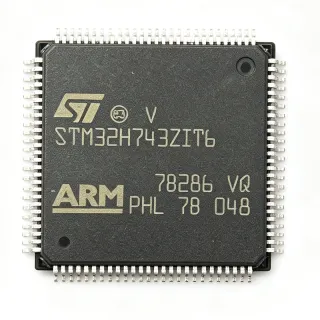
STM32H723ZGT6 - 550MHz Cortex-M7 MCU, 1MB Flash | ST
MPN: STM32H723ZGT6 ✓ Active| Qty | Unit Price | Extended |
|---|---|---|
| 1 | $8.19 | $8.19 |
| 10 | $7.78 | $77.80 |
| 100 | $7.21 | $721.00 |
| 500 | $6.8 | $3,400.00 |
| 1,000 | $6.39 | $6,390.00 |
STM32H723ZGT6 Overview
A microcontroller (MCU) is a single-chip computer that integrates a processor core, memory, and peripherals on one die, forming the top of the embedded processing hierarchy that also spans DSPs and application processors. The STM32H7 family sits at the high-performance end of the STM32 portfolio, targeting real-time control and signal-processing workloads that previously required a separate DSP.
Key features include the Cortex-M7 core with double-precision FPU and L1 cache, an external memory interface, and 35 communication peripherals and analog interfaces. Integrated Ethernet, USB, and 3x FDCAN controllers make the device well suited for connected industrial nodes, while 2x 16-bit ADCs with 12-bit resolution handle multi-channel analog acquisition.
Architecturally, the STM32H723 combines the DSP and double-precision floating-point capabilities of the Cortex-M7 with ST ART Accelerator prefetch logic, enabling execution from internal Flash at full core speed. The 564 KB RAM is organized in multiple blocks (including DTCM/ITCM) to sustain deterministic real-time behavior at 550 MHz.
Typical applications include drone flight controllers (ArduPilot/PX4 autopilots such as Cube Orange+/Purple class hardware), industrial automation and motor control, and connected IoT gateways using the integrated Ethernet and FDCAN interfaces.
When designing with the STM32H723ZGT6, budget the 550 MHz core supply rail (VOS0 operation) carefully and verify that peripheral subsets required by your firmware are present in this family member; pin-compatible H7 siblings differ in memory size and clock ceiling.
This page synthesizes distributor pricing, drop-in alternatives, and practical design notes not found in the manufacturer datasheet.
Drop-in alternatives for STM32H723ZGT6 — same package, pin-to-pin compatible. Different-package parts requiring PCB rework are excluded.
Variants in this series
Same-series models that are drop-in compatible with STM32H723ZGT6 (same form factor and footprint) — differing in Core, Flash Memory, Package, ADC, Communication Interfaces.
Quick Comparison Tool — Select alternative parts for side-by-side comparison:
STM32H743ZIT6
✅ Drop-In✓ In Stock
$8.55 / Unit
View Datasheet →STM32H725ZGT6
✅ Drop-In✓ In Stock
$8.1 / Unit
View Datasheet →STM32H733ZGT6
✅ Drop-In📋 Reference alternative (not in catalog)
STM32H730ZBT6
✅ Drop-In📋 Reference alternative (not in catalog)
STM32H743ZGT6
✅ Drop-In ⚠️ 参数待验证📋 Reference alternative (not in catalog)
STM32H723ZGT6 Maximum Ratings & Electrical Characteristics
| Core | 32-bit Arm Cortex-M7 with DP-FPU |
| Maximum CPU Frequency | 550 MHz |
| Flash Memory | 1 MB |
| SRAM | 564 KB |
| Cache | L1 cache (instruction and data) |
| ADC Resolution | 12-bit (2x 16-bit ADCs) |
| CAN Interfaces | 3x FDCAN |
| Ethernet | Yes (integrated MAC) |
| USB | Yes |
| External Memory Interface | Yes |
| Peripherals & Analog Interfaces | 35 communication peripherals and analog interfaces |
| Package | 144-LQFP (20x20 mm) |
| Mounting Type | Surface Mount |
| MSL Level | 3 |
| RoHS Status | Compliant |
| Series | STM32H7 |
STM32H723ZGT6 144-lqfp (20x20 mm) Pin Configuration Guide
Pin configuration for STM32H723ZGT6 (144-lqfp (20x20 mm) package). This digital IC includes GPIO, communication interfaces (UART, SPI, I2C), and power pins. Refer to the manufacturer datasheet for alternate pin functions and configuration options. Essential for embedded system design and PCB layout.

No detailed pinout data available for STM32H723ZGT6.
Refer to the datasheet for full pin configuration.
Typical Applications
STM32H723ZGT6 is suitable for 6 applications: Drone Flight Controllers, Industrial Automation, Motor Control, IoT Gateways, Test and Measurement Instruments, Medical and Health Monitoring Devices.
Drone Flight Controllers
The STM32H723ZGT6 is the mainstream MCU in high-performance drone autopilot boards such as Cube Orange+/Purple class hardware running ArduPilot and PX4. Its 550 MHz Cortex-M7 with double-precision FPU executes EKF sensor fusion and navigation loops with ample headroom, while 564 KB RAM holds inertial sensor buffers and logging. Three FDCAN controllers connect to multiple ESC and peripheral CAN buses, and 2x 16-bit ADCs sample battery and analog sensors. Compared with the earlier H743-based designs, the H723 offers the same footprint and peripheral breadth at lower cost, making it the preferred choice for new flight-controller designs targeting cost-sensitive commercial drone platforms.
Recommended
Industrial Automation
In industrial automation nodes, the STM32H723ZGT6 serves as a real-time controller combining fieldbus connectivity with local control logic. The integrated Ethernet MAC enables direct PROFINET/EtherCAT-class connectivity with an external PHY, while 3x FDCAN interfaces cover CANopen and J1939 device networks. The 550 MHz core with L1 cache closes high-speed motion and process control loops deterministically, and the 35 peripherals and analog interfaces (including 2x 16-bit, 12-bit-resolution ADCs) consolidate sensor acquisition without external front-ends. The industrial-grade LQFP-144 package suits panel-mounted control boards, and same-footprint H743 parts provide a 2 MB Flash upgrade path if firmware grows.
Recommended
Motor Control
Field-oriented motor control benefits directly from the STM32H723ZGT6 parameter set. The 550 MHz Cortex-M7 with double-precision FPU executes current-loop, speed-loop, and position-observer mathematics in a single control period, while hardware-triggered 12-bit ADC conversions synchronize sampling to the PWM carrier generated by its advanced timers. Three FDCAN units support CANopen drive profiles for multi-axis networks. The 564 KB RAM holds observer state, diagnostic buffers, and a real-time logging trace without external memory. Because the H723 shares its LQFP-144 footprint with the STM32H743, inverter designs can scale memory or security features without respinning the control board.
Recommended
IoT Gateways
The STM32H723ZGT6 consolidates an entire IoT gateway data path on one chip: the Ethernet MAC links to the plant or building network, USB handles local commissioning and service tools, and the 550 MHz core runs TLS stacks and protocol conversion (Modbus, MQTT, OPC-UA class workloads) in the 564 KB RAM. External memory interface support allows SPI/parallel flash expansion for logging and certificates, and 12-bit ADCs enable local analog sensing of environmental or power metrics. Compared with running a gateway on a separate MCU plus network coprocessor, the integrated solution cuts BOM cost, board area, and latency between fieldbus and uplink.
Recommended
Test and Measurement Instruments
Bench and portable instruments exploit the STM32H723ZGT6's combination of 550 MHz processing, 12-bit ADC acquisition channels, and rich communication peripherals. As a front-panel and acquisition controller, it samples analog channels via the 2x 16-bit ADCs, applies DSP filtering using the Cortex-M7 DSP instructions, and streams results over USB or Ethernet. The L1 cache sustains throughput for waveform processing loops, while 564 KB RAM buffers captures for display rendering. Graphics capability in the H7 family supports direct driving of LCD front panels. Instruments that may later need more memory can adopt the pin-compatible STM32H743ZIT6 without PCB changes.
Recommended
Medical and Health Monitoring Devices
Connected medical monitoring equipment benefits from the STM32H723ZGT6's blend of signal-processing throughput and secure connectivity. The 550 MHz core performs real-time filtering and feature extraction on physiological signals acquired through the 12-bit ADCs or external precision front-ends, and the Ethernet/USB interfaces support integration into hospital networks and diagnostic workstations. The 564 KB RAM accommodates multi-channel waveform buffering for review workflows. Designers should follow applicable medical-device quality processes for the MCU supply chain; the STM32H7 family documentation and long-term availability commitments from STMicroelectronics support the extended lifecycle planning that medical products require.
Recommended
Recommended Products Summary
Engineering reference data for STM32H723ZGT6 — comparison, design guidance, and compliance information.
Selection Guide
Comparison with Alternatives
| Parameter | This Product | STM32H743ZIT6 | STM32H725ZGT6 | STM32H733ZGT6 | STM32H730ZBT6 |
|---|---|---|---|---|---|
| Package | LQFP-144 (20x20 mm) | LQFP-144 (20x20 mm) - same, pin-to-pin | LQFP-144 - same footprint | LQFP-144 - same footprint | LQFP-144 - same footprint |
| Brand | STMicroelectronics | STMicroelectronics | STMicroelectronics | STMicroelectronics | STMicroelectronics |
| Core / Max Frequency | Cortex-M7, 550 MHz | Cortex-M7, 480 MHz class | Cortex-M7, 550 MHz class | Cortex-M7, 550 MHz class | Cortex-M7, 550 MHz class |
| Flash Memory | 1 MB | 2 MB | 1 MB | 1 MB | Reduced (128 KB internal + external execution) |
| Security Features | Standard | Standard H743 set | Variations vs H723 | Enhanced security | Standard |
Key Differentiators
- Highest clock ceiling in its footprint class (vs STM32H743ZIT6)
- Lower cost than higher-memory siblings (vs STM32H743ZIT6)
- Balanced feature set for flight-control designs (vs STM32H730ZBT6)
Design Notes
The STM32H723ZGT6 reaches 550 MHz only in the highest core-voltage operating mode (VOS0). Design the VDD/VCORE rail with the recommended LDO/buck configuration from the ST datasheet power-supply section, and sequence power supplies so core voltage is stable before releasing reset. Place a 100 nF decoupling capacitor at every VDD pair plus bulk capacitance at each supply domain; the LQFP-144 (20x20 mm) 144-pin package spreads supply pins across all four sides, so distribute decoupling around the perimeter rather than clustering it in one corner.
For Ethernet, route RMII traces as length-matched pairs to the PHY and keep the 50 MHz clock away from analog ADC inputs. The integrated 12-bit ADCs perform best with a clean VREF+ rail - use a separate reference source or filtered VDDA and star-ground analog returns. Confirm flash execution performance: at 550 MHz, enable the ART Accelerator and caches; place hard real-time code in ITCM/RAM where jitter matters.
Per the ST community confirmation, STM32H723ZGT6 and STM32H743ZIT6 are pin-to-pin compatible, but the parts differ in memory amount, maximum clock, and peripheral subsets. Before substituting, run STM32CubeMX Pinout -> List Pinout Compatible MCUs and re-verify clock configuration: a project tuned for H743 480 MHz limits must be re-timed for the H723's 550 MHz capability, and code size must fit 1 MB Flash. Also verify MSL 3 floor-life handling (bake or dry cabinet) before reflow.
Compliance Information
RoHS Compliant per PartGenie distributor compliance data; MSL 3. T6 suffix indicates lead-free grade. REACH status reported as pending confirmation in distributor records - request latest ST compliance certificate for formal qualification.