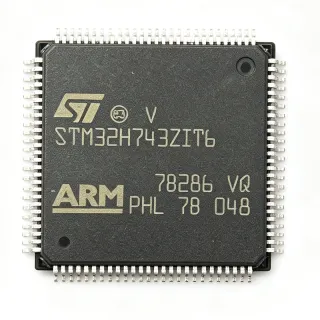
STM32F469ZIT6 - 180MHz Cortex-M4 MCU 2MB Flash | ST
MPN: STM32F469ZIT6 ✓ Active| Qty | Unit Price | Extended |
|---|---|---|
| 1 | $22.28 | $22.28 |
| 10 | $21.17 | $211.70 |
| 100 | $20.06 | $2,006.00 |
| 500 | $18.94 | $9,470.00 |
| 1,000 | $17.83 | $17,830.00 |
STM32F469ZIT6 Overview
An MCU (microcontroller unit) is a single integrated circuit that combines a processor core, memory, and peripherals into one chip, forming the lowest complete computing tier in the embedded hierarchy: microcontroller -> embedded processor -> system-on-chip. The STM32 family is STMicroelectronics' mainstream 32-bit MCU platform built on the ARM Cortex-M architecture, one of the most widely adopted embedded ecosystems in industry.
Key features of the STM32F469 line include the ART Accelerator and Chrom-ART graphical hardware accelerator for high-resolution GUI performance, an integrated TFT LCD controller and MIPI DSI host controller, and ST's adaptive real-time memory accelerator that enables zero-wait-state execution from Flash at 180 MHz. The Cortex-M4 core includes single-cycle multiply-accumulate DSP instructions and a hardware floating-point unit (FPU), making it efficient for signal processing alongside control tasks.
Technically, the STM32F469 series is based on the proven STM32F429 platform with enhanced graphics and display capabilities, operating from a 3.3V supply. According to the ST product page, the STM32F469xx devices are based on the high-performance Arm Cortex-M4 32-bit RISC core operating at up to 180 MHz. The 144-LQFP package offers abundant GPIO and peripheral interfaces for complex designs while remaining hand-solderable relative to ball-grid packages.
Typical applications include industrial HMI panels and TFT displays, consumer appliances with GUIs, medical monitoring devices, building automation, and motor control systems requiring a blend of graphics, connectivity, and real-time control.
A key design consideration is power integrity: the device requires decoupling capacitors on all VDD pins and careful PCB layout of the VCAP pins for the internal 1.2V core regulator. Firmware development is supported by STM32CubeMX and STM32CubeIDE free tooling.
This page synthesizes distributor pricing, verified drop-in alternatives within the STM32F4 family, and practical design notes not found in a single manufacturer document.
Drop-in alternatives for STM32F469ZIT6 — same package, pin-to-pin compatible. Different-package parts requiring PCB rework are excluded.
Variants in this series
Same-series models that are drop-in compatible with STM32F469ZIT6 (same form factor and footprint) — differing in Core, Flash Memory, Package, SRAM, Supply Voltage.
Quick Comparison Tool — Select alternative parts for side-by-side comparison:
STM32F429ZIT6
✅ Drop-In ⚠️ 参数待验证✓ In Stock
$9.9 / Unit
View Datasheet →STM32F439ZIT6
✅ Drop-In ⚠️ 参数待验证📋 Reference alternative (not in catalog)
STM32F427ZIT6
✅ Drop-In ⚠️ 参数待验证✓ In Stock
$8.1 / Unit
View Datasheet →STM32F469ZET6
✅ Drop-In ⚠️ 参数待验证📋 Reference alternative (not in catalog)
STM32F469ZIT6 Maximum Ratings & Electrical Characteristics
| Core | ARM Cortex-M4 32-bit with FPU |
| Maximum CPU Frequency | 180 MHz |
| Flash Memory | 2 MB (2M x 8) |
| SRAM | 384 KB |
| Supply Voltage | 3.3 V |
| Package | 144-LQFP (20x20 mm) |
| Mounting Type | Surface Mount |
| Data Bus Width | 32 bit |
| Core Architecture | RISC, Harvard |
| Accelerators | ART Accelerator, Chrom-ART Accelerator |
| Display Support | TFT LCD controller, MIPI DSI |
| DSP Instructions | Yes (single-cycle MAC) |
| Series | STM32F4 Series / STM32F469 |
| Packaging | Tray |
STM32F469ZIT6 144-lqfp (20x20 mm) Pin Configuration Guide
Pin configuration for STM32F469ZIT6 (144-lqfp (20x20 mm) package). This digital IC includes GPIO, communication interfaces (UART, SPI, I2C), and power pins. Refer to the manufacturer datasheet for alternate pin functions and configuration options. Essential for embedded system design and PCB layout.

No detailed pinout data available for STM32F469ZIT6.
Refer to the datasheet for full pin configuration.
Typical Applications
STM32F469ZIT6 is suitable for 6 applications: Industrial HMI Panels, Consumer Appliances with GUI, Motor Control Systems, Medical Monitoring Devices, Building Automation and IoT Gateways, Test and Measurement Instruments.
Industrial HMI Panels
Industrial human-machine interface panels benefit directly from the STM32F469ZIT6's graphics-oriented architecture. The Chrom-ART (DMA2D) accelerator performs 2D blitting and framebuffer composition in hardware, so the 180 MHz Cortex-M4 core remains available for control loops, protocol handling, and safety logic. The integrated TFT LCD controller drives parallel RGB panels from internal SRAM or external SDRAM frame buffers, and the 384 KB SRAM plus 2 MB Flash host GUI assets such as fonts, icons, and localized string tables. In a typical design the MCU runs TouchGFX or an RTOS-based GUI stack at 60 fps while simultaneously servicing Modbus or CAN fieldbus traffic, an achievable combination because graphics rendering consumes minimal CPU cycles when offloaded to DMA2D.
Recommended
Consumer Appliances with GUI
Smart ovens, coffee machines, thermostats, and white goods increasingly require capacitive-touch color displays, and the STM32F469ZIT6 addresses this segment cost-effectively. Its single-chip integration of TFT LCD controller, MIPI DSI host, and capacitive-touch sensing support (touch sensing controller and external touch controllers over I2C) removes the need for a separate display driver IC. The 180 MHz Cortex-M4 with FPU manages both the UI and appliance control tasks such as temperature regulation and motor-driven actuation on one die, cutting BOM cost. The 2 MB Flash is large enough to store animation sequences and multilingual UI resources, while the ART accelerator guarantees deterministic Flash execution even during interrupt-heavy control operation.
Recommended
Motor Control Systems
The STM32F469ZIT6 suits advanced motor control such as field-oriented control (FOC) of PMSM and BLDC motors. The Cortex-M4's DSP instructions and hardware FPU execute Clarke/Park transforms and PI current loops at 180 MHz with single-precision arithmetic, while advanced timers generate center-aligned complementary PWM with dead-time insertion and emergency-stop inputs. Fast 12-bit ADCs sample phase currents synchronously with PWM triggers, enabling loop rates in the tens of kHz. Because the FPU offloads trigonometric computation from software, cycle counts drop significantly versus fixed-point implementations on M3-class parts. An HMI or DSI display can even run on the same chip for drive parameterization, consolidating control and user interface in one MCU.
Recommended
Medical Monitoring Devices
Portable and benchtop medical monitors use the STM32F469ZIT6 to combine signal processing with a graphical display. The Cortex-M4 DSP capability performs digital filtering and FFT analysis on ECG, SpO2, or pressure waveform data at 180 MHz, while the FPU maintains numerical accuracy in calibration and algorithm math. The LCD/DSI display subsystem renders waveforms and vital-sign numerics, and the 2 MB Flash stores patient-profile firmware assets and log structures. Deterministic interrupt latency and the ART accelerator support hard real-time alarm logic. Designers should implement the required medical-grade watchdog supervision and memory self-test in software, leveraging the device's independent watchdog, window watchdog, and CRC peripherals.
Recommended
Building Automation and IoT Gateways
Building automation nodes and small IoT gateways leverage the STM32F469ZIT6's rich connectivity: multiple USARTs, SPI, I2C, CAN, and dual USB OTG interfaces link sensors, actuators, and backhaul radios. The 180 MHz Cortex-M4 handles protocol stacks (MQTT, BACnet MS/TP, Modbus) with headroom, and the 2 MB Flash accommodates OTA-update firmware images with dual-bank-style staging. The graphics subsystem can drive a wall-panel display when the node doubles as a room controller. Estimated power draw scales with clock gating: the MCU supports multiple low-power modes (Sleep, Stop, Standby) suitable for battery-assisted sensor hubs, though continuous 180 MHz GUI operation should be reserved for mains-powered panels.
Recommended
Test and Measurement Instruments
Handheld and bench instruments, including multimeters, data loggers, and portable scopes, use the STM32F469ZIT6 as the processor behind both acquisition and display. The 12-bit ADCs plus timers support time-interval and frequency measurements, while the Cortex-M4 FPU executes calibration curves and measurement math at 180 MHz. The TFT LCD controller drives the user interface with waveform or readout graphics accelerated by Chrom-ART, and USB OTG provides PC connectivity and data export. The 384 KB SRAM buffers captured sample data before upload. Instruments benefit from the device's CRC unit and independent watchdog for measurement-integrity supervision, and the mature STM32Cube ecosystem shortens firmware development cycles for calibration and UI code.
Recommended
Recommended Products Summary
Engineering reference data for STM32F469ZIT6 — comparison, design guidance, and compliance information.
Selection Guide
Comparison with Alternatives
| Parameter | This Product | STM32F429ZIT6 | STM32F439ZIT6 | STM32F427ZIT6 | STM32F469ZET6 |
|---|---|---|---|---|---|
| Package | 144-LQFP (20x20 mm) | 144-LQFP (20x20 mm) - same | 144-LQFP (20x20 mm) - same | 144-LQFP (20x20 mm) - same | 144-LQFP (20x20 mm) - same |
| Brand | STMicroelectronics | STMicroelectronics | STMicroelectronics | STMicroelectronics | STMicroelectronics |
| Core / Max Frequency | Cortex-M4, 180 MHz | Cortex-M4, 180 MHz | Cortex-M4, 180 MHz | Cortex-M4, 180 MHz | Cortex-M4, 180 MHz |
| Flash Memory | 2 MB | 2 MB | 2 MB | 2 MB | 512 KB |
| MIPI DSI Host | Yes | No | No | No | Yes |
| Crypto Accelerator | No | No | Yes (AES/hash) | No | No |
| Supply Voltage | 3.3 V | 3.3 V | 3.3 V | 3.3 V | 3.3 V |
Key Differentiators
- Integrated MIPI DSI host controller (vs STM32F429ZIT6)
- Upgraded TFT LCD controller and Chrom-ART graphics acceleration (vs STM32F427ZIT6)
- Trade-off: no cryptographic hardware accelerator (vs STM32F439ZIT6)
Design Notes
Decouple every VDD/VDDA pin pair with 100 nF ceramic capacitors placed within 2-3 mm of the pins, plus one bulk 4.7-10 uF capacitor per supply domain. The VCAP1/VCAP2 pins require the exact 2.2 uF capacitors specified in the datasheet because they stabilize the internal 1.2V core regulator - use low-ESR ceramics and do not share these pins with other loads. VDDA should be filtered from VDD via an RC or ferrite bead in noisy designs to preserve ADC accuracy.
Pay attention to the temperature suffix: STM32F469ZIT6 ('6') is rated -40C to +85C; designs requiring up to +105C must specify the ZIT7 variant. Also confirm boot configuration: BOOT0 must be pulled to GND (via 10 kOhm) for normal Flash boot; leaving it floating can cause intermittent boot failures from system memory. NRST needs a 100 nF capacitor to ground for reliable reset behavior with ST-LINK debuggers.
For LCD/DSI or high-speed GPIO-heavy designs, route the LCD/DSI pairs as controlled-impedance differential pairs and keep them away from switching regulator nodes. Use a solid ground plane under the MCU and keep the 8/16 MHz crystal loop (OSC_IN/OSC_OUT) tight with short traces and guard grounding. Assign high-toggle-rate GPIOs away from analog inputs to minimize crosstalk-induced ADC noise.
Estimated: a 180 MHz fully-active configuration with peripherals typically draws in the range of tens to low hundreds of mA from 3.3 V depending on peripheral activity - size the 3.3 V regulator with margin above your measured active current plus the external display and SDRAM loads. Use Stop/Standby modes via STM32CubeMX power configurations for battery-sensitive designs; wake-up sources and RAM retention behavior are detailed in the family reference manual.
Compliance Information
Compliance status was not stated in the retrieved web data; STM32F4 commercial parts are typically RoHS-compliant, but this must be confirmed on the official ST compliance page before use in regulated products.