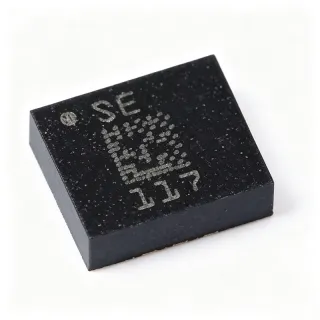
STM32WBA63CIU6 - BLE 6.0 + 802.15.4 Cortex-M33 MCU | ST
MPN: STM32WBA63CIU6 ✓ Active| Qty | Unit Price | Extended |
|---|---|---|
| 1 | $4.85 | $4.85 |
| 10 | $4.45 | $44.50 |
| 100 | $3.95 | $395.00 |
| 500 | $3.55 | $1,775.00 |
| 1,000 | $3.2 | $3,200.00 |
STM32WBA63CIU6 Overview
A wireless MCU (microcontroller unit) combines a processor core, memory, peripherals, and a radio transceiver on a single die, sitting within the broader hierarchy of 32-bit MCUs -> wireless connectivity MCUs -> system-on-chip (SoC) devices. Multiprotocol wireless MCUs like this one let a single chip and a single PCB design serve multiple connectivity standards, simplifying inventory and certification for smart-building and IoT product lines.
Key features include the 100 MHz Cortex-M33 core with TrustZone security isolation and hardware FPU, 2 Mbytes of on-chip Flash for large concurrent protocol stacks and application code, and an ultra-low-power profile engineered for battery-powered devices. The radio subsystem is compliant with Bluetooth LE and IEEE 802.15.4-2015, enabling simultaneous support of Matter-over-Thread and Zigbee ecosystems.
Architecturally, the STM32WBA6xxx series is part of ST's STM32WBA family, which pairs the high-efficiency Cortex-M33 pipeline with a dedicated 2.4 GHz radio and security accelerators. TrustZone provides hardware-enforced partitioning between secure and non-secure firmware, which is increasingly required by platform ecosystem certification programs for connected devices.
Typical applications include smart-home devices (sensors, actuators, Matter/Thread end nodes), Zigbee lighting and building automation, Bluetooth LE beacons and wearable accessories, and industrial wireless sensor nodes where ultra-low sleep current extends battery life for years.
When designing with this device, budget RF layout carefully: the 2.4 GHz radio requires controlled-impedance matching and a solid ground plane on the exposed pad; also verify supply decoupling per the ST datasheet to minimize radio spurs.
This page synthesizes distributor pricing, same-family drop-in alternatives, and practical design guidance not found on any single manufacturer or distributor page.
Drop-in alternatives for STM32WBA63CIU6 — same package, pin-to-pin compatible. Different-package parts requiring PCB rework are excluded.
Quick Comparison Tool — Select alternative parts for side-by-side comparison:
STM32WBA65CIU6
✅ Drop-In ⚠️ 参数待验证📋 Reference alternative (not in catalog)
STM32WBA55CGU6
✅ Drop-In ⚠️ 参数待验证📋 Reference alternative (not in catalog)
STM32WBA54CGU6
✅ Drop-In ⚠️ 参数待验证📋 Reference alternative (not in catalog)
STM32WBA63CIU6 Maximum Ratings & Electrical Characteristics
| Core Processor | Arm Cortex-M33 32-bit RISC with TrustZone and FPU |
| Maximum Clock Frequency | 100 MHz |
| Flash Memory | 2 Mbytes (2000 KB) |
| Data Bus Width | 32 bit |
| Wireless Protocol | Bluetooth LE 6.0 (v5.4 per distributor data), IEEE 802.15.4-2015, Zigbee, Thread, Matter |
| Radio Frequency Band | 2.4 GHz |
| Operating Temperature Range | -40 C to +85 C |
| Package Type | 48-pin UFQFPN with Exposed Pad |
| Pin Count | 48 |
| Mounting Type | Surface Mount |
| Security Features | Arm TrustZone, secure boot capable |
| Series | STM32WBA6xxx |
| Lifecycle Status | Active |
STM32WBA63CIU6 48-pin ufqfpn with exposed pad Pin Configuration Guide
Pin configuration for STM32WBA63CIU6 (48-pin ufqfpn with exposed pad package). This digital IC includes GPIO, communication interfaces (UART, SPI, I2C), and power pins. Refer to the manufacturer datasheet for alternate pin functions and configuration options. Essential for embedded system design and PCB layout.

No detailed pinout data available for STM32WBA63CIU6.
Refer to the datasheet for full pin configuration.
Typical Applications
STM32WBA63CIU6 is suitable for 6 applications: Smart Home Matter / Thread Devices, Zigbee Lighting and Building Automation, Bluetooth LE Wearables and Beacons, Industrial Wireless Sensor Networks, Connected Building Security Sensors, Multi-Protocol Gateway Edge Nodes.
Smart Home Matter / Thread Devices
The STM32WBA63CIU6 fits Matter-over-Thread smart home products because it combines a 2.4 GHz IEEE 802.15.4-2015 radio, Thread protocol support, and Matter compatibility on a single 100 MHz Cortex-M33 die with 2 Mbytes of Flash. The large Flash bank accommodates the Thread stack, Matter data model, and OTA update images concurrently, while TrustZone provides the secure-element-class isolation that Matter ecosystem certification expects. In a sensor or actuator node, the radio handles 802.15.4 communication while the Cortex-M33 core runs application logic and AES security acceleration, and ultra-low-power sleep modes keep coin-cell or AA-battery budgets viable for multi-year deployment. Layout should reserve matching-network area for the 2.4 GHz front end per ST reference designs.
Recommended
Zigbee Lighting and Building Automation
Zigbee lighting ballasts, occupancy sensors, and wall controllers are natural fits for the STM32WBA63CIU6: its IEEE 802.15.4-2015 radio runs Zigbee stacks, the 2 Mbyte Flash stores both the Zigbee stack and over-the-air provisioning firmware, and the 100 MHz Cortex-M33 with FPU executes lighting control algorithms and DALI/PWM peripheral timing without a secondary controller. Ultra-low-power characteristics matter in battery-powered occupancy and door/window sensors, where sleep current dominates battery life. The TrustZone architecture partitions commissioning credentials from user application code, a security posture increasingly demanded in commercial building deployments. ST reference designs cover Zigbee light-link topologies, reducing time-to-certification for new luminaires and control devices.
Recommended
Bluetooth LE Wearables and Beacons
For wearables, tags, and beacons, the STM32WBA63CIU6 offers Bluetooth LE 6.0-capable connectivity alongside generous on-chip resources: 2 Mbytes of Flash holds BLE stack, OTA firmware, and sensor-logging data, while the hardware FPU at 100 MHz handles sensor-fusion math locally. Ultra-low-power design is the decisive advantage here - wearable battery budgets are measured in milliamp-hours, so the WBA6 series sleep and low-power-run modes directly extend runtime. The 48-UFQFPN exposed-pad package is compact enough for earbud charging cases, fitness bands, and asset tags. TrustZone secures pairing keys and user health data, supporting GDPR-style privacy requirements in consumer wellness products.
Recommended
Industrial Wireless Sensor Networks
Industrial sensor nodes measuring vibration, temperature, or flow benefit from the STM32WBA63CIU6's combination of a -40 C to +85 C operating range, 2.4 GHz multiprotocol radio (BLE for provisioning, Thread/Zigbee for mesh backhaul), and 2 Mbyte Flash for edge-processing firmware. The Cortex-M33 core with FPU runs FFT-based vibration analytics locally, transmitting event summaries instead of raw waveforms and cutting network duty cycle. TrustZone isolates safety-relevant firmware from wireless attack surfaces, and the exposed-pad UFQFPN-48 package simplifies RF layout on standard two-layer-plus PCBs. Battery life targets of 5-10 years are achievable with the ultra-low-power sleep modes when radio duty cycles are kept under a few percent.
Recommended
Connected Building Security Sensors
Door locks, glass-break detectors, and security panels demand authenticated wireless links and Tamper-resilient storage - precisely where the STM32WBA63CIU6's TrustZone and 2.4 GHz multiprotocol radio converge. BLE 6.0 supports smartphone commissioning and user access, while Thread/Zigbee mesh connects sensors to a hub across large floorplans. The 2 Mbyte Flash stores cryptographic key material and full audit logs locally, and the Cortex-M33's security extensions accelerate ECC and AES for fast, authenticated reconnection events. Operating from -40 C to +85 C, the part tolerates unheated entryways and attic-mounted hubs. Exposed-pad grounding also serves as a shielding strategy against RF interference in dense multi-node buildings.
Recommended
Multi-Protocol Gateway Edge Nodes
Edge nodes bridging BLE accessories into Thread or Zigbee backbones use the STM32WBA63CIU6's dual-protocol 2.4 GHz radio and 100 MHz Cortex-M33 headroom to translate between stacks in real time. With 2 Mbytes of Flash, both protocol stacks plus a lightweight application layer coexist on-chip, eliminating external storage and reducing BOM cost. The FPU accelerates sensor aggregation and filtering, and hardware security (TrustZone, crypto accelerators) secures credential exchange between networks - a common audit requirement in commercial gateways. The 48-UFQFPN package with exposed pad supports the compact, well-grounded RF layout gateways need, and its -40 C to +85 C range covers rooftop and unconditioned electrical-room installations.
Recommended
Recommended Products Summary
Engineering reference data for STM32WBA63CIU6 — comparison, design guidance, and compliance information.
Selection Guide
Comparison with Alternatives
| Parameter | This Product | STM32WBA65CIU6 | STM32WBA55CGU6 | STM32WBA54CGU6 |
|---|---|---|---|---|
| Package | 48-UFQFPN (Exposed Pad) | 48-UFQFPN (Exposed Pad) - same | 48-UFQFPN (Exposed Pad) - same | 48-UFQFPN (Exposed Pad) - same |
| Brand | STMicroelectronics | STMicroelectronics | STMicroelectronics | STMicroelectronics |
| Core | Cortex-M33 100 MHz, TrustZone, FPU | Cortex-M33 100 MHz, TrustZone, FPU | Cortex-M33, TrustZone, FPU | Cortex-M33, TrustZone, FPU |
| Flash Memory | 2 Mbytes | 2 Mbytes (family spec) | 1 Mbyte | 1 Mbyte |
| Bluetooth LE | LE 6.0 capable (v5.3/5.4 listed) | Bluetooth LE | Bluetooth LE | Bluetooth LE |
| IEEE 802.15.4 (Zigbee/Thread/Matter) | Yes | Yes | No | No |
Key Differentiators
- Multiprotocol 2.4 GHz radio with 2 MB Flash (vs STM32WBA55CGU6)
- Footprint-compatible cost-down path (vs STM32WBA54CGU6)
- Hardware security isolation (vs STM32WBA55CGU6)
Design Notes
The 48-UFQFPN exposed pad is the primary RF and thermal ground. Connect it to a continuous ground plane with an array of thermal vias (typically 4x4 or denser) directly under the pad. Keep the 2.4 GHz matching network between the RF pin and antenna as short as possible, follow the ST reference design layout for the WBA series, and keep crystal load capacitors close to the oscillator pins. Estimate: antenna matching component values must come from the ST datasheet and reference design, not from generic formulas.
Supply decoupling determines radio spur performance. Place one decoupling capacitor per supply pin as close as possible to the device, following the ST datasheet recommended values, and separate the RF supply domain from digital rails per the reference design. Battery-powered nodes should exploit the WBA series low-power modes; measure actual sleep current on your board because leakage from external pull-ups can dominate. Estimated rule of thumb: every 1 uA of sleep current consumes roughly 8.8 mAh per year of battery life.
Do not assume firmware portability is automatic within the WBA family: moving from a BLE-only WBA54/55 to this multiprotocol part requires switching to the multiprotocol stack package (Thread/Zigbee middleware), which changes linker memory maps. Plan Flash partitioning for dual-bank OTA on the 2 Mbyte array early - retrofitting OTA into a full-Flash design is painful. Also verify the exact BLE specification version supported by your ST firmware release, since distributor listings (v5.3/5.4) and ST marketing (LE 6.0) differ by certification timing.
Compliance Information
Compliance data was not present in the provided web data. ST standard products are typically RoHS-compliant, but this must be verified on the official ST product page before claiming compliance.