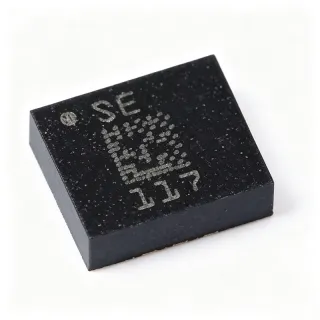
STM32WLE5J8I6 - LoRa Sub-GHz Wireless MCU 64KB | STMicroelectronics
MPN: STM32WLE5J8I6 ✓ Active| Qty | Unit Price | Extended |
|---|---|---|
| 1 | $6.15 | $6.15 |
| 10 | $5.72 | $57.20 |
| 100 | $5.1 | $510.00 |
| 500 | $4.65 | $2,325.00 |
| 1,000 | $4.28 | $4,280.00 |
STM32WLE5J8I6 Overview
A wireless MCU (microcontroller unit) is a single-chip device that combines a general-purpose processor with a radio transceiver, eliminating the need for a separate RF IC. Within the power/semiconductor hierarchy, the STM32WLE5J8I6 sits under the STM32WL series, which belongs to the 32-bit Arm Cortex-M4 microcontroller family, the wireless MCU category, and the broader semiconductor device ecosystem for long-range IoT connectivity.
Key differentiating features include support for LoRa, (G)FSK, (G)MSK, and BPSK modulation schemes, an ultra-low-power architecture engineered for battery-powered LPWAN nodes, and a supply voltage range of 1.8 V to 3.6 V. Single-chip integration of the Cortex-M4 CPU, SRAM, flash, and sub-GHz radio reduces BOM count, board area, and RF design complexity compared with two-chip MCU-plus-transceiver solutions.
Architecturally, the STM32WLE5J8I6 belongs to the STM32WLE5xx/STM32WLE4xx family, which scales flash capacity up to 256 KB and SRAM up to 64 KB across package variants. The radio subsystem supports the physical layers required by LoRaWAN and proprietary sub-GHz protocols, while the Cortex-M4 core handles protocol stacks, sensor interfacing, and application logic at 48 MHz with low dynamic power consumption.
Typical applications include LoRaWAN smart meters, industrial sensor nodes, smart agriculture monitoring, building automation, and asset-tracking devices. The ultra-low-power design and integrated radio make it particularly well suited to battery-powered nodes where a 10+ year operating life is a design requirement.
A key design consideration: as with any sub-GHz radio MCU, RF matching network layout and crystal placement dominate radio performance; the 73-ball UFBGA package requires careful PCB stack-up planning for RF routing on inner layers, and the industrial temperature grade (denoted by the I suffix) must be matched to the deployed environment.
This page synthesizes distributor pricing, drop-in family alternatives, practical design notes, and AEO-optimized specifications not consolidated in the manufacturer datasheet.
Drop-in alternatives for STM32WLE5J8I6 — same package, pin-to-pin compatible. Different-package parts requiring PCB rework are excluded.
Quick Comparison Tool — Select alternative parts for side-by-side comparison:
STM32WLE5JCI6
✅ Drop-In📋 Reference alternative (not in catalog)
STM32WLE5C8U6
✅ Drop-In📋 Reference alternative (not in catalog)
STM32WLE4JCI6
✅ Drop-In📋 Reference alternative (not in catalog)
STM32WL54JCI6
✅ Drop-In📋 Reference alternative (not in catalog)
STM32WLE5J8I6 Maximum Ratings & Electrical Characteristics
| Core | 32-bit Arm Cortex-M4 |
| Maximum CPU Frequency | 48 MHz |
| Flash Memory | 64 KB |
| SRAM | 20 KB |
| Radio Frequency Range | 150 MHz to 960 MHz |
| Modulation Formats | LoRa, (G)FSK, (G)MSK, BPSK |
| Wireless Protocol | LoRa / LPWAN / 802.15.4 compatible RF |
| Supply Voltage Range | 1.8 V to 3.6 V |
| Package | 73-ball UFBGA |
| Mounting Type | Surface Mount |
| Operating Temperature | -40C to +85C (industrial, I grade) |
| Product Family | STM32WLE5xx / STM32WL |
| Product Type | RF Transceiver + MCU (single-chip wireless MCU) |
| RoHS Status | Compliant |
| Packaging | Tray |
| Typical Applications | LPWAN, LoRaWAN, smart metering, IoT sensor nodes |
STM32WLE5J8I6 73-ball ufbga Pin Configuration Guide
Pin configuration for STM32WLE5J8I6 (73-ball ufbga package). This digital IC includes GPIO, communication interfaces (UART, SPI, I2C), and power pins. Refer to the manufacturer datasheet for alternate pin functions and configuration options. Essential for embedded system design and PCB layout.

No detailed pinout data available for STM32WLE5J8I6.
Refer to the datasheet for full pin configuration.
Typical Applications
STM32WLE5J8I6 is suitable for 6 applications: LoRaWAN Smart Metering, Smart Agriculture Sensor Nodes, Industrial IoT and Building Automation, Asset Tracking and Logistics, Smart City Infrastructure, Wireless Module and OEM Board Design.
LoRaWAN Smart Metering
The STM32WLE5J8I6 fits smart water, gas, and electricity meters because its integrated 150 MHz to 960 MHz radio covers all regional LPWAN ISM bands (433/470/868/915 MHz) without a second RF chip. The Cortex-M4 at 48 MHz handles the LoRaWAN MAC stack plus metrology firmware, while 64 KB flash and 20 KB SRAM are sufficient for class A endpoint stacks. Single-chip integration reduces meter BOM cost and quiescent energy versus MCU-plus-transceiver designs, extending battery life toward the 10+ year targets typical of metering deployments. Place the part with a short, controlled-impedance RF trace to the matching network and keep the 32 MHz radio crystal adjacent to minimize phase noise, which directly limits link budget at 868 MHz.
Recommended
Smart Agriculture Sensor Nodes
Agricultural monitoring nodes - soil moisture, weather stations, irrigation controllers - need long range and multi-year battery operation. The STM32WLE5J8I6 addresses both: its LoRa modulation maximizes link budget at low data rates across open fields, and the ultra-low-power STM32WL architecture keeps average current low in duty-cycled sleep/wake patterns. The industrial -40C to +85C rating tolerates outdoor enclosures, and the 1.8 V to 3.6 V supply range allows direct operation from a single lithium cell through the lower end of the range. With 64 KB flash and 20 KB SRAM, the node can run a compact LoRaWAN stack plus sensor calibration code; designs requiring edge analytics should step up to the pin-compatible STM32WLE5JCI6 with 256 KB flash.
Recommended
Industrial IoT and Building Automation
In factories and smart buildings, sub-GHz LPWAN links penetrate walls and metal racking better than 2.4 GHz, making the STM32WLE5J8I6's 150 MHz to 960 MHz radio a strong fit for condition-monitoring sensors, occupancy detectors, and HVAC controllers. The (G)FSK and (G)MSK modes support proprietary high-throughput protocols alongside LoRa, letting one hardware platform serve both private networks and public LoRaWAN. The single-chip design shrinks sensor node PCB area for compact enclosures, and the Cortex-M4 core provides headroom for local filtering and protocol translation. Designers should budget the 64 KB flash carefully when combining a full LoRaWAN stack with security features such as AES link-layer encryption.
Recommended
Asset Tracking and Logistics
Cargo trackers and pallet tags require wide-area coverage with minimal energy per report. The STM32WLE5J8I6 enables geolocation-aware tracking nodes using LoRaWAN, with the 48 MHz Cortex-M4 handling accelerometer integration and report scheduling between transmissions. Because the radio and MCU share one die, sleep-state coordination is tighter than in two-chip solutions, cutting standby overhead that dominates tracker energy budgets. The 73-ball UFBGA keeps the module footprint small enough for adhesive-mounted tags, and the industrial temperature range covers unconditioned shipping containers. For trackers that log large route histories locally, the same-footprint STM32WLE5JCI6 with 256 KB flash and 64 KB SRAM provides four times the logging capacity without PCB changes.
Recommended
Smart City Infrastructure
Streetlight controllers, parking sensors, and waste-bin monitors across a city mesh benefit from the STM32WLE5J8I6's combination of LoRaWAN connectivity and industrial-grade reliability. The 868 MHz and 915 MHz bands supported by the integrated radio are license-exempt in most municipalities, and LoRa's long range lets one gateway serve thousands of street-level nodes, lowering network infrastructure cost per point. The 64 KB flash configuration suits fixed-function controllers with stable firmware images, and the tray packaging supports standard SMT assembly for high-volume municipal deployments. Engineers should validate regional RF regulatory parameters (duty cycle, ERP limits) in firmware since the radio itself spans all relevant bands from 150 MHz to 960 MHz.
Recommended
Wireless Module and OEM Board Design
Module manufacturers building certified sub-GHz OEM modules use the STM32WLE5J8I6 as the core silicon because single-chip integration minimizes module size and certification scope - one transmitter rather than an MCU-plus-radio pair. The 73-ball UFBGA supports dense two- and four-layer module stacks with an RF trace to an onboard antenna or U.FL connector, and ST's ecosystem (STM32CubeWL, CubeMX) provides radio HAL drivers, LoRaWAN stacks, and certification-ready reference firmware that shorten module time-to-market. When designing the module, allocate flash margin for customer firmware: the 64 KB device suits AT-command-style modules, while fully reprogrammable host modules are better built on the pin-compatible 256 KB STM32WLE5JCI6.
Recommended
Recommended Products Summary
Engineering reference data for STM32WLE5J8I6 — comparison, design guidance, and compliance information.
Selection Guide
Comparison with Alternatives
| Parameter | This Product | STM32WLE5JCI6 | STM32WLE5C8U6 | STM32WLE4JCI6 | STM32WL54JCI6 |
|---|---|---|---|---|---|
| Package | 73-ball UFBGA | 73-ball UFBGA - same | 73-ball UFBGA - same (C code) | 73-ball UFBGA - same | 73-ball UFBGA - same |
| Brand | STMicroelectronics | STMicroelectronics | STMicroelectronics | STMicroelectronics | STMicroelectronics |
| Core | Arm Cortex-M4 @ 48 MHz (single core) | Arm Cortex-M4 @ 48 MHz (single core) | Arm Cortex-M4 @ 48 MHz (single core) | Arm Cortex-M4 family | Cortex-M4 + Cortex-M0+ (dual core) |
| Flash Memory | 64 KB | 256 KB | 64 KB | 256 KB | 256 KB |
| SRAM | 20 KB | 64 KB | 20 KB | 64 KB | 64 KB |
| Radio Frequency Range | 150 MHz to 960 MHz | 150 MHz to 960 MHz | 150 MHz to 960 MHz | 150 MHz to 960 MHz | 150 MHz to 960 MHz |
| Supply Voltage | 1.8 V to 3.6 V | 1.8 V to 3.6 V | 1.8 V to 3.6 V | 1.8 V to 3.6 V | 1.8 V to 3.6 V |
| Modulation Support | LoRa, (G)FSK, (G)MSK, BPSK | LoRa, (G)FSK, (G)MSK, BPSK | LoRa, (G)FSK, (G)MSK, BPSK | Reduced radio feature set | LoRa, (G)FSK, (G)MSK, BPSK |
Key Differentiators
- Smallest memory option in the UFBGA-73 family with the lowest cost (vs STM32WLE5JCI6)
- Simpler single-core architecture for compact LoRaWAN stacks (vs STM32WL54JCI6)
- Full-featured radio of the WLE5 tier (vs STM32WLE4JCI6)
Design Notes
The 73-ball UFBGA is a fine-pitch BGA: create the land pattern strictly per the ST datasheet mechanical drawing, use via-in-pad or dog-bone fanout for inner balls, and specify a solder mask-defined versus non-solder-mask-defined pad consistently. For the RF path, keep the trace from the RF ball to the matching network as short as possible with 50-ohm controlled impedance, and place the 32 MHz radio crystal within a few millimeters of its balls with a solid ground return. Budget at least one inner ground plane for RF integrity.
Operate the STM32WLE5J8I6 within its 1.8 V to 3.6 V supply range and decouple each VDD/VDDA ball with 100 nF ceramics placed close to the balls, plus a bulk capacitor near the package. For battery nodes, exploit the STM32WL ultra-low-power sleep modes and coordinate radio TX bursts with the power budget: transmit current dominates the energy profile, so minimizing time-on-air via LoRa spreading-factor selection and data-rate tuning directly extends battery life. Estimated: halving time-on-air roughly halves TX energy per report.
Three frequent mistakes with this part: (1) sizing firmware against 64 KB flash without OTA-update headroom - the LoRaWAN stack plus security can approach the limit; verify image size before committing, or choose the pin-compatible STM32WLE5JCI6. (2) Ignoring regional RF regulations - the radio spans 150 MHz to 960 MHz, but duty-cycle and ERP limits are region-specific and must be enforced in firmware. (3) Treating the UFBGA package as reworkable - BGA rework is costly, so prototype with the ST NUCLEO-WL55/available discovery tooling before committing the layout.
Compliance Information
RoHS compliant per STMicroelectronics standard policy for active STM32 products and distributor listings. Not an automotive-qualified (AEC-Q100) part; verify with ST if automotive use is intended. REACH and halogen-free status should be confirmed from the current ST product page certificate.