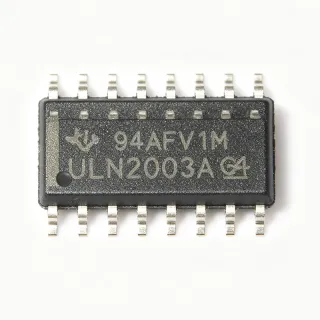
SN65HVD234QDRQ1 - 3.3V Automotive CAN Transceiver | Texas Instruments
MPN: SN65HVD234QDRQ1 ✓ Active| Qty | Unit Price | Extended |
|---|---|---|
| 1 | $1.95 | $1.95 |
| 10 | $1.76 | $17.60 |
| 100 | $1.42 | $142.00 |
| 500 | $1.18 | $590.00 |
| 1,000 | $0.98 | $980.00 |
SN65HVD234QDRQ1 Overview
A CAN (Controller Area Network) transceiver is a physical-layer interface IC that converts the TTL-level TX and RX signals of a CAN controller into the differential CANH/CANL bus signals defined by ISO 11898. Positioned between the protocol controller and the twisted-pair bus in the system hierarchy, the transceiver determines bus robustness, fault tolerance, and power consumption of the entire CAN node.
Key features include a 1 Mbps maximum signaling rate, fault-protected bus pins, and the SN65HVD234-Q1 variant's ultralow-current sleep mode: applying a low level to the EN pin (pin 5) disables both driver and receiver, drastically reducing node current consumption for battery-connectedECU domains. The device wakes when a high logic level is reapplied to pin 5. The SN65HVD233-Q1, SN65HVD234-Q1, and SN65HVD235-Q1 family members share pinout and package, differing mainly in feature set.
The architecture includes an internal TXD-to-RS pin loopback that assists the CAN controller with baud-rate detection (autobaud function), simplifying firmware in systems where the bus speed is not fixed. Differential driver and receiver stages provide common-mode bus tolerance suitable for harsh automotive electrical environments.
Typical applications include automotive body control modules, instrument clusters, gateway ECUs, and industrial 3.3-V CAN nodes where low-voltage logic directly interfaces the CAN controller (e.g., 3.3-V MCUs such as TMS320F280xx and MSPM0 devices) without level shifting.
Design tip: respect the 3.6 V absolute maximum supply and place a 0.1 uF decoupling capacitor directly at VCC; control the EN pin carefully during startup to avoid unintended bus dominant states.
Drop-in alternatives for SN65HVD234QDRQ1 — same package, pin-to-pin compatible. Different-package parts requiring PCB rework are excluded.
Variants in this series
Same-series models that are drop-in compatible with SN65HVD234QDRQ1 (same form factor and footprint) — differing in Protocol, Package, Data Rate, Function, Duplex.
Quick Comparison Tool — Select alternative parts for side-by-side comparison:
SN65HVD230QDRQ1
✅ Drop-In✓ In Stock
$1.11 / Unit
View Datasheet →SN65HVD232QDRQ1
✅ Drop-In ⚠️ Specs Unverified📋 Reference alternative (not in catalog)
SN65HVD235QDRQ1
✅ Drop-In ⚠️ Specs Unverified📋 Reference alternative (not in catalog)
TCAN1042GVDRQ1
✅ Drop-In✓ In Stock
$0.349 / Unit
View Datasheet →TCAN1051-Q1
✅ Drop-In✓ In Stock
$1.05 / Unit
View Datasheet →TJA1051T/3/1
✅ Drop-In ⚠️ Specs Unverified✓ In Stock
$0.4102 / Unit
View Datasheet →SN65HVD234QDRQ1 Specifications
| Function | Half CANbus Transceiver (Driver + Receiver) |
| Supply Voltage Min | 3 V |
| Supply Voltage Max | 3.6 V |
| Operating Supply Current | 6 mA |
| Data Rate | 1 Mbps |
| Sleep Mode | Yes (ultralow-current via EN pin, low level on pin 5) |
| Autobaud Loopback | Yes (internal TXD to RS pin loopback) |
| Automotive Qualification | AEC-Q100 (Q1) |
| Operating Temperature Max | +125 C |
| Package | 8-SOIC (D) |
| Mounting Type | Surface Mount |
| Protocol | CAN (ISO 11898 physical layer) |
| Number of Drivers / Receivers | 1 / 1 |
| RoHS Status | Compliant |
SN65HVD234QDRQ1 Pin Configuration
| Pin 1 | TXD — Transmit data input from CAN controller |
| Pin 2 | GND — Ground reference |
| Pin 3 | VCC — 3.3-V supply (3 V to 3.6 V) |
| Pin 4 | RXD — Receive data output to CAN controller |
| Pin 5 | EN / RS — Enable / slope control; low level on SN65HVD234-Q1 enters ultralow-current sleep mode |
| Pin 6 | CANL — CAN low bus line |
| Pin 7 | CANH — CAN high bus line |
| Pin 8 | RS / Vref — Slope control / reference; internal TXD to RS loopback supports autobaud |
Typical Applications
SN65HVD234QDRQ1 is suitable for 6 applications: Automotive Body Control Modules, Instrument Clusters, ECU Gateways, Battery Management Systems, Industrial CAN Networks, Telematics and Fleet Tracking Units.
Automotive Body Control Modules
The SN65HVD234QDRQ1 fits body control modules because its 3.3-V native supply matches modern BCM microcontrollers and its AEC-Q100 qualification covers the -40 C to +125 C automotive ambient range. The ultralow-current sleep mode via EN pin keeps node current near zero when the vehicle is parked, protecting battery state of charge. Placed between the CAN controller TX/RX pins and the CANH/CANL bus with 120-ohm bus termination, it provides fault-protected differential signaling up to 1 Mbps.
Recommended
Instrument Clusters
Instrument clusters require a CAN node that survives harsh automotive transients while maintaining low quiescent draw. The SN65HVD234QDRQ1 provides 1 Mbps high-speed CAN signaling from a 3.3-V rail shared with the cluster MCU, and the internal TXD-to-RS loopback supports autobaud detection when the cluster must adapt to different bus segments. Its 8-SOIC footprint keeps the PCB area minimal behind tight cluster housings, and sleep mode through pin 5 allows the cluster to drop into a low-power state on ignition-off.
Recommended
ECU Gateways
Gateway ECUs bridge multiple CAN segments and must tolerate differing ground potentials and bus faults. The SN65HVD234QDRQ1 offers fault-protected 3.3-V CAN physical layers for low-voltage domains, while TI's ISO1042BQDWVRQ1 isolated transceiver can be paired on gateway-facing isolated segments. The SN65HVD234-Q1's 1 Mbps rate matches classical CAN backbone speeds, and its 6 mA typical supply current plus sleep mode helps meet gateway net idle-current budgets specified by OEMs.
Recommended
Battery Management Systems
In EV and hybrid battery packs, communication nodes benefit from the SN65HVD234QDRQ1's low 3.3-V supply and ultralow sleep current, which minimize pack-level drain when the contactors are open. The transceiver interfaces BCU microcontrollers such as the BQ76952Q-Q1 companion AFE host to the CAN bus at up to 1 Mbps. Its AEC-Q100 qualification and fault protection suit the high-transient environment near contactors and precharge circuits. Use standard 120-ohm termination and verify common-mode range against pack ground shift.
Recommended
Industrial CAN Networks
Industrial machinery adopting 3.3-V logic platforms can use the SN65HVD234QDRQ1 as a robust physical-layer interface at 1 Mbps on the CANopen or DeviceNet-style segments. Its fault protection on bus pins tolerates wiring faults common in factory floor cabling, and operation to +125 C suits drive cabinets near heat sources. Pairing with TI's SN65HVD230QDRQ1 on non-sleep nodes keeps a single footprint across the network BOM. Place the transceiver near the connector with a ground plane and TVS diodes for surge immunity.
Recommended
Telematics and Fleet Tracking Units
Telematics black boxes connect directly to the vehicle CAN bus and must draw near-zero current when the ignition is off. The SN65HVD234QDRQ1's EN-pin sleep mode addresses exactly this need: a low level on pin 5 disables both driver and receiver, leaving only ultralow leakage. The 3.3-V supply matches cellular modem and GPS module rails, and the autobaud loopback lets the telemetry MCU detect vehicle bus speed automatically. Its 8-SOIC package fits compact tracking hardware with room to spare.
Recommended
Recommended Products Summary
Engineering reference data for SN65HVD234QDRQ1 — comparison, design guidance, and compliance information.
Selection Guide
Comparison with Alternatives
| Parameter | This Product | SN65HVD230QDRQ1 | TCAN1042GVDRQ1 | TJA1051T/3/1 |
|---|---|---|---|---|
| Package | 8-SOIC (D) | 8-SOIC (D) - same | 8-SOIC (D) - same | 8-SOIC - same footprint family |
| Brand | Texas Instruments | Texas Instruments | Texas Instruments | NXP Semiconductors |
| Supply Voltage | 3 V to 3.6 V | 3 V to 3.6 V | 4.5 V to 5.5 V | 3 V to 5.5 V (3.3-V variant) |
| Data Rate | 1 Mbps | 1 Mbps | 5 Mbps (CAN FD capable) | 1 Mbps |
| Sleep / Standby Mode | Yes (EN pin low, ultralow current) | Low-power mode via RS pin | Standby mode | Silent mode |
| AEC-Q100 | Qualified (Q1) | Qualified (Q1) | Qualified (Q1) | Qualified (AEC-Q100) |
Key Differentiators
- True ultralow-current sleep via dedicated EN pin (vs SN65HVD230QDRQ1)
- Native 3.3-V operation avoids level shifting (vs TCAN1042GVDRQ1)
- Autobaud support via internal TXD-to-RS loopback (vs TJA1051T/3/1)
Design Notes
Place a 0.1 uF ceramic decoupling capacitor within 2 mm of the VCC pin (pin 3), with a low-impedance ground return to pin 2. Route CANH and CANL (pins 7 and 6) as a tightly coupled differential pair toward the bus connector, and place the 120-ohm termination split termination network (two 60-ohm resistors plus split capacitor) close to the transceiver. Keep the TXD/RXD traces short and away from the bus lines to avoid coupling.
The EN pin (pin 5) controls sleep on the SN65HVD234-Q1: a floating or glitched pin during power-up can place the transceiver in sleep or generate an unintended dominant state on the bus. Use a pullup/pulldown with defined logic from the MCU, and sequence EN after VCC stabilizes. Never exceed the 3.6 V supply maximum; automotive 12-V load-dump transients must be clamped upstream by a regulator and TVS diode.
Use the RS pin slope-control option to trade rise/fall time against EMI on slower buses: setting slope control via the RS pin resistance reduces electromagnetic emissions on networks below 125 kbps, while full-slew settings are appropriate at 1 Mbps where timing dominates. Verify CISPR-style radiated emissions at the vehicle harness level; a common-mode choke in series with CANH/CANL further suppresses RF emissions without degrading differential signaling.
Compliance Information
AEC-Q100 automotive qualified (Q1 suffix). RoHS status per TI product page; REACH and halogen-free status not stated in provided data.