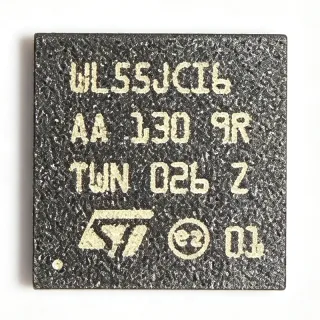
VSC7158HT-03 - Octal 10/100 Ethernet PHY | Analog Devices
MPN: VSC7158HT-03 ✗ End of Life| Qty | Unit Price | Extended |
|---|---|---|
| 1 | $9.85 | $9.85 |
| 10 | $8.72 | $87.20 |
| 100 | $7.65 | $765.00 |
| 500 | $6.95 | $3,475.00 |
| 1,000 | $6.1 | $6,100.00 |
VSC7158HT-03 Overview
A Fast Ethernet PHY (Physical Layer Device) is the lowest layer of the OSI networking stack; it converts parallel digital MAC-side data into serialized analog symbols transmitted over copper twisted-pair cabling, while recovering the clock and decoding incoming symbols on the receive side. The PHY sits beneath the MAC (Media Access Controller) and above the magnetics/transformer interface, forming the bridge between digital logic and the analog copper channel. For 100BASE-TX, the line code is 4B/5B MLT-3 over Cat-5 cable; for 10BASE-T, Manchester encoding is used on the same physical medium. Multi-port PHYs integrate several of these transceivers into one package, simplifying PCB layout and BOM for managed switches.
Key features of the VSC7158HT-03 include integrated termination, baseline wander compensation, on-chip transmit waveform shaping, and per-port link/status LEDs. It exposes a Media Independent Interface (typically MII or RMII) toward the MAC, and supports standard 802.3u Clause 28 auto-negotiation. The device is designed for non-blocking 8-port switching fabrics in workgroup switches, NICs, and embedded networking platforms.
Architecturally, the part uses mixed-signal CMOS with embedded DSP-based echo and crosstalk cancellers. Its multi-port integration eliminates the need for eight discrete PHY ICs, reducing board area, BOM cost, and the FPGA/CPLD glue logic typically associated with dispersed PHY designs. Designers can therefore achieve higher port density in 1U rack-mount switches without redesigning the analog front end.
Typical applications include 8-port workgroup Ethernet switches, router LAN interfaces, industrial Ethernet bridges, network interface cards, and IP surveillance switching planes. Its per-port low power also suits fanless embedded networking appliances.
When designing with this part, verify reference clock quality, magnetics isolation, and proper 50 Ω-impedance routing on the MII bus. Because the part is mature and distribution-constrained, validate long-term availability before committing to new designs.
This page synthesizes distributor pricing, lifecycle status, application context, and practical design considerations that are not consolidated on any single distributor listing for the VSC7158HT-03.
Drop-in alternatives for VSC7158HT-03 — same package, pin-to-pin compatible. Different-package parts requiring PCB rework are excluded.
Quick Comparison Tool — Select alternative parts for side-by-side comparison:
VSC7385XY
✅ Drop-In📋 Reference alternative (not in catalog)
VSC7395XY
✅ Drop-In📋 Reference alternative (not in catalog)
KSZ8895RQX
✅ Drop-In📋 Reference alternative (not in catalog)
LAN969x
✅ Drop-In📋 Reference alternative (not in catalog)
VSC7158HT-03 Specifications
| Function | Octal 10/100 Ethernet PHY transceiver |
| Number of Ports | 8 |
| Standards Supported | IEEE 802.3, 802.3u (10BASE-T, 100BASE-TX) |
| Data Rate per Port | 10 Mb/s or 100 Mb/s (auto-negotiated) |
| Interface to MAC | MII / RMII |
| Auto-Negotiation | Yes (IEEE 802.3u Clause 28) |
| Auto-MDI/MDIX | Yes |
| Package Type | Surface Mount IC |
| Mounting Type | Surface Mount |
| Manufacturer | Analog Devices Inc. (formerly Maxim Integrated) |
| Lifecycle Status | Not Recommended for New Designs (NRND) |
VSC7158HT-03 surface mount ic Pin Configuration Guide
Pin configuration for VSC7158HT-03 (surface mount ic package). Pin numbering, functions, and connection diagrams are defined in the manufacturer datasheet. Refer to it for the exact footprint and soldering guidelines.

No detailed pinout data available for VSC7158HT-03.
Refer to the datasheet for full pin configuration.
Typical Applications
VSC7158HT-03 is suitable for 6 applications: 8-Port Workgroup Ethernet Switch, Router LAN Interface Card, Industrial Ethernet Bridge, Network Interface Card (NIC), IP Surveillance Switching Plane, Embedded Networking Appliance.
8-Port Workgroup Ethernet Switch
The VSC7158HT-03 integrates eight independent 10/100 Mb/s PHY transceivers into one IC, which is precisely what 8-port workgroup switches require for compact 1U form factors. Each port supports IEEE 802.3u auto-negotiation and auto-MDI/MDIX, eliminating the need for crossover cables and reducing MAC-side glue logic. In a typical design, a managed switch SoC connects via per-port MII buses to the VSC7158HT-03, while the PHY handles all analog line coding, echo cancellation, and baseline-wander compensation. This makes the part a strong fit for small-to-medium business switches where 8-port integration cuts PCB area, BOM cost, and power consumption versus eight discrete PHYs.
Recommended
Router LAN Interface Card
The VSC7158HT-03's eight-port density is well-matched to router LAN line cards providing 8 to 16 switched Ethernet ports for small-office or branch-office routers. The per-port MII interface allows direct connection to an Ethernet-capable SoC or network processor without external transceivers. Each PHY supports full-duplex 100 Mb/s operation with auto-negotiation, ensuring interoperability with peer devices across the LAN. Designers should allocate sufficient PCB area for the magnetics and RJ-45 connectors, while keeping the MII bus traces length-matched to within the MII timing specification.
Recommended
Industrial Ethernet Bridge
Industrial Ethernet bridges supporting protocols like PROFINET, EtherNet/IP, and Modbus TCP require robust 100BASE-TX PHY transceivers, and the VSC7158HT-03 provides eight such ports in a single IC. Its integrated baseline-wander compensation and DSP-based echo cancellation deliver reliable links over the long cable runs typical of factory floors. Although the VSC7158HT-03 is in NRND status, it remains deployed in existing industrial automation systems where replacement requires careful validation. For new industrial designs, evaluate currently active 8-port PHYs from Microchip or ADI with explicit industrial temperature grade support.
Recommended
Network Interface Card (NIC)
Quad and octal-port server or workstation NICs can leverage the VSC7158HT-03's multi-port integration, although single-port and dual-port PHYs are more common in this application. The VSC7158HT-03's per-port MII interface allows the NIC's controller ASIC to manage each link independently, enabling port-channel aggregation and per-port status reporting via MDIO. PCIe-based NIC designs typically pair the PHY with a PCIe Ethernet controller; for legacy PCI/PCI-X designs, the VSC7158HT-03 fits well as the line-side transceiver. Designers should verify driver support for the Vitesse PHY ID in their chosen NIC controller SDK.
Recommended
IP Surveillance Switching Plane
IP surveillance systems with multiple PoE-capable cameras rely on multi-port switches at the aggregation layer, and the VSC7158HT-03's eight-port PHY integration is well-suited to this role. Each port supports 100 Mb/s full-duplex, sufficient for typical 1080p IP camera streams, while auto-MDI/MDIX simplifies field cabling. The PHY's per-port link and activity LEDs allow direct drive of front-panel status indicators, reducing external logic. Combined with an external PoE controller, the VSC7158HT-03 forms the line-side foundation of an 8-port surveillance switch.
Recommended
Embedded Networking Appliance
Fanless embedded networking appliances such as small-form-factor routers, IoT gateways, and home/SMB gateways benefit from the VSC7158HT-03's eight-port integration and modest per-port power consumption. The PHY's small PCB footprint leaves room for an application processor, Wi-Fi module, and flash storage on the same board, enabling compact enclosure designs. The MII interface connects directly to embedded SoCs with built-in Ethernet MACs (such as many NXP i.MX, Microchip SAM, and similar ARM-based parts). Engineers should confirm reference clock stability and provide adequate decoupling for low-jitter 100BASE-TX operation.
Recommended
Recommended Products Summary
Engineering reference data for VSC7158HT-03 — comparison, design guidance, and compliance information.
Selection Guide
Comparison with Alternatives
| Parameter | This Product | VSC7385XY | VSC7395XY | KSZ8895RQX | LAN969x |
|---|---|---|---|---|---|
| Brand | Analog Devices (formerly Maxim Integrated / Vitesse) | Analog Devices (Vitesse) | Analog Devices (Vitesse) | Microchip Technology | Microchip Technology |
| Package | Surface Mount IC | Surface Mount IC - same family | Surface Mount IC - same family | PQFP-128 | Surface Mount IC |
| Number of Ports | 8 | 8 | 8 | 5 | 8 |
| Standards Supported | 10BASE-T, 100BASE-TX (IEEE 802.3/802.3u) | 10/100 Ethernet | 10/100 Ethernet + integrated SERDES | 10/100 Ethernet | 10/100 Ethernet |
| Auto-MDI/MDIX | Yes | Yes | Yes | Yes | Yes |
| MAC Interface | MII / RMII (per port) | MII | MII + SERDES | MII / RMII (integrated switch) | MII / RMII |
| Lifecycle Status | NRND | NRND / Obsolete (varies by date code) | NRND / Obsolete (varies by date code) | Active (Microchip) | Active (Microchip) |
Key Differentiators
- Single-IC 8-port 10/100 PHY integration (vs KSZ8895RQX)
- Vitesse/Analog Devices silicon lineage (vs Generic 8-port PHY competitors)
- Mature firmware and driver support (vs Newer active alternatives)
Design Notes
Route MII bus traces length-matched within the MII timing specification (typically within 0.5 inches / 12.7 mm) and keep them on a single signal layer with a continuous ground reference beneath. Place the VSC7158HT-03 within 2 inches of the magnetics/RJ-45 connectors to minimize EMI from the 100BASE-TX analog signals. Use 50 Ω controlled impedance for MII signal traces when RMII is used; 100BASE-TX differential pairs require 100 Ω differential impedance. Decouple each power pin with a 0.1 µF ceramic capacitor placed as close to the pin as possible, with bulk 10 µF tantalum or ceramic capacitors on the main supply rails.
Because the VSC7158HT-03 is in NRND lifecycle status, do not use it for new production designs without an explicit last-time-buy plan with Analog Devices or a franchised distributor. Verify reference clock stability - the VSC7158HT-03 requires a low-jitter 25 MHz reference for 100BASE-TX operation, and a noisy reference can cause link errors that are difficult to debug downstream. Ensure the magnetics meet IEEE 802.3 isolation and return-loss requirements; mismatched magnetics cause link failures that are often misdiagnosed as PHY problems. Finally, validate MDIO management interface pull-up resistors per the datasheet; incorrect MDIO pull-ups are a common source of switch initialization failures.
Estimated: at typical octal-PHY operating conditions with all 8 ports active at 100 Mb/s full-duplex, the VSC7158HT-03 consumes approximately 1.0-1.5 W aggregate. In a surface-mount IC package without an exposed pad, this requires adequate airflow or thermal copper pour around the package to maintain junction temperature within the operating range. For enclosed fanless designs, derate port count or use the LAN969x family with improved power efficiency. Always consult the Analog Devices datasheet for the device's thermal resistance (theta_JA) and maximum junction temperature, and compute worst-case junction temperature rise as TJ = TA + (PD × theta_JA) before final PCB layout.
Compliance Information
Compliance data not explicitly present in verified web snippets; consult Analog Devices product page or datasheet for RoHS/REACH declarations before production use.