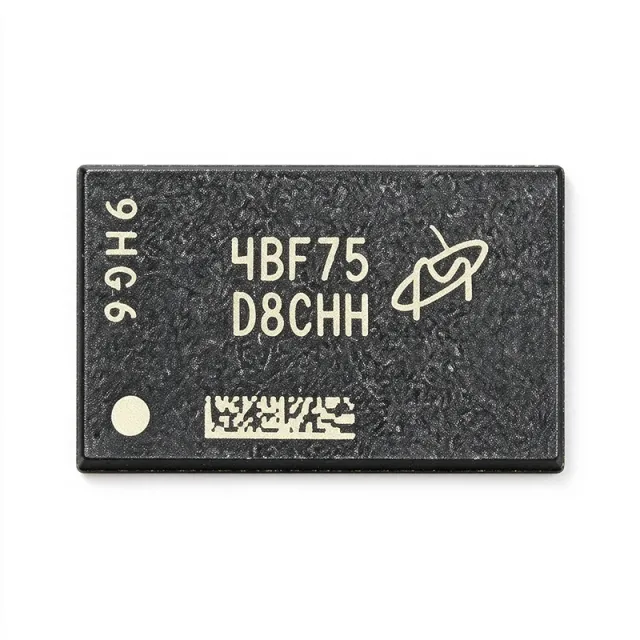
What Is the MT40A512M16TD-062E and What Do Buyers Need to Know First?
The Micron MT40A512M16TD-062E is an 8 Gbit DDR4 SDRAM organized as 512M x 16, specified for 3200 MT/s (1600 MHz clock) with a 19 ns access time. It runs from a 1.2 V VDD core supply plus a separate 2.5 V VPP wordline-boost rail and ships in a 96-ball FBGA package measuring 7.5 x 13 mm. The device is active and in stock: XAIPART lists 32,000 units at an MOQ of 1, with tiered pricing from $84.375 at 1 piece to $49.2188 at 1000 pieces, as of 2026-10-14.
A single component delivers a complete 16-bit DDR4-3200 channel: 6.4 GB/s at 3200 MT/s x 16 bits. Two parts on a 32-bit controller yield 2 GB at 12.8 GB/s; four on a 64-bit channel yield 4 GB at 25.6 GB/s. That granularity is why this part appears in server mezzanine cards, networking packet buffers, industrial embedded boards and automotive ECUs where a full DIMM channel is more than the design needs.
Verified specification summary
| Parameter | Verified value |
|---|---|
| Manufacturer / MPN | Micron Technology / MT40A512M16TD-062E |
| Memory type | DDR4 SDRAM (volatile DRAM) |
| Density / organization | 8 Gbit / 512M x 16 |
| Data rate / clock | 3200 MT/s (DDR4-3200) / 1600 MHz |
| Access time | 19 ns |
| Supply rails | VDD = 1.2 V; VPP = 2.5 V |
| Interface | Parallel, 16-bit |
| Package / mounting | 96-ball FBGA, 7.5 x 13 mm / surface mount |
| Burst length | BL8 / BC4 |
| Features | Programmable data strobe preambles, ODT, TCSR |
| Temperature grade | Commercial (0 C to +85 C); AUT/AIT/AAT variants available |
| Lifecycle / stock | Active / 32,000 units, MOQ 1 |
Two derived numbers matter for planning. First, 8 Gbit equals 1 GB, so capacity scales linearly with component count. Second, the clock period is 1 / 1600 MHz = 0.625 ns, which makes the 19 ns access time roughly 30.4 clock cycles - the figure you need when budgeting read latency inside a controller timing table.
Pricing note - a documented conflict. XAIPART tiers as of 2026-10-14 start at $84.375 (qty 1) and fall to $49.2188 (qty 1000). The product FAQ separately records distributor data showing $6.20032 for the closely related MT40A512M16TB-062E:R as of 2026-09-02. Different die suffix, different channel, different date - do not blend the two. Quote the exact orderable suffix you intend to buy.
Buyer takeaway: treat the MT40A512M16TD-062E as an active, stocked 8 Gbit DDR4-3200 x16 device. Confirm your controller accepts a 16-bit DDR4-3200 channel before design-in, then price at the 1000-piece tier for planning and request a quote for the exact suffix.
How Do You Design In the MT40A512M16TD-062E?
Supply rails, sequencing and decoupling
Two rails are mandatory: 1.2 V VDD for core and I/O, and 2.5 V VPP for wordline boost. The product data is explicit that VPP draws relatively little current but must be present - operating without it can corrupt wordline bias and cause data errors. Sequence both rails per the power-up requirements in the Micron datasheet. Decouple with bulk capacitance plus per-ball high-frequency ceramic capacitors placed close to the package; the verified dataset does not carry capacitor values, so derive them from Micron's layout guidelines for the 96-ball x16 FBGA.
Matching the memory controller
The interface is parallel, 16 bits wide, at 3200 MT/s from a 1600 MHz clock. Burst modes are BL8 and BC4, and read and write latency are programmable, which lets you tune timing to a specific SoC, FPGA or network-processor controller instead of over-margining the bus. On-die termination and programmable data strobe preambles are built in - both matter on multi-rank or heavily loaded channels.
Bandwidth and capacity planning - and a data conflict to resolve
Compute bandwidth from the verified numbers: 3200 MT/s x 16 bit / 8 = 6.4 GB/s per component; a 64-bit channel built from four x16 parts = 25.6 GB/s. The product applications text states 25.6 GB/s per 16-bit component and 102 GB/s for four components on a 64-bit controller. Both figures conflict with the verified data rate and bus width. Design to the derived values and raise the discrepancy with your platform team before quoting throughput to a customer.
| Channel width | Components | Capacity (8 Gbit each) | Peak bandwidth (derived) |
|---|---|---|---|
| 16-bit | 1 | 1 GB | 6.4 GB/s |
| 32-bit | 2 | 2 GB | 12.8 GB/s |
| 64-bit | 4 | 4 GB | 25.6 GB/s |
Signal integrity on a loaded bus
On-die termination and programmable data strobe preambles maintain eye margins on multi-rank buses and long traces, which is why this device is used on registered server modules and densely routed accelerator boards. Use controlled-impedance traces and adequate decoupling per Micron layout guidelines. The x16 organization also simplifies the channel: where four x8 devices would be needed for 32 bits of width, two x16 devices do the same job and consume less board area.
Thermal grade and one-layout strategy
The TD grade is commercial, 0 C to +85 C. AUT, AIT and AAT variants are available in the same 96-ball FBGA and the same 512M x 16 organization, so a single PCB layout serves commercial, industrial and automotive builds - you change the orderable suffix, not the board. The AIT industrial grade covers -40 C to +85 C, and the AUT:R variant is described as AEC-Q100 qualified in the Arrow.com listing referenced by the product FAQ. RoHS and REACH documentation is issued per orderable part number, so pull the compliance package for the exact suffix you purchase.
Burst length, refresh and sustained operation
Use BL8 for streaming workloads such as packet buffering, ADC capture and model-weight staging, and BC4 for shorter, latency-sensitive transfers. Temperature-compensated self-refresh adjusts refresh across the thermal excursions typical of dense server chassis and airflow-constrained accelerator cards, protecting data without over-refreshing at nominal temperature.
Design takeaway: bring up VDD and VPP together with correct sequencing, close the 16-bit DDR4-3200 timing table against the programmable RL/WL registers, and budget 6.4 GB/s per component - not the higher figure in the applications text.
What Are the Drop-In Alternatives and How Do They Compare?
Substitution is practical because every JEDEC-compliant 8 Gb x16 DDR4 device shares the same standard 96-ball FBGA x16 ball-out. The product FAQ names Micron MT40A512M16TB-062E and MT40A512M16LY-062E, Alliance Memory AS4C512M16D4A-62BCN, ISSI IS43QR16512B-062AABL, Nanya NT5AD512M16A4-HR and Samsung K4A8G165WC-BCWE as pin-to-pin candidates, plus the MT40A512M16TD-062E AAT:R automotive-grade build of the same die.
| Parameter | MT40A512M16TD-062E (verified) | What a drop-in alternative must match |
|---|---|---|
| Memory type | DDR4 SDRAM (volatile) | DDR4 SDRAM |
| Density | 8 Gbit | 8 Gbit |
| Organization | 512M x 16 | 512M x 16 |
| Ball-out / footprint | 96-ball FBGA, 7.5 x 13 mm, standard x16 ball-out | Same 96-ball x16 ball-out; FAQ names Micron TB/LY, Alliance AS4C512M16D4A-62BCN, ISSI IS43QR16512B-062AABL, Nanya NT5AD512M16A4-HR and Samsung K4A8G165WC-BCWE as sharing it |
| Data rate / clock | 3200 MT/s (DDR4-3200) / 1600 MHz | -062 speed grade (3200 MT/s) so the controller timing table stays valid |
| Access time | 19 ns | Verify against your controller's read-latency budget |
| Supply rails | VDD 1.2 V, VPP 2.5 V | Same 1.2 V / 2.5 V rails and sequencing |
| Burst and features | BL8 / BC4; programmable data strobe preambles, ODT, TCSR | Confirm BL8/BC4 and ODT support |
| Temperature grade | Commercial 0 C to +85 C; AUT/AIT/AAT variants available | Match the grade suffix to the thermal profile |
| Lifecycle / stock | Active; 32,000 units; MOQ 1 | Confirm active status and stock before substituting |
Two cautions apply. The verified dataset carries a full spec table only for the MT40A512M16TD-062E; for any alternative, confirm speed grade, AC timing and grade suffix on that part's own datasheet. And the -062 speed grade must match the memory controller timing table, or bring-up time goes into re-deriving timings the datasheet already fixes.
Comparison takeaway: shortlist Micron TB or LY for a pin-identical drop-in, Alliance, ISSI, Nanya or Samsung for cross-brand second sourcing, and the AAT:R build when the temperature requirement moves - then verify each candidate's speed grade before release.
What Is the Market Position, Lifecycle Status and Supply Situation?
The MT40A512M16TD-062E is active. XAIPART shows 32,000 units in stock with an MOQ of 1 and five price tiers as of 2026-10-14: $84.375 (qty 1), $60.9375 (qty 10), $53.9062 (qty 100), $51.5625 (qty 500) and $49.2188 (qty 1000). The slope from the first tier to the last is roughly 42%, which is typical of commodity DRAM: the 1-piece price reflects handling and break-bulk, not the market rate.
Channel availability is broad. DigiKey and Mouser stock the AAT, AUT and AIT temperature-grade variants, Octopart aggregates multi-distributor pricing, and Alliance Memory sells a second-source cross-reference. Lead time for the commercial grade is typically from stock to a few weeks per the product FAQ; AUT and AIT grades can run longer because of screening.
Supply risk in this category is not allocation - it is provenance. The FAQ warns that remarked DRAM is a known counterfeit risk in the commodity memory market, which makes authorized-channel purchasing a hard requirement rather than a preference. Wider capacity context: XAIPART industry coverage tracks SEMI's $227B 300 mm fab equipment outlay forecast through 2029, a leading indicator for DRAM wafer capacity and, eventually, DDR4 pricing.
Industry takeaway: lifecycle is active and the stock position is deep, so design-in risk is low. Manage price and authenticity instead - buy authorized, quote the exact suffix, and re-price every quarter because DDR4 moves with the commodity cycle.
What Should Buyers Watch in DDR4 Supply and Design Trends?
Four items are worth tracking, all anchored to verified specs.
1. Speed-grade discipline. DDR4-3200 is the bin today's 16-bit controllers are tuned for. If a design does not need 3200 MT/s, the product FAQ notes the -075E grade (2666 MT/s) in the same footprint is a compatible lower-cost alternative - but the timing table changes with it.
2. Die revision churn. Micron's TD, TB and LY suffixes denote different die generations with the same ball-out and speed grade. Alliance Memory publishes a TB-versus-TD comparison document (named in the product FAQ), which is the kind of evidence you need before substituting inside a qualified product. Track part-change notifications per suffix, not per family.
3. Temperature-grade consolidation. Because commercial, industrial and automotive builds share the 96-ball FBGA footprint and 512M x 16 organization, programs increasingly standardize one layout and vary only the suffix. The AUT:R build's AEC-Q100 qualification, per the Arrow.com listing cited in the FAQ, is what makes that strategy auditable.
4. Embedded AI and data-capture demand. Where HBM or GDDR is too costly or capacity-constrained, DDR4-3200 x16 remains the volume workhorse for model-weight staging and ADC capture buffers. Teams working on latency-critical systems should read edge AI latency and local LLM BOM analysis; the same memory-bandwidth math applies here at 6.4 GB/s per component.
Trend takeaway: the -062E speed grade, the x16 granularity and the shared 96-ball footprint are the stable parts of this decision. Watch die revisions, temperature-grade SKUs and quarterly DDR4 pricing, and re-verify timing whenever any of the three changes. Browse the full component catalog or the MT40A512M16TD-062E product page for current stock.
Comentários
Seja o primeiro a comentar.
🔐 Por favor entrar para publicar um comentário.
Não tem uma conta? Cadastre-se