STMicroelectronics

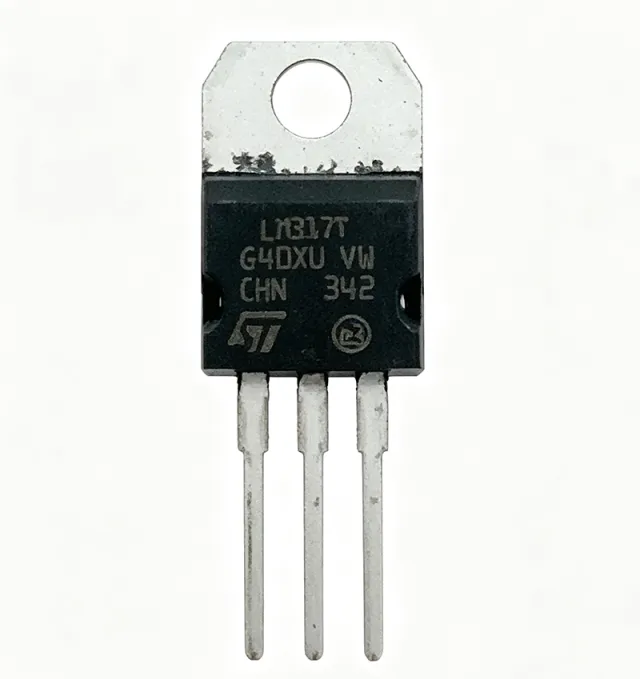
LM317T - 1.5A Adjustable 1.2-37V Regulator | STMicroelectronics

N.º da peça: LM317T ✓ Ativo
Em estoque Enviado em 1 a 3 dias úteis
1.2 V to 37 V Vdss 1.5 A Id TO-220 Package
Contato para preços
MOQ: 1 |
Preço atualizado: 2026-10-08
Preços por volume
Qtd. Preço unitário Total
1 $0 $0,00
10 $0 $0,00
100 $0 $0,00
500 $0 $0,00
1.000 $0 $0,00
ℹ️ Todos os preços estão em USD

LM317T Visão geral

The STMicroelectronics LM317T is a three-terminal adjustable positive linear voltage regulator rated for 1.5A output current and an adjustable output range of 1.2V to 37V, supplied in a TO-220 package. It requires only two external resistors to establish the output voltage and provides internal current limiting, thermal overload protection, and safe-area compensation.

An adjustable linear voltage regulator maintains a nearly constant output by operating a pass transistor in its linear region and correcting the output through feedback. The LM317T belongs to the linear regulator and voltage regulator branches of power-management ICs. Compared with switching regulators, it introduces little switching ripple and needs few external components, but its efficiency falls as input-to-output voltage difference and load current increase.

Key electrical features include typical line regulation of 0.01% per volt and typical load regulation of 0.1%. The internal architecture regulates a nominal 1.25V reference between the output and adjustment pins. Internal current limiting limits fault current, thermal overload protection shuts down excessive temperature conditions, and safe-area compensation improves robustness when input and output conditions approach the pass transistor limits.

The regulator uses a bandgap reference, error amplifier, and power pass transistor. Its output follows VOUT = 1.25V × (1 + R1/R2) plus the adjustment-pin current contribution, making resistor tolerance relevant to overall accuracy. The verified source data states an input-to-output differential range of 3V to 40V and a typical dropout voltage of 2V at a 1.5A load.

Typical applications include adjustable laboratory supplies, battery chargers, constant-current sources, local regulation for audio and instrumentation, and general-purpose power rails. The TO-220 body is readily heatsinked, making the device practical when several watts must be removed, although allowable dissipation depends on junction temperature and thermal resistance.

Designers should preserve at least the required input-to-output headroom, use a suitable heatsink, place input and output capacitors close to the device, and consider adjustment-pin bypassing for ripple rejection. Protection diodes may be needed when output capacitance creates discharge current through the regulator. This page also synthesizes verified source data, drop-in candidates, and practical engineering guidance beyond the basic datasheet description.

Alternativas drop-in para LM317T — mesmo encapsulamento, compatível pino a pino. Peças de encapsulamento diferente que exigem retrabalho na PCB são excluídas.

Ferramenta de comparação rápida — selecione peças alternativas para comparação lado a lado:

LM317T/NOPB

✅ Drop-In
📦 TO-220
Same 1.5A adjustable-regulator class and TO-220 form factor; manufacturer-specific limits and tolerances require datasheet verification.

📋 Alternativa de referência (fora do catálogo)

LM317T

✅ Drop-In
STMicroelectronics
📦 TO-220
Positive adjustable linear voltage regulator · 1.5 A · 1.2 V to 37 V · 3 V to 40 V · 2 V typical at 1.5 A · 1.25 V between output and adjustment pins · 0.01%/V · 0.1%

✓ Em estoque

Consulte o preço

Ver ficha técnica →
ℹ️ 3 peça(s) de outro encapsulamento ocultada(s) — um encapsulamento diferente exige retrabalho na PCB e não é uma substituição drop-in verdadeira. Fale conosco se precisar de sugestões de outros encapsulamentos.

LM317T Classificações máximas e características elétricas

Regulator Type Positive adjustable linear voltage regulator
Output Current 1.5 A
Faixa de tensão de saída 1.2 V to 37 V
Input-to-Output Differential Range 3 V to 40 V
Tensão de dropout 2 V typical at 1.5 A
Internal Reference Voltage 1.25 V between output and adjustment pins
Typical Line Regulation 0.01%/V
Typical Load Regulation 0.1%
Current Limiting Internal
Thermal Protection Internal thermal overload protection
Pass Transistor Protection Safe-area compensation
Output Polarity Positive
Adjustment Method Two external resistors
Encapsulamento TO-220
Contagem de pinos 3 pins
Manufacturer Recommended Dissipation Up to 20 W with proper thermal management

Configuração de pinos do LM317T

TO-220 Package Pinout Diagram TO-220 3-pin vertical mount with tab, JEDEC. 1 2 3 TO-220
Pino 1 ADJ — Adjustment input used with the external resistor divider
Pino 2 OUT — Regulated output; verify orientation against the STMicroelectronics TO-220 drawing
Pino 3 IN — Regulator input

Pass-Transistor Área de Operação Segura

Operação contínua em CC

Aplicações típicas

LM317T é adequado para 6 aplicaçãos: Adjustable Laboratory Power Supply, Battery Charger Output Stage, Precision Audio Supply, Constant-Current LED Driver, Industrial Control and Instrumentation Rail, Bench Top and DIY Supply.

🔧

Adjustable Laboratory Power Supply

The LM317T suits a basic adjustable laboratory supply because two external resistors can establish an output from 1.2V to 37V, and the three-pin arrangement keeps the control topology understandable. With a rated current capability of 1.5A, it can support moderate loads, but its linear architecture requires substantial cooling as VIN minus VOUT rises. At an estimated 12V input, 5V output, and 1.5A load, pass-device dissipation would be 10.5W. A generous heatsink, output capacitor, current limit, and controlled discharge path are therefore essential.

⚡

Battery Charger Output Stage

The LM317T can serve as the controllable pass element in a basic linear battery-charger design because its adjustment pin permits current or voltage feedback around a 1.25V reference. The TO-220 package supports heatsinking when charging current and input-output headroom produce substantial loss. Designers must account for battery chemistry, maximum charge voltage, current accuracy, thermal shutdown behavior, and reverse-current paths. Protection diodes and input/output capacitors are recommended according to the manufacturer guidance before connecting a battery with stored energy.

🎧

Precision Audio Supply

The LM317T is viable for a modest audio preamp or active-bias rail because linear regulation avoids introducing switching ripple directly into the power path. Its output is adjustable over 1.2V to 37V, allowing the rail to match the required circuit headroom. The trade-off is heat: every volt of input-output headroom multiplied by audio current becomes pass-device loss. Place input and output capacitors close to the leads, use a stable heatsink, and consider a lower-noise regulator such as a TPS7A4700 when the noise floor, not simplicity, is the dominant requirement.

💡

Constant-Current LED Driver

The LM317T can regulate current in a simple constant-current LED or lighting circuit by using its output-to-adjustment reference and an appropriate sensing resistor. The nominal 1.25V reference makes resistor-based current setting practical, while the 1.5A capability covers many moderate LED arrays. However, power in the sensing resistor and regulator grows with forward voltage and supply headroom. Validate LED current at minimum and maximum supply voltage, include driver-transistor protection where needed, and ensure the TO-220 thermal design keeps the junction within its manufacturer limits.

🏭

Industrial Control and Instrumentation Rail

The LM317T is appropriate for local regulation of moderate-current industrial control boards when a simple, serviceable three-terminal solution is preferred. Its 1.2V-to-37V range supports multiple unipolar rail requirements, while current limiting and thermal overload protection add basic resilience. The board should still provide input and output capacitors close to the package, adequate copper thermal paths, and a heatsink sized from the worst-case input-output difference. For very low dropout or high-efficiency conversion, a switching regulator is generally a better architectural choice.

⚡

Bench Top and DIY Supply

The LM317T is easy to implement in educational and hobby bench supplies because the output equation is straightforward and only two resistors establish the voltage. The TO-220 package is large, easy to heatsink, and tolerant of straightforward through-hole assembly. Designers should add current protection, an input fuse, an output capacitor rated for the selected voltage, and a visible discharge indicator for stored capacitor energy. Avoid claiming the full 1.5A at large voltage differences unless the enclosure provides adequate ventilation and the calculated pass-device loss has been thermally validated.

What are the key specifications of LM317T that engineers should know?
The LM317T is a 1.5A adjustable positive linear regulator with a 1.2V-to-37V output range in a three-pin TO-220 package. According to the STMicroelectronics manufacturer datasheet, it provides typical line regulation of 0.01% per volt, typical load regulation of 0.1%, a nominal 1.25V internal reference, and a 2V typical dropout voltage at 1.5A. Internal current limiting, thermal overload protection, and pass-transistor safe-area compensation support robust operation.
What is the output voltage range of LM317T?
The LM317T provides an adjustable output from 1.2V to 37V using two external resistors. The verified manufacturer datasheet identifies a nominal 1.25V reference between the output and adjustment pins, so the resistor network sets the regulated level rather than a fixed internal output. The design must retain sufficient input-to-output differential voltage for regulation; the verified internal data states a differential range of 3V to 40V.
How much current can LM317T supply?
The LM317T is rated for 1.5A output current in the TO-220 package. Current delivery still depends on input voltage, output voltage, copper area, heat sinking, and ambient temperature. The manufacturer datasheet also identifies internal current limiting and thermal overload protection. Because power dissipation rises with both load current and the input-to-output voltage difference, a 1.5A operating point may require substantial thermal management.
Where can I download the LM317T datasheet PDF?
The official STMicroelectronics LM317 datasheet PDF is available at https://www.st.com/resource/en/datasheet/lm317.pdf. The manufacturer document is the preferred source for electrical limits, protection behavior, thermal information, and application guidance. DigiKey also identifies LM317T as a TO-220 positive adjustable linear regulator, while third-party datasheet indexes can help locate historical copies but should not replace the manufacturer document.
Where can I find the LM317T pinout?
The LM317T uses three leads in the TO-220 package: input, output, and adjustment. The manufacturer datasheet is the authoritative location for the exact lead orientation and package drawing. Preserve the standard front-facing pin sequence shown by STMicroelectronics when orienting the device; reversing input and output can cause severe damage. The exposed tab is electrically associated with the output lead on the specified package.
How do I calculate the LM317T output voltage?
The LM317T output is primarily set by two external resistors according to VOUT = 1.25V × (1 + R1/R2), plus a small adjustment-pin-current term. The verified internal data identifies 1.25V as the nominal reference. Resistor tolerance and adjustment-pin current affect absolute accuracy, while the pass element still requires adequate input-to-output differential voltage. Choose resistor values that keep current and power within their ratings.
What happens if the LM317T input voltage is too close to the output?
The LM317T cannot regulate properly when the input-to-output differential voltage falls below the level required to keep its pass transistor in the operating region. The verified internal data states a 3V-to-40V differential range and a typical 2V dropout at 1.5A. At light load, the practical dropout can differ, but a design should preserve adequate headroom across temperature, load, and line variation rather than relying on the typical figure alone.
Does LM317T need a heatsink at 1.5A?
Yes, a heatsink is normally required near the full 1.5A rating when the input-to-output voltage difference is appreciable. Estimated: power loss equals VIN minus VOUT, multiplied by output current; at 12V input, 5V output, and 1.5A, the regulator dissipates 10.5W. The verified internal data mentions up to 20W with proper thermal management, but actual junction temperature must be verified against manufacturer limits and the installed thermal resistance.
What protection features are built into LM317T?
The LM317T includes internal current limiting, thermal overload protection, and output-transistor safe-area compensation. According to the STMicroelectronics manufacturer datasheet, these functions help limit fault conditions and protect the internal pass device. They do not eliminate the need for suitable input and output capacitors, thermal design, or application-level reverse-polarity and output-discharge protection where the operating environment requires it.
Is LM317T suitable for a laboratory adjustable power supply?
The LM317T is suitable for a laboratory adjustable supply when its dissipation and protection requirements are controlled. Its 1.2V-to-37V adjustment range and simple two-resistor network support multiple output settings, while internal current limiting and thermal shutdown provide basic fault handling. A practical supply should also include reverse-polarity protection, a robust heatsink, output capacitors, current margin, and a safer shutdown arrangement for high-energy capacitors.
LM317T versus LM317T/NOPB — which is the direct replacement?
The LM317T from STMicroelectronics and LM317T/NOPB from Texas Instruments are both listed as 1.5A adjustable positive linear regulators in TO-220 packages. The available distributor result confirms the same class, output current, adjustment function, and package form factor. Engineers should still compare electrical limits, temperature range, pin orientation, tolerance, and protection behavior against the current manufacturer datasheets before treating either part as a production drop-in replacement.
When should I choose LM317T instead of a switching regulator?
Choose the LM317T when low ripple, simple control, and minimal component count matter more than conversion efficiency. A linear regulator dissipates the voltage difference across its pass transistor, so efficiency falls as input-to-output voltage or load increases. A switching regulator is usually preferable when substantial power must be converted efficiently, although it introduces switching ripple and typically needs an inductor, compensation, and more careful layout.
What is the best drop-in replacement for LM317T?
A valid drop-in replacement must have the same three-lead TO-220 footprint, pin orientation, voltage range, current capability, and external adjustment scheme. The verified cross-reference search identifies Texas Instruments LM317T/NOPB as a closely matching 1.5A TO-220 adjustable regulator. Because cross-brand interchangeability still depends on manufacturer-specific electrical and thermal limits, verify the TI datasheet and test the finished design rather than relying only on the family name.
Can LM317T be used as a constant-current source?
Yes, the LM317T can be configured as an adjustable constant-current source by placing a current-setting resistor between its adjustment and output-related node. This exploits the regulator's internal reference and error loop to maintain approximately constant voltage across the sensing arrangement. Set the resistor for the required current, account for package power dissipation, and protect the load and wiring against overcurrent and reverse voltage. The exact sensing topology should follow the manufacturer guidance.
Where to buy LM317T online and what is its price?
The verified DigiKey listing provides a direct purchase route for the STMicroelectronics LM317T and identifies it as a 1.5A TO-220 adjustable linear regulator. Current unit price, stock, and lead time were not included in the supplied data and therefore are not asserted here. As of 2026-10-08, request a live distributor quotation and inventory confirmation before budgeting the part; the official STMicroelectronics datasheet is linked for technical review.
Is LM317T in stock, and what is its lead time?
The verified DigiKey result states that LM317T can be purchased and shipped, but it does not provide a captured stock quantity, lifecycle quantity, or dated lead-time commitment. As of 2026-10-08, treat live availability as distributor-specific and request confirmation at the intended quantity. The internal product record identifies the device as active, but a production purchasing decision should still consider regional inventory, lifecycle notices, and approved-source requirements.

Dados de referência de engenharia para LM317T — comparação, orientação de projeto e informações de conformidade.

Guia de seleção

Choose the STMicroelectronics LM317T when the design needs a simple, adjustable positive rail up to 37V, current capability near 1.5A, and a readily heatsinkable TO-220 package. It is especially appropriate for prototypes, laboratory supplies, battery-charging experiments, and modest industrial boards where linear simplicity and serviceability outweigh efficiency. Select LM317T/NOPB or the onsemi LM317T as candidate second sources after checking exact electrical limits, tolerances, thermal ratings, and lifecycle documents. LM317DCYR, LM317LCPK, and LM317QDCYRQ1 can serve the same broad regulator function but use smaller packages and therefore are not literal drop-ins for a TO-220 footprint. For low dropout, very low noise, or high conversion efficiency, consider an LDO or switching regulator instead.

Comparação com alternativas

Parâmetro Este produto LM317T/NOPB LM317T LM317DCYR LM317LCPK
Brand STMicroelectronics Texas Instruments onsemi Texas Instruments Texas Instruments
Package TO-220 TO-220-3 TO-220 SOT-223 TO-252
Regulator Function Positive adjustable linear regulator Positive adjustable linear regulator Positive adjustable linear regulator Positive adjustable linear regulator Positive adjustable linear regulator
Current Limiting Internal Internal Internal Internal Internal
Thermal Overload Protection Internal Internal Internal Internal Internal

Principais diferenciais

  • Same-package second-source potential (vs LM317T/NOPB)
  • Direct onsemi family match (vs onsemi LM317T)
  • Serviceable through-hole thermal path (vs LM317DCYR)

Notas de projeto

Estimated: regulator dissipation is PD = (VIN - VOUT) × IOUT. Using the verified maximum-current condition of 12V input, 5V output, and 1.5A load gives 10.5W. Select the TO-220 heatsink from that worst-case loss and the manufacturer's thermal-resistance data while accounting for ambient temperature and lead length. Do not use the stated 20W capability without confirming the required junction-temperature margin.

Keep the input-to-output differential high enough to regulate under line, load, and temperature variation. The verified data gives a 3V-to-40V differential range and a typical 2V dropout at 1.5A, but typical dropout is not a worst-case guarantee. Use remote output sensing when cable or load resistance would otherwise create an additional error, and place the regulating feedback point near the load.

Connect input and output bypass capacitors close to their respective leads with short, low-resistance paths. Keep high-current return current away from sensitive signal ground and place the heatsink thermally where airflow is available. The adjustable lead should be kept short and isolated from noisy routes; if ripple rejection is important, manufacturer-recommended adjustment-pin bypassing may help but must be checked for stability.

Do not confuse the 1.5A current rating with a guarantee that every load can be supplied at every voltage ratio. Large output capacitors can discharge into the regulator during shutdown, so evaluate protection diodes and discharge behavior. Also avoid treating the 0.01%/V line regulation or 0.1% load regulation figures as total output accuracy; resistor tolerance and the adjustment-pin current add error.

Informações de conformidade

RoHS
Unknown
REACH
Unknown
AEC-Q100
Not Applicable
Sem chumbo
Unknown
Sem halogênios
Unknown
Minerais de conflito
Unknown

The supplied verified data does not explicitly state RoHS, REACH, lead-free, halogen-free, or conflict-minerals status for this device. AEC-Q100 is treated as not applicable to this non-automotive-qualified standard LM317T designation, but no automotive qualification claim was provided.

Dados verificados em: 2026-10-08 — dados verificados e curados pela equipe de engenharia de componentes da XAIPART

Buscas relacionadas

LM317T LM317T datasheet STMicroelectronics LM317T LM317T 1.5A adjustable regulator LM317T 1.2V to 37V TO-220 adjustable voltage regulator LM317T laboratory power supply LM317T battery charger circuit LM317T vs LM317T/NOPB LM317T drop-in replacement LM317T pinout LM317T heatsink calculation LM317T buy online LM317T price and stock TO-220 voltage regulator with current limiting

Componentes & termos relacionados

STMicroelectronics LM317T Texas Instruments onsemi LM317T/NOPB LM317DCYR LM317LCPK LM317QDCYRQ1 positive adjustable linear voltage regulator linear regulator voltage regulator power-management IC TO-220 DIP through-hole package three-terminal regulator bandgap reference error amplifier pass transistor dropout voltage line regulation load regulation current limiting thermal overload protection safe-area compensation battery charger laboratory power supply
RFQ de cotação rápida
Preencha todos os detalhes — nossa equipe de vendas responderá em até 24 horas
Part number Fabricante Encapsulamento QTY Preço-alvo Total
Total: $0.00 USD
✓
Cotação enviada!

Responderemos seu e-mail em até 24 horas

1
RFQ enviada
2
Cotação recebida
3
Pedido realizado
4
Pagamento
5
Enviado
6
Entregue
Ver detalhes da RFQ

