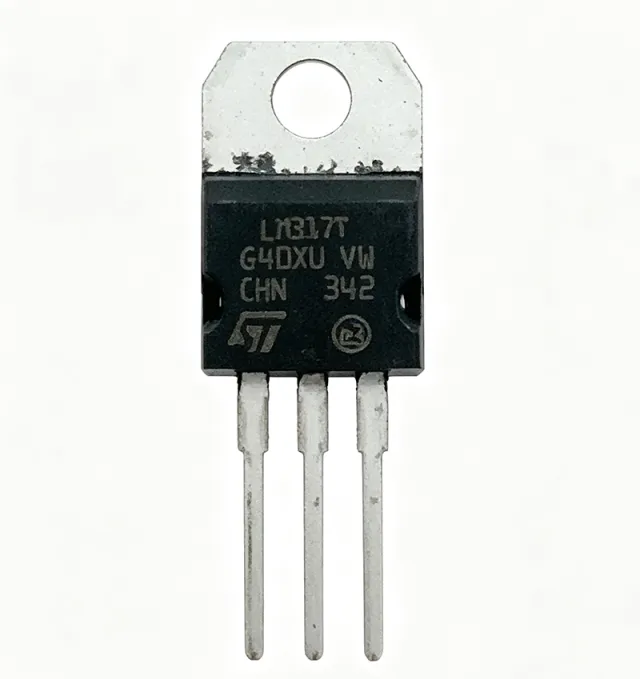
LM317T - 1.5A Adjustable 1.2-37V Regulator | STMicroelectronics
N.º de pieza: LM317T ✓ Activo| Cant. | Precio unitario | Total |
|---|---|---|
| 1 | $0 | $0,00 |
| 10 | $0 | $0,00 |
| 100 | $0 | $0,00 |
| 500 | $0 | $0,00 |
| 1.000 | $0 | $0,00 |
LM317T Descripción general
An adjustable linear voltage regulator maintains a nearly constant output by operating a pass transistor in its linear region and correcting the output through feedback. The LM317T belongs to the linear regulator and voltage regulator branches of power-management ICs. Compared with switching regulators, it introduces little switching ripple and needs few external components, but its efficiency falls as input-to-output voltage difference and load current increase.
Key electrical features include typical line regulation of 0.01% per volt and typical load regulation of 0.1%. The internal architecture regulates a nominal 1.25V reference between the output and adjustment pins. Internal current limiting limits fault current, thermal overload protection shuts down excessive temperature conditions, and safe-area compensation improves robustness when input and output conditions approach the pass transistor limits.
The regulator uses a bandgap reference, error amplifier, and power pass transistor. Its output follows VOUT = 1.25V × (1 + R1/R2) plus the adjustment-pin current contribution, making resistor tolerance relevant to overall accuracy. The verified source data states an input-to-output differential range of 3V to 40V and a typical dropout voltage of 2V at a 1.5A load.
Typical applications include adjustable laboratory supplies, battery chargers, constant-current sources, local regulation for audio and instrumentation, and general-purpose power rails. The TO-220 body is readily heatsinked, making the device practical when several watts must be removed, although allowable dissipation depends on junction temperature and thermal resistance.
Designers should preserve at least the required input-to-output headroom, use a suitable heatsink, place input and output capacitors close to the device, and consider adjustment-pin bypassing for ripple rejection. Protection diodes may be needed when output capacitance creates discharge current through the regulator. This page also synthesizes verified source data, drop-in candidates, and practical engineering guidance beyond the basic datasheet description.
Alternativas directas para LM317T — mismo encapsulado, compatible pin a pin. Se excluyen las piezas de otro encapsulado que requieren retrabajo de la PCB.
Herramienta de comparación rápida — seleccione piezas alternativas para compararlas lado a lado:
LM317T/NOPB
✅ Sustitución directa📋 Alternativa de referencia (no en el catálogo)
LM317T
✅ Sustitución directa✓ En stock
Consulte el precio
Ver hoja de datos →LM317T Valores máximos y características eléctricas
| Regulator Type | Positive adjustable linear voltage regulator |
| Output Current | 1.5 A |
| Rango de tensión de salida | 1.2 V to 37 V |
| Input-to-Output Differential Range | 3 V to 40 V |
| Tensión de dropout | 2 V typical at 1.5 A |
| Internal Reference Voltage | 1.25 V between output and adjustment pins |
| Typical Line Regulation | 0.01%/V |
| Typical Load Regulation | 0.1% |
| Current Limiting | Internal |
| Thermal Protection | Internal thermal overload protection |
| Pass Transistor Protection | Safe-area compensation |
| Output Polarity | Positive |
| Adjustment Method | Two external resistors |
| Encapsulado | TO-220 |
| Recuento de pines | 3 pins |
| Manufacturer Recommended Dissipation | Up to 20 W with proper thermal management |
Configuración de pines de LM317T
| Pin 1 | ADJ — Adjustment input used with the external resistor divider |
| Pin 2 | OUT — Regulated output; verify orientation against the STMicroelectronics TO-220 drawing |
| Pin 3 | IN — Regulator input |
Pass-Transistor Área de funcionamiento seguro
Aplicaciones típicas
LM317T es adecuado para 6 aplicacións: Adjustable Laboratory Power Supply, Battery Charger Output Stage, Precision Audio Supply, Constant-Current LED Driver, Industrial Control and Instrumentation Rail, Bench Top and DIY Supply.
Adjustable Laboratory Power Supply
The LM317T suits a basic adjustable laboratory supply because two external resistors can establish an output from 1.2V to 37V, and the three-pin arrangement keeps the control topology understandable. With a rated current capability of 1.5A, it can support moderate loads, but its linear architecture requires substantial cooling as VIN minus VOUT rises. At an estimated 12V input, 5V output, and 1.5A load, pass-device dissipation would be 10.5W. A generous heatsink, output capacitor, current limit, and controlled discharge path are therefore essential.
Recomendado
Battery Charger Output Stage
The LM317T can serve as the controllable pass element in a basic linear battery-charger design because its adjustment pin permits current or voltage feedback around a 1.25V reference. The TO-220 package supports heatsinking when charging current and input-output headroom produce substantial loss. Designers must account for battery chemistry, maximum charge voltage, current accuracy, thermal shutdown behavior, and reverse-current paths. Protection diodes and input/output capacitors are recommended according to the manufacturer guidance before connecting a battery with stored energy.
Recomendado
Precision Audio Supply
The LM317T is viable for a modest audio preamp or active-bias rail because linear regulation avoids introducing switching ripple directly into the power path. Its output is adjustable over 1.2V to 37V, allowing the rail to match the required circuit headroom. The trade-off is heat: every volt of input-output headroom multiplied by audio current becomes pass-device loss. Place input and output capacitors close to the leads, use a stable heatsink, and consider a lower-noise regulator such as a TPS7A4700 when the noise floor, not simplicity, is the dominant requirement.
Recomendado
Constant-Current LED Driver
The LM317T can regulate current in a simple constant-current LED or lighting circuit by using its output-to-adjustment reference and an appropriate sensing resistor. The nominal 1.25V reference makes resistor-based current setting practical, while the 1.5A capability covers many moderate LED arrays. However, power in the sensing resistor and regulator grows with forward voltage and supply headroom. Validate LED current at minimum and maximum supply voltage, include driver-transistor protection where needed, and ensure the TO-220 thermal design keeps the junction within its manufacturer limits.
Recomendado
Industrial Control and Instrumentation Rail
The LM317T is appropriate for local regulation of moderate-current industrial control boards when a simple, serviceable three-terminal solution is preferred. Its 1.2V-to-37V range supports multiple unipolar rail requirements, while current limiting and thermal overload protection add basic resilience. The board should still provide input and output capacitors close to the package, adequate copper thermal paths, and a heatsink sized from the worst-case input-output difference. For very low dropout or high-efficiency conversion, a switching regulator is generally a better architectural choice.
Recomendado
Bench Top and DIY Supply
The LM317T is easy to implement in educational and hobby bench supplies because the output equation is straightforward and only two resistors establish the voltage. The TO-220 package is large, easy to heatsink, and tolerant of straightforward through-hole assembly. Designers should add current protection, an input fuse, an output capacitor rated for the selected voltage, and a visible discharge indicator for stored capacitor energy. Avoid claiming the full 1.5A at large voltage differences unless the enclosure provides adequate ventilation and the calculated pass-device loss has been thermally validated.
Recomendado
Resumen de productos recomendados
Datos de referencia de ingeniería para LM317T — comparación, orientación de diseño e información de cumplimiento.
Guía de selección
Comparación con alternativas
| Parámetro | Este producto | LM317T/NOPB | LM317T | LM317DCYR | LM317LCPK |
|---|---|---|---|---|---|
| Brand | STMicroelectronics | Texas Instruments | onsemi | Texas Instruments | Texas Instruments |
| Package | TO-220 | TO-220-3 | TO-220 | SOT-223 | TO-252 |
| Regulator Function | Positive adjustable linear regulator | Positive adjustable linear regulator | Positive adjustable linear regulator | Positive adjustable linear regulator | Positive adjustable linear regulator |
| Current Limiting | Internal | Internal | Internal | Internal | Internal |
| Thermal Overload Protection | Internal | Internal | Internal | Internal | Internal |
Diferenciadores clave
- Same-package second-source potential (frente a LM317T/NOPB)
- Direct onsemi family match (frente a onsemi LM317T)
- Serviceable through-hole thermal path (frente a LM317DCYR)
Notas de diseño
Estimated: regulator dissipation is PD = (VIN - VOUT) × IOUT. Using the verified maximum-current condition of 12V input, 5V output, and 1.5A load gives 10.5W. Select the TO-220 heatsink from that worst-case loss and the manufacturer's thermal-resistance data while accounting for ambient temperature and lead length. Do not use the stated 20W capability without confirming the required junction-temperature margin.
Keep the input-to-output differential high enough to regulate under line, load, and temperature variation. The verified data gives a 3V-to-40V differential range and a typical 2V dropout at 1.5A, but typical dropout is not a worst-case guarantee. Use remote output sensing when cable or load resistance would otherwise create an additional error, and place the regulating feedback point near the load.
Connect input and output bypass capacitors close to their respective leads with short, low-resistance paths. Keep high-current return current away from sensitive signal ground and place the heatsink thermally where airflow is available. The adjustable lead should be kept short and isolated from noisy routes; if ripple rejection is important, manufacturer-recommended adjustment-pin bypassing may help but must be checked for stability.
Do not confuse the 1.5A current rating with a guarantee that every load can be supplied at every voltage ratio. Large output capacitors can discharge into the regulator during shutdown, so evaluate protection diodes and discharge behavior. Also avoid treating the 0.01%/V line regulation or 0.1% load regulation figures as total output accuracy; resistor tolerance and the adjustment-pin current add error.
Información de cumplimiento
The supplied verified data does not explicitly state RoHS, REACH, lead-free, halogen-free, or conflict-minerals status for this device. AEC-Q100 is treated as not applicable to this non-automotive-qualified standard LM317T designation, but no automotive qualification claim was provided.