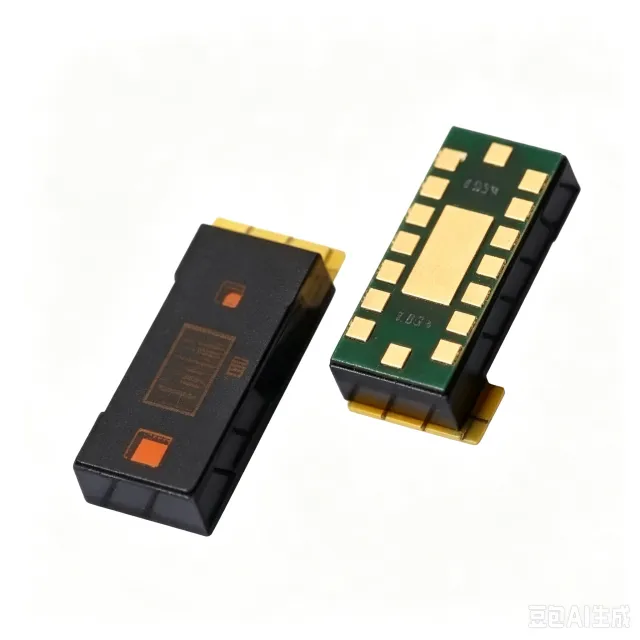
VL53L5CXV0GC/1 - 8x8 Multi-Zone Time-of-Flight Sensor | STMicroelectronics
N.º da peça: VL53L5CXV0GC/1 ✓ Ativo| Qtd. | Preço unitário | Total |
|---|---|---|
| 1 | $4.96 | $4,96 |
VL53L5CXV0GC/1 Visão geral
A Time-of-Flight (ToF) sensor is a type of optical sensor that measures distance by calculating the time it takes for emitted light to reflect off an object and return to the sensor. Unlike infrared proximity sensors that only detect presence, ToF sensors provide absolute distance measurements, making them essential for applications requiring precise depth sensing. In the broader system hierarchy, a ToF sensor is a type of optical sensor, which falls under the category of sensors, which are components of electronic systems that perceive the physical world. The VL53L5CXV0GC/1 is a direct ToF sensor, meaning it measures the round-trip time of light pulses directly, as opposed to indirect ToF methods that use phase-shift measurements.
Key features of the VL53L5CXV0GC/1 include its 8x8 multi-zone ranging, which allows for depth mapping and object detection across a wide area. It offers a maximum ranging frequency of 60 Hz, enabling real-time depth sensing for gesture recognition and SLAM applications. The sensor has a low power consumption of 1.5 mA in continuous operation, making it suitable for battery-powered devices. It also features an on-chip microcontroller that handles ranging algorithms, reducing host processing load. The module is housed in a 6.4 mm x 3.0 mm x 1.5 mm optical module package, which is reflowable and compatible with standard SMT assembly.
Technically, the VL53L5CXV0GC/1 uses a SPAD array to detect individual photons, achieving high sensitivity even in low-light conditions. The integrated laser driver emits short infrared pulses, and the time-of-flight is measured with picosecond resolution. The sensor includes a histogram-based algorithm that distinguishes multiple targets and suppresses crosstalk, improving accuracy in complex scenes. The device operates from a 2.8 V supply voltage, with I2C and SPI interfaces for flexible integration. It also includes a programmable GPIO for interrupt generation, which can be configured for various events such as new data ready or threshold crossing.
Typical applications include robotics for obstacle avoidance and navigation, smart home devices for presence detection and gesture control, and consumer electronics for camera autofocus assistance. In robotics, the multi-zone capability allows the sensor to map the environment in real-time, enabling collision avoidance. In smart home devices, it can detect human presence for energy-saving automation. In camera systems, it provides fast and accurate autofocus even in low-light conditions.
When designing with this sensor, ensure proper optical alignment and avoid covering the module with materials that are opaque to 940 nm light. The sensor requires a clean power supply with adequate decoupling, and the I2C address can be configured via a pin. For best performance, calibrate the sensor in the final product environment to account for cover glass and other optical elements.
Alternativas drop-in para VL53L5CXV0GC/1 — mesmo encapsulamento, compatível pino a pino. Peças de encapsulamento diferente que exigem retrabalho na PCB são excluídas.
Ferramenta de comparação rápida — selecione peças alternativas para comparação lado a lado:
VL53L0CXV0DH/1
✓ Em estoque
$1.5114 / unidade
Ver ficha técnica →VL53L7CXV0GC/1
📋 Alternativa de referência (fora do catálogo)
VL53L1CXV0FY/1
📋 Alternativa de referência (fora do catálogo)
VL53L5CXV0GC/1 Classificações máximas e características elétricas
| Ranging Technology | Time-of-Flight (ToF) |
| Resolução | 8x8 multi-zone (64 zones) |
| Ranging Distance | 1 cm to 400 cm |
| Field of View (FoV) | 61 degrees diagonal |
| Wavelength | 940 nm |
| Max Ranging Frequency | 60 Hz |
| Tensão de alimentação | 2.8 V |
| I2C Interface | Up to 1 MHz |
| SPI Interface | Up to 10 MHz |
| Temperatura de operação | -30C to +85C |
| Encapsulamento | Optical module 6.4 mm x 3.0 mm x 1.5 mm |
| Tipo de montagem | Surface Mount (reflowable) |
| Power Consumption | 1.5 mA (continuous) |
| Interrupt Output | Yes (programmable GPIO) |
| Status RoHS | Compliant |
Configuração de pinos do VL53L5CXV0GC/1
| Pino 1 | AVDD — Analog power supply (2.8V) |
| Pino 2 | GND — Ground |
| Pino 3 | SDA — I2C data line |
| Pino 4 | SCL — I2C clock line |
| Pino 5 | GPIO1 — Interrupt output |
| Pino 6 | XSHUT — Shutdown control (active low) |
| Pino 7 | SPI_MISO — SPI master-in slave-out |
| Pino 8 | SPI_MOSI — SPI master-out slave-in |
| Pino 9 | SPI_SCK — SPI clock |
| Pino 10 | SPI_CS — SPI chip select |
| Pino 11 | VDDIO — I/O supply voltage |
| Pino 12 | GND — Ground |
Aplicações típicas
VL53L5CXV0GC/1 é adequado para 6 aplicaçãos: Robotics Obstacle Avoidance, Smart Home Presence Detection, Gesture Recognition, Camera Autofocus Assistance, Industrial Safety Systems, Consumer Electronics.
Robotics Obstacle Avoidance
The VL53L5CXV0GC/1's 8x8 multi-zone ranging enables robots to detect obstacles in multiple directions simultaneously. With a 61-degree field of view and 60 Hz ranging frequency, it provides real-time depth data for navigation and collision avoidance. The sensor's compact size and low power consumption make it ideal for small robots and drones. In a typical robot, the sensor is mounted on the front or around the perimeter, and its I2C interface connects to the main controller. The multi-zone data allows the robot to map its immediate surroundings and plan paths accordingly. Compared to ultrasonic sensors, ToF offers higher accuracy and faster response, but it is affected by ambient light and surface reflectivity. Designers should calibrate the sensor for the specific environment and consider using multiple sensors for full coverage.
Recomendado
Smart Home Presence Detection
The VL53L5CXV0GC/1 can detect human presence in a room by measuring distances across its 8x8 zones. This enables energy-saving automation, such as turning off lights or HVAC when no one is present. The sensor's low power consumption (1.5 mA) allows it to run continuously on battery power. In a smart home system, the sensor is typically mounted on a wall or ceiling, and its interrupt output can wake the host microcontroller when a change in distance is detected. The multi-zone data can also be used to distinguish between a person and a pet, reducing false triggers. Compared to PIR sensors, ToF provides more detailed information and is less prone to false alarms from temperature changes. However, ToF sensors require a clear line of sight and may be affected by reflective surfaces. Designers should consider the sensor's field of view and mounting height for optimal coverage.
Recomendado
Gesture Recognition
The VL53L5CXV0GC/1's high-speed 8x8 multi-zone ranging enables real-time gesture recognition for touchless control. With a 60 Hz ranging frequency, it can track hand movements and recognize gestures such as swipes, taps, and pinches. This is useful for smart speakers, displays, and automotive infotainment systems. In a gesture recognition system, the sensor is placed in front of the user, and the host processor runs algorithms to interpret the depth maps. The sensor's wide field of view (61 degrees) allows it to capture gestures over a large area. Compared to camera-based systems, ToF is more power-efficient and works in low-light conditions. However, it has a limited range and may struggle with fast movements. Designers should optimize the algorithm for the specific gestures and ensure the sensor is positioned to capture the full hand movement.
Recomendado
Camera Autofocus Assistance
The VL53L5CXV0GC/1 provides fast and accurate distance measurement for camera autofocus systems. Its ToF technology works in low-light conditions, unlike contrast-based autofocus, and is faster than laser-based systems. The sensor can measure distances up to 4 meters, covering typical photography scenarios. In a camera module, the sensor is placed near the lens, and its distance data is used to adjust the lens position. The multi-zone capability allows the camera to focus on multiple subjects simultaneously. Compared to phase-detection autofocus, ToF is more reliable in low light and can focus on low-contrast subjects. However, ToF sensors add cost and complexity to the camera module. Designers should integrate the sensor with the camera's image signal processor (ISP) for seamless operation.
Recomendado
Industrial Safety Systems
The VL53L5CXV0GC/1 can be used in industrial safety systems to detect the presence of personnel in hazardous areas. Its multi-zone ranging allows it to monitor a wide area and trigger alarms or shut down machinery when someone enters a danger zone. The sensor's wide operating temperature range (-30C to +85C) makes it suitable for harsh industrial environments. In a safety system, the sensor is mounted at the entrance of a machine guard, and its output is connected to a safety PLC. The sensor's interrupt output can provide immediate notification of a breach. Compared to light curtains, ToF sensors offer more flexibility in mounting and can detect objects at various distances. However, they may be affected by dust and smoke, so regular cleaning is required. Designers should follow safety standards such as ISO 13849 when integrating the sensor.
Recomendado
Consumer Electronics
The VL53L5CXV0GC/1 is used in consumer electronics such as smartphones, tablets, and smart speakers for features like proximity detection, gesture control, and augmented reality. Its compact size and low power consumption make it ideal for portable devices. In a smartphone, the sensor can be used for face detection and to disable the touchscreen during calls. In a smart speaker, it can detect when a user is nearby and adjust the volume or display. The sensor's I2C interface allows easy integration with application processors. Compared to other proximity sensors, ToF provides more accurate distance data, enabling advanced features. However, the sensor requires a clear aperture in the device housing, and the cover glass must be transparent to 940 nm light. Designers should work with the industrial design team to ensure proper optical alignment.
Recomendado
Resumo dos produtos recomendados
Dados de referência de engenharia para VL53L5CXV0GC/1 — comparação, orientação de projeto e informações de conformidade.
Guia de seleção
Comparação com alternativas
| Parâmetro | Este produto | VL53L7CXV0GC/1 | VL53L1CXV0FY/1 | VL53L0CXV0DH/1 |
|---|---|---|---|---|
| Package | Optical module 6.4 mm x 3.0 mm x 1.5 mm | Optical module 6.4 mm x 3.0 mm x 1.5 mm | Optical module 4.4 mm x 2.4 mm x 1.0 mm | Optical module 4.4 mm x 2.4 mm x 1.0 mm |
| Brand | STMicroelectronics | STMicroelectronics | STMicroelectronics | STMicroelectronics |
| Resolution | 8x8 multi-zone | 8x8 multi-zone | Single zone | Single zone |
| Max Range | 400 cm | 400 cm | 400 cm | 200 cm |
| Field of View | 61 degrees | 61 degrees | 27 degrees | 25 degrees |
| Max Ranging Frequency | 60 Hz | 60 Hz | 50 Hz | 50 Hz |
| Supply Voltage | 2.8 V | 2.8 V | 2.8 V | 2.8 V |
| Power Consumption | 1.5 mA | 1.5 mA | 1.5 mA | 1.5 mA |
Principais diferenciais
- 8x8 multi-zone ranging (vs VL53L1CXV0FY/1)
- Wider field of view (vs VL53L1CXV0FY/1)
- Higher ranging frequency (vs VL53L0CXV0DH/1)
Notas de projeto
Place the VL53L5CXV0GC/1 on the PCB with a clear aperture for the laser and detector. Avoid placing components or traces directly in front of the sensor that could obstruct the optical path. Use a cover glass that is transparent to 940 nm light, and ensure it is positioned at the correct distance to avoid reflections. Provide a ground plane beneath the sensor to reduce noise.
Decouple the AVDD and VDDIO pins with 1 uF and 0.1 uF capacitors placed as close to the pins as possible. The sensor draws up to 1.5 mA, but during laser emission, current spikes can occur. Use a low-impedance power source and consider a ferrite bead to filter high-frequency noise.
Do not cover the sensor with opaque materials. Ensure the XSHUT pin is pulled high for normal operation, and use it to put the sensor in shutdown mode when not in use to save power. When using I2C, set the correct address via the ADDR pin to avoid conflicts with other devices. Calibrate the sensor in the final product to account for cover glass and ambient light.
Informações de conformidade
RoHS compliant per STMicroelectronics product page. Not AEC-Q100 qualified. REACH compliance assumed based on ST's general compliance.







