Товары (46.000+)

STM32H745ZGT6 - Dual Cortex-M7/M4 MCU 1MB Flash | STMicroelectronics
STM32H745ZGT6

STM32H745ZGT6 - Dual Cortex-M7/M4 MCU 1MB Flash | STMicroelectronics

The STMicroelectronics STM32H745ZGT6 is a dual-core 32-bit ARM microcontroller integrating an Arm Cortex-M7 core running up to 480 MHz and a Cortex-M4 core running up to 240 MHz, packaged in a 144-pin LQFP (20x20 mm) with 1 MB of embedded Flash and approximately 1 MB of SRAM. It belongs to the high-performance STM32H7 family and is engineered for compute-intensive real-time control, motor drives, audio processing, and human-machine interface (HMI) applications where two heterogeneous cores share a workload - the M7 for DSP/graphics and the M4 for housekeeping, communications, or low-power task scheduling. As a microcontroller (MCU), the STM32H745ZGT6 sits in the broader taxonomy of embedded processing devices: MCU -> ARM Cortex-M MCU -> STM32 family -> STM32H7 high-performance series. It is a system-on-chip integrating CPU cores, memory, analog peripherals, and digital interfaces in a single package, programmed typically via STM32CubeIDE, STM32CubeMX, and the HAL/LL driver libraries. Key differentiating features include the dual-core asymmetric architecture (M7 + M4) with separate instruction caches, an integrated SMPS step-down converter for core supply (improving efficiency versus external LDOs), up to 2 MB Flash and 1 MB RAM across the full H745 line, a Chrom-ART graphics accelerator, JPEG codec hardware, and an extensive peripheral set including 16-/12-bit ADCs, DACs, timers, Ethernet, USB, CAN FD, and high-speed SPI/QSPI interfaces for external memory or displays. The device operates from 1.62 V to 3.6 V with internal SMPS generating the core voltage. Typical applications include industrial motor control (field-oriented control), audio amplifiers and DSP effects processors, HMI panels with TFT-LCD and touch, building automation, IoT edge gateways, programmable logic controllers, and medical instrumentation. The dual-core design enables deterministic real-time response on the M4 while the M7 executes complex algorithms without mutual blocking. When designing with this part, allocate a minimum 4-layer PCB with continuous GND pour around the LQFP-144 package to manage thermal dissipation at high clock speeds. Decouple each VDD/VBAT pin with 100 nF X7R ceramic capacitors placed within 2 mm of the respective pins. Use STM32CubeMX to configure the SMPS inductor and feedback compensation to achieve the specified core voltage ripple under your worst-case load transient. This page synthesizes distributor pricing, drop-in pin-compatible alternatives within the STM32H7 family, and practical PCB layout notes not found in the manufacturer datasheet.

Запрос цены Контакты
STM32H745ZIT6 - Dual-Core Cortex-M7/M4 MCU, 480MHz, 2MB Flash | STMicroelectronics
STM32H745ZIT6

STM32H745ZIT6 - Dual-Core Cortex-M7/M4 MCU, 480MHz, 2MB Flash | STMicroelectronics

The STMicroelectronics STM32H745ZIT6 is a high-performance dual-core 32-bit microcontroller pairing an Arm Cortex-M7 core running up to 480 MHz with a Cortex-M4 core running up to 240 MHz, integrating 2 MB of Flash and 1 MB of SRAM in a 144-pin LQFP (20x20 mm) package. The device targets demanding real-time embedded workloads where DSP-grade signal processing, GUI rendering, and deterministic control must coexist on one silicon die. A Chrom-ART graphics accelerator and hardware JPEG codec offload pixel and image pipelines, while an integrated cryptographic accelerator handles AES, hash, and True Random Number Generator functions for secure connectivity. A microcontroller (MCU) is a compact, self-contained computer on a single integrated circuit that combines a processor core, volatile and non-volatile memory, programmable peripherals, and bus fabric. The STM32 family is STMicroelectronics' 32-bit Arm Cortex-M portfolio, with the STM32H7 series occupying the high-performance tier that bridges MCU and application-processor territory. The H745 sub-family adds heterogeneous dual-core asymmetric multiprocessing (AMP), so heavy graphics and DSP work runs on the M7 while time-critical control loops run independently on the M4. Key differentiating features include 480 MHz Cortex-M7 with double-precision FPU, 240 MHz Cortex-M4 with single-precision FPU, 2 MB dual-bank Flash for live firmware updates, 1 MB SRAM split across DTCM, AXI SRAM, and SRAM1-4 domains, and an extensive peripheral set including Ethernet, USB 2.0 HS, CAN-FD, SDMMC, three 12-bit ADCs up to 3.6 MSPS, two 12-bit DACs, and TFT LCD interface. Operating voltage spans 1.62 V to 3.6 V with multiple low-power modes (D1 Stop, Standby, VBAT) for energy-constrained designs. Architecturally, the device is built on ST's 40 nm low-power process and uses a multilayer AHB/APB bus matrix plus an AXI-to-DTCM bridge so each core can fetch zero-wait-state from its private TCM. The Cortex-M7 issues single-precision and double-precision floating-point instructions natively, while the Cortex-M4 handles real-time control and housekeeping. Dedicated DMA controllers (MDMA, DMA1/DMA2) keep peripherals fed without CPU intervention, enabling overlapped computation and data movement. Typical applications include industrial motor control and field-oriented drive (FOD) inverters, smart-home gateways with embedded graphics, audio processing and effects units, advanced HMI panels, factory automation PLCs, and high-end consumer devices requiring simultaneous DSP and GUI work. The dual-core split makes it a strong fit for protocols stacks (M4) plus UI/DSP (M7) architectures. When designing with this device, allocate decoupling capacitance close to every VDD/VDDA/VBAT pin and place the four-layer break-out symmetric around the exposed pad to dissipate the M7's dynamic power. Use the ST MC SDK for motor control and STM32CubeIDE plus TouchGFX for HMI development, and respect the boot pin strapping for Flash boot versus system memory bootloader. Cross-check VCAP pins with the reference schematic to avoid reset instability.

Запрос цены Контакты
STM32H747AII6 - Dual Cortex-M7+M4 MCU 480MHz 2MB Flash | ST
STM32H747AII6

STM32H747AII6 - Dual Cortex-M7+M4 MCU 480MHz 2MB Flash | ST

The STMicroelectronics STM32H747AII6 is a high-performance dual-core 32-bit microcontroller built around an Arm Cortex-M7 core running up to 480 MHz and a Cortex-M4 core running up to 240 MHz, with 2 MB of Flash and 1 MB of SRAM, housed in a 169-pin UFBGA (7x7 mm) package. The part integrates an extensive peripheral set, hardware accelerators for graphics and DSP, and an on-chip SMPS that dynamically scales core voltage to maximize efficiency versus performance. A microcontroller (MCU) is a single-chip computer that combines a CPU core, program memory (Flash), working memory (SRAM), and a wide range of on-chip peripherals such as timers, ADCs, communication controllers, and GPIO. Within the broader taxonomy, an MCU is a type of embedded microcontroller -> microcontroller -> microprocessor -> semiconductor -> integrated circuit. The STM32H747AII6 occupies the top of the ST general-purpose 32-bit MCU family, between Cortex-M4-only mainstream MCUs and application processors requiring an MPU. Key features include 2 MB dual-bank Flash, 1 MB SRAM (including 192 KB DTCM + 64 KB ITCM for the M7 core), Chrom-ART graphics accelerator, JPEG codec, MIPI-DSI and parallel display interfaces, two 16-bit ADCs (3.6 MSPS), two 12-bit DACs, an SMPS step-down converter plus LDO regulators, and a USB 2.0 HS OTG PHY. Communication is supported by multiple SPI, I2C, USART/UART, SAI, CAN-FD, SDMMC, FMC, and Ethernet (MII/RMII) controllers. The 169-UFBGA package provides dense pin count and efficient signal routing for high-IO applications. The dual-core architecture allows one core to handle real-time deterministic control while the other runs HMI graphics, communication stacks, or DSP algorithms. The on-chip SMPS supplies the M7 core directly with high current capability while keeping the external supply topology simple. Hardware crypto accelerators (AES, SHA, TRNG) and secure-boot features enable secure firmware updates for connected products. Typical applications include human-machine interface (HMI) panels with TFT or MIPI-DSI displays, industrial motor control and drives, audio processing units, point-of-sale terminals, smart appliances, building automation gateways, and high-performance IoT edge nodes. The dual cores allow an RTOS to run on the M4 while complex code paths execute on the M7 with full DSP and FPU support. When designing with this device, place the 100 nF + 4.7 µF decoupling network as close as possible to each VDD pin, and assign the SMPS inductor to its dedicated pins with the shortest loop possible. Boot mode and option bytes should be reviewed early in the schematic to avoid lockout conditions on first prototypes. This page synthesizes XAIPART distributor pricing, validated drop-in alternatives, application reference designs, and practical design notes that are not collected in a single place on the ST datasheet.

Запрос цены Контакты
STM32H747BGT6 - Dual Cortex-M7/M4 MCU, 1MB Flash | STMicroelectronics
STM32H747BGT6

STM32H747BGT6 - Dual Cortex-M7/M4 MCU, 1MB Flash | STMicroelectronics

The STMicroelectronics STM32H747BGT6 is a high-performance dual-core microcontroller integrating a 480 MHz Arm Cortex-M7 core and a 240 MHz Arm Cortex-M4 core with 1 MB of Flash and 1 MB of SRAM in a 208-pin LQFP package. It belongs to the STM32H7 series, ST's top-tier MCU family designed for applications that require intensive computation, rich connectivity, and advanced security features. A microcontroller (MCU) is a compact integrated circuit that embeds a processor core, memory, and programmable peripherals to govern a specific operation in an embedded system. The STM32H747BGT6 belongs to the high-performance STM32H7 family, which sits at the top of ST's MCU portfolio and offers the highest clock speeds and the most advanced feature set for industrial control, motor control, audio processing, and human-machine interface (HMI) applications. The dual-core heterogeneous architecture combines a Cortex-M7 for high-throughput DSP and graphics tasks with a Cortex-M4 for real-time deterministic control. Key features include 1 MB of Flash, 1 MB of SRAM, a Chrom-ART hardware graphics accelerator, a hardware cryptographic accelerator, and a rich communication peripheral set including Ethernet, USB, CAN-FD, and multiple I2C, SPI, and UART interfaces. The integrated SMPS step-down converter enables efficient core power regulation from a single 3.3 V rail. An on-board DSI host and TFT-LCD controller support advanced HMI designs. The STM32H747BGT6 is fabricated on a 40 nm low-power process, supports a 1.62 V to 3.6 V supply range, and operates from -40 °C to +85 °C. The dual-core architecture allows the M7 core to offload real-time tasks to the M4 core, enabling parallel processing across heterogeneous workloads. Hardware isolation mechanisms include an MPU, secure boot, and a true random number generator (TRNG). Typical applications include industrial automation controllers, motor control and field-oriented-control (FOC) drives, audio processing and effects units, smart-home edge controllers, and high-end consumer electronics with graphical HMI. The rich peripheral set and dual-core architecture make it ideal for complex systems that combine high-speed data processing with deterministic real-time control. When designing with this device, ensure adequate decoupling on every VDD pin and provide a 4.7 µF bulk capacitor close to the SMPS inductor. Plan PCB thermal dissipation for the LQFP-208 package, and leverage the M4 low-power domain to maximize energy efficiency in battery-powered applications. The package pinout is documented in the ST datasheet referenced below. This page synthesizes distributor pricing, drop-in alternatives, and practical design notes not found in the manufacturer datasheet, providing a single reference for engineers and procurement teams evaluating the STM32H747BGT6.

Запрос цены Контакты
STM32H747BIT6 - 480MHz Dual-Core MCU | STMicroelectronics
STM32H747BIT6

STM32H747BIT6 - 480MHz Dual-Core MCU | STMicroelectronics

STMicroelectronics STM32H747BIT6 is a 32-bit dual-core Arm Cortex-M7 and Cortex-M4 microcontroller with core clocks of 480 MHz and 240 MHz, respectively. It integrates 2 MB of flash memory and is available in a 208-pin LQFP package measuring 28 mm by 28 mm. The device combines high-performance Cortex-M7 processing with a Cortex-M4 core for parallel control, communications, and real-time workloads. A microcontroller is a programmable semiconductor that integrates a processor core, memory, communication interfaces, timers, and other peripherals on one integrated circuit. The STM32H7 family occupies the high-performance segment of the microcontroller hierarchy, combining real-time embedded control with the processing throughput needed for graphics, industrial communications, audio processing, and connected equipment. The STM32H747BIT6 specifically combines a Cortex-M7 core with a Cortex-M4 core in one package. Three defining characteristics are its 480 MHz Cortex-M7 core, 240 MHz Cortex-M4 core, and 2 MB of flash memory. The higher-frequency Cortex-M7 side can execute compute-intensive tasks, while the Cortex-M4 core can manage independent real-time tasks. Its 208-LQFP package provides a large number of external connections for demanding mixed-signal, communication, storage, and human-machine-interface designs. The STM32H747 architecture is suited to systems that benefit from heterogeneous processing. Developers can divide appropriate workloads between the two Arm cores rather than forcing every task onto a single execution engine. The 2 MB embedded flash supports substantial firmware, while the dual-core arrangement allows real-time control tasks to coexist with more demanding application processing. Exact cache, RAM, voltage, peripheral, and timing parameters should be selected from the manufacturer ordering information and datasheet. Typical applications include industrial automation controllers, high-resolution human-machine interfaces, industrial networking equipment, audio and digital signal processing systems, motor-control platforms, and test-and-measurement instruments. The dual-core organization is particularly useful when a communications or control task must remain responsive while another task performs heavier computation. PCB implementation requires careful review of the 208-pin LQFP footprint, power supply architecture, decoupling strategy, high-speed signal integrity, and programming interface. Because the package exposes a large number of pins, designers should preserve the manufacturer reference layout and verify that every assigned signal has adequate routing space. Firmware should also validate clock, cache, power-domain, and peripheral assignments before production deployment. This page consolidates the manufacturer product identity, distributor listings, family-level alternatives, and practical design guidance for engineers evaluating the STM32H747BIT6. It also distinguishes exact-orderable variants from broader STM32H7 devices and highlights the checks required before treating a substitute as a true drop-in replacement.

Запрос цены Контакты
STM32H747IIT6 - 480MHz Dual-Core MCU | STMicroelectronics
STM32H747IIT6

STM32H747IIT6 - 480MHz Dual-Core MCU | STMicroelectronics

The STMicroelectronics STM32H747IIT6 is a 32-bit dual-core Arm Cortex microcontroller combining a 480 MHz Cortex-M7 core with a 240 MHz Cortex-M4 core, 2 MB of internal flash, and 1 MB of RAM in a 176-pin LQFP package measuring 24 x 24 mm. It operates from 1.62 V to 3.6 V over a -40°C to +85°C temperature range. A dual-core microcontroller is an integrated circuit containing two processor cores that can execute software concurrently or divide workloads between high-performance and real-time tasks. Within the product hierarchy, the STM32H747IIT6 belongs to the STM32H7 high-performance microcontroller family, combining Cortex-M7 and Cortex-M4 processing capabilities with extensive connectivity, analog, security, and real-time peripherals. Principal features include simultaneous operation of the 480 MHz Cortex-M7 and 240 MHz Cortex-M4 cores, 2 MB of flash, 1 MB of RAM, 12-bit and 16-bit converters, and a 176-pin LQFP-176 package. The dual-core architecture allows the M7 core to manage demanding control loops, graphics, or signal processing while the M4 core handles peripheral control, communications, or safety monitoring, reducing the need for an additional discrete controller. The STM32H747 device family is based on STMicroelectronics high-performance microcontroller technology and provides a large peripheral set for demanding embedded systems. Its operating-voltage range supports conventional embedded rails, while the split-core architecture allows independent code execution without duplicating the external package and power infrastructure. Firmware developers can also use the ST application-note workflow for migrating compatible STM32F7 designs to the STM32H743/H753 line when package compatibility is confirmed in the selected device. Typical uses include industrial automation controllers, high-end audio and DSP equipment, networked embedded gateways, motor-control systems, medical monitoring equipment, and human-machine interfaces. The 176-pin package exposes a broad selection of communication and general-purpose I/O, making it suitable for designs that need both processing performance and extensive peripheral connectivity. Design the power rails so that the 1.62 V to 3.6 V operating range, decoupling requirements, and internal regulator configuration are respected before applying external signals. The LQFP-176 footprint is large relative to smaller MCU packages, so its 0.5 mm lead pitch requires careful inspection during PCB assembly and rework.

Запрос цены Контакты
STM32H747XIH6 - Dual-Core Cortex-M7/M4 MCU, 2MB Flash | STMicroelectronics
STM32H747XIH6

STM32H747XIH6 - Dual-Core Cortex-M7/M4 MCU, 2MB Flash | STMicroelectronics

The STMicroelectronics STM32H747XIH6 is a high-performance dual-core microcontroller combining an Arm Cortex-M7 core running at up to 480 MHz and an Arm Cortex-M4 core running at up to 240 MHz, packaged in a 240+25-pin TFBGA (14x14 mm) form factor. It integrates 2 MB of flash memory, 1 MB of SRAM, and the Chrom-ART graphics accelerator, all on a 40 nm process node. The Cortex-M7 core delivers 2400 CoreMark / 1027 DMIPS, while the Cortex-M4 adds a separate real-time control plane, allowing developers to partition compute-intensive DSP or AI workloads from deterministic control loops on a single die. A microcontroller (MCU) is a compact integrated circuit that integrates a processor core, on-chip memory, and programmable input/output peripherals into a single chip. Within STMicroelectronics' portfolio, the STM32 family is the company's mainstream 32-bit Arm Cortex-M line, and the STM32H7 sub-family sits at the top of that portfolio, representing the highest-performance Cortex-M class devices ST produces. The H747 specifically targets applications that benefit from a heterogeneous dual-core architecture, with the Cortex-M7 handling signal processing, graphics, and AI inference while the Cortex-M4 handles low-latency motor control, communication stacks, and housekeeping. Key features include 2 MB of flash, 1 MB of SRAM, three 16-bit ADC converters running up to 3.6 MSPS, two 12-bit DACs, a TFT-LCD controller with DSI interface support, a hardware JPEG codec, a digital camera interface, and a hardware cryptographic accelerator. Communication interfaces include multiple SPI/I2C/UART instances, two USB 2.0 OTG controllers, two CAN-FD modules, an Ethernet MAC, SDMMC, and a flexible static memory controller for SRAM/NOR/NAND. The architecture is built on a 40 nm CMOS process, enabling high clock speeds with efficient power consumption. An integrated SMPS step-down converter improves dynamic efficiency by generating internal core voltage from the 1.62-3.6 V external supply. The device also features a true random number generator and 128 unique-device-ID bits, supporting secure-boot and key-storage flows. Typical applications include industrial automation and PLCs, motor drives and servo control, smart home gateways, audio processing and consumer audio, machine vision, edge AI inference, and human-machine-interface (HMI) panels with TFT-LCD or DSI displays. The combination of high-speed DSP, rich connectivity, and an integrated display pipeline makes it suitable for products that need both local processing and cloud connectivity. When designing with this device, careful PCB layout and power-supply decoupling are required to achieve stable 480 MHz operation; ST recommends a 4-layer PCB with a continuous ground plane. Multiple low-power modes (D1/D2/D3 domains with DStop/DStandby) allow developers to optimize for battery-powered edge devices while still retaining sub-millisecond wake-up latency. This page synthesizes distributor pricing, drop-in alternatives, and practical design notes not found in the manufacturer datasheet alone.

Запрос цены Контакты
STM32H747ZIT6 - Dual-Core Cortex-M7/M4 MCU | STMicroelectronics
STM32H747ZIT6

STM32H747ZIT6 - Dual-Core Cortex-M7/M4 MCU | STMicroelectronics

The STMicroelectronics STM32H747ZIT6 is a high-performance dual-core microcontroller based on the Arm Cortex-M7 and Cortex-M4 cores, operating at up to 480 MHz and 240 MHz respectively. It is housed in a 144-pin LQFP package (LQFP144) and offers 2 MB of flash memory and 1 MB of RAM, making it suitable for complex applications requiring both high compute performance and real-time control. A microcontroller (MCU) is a compact integrated circuit designed to govern a specific operation in an embedded system. It integrates a processor core, memory, and programmable input/output peripherals on a single chip. The STM32H747ZIT6 belongs to the STM32H7 series, which is part of the broader STM32 family of 32-bit microcontrollers based on the Arm Cortex architecture. This family is widely used in industrial, consumer, and automotive applications due to its balance of performance, power efficiency, and peripheral integration. Key features of the STM32H747ZIT6 include a dual-core architecture with a Cortex-M7 running at 480 MHz and a Cortex-M4 at 240 MHz, enabling parallel processing for tasks such as signal processing and user interface management. It provides 2 MB of flash memory and 1 MB of SRAM, along with a rich set of peripherals including multiple UARTs, SPIs, I2Cs, CAN, USB, Ethernet, and advanced timers. The device also features a Chrom-ART Accelerator for graphics, a hardware cryptographic accelerator, and a true random number generator (TRNG). The dual-core design allows the Cortex-M7 to handle compute-intensive tasks like DSP and AI inference, while the Cortex-M4 can manage real-time control and communication. The device supports a wide operating voltage range of 1.62V to 3.6V and operates over a temperature range of -40°C to +85°C. It includes a flexible memory controller for external SDRAM, and a comprehensive set of security features including secure boot and hardware encryption. Typical applications include industrial automation, motor control, smart home gateways, audio processing, and high-end consumer electronics. The dual-core architecture is particularly beneficial for applications requiring simultaneous high-speed data processing and low-latency control, such as robotics and advanced human-machine interfaces. When designing with this MCU, careful attention must be paid to power supply decoupling and PCB layout to ensure stable operation at high clock frequencies. The device requires multiple supply pins, and proper placement of decoupling capacitors is critical. Additionally, the boot configuration pins must be set correctly to select the desired boot source.

Запрос цены Контакты
STM32H750IBK6 - 480MHz Cortex-M7 MCU, 1MB RAM | STMicroelectronics
STM32H750IBK6

STM32H750IBK6 - 480MHz Cortex-M7 MCU, 1MB RAM | STMicroelectronics

The STMicroelectronics STM32H750IBK6 is a high-performance 32-bit Arm Cortex-M7 microcontroller operating at up to 480 MHz, featuring 128 KB of embedded Flash and 1 MB of SRAM, in a 176+25-pin UFBGA (10x10 mm) package. The part integrates a single-precision FPU, 16 KB + 16 KB of L1 instruction/data cache, hardware JPEG codec, AES-256, Hash and True Random Number Generator (TRNG) crypto accelerators, and an 8- to 16-bit parallel external memory interface for SDRAM, SRAM, and NOR/NAND Flash expansion. An Arm Cortex-M7 microcontroller is a 32-bit RISC processor core with superscalar pipeline, hardware Floating-Point Unit (FPU), and tightly-coupled memory (TCM) interfaces, designed for deterministic real-time performance at high clock rates. The Cortex-M7 occupies the high-performance tier of the Cortex-M family (Cortex-M0/M0+/M3/M4/M7/M33), sitting above the Cortex-M4 in DSP performance and below the Cortex-M85 in application-class workloads. It is widely used in industrial motor control, audio processing, graphics HMIs, and high-speed IoT edge nodes, where it is hierarchically classified as: microcontroller -> embedded MCU -> 32-bit RISC MCU -> Arm-based MCU -> STM32 family -> STM32H7 series -> STM32H750 value line. Key features of the STM32H750IBK6 include 480 MHz CPU speed with 1027 DMIPS / 2854 CoreMark performance, dual-octal SPI interfaces, three ADC units up to 3.6 MSPS, two 12-bit DACs, multiple CAN-FD, USB OTG (FS+HS), Ethernet, and SDMMC peripherals. The 1 MB of internal SRAM is partitioned into DTCM, AXI SRAM and Backup SRAM domains to support the dual-bus matrix that the Cortex-M7 requires for parallel instruction and data fetches. The 176+25 UFBGA package exposes the full STM32H7 peripheral set: 35 communication interfaces, up to 168 GPIO, and 4 KB of battery-domain backup registers. The 128 KB Flash makes this the value-line sibling of the STM32H743/H753 - designers using external Quad-SPI or FMC memory can keep the application in 128 KB and back it with execute-in-place (XiP) external Flash for code and a dedicated SDRAM bank for data. Typical applications for the STM32H750IBK6 include industrial drives and motor control (FOC, PFC), high-end audio processing and consumer audio, human-machine interface (HMI) panels, point-of-sale terminals, machine-vision edge nodes, and high-speed IoT gateways. The 480 MHz core, hardware JPEG codec, and large SRAM make it especially attractive for camera-based systems and graphics-rich GUIs rendered on TFT LCDs. When designing with this part, note that the value-line 128 KB Flash requires most firmware to be executed from external memory (XiP over OSPI/FMC); the internal Flash is typically used for the boot loader, secure firmware update, and key storage. The UFBGA 176+25 footprint also requires careful PCB layout with microvia fan-out and matched-length traces on the parallel memory bus.

Запрос цены Контакты
STM32H750IBT6 - 480MHz Cortex-M7 MCU 128KB Flash | ST
STM32H750IBT6

STM32H750IBT6 - 480MHz Cortex-M7 MCU 128KB Flash | ST

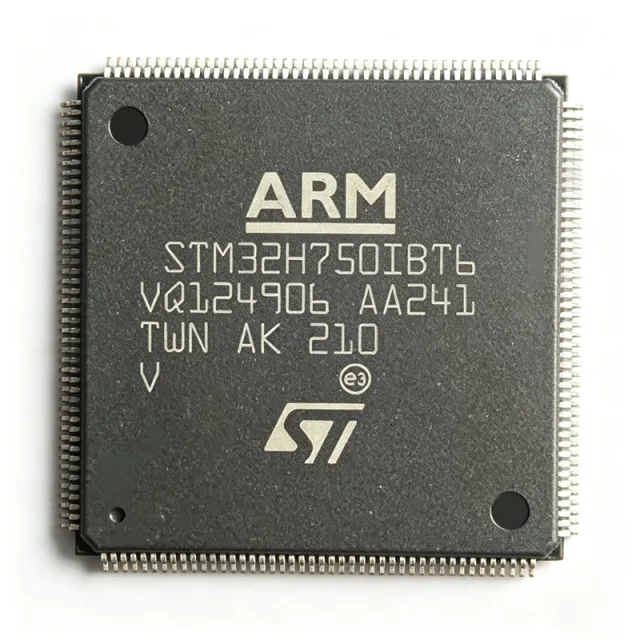
The STMicroelectronics STM32H750IBT6 is a high-performance 32-bit ARM Cortex-M7 microcontroller running at up to 480 MHz with 128 KB of on-chip flash memory and 1 MB of RAM, housed in a 176-pin LQFP package (24x24 mm body). A microcontroller (MCU) is a compact integrated circuit that combines a processor core, memory, and programmable input/output peripherals on a single chip to govern a specific operation in an embedded system. The STM32H750IBT6 sits at the top of the embedded processing hierarchy: MCU -> ARM Cortex-M7 -> STM32H7 series -> STM32 family -> 32-bit microcontroller, positioned above mainstream STM32F4/F7 parts for compute-intensive applications. Key features include a 480 MHz Cortex-M7 core with double-precision FPU, 1 MB of SRAM, a comprehensive peripheral set with multiple 16-bit ADCs, DACs, high-resolution timers, and communication interfaces including SPI, I2C, UART, CAN, USB, and Ethernet. ST reports 1027 CoreMark and 2143 DMIPS performance for the 480 MHz Cortex-M7, and the chip integrates a Chrom-ART graphics accelerator, JPEG codec, and TFT-LCD controller for HMI designs. Architecturally, the device leverages a 6-stage Cortex-M7 pipeline with an ART Accelerator and L1 caches, delivering approximately 2.14 CoreMark/MHz. It includes a Memory Protection Unit (MPU), single- and double-precision FPU, DSP instruction extensions, and a flexible memory controller (FMC) supporting external SDRAM, SRAM, and NOR/NAND flash. Boot from flash, SRAM, or system memory is supported. Because the STM32H750 series carries only a small 128 KB user flash, code is typically executed in place from external QSPI or memory-mapped flash in large applications, while the 1 MB internal RAM covers buffers, frame buffers, and real-time data. Typical applications include industrial motor control, digital power conversion, high-end HMI with TFT displays, audio processing, and test and measurement equipment. High-resolution timers plus fast ADCs enable precise PWM and current sensing, while the 480 MHz core handles complex control loops and signal processing. Design consideration: ensure solid decoupling on all VDD/VSS pairs and a low-impedance ground plane, since a 480 MHz core demands careful PCB layout for signal integrity and EMI control. This page adds value beyond the ST datasheet by synthesizing distributor pricing as of 2026-09-01, drop-in alternatives, and practical design guidance in one place.

USD $8,85 Контакты
STM32H750VBT6 - 480MHz Cortex-M7 MCU, 128KB Flash | STMicroelectronics
STM32H750VBT6

STM32H750VBT6 - 480MHz Cortex-M7 MCU, 128KB Flash | STMicroelectronics

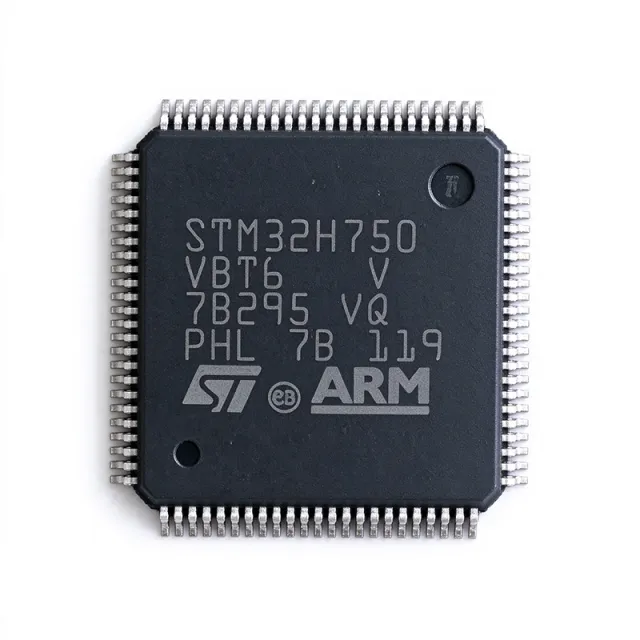
The STMicroelectronics STM32H750VBT6 is a high-performance 32-bit Arm Cortex-M7 microcontroller with double-precision FPU operating at up to 480 MHz, featuring 128 KB of flash and 1 MB of SRAM in a 100-pin LQFP (14x14 mm) package. A microcontroller (MCU) is a compact integrated circuit that combines a processor core, memory, and programmable I/O peripherals on a single die to govern a specific embedded operation. The STM32H750VBT6 sits at the top of the STM32H7 Value-Line hierarchy, which itself belongs to the broader STMicroelectronics STM32 family of 32-bit Arm Cortex-M microcontrollers, placing it well above mainstream families such as the STM32F4 in both clock speed and peripheral richness. Key features include the 480 MHz Cortex-M7 core with DP-FPU and L1 cache, 1 MB of SRAM paired with only 128 KB of internal flash (a deliberate value-line trade-off that encourages executing code from external memory or XSPI RAM), a hardware cryptographic accelerator for AES/DES/3DES/HASH/SHA, and a rich connectivity set with 46 communication interfaces including USART, SPI, I2C, FDCAN, USB OTG, Ethernet MAC, an SDMMC, a TFT-LCD controller, a DCMI camera interface, and the Chrom-ART graphics accelerator. The device operates from a 1.62 V to 3.6 V supply across -40 C to +85 C. Architecturally, the device integrates an MPU, an NVIC with hardware tail chaining, and four flexible power modes (Run, Sleep, Stop, Standby) managed through an internal SMPS-capable voltage regulator that can be configured to balance performance versus consumption. The Cortex-M7 superscalar pipeline with branch prediction delivers 2.14 DMIPS/MHz and a CoreMark score in the hundreds per MHz. Typical applications include industrial motor drives and power conversion, medical instrumentation, smart-home and audio hubs, and HMI/graphics systems where 480 MHz throughput, 1 MB on-chip RAM, and LCD/camera interfaces remove the need for external memory in many designs. Design consideration: with only 128 KB of internal flash, large applications must run from XSPI external memory or internal RAM, so budget code placement and boot configuration early in the project lifecycle. This page synthesizes distributor pricing, drop-in alternatives, and practical design notes not found in the manufacturer datasheet alone.

USD $5,25 В наличии
STM32H750VBT6TR - 480MHz Cortex-M7 MCU, 128KB Flash | STMicroelectronics (Tape & Reel)
STM32H750VBT6TR

STM32H750VBT6TR - 480MHz Cortex-M7 MCU, 128KB Flash | STMicroelectronics (Tape & Reel)

The STMicroelectronics STM32H750VBT6TR is a high-performance 32-bit Arm Cortex-M7 microcontroller with double-precision FPU operating at up to 480 MHz, featuring 128 KB of flash and 1 MB of SRAM in a 100-pin LQFP (14x14 mm) package. A microcontroller (MCU) is a compact integrated circuit that combines a processor core, memory, and programmable I/O peripherals on a single die to govern a specific embedded operation. The STM32H750VBT6TR sits at the top of the STM32H7 Value-Line hierarchy, which itself belongs to the broader STMicroelectronics STM32 family of 32-bit Arm Cortex-M microcontrollers, placing it well above mainstream families such as the STM32F4 in both clock speed and peripheral richness. Key features include the 480 MHz Cortex-M7 core with DP-FPU and L1 cache, 1 MB of SRAM paired with only 128 KB of internal flash (a deliberate value-line trade-off that encourages executing code from external memory or XSPI RAM), a hardware cryptographic accelerator for AES/DES/3DES/HASH/SHA, and a rich connectivity set with 46 communication interfaces including USART, SPI, I2C, FDCAN, USB OTG, Ethernet MAC, an SDMMC, a TFT-LCD controller, a DCMI camera interface, and the Chrom-ART graphics accelerator. The device operates from a 1.62 V to 3.6 V supply across -40 C to +85 C. Architecturally, the device integrates an MPU, an NVIC with hardware tail chaining, and four flexible power modes (Run, Sleep, Stop, Standby) managed through an internal SMPS-capable voltage regulator that can be configured to balance performance versus consumption. The Cortex-M7 superscalar pipeline with branch prediction delivers 2.14 DMIPS/MHz and a CoreMark score in the hundreds per MHz. Typical applications include industrial motor drives and power conversion, medical instrumentation, smart-home and audio hubs, and HMI/graphics systems where 480 MHz throughput, 1 MB on-chip RAM, and LCD/camera interfaces remove the need for external memory in many designs. Design consideration: with only 128 KB of internal flash, large applications must run from XSPI external memory or internal RAM, so budget code placement and boot configuration early in the project lifecycle. This page synthesizes distributor pricing, drop-in alternatives, and practical design notes not found in the manufacturer datasheet alone.

USD $5,73 В наличии
STM32H750XBH6 - 480MHz Cortex-M7 128KB Flash MCU | ST
STM32H750XBH6

STM32H750XBH6 - 480MHz Cortex-M7 128KB Flash MCU | ST

The STMicroelectronics STM32H750XBH6 is a high-performance 32-bit Arm Cortex-M7 microcontroller operating at up to 480 MHz, with 128 KB of flash memory and 1 MB of RAM, housed in a 240+25-TFBGA package measuring 14 x 14 mm. Its combination of high processing speed, digital signal processing capability, and compact ball-grid-array packaging makes it suitable for embedded control, communications, audio, and industrial applications. A microcontroller is a programmable system-on-chip that integrates a processor core, memory, peripherals, and communication interfaces into one component. The STM32H7 series belongs to the Arm Cortex-M microcontroller hierarchy, combining real-time embedded control with high-performance digital signal processing. The STM32H750XBH6 is designed for applications that require more processing throughput than general-purpose microcontrollers while retaining a compact embedded package. According to the verified distributor data, the device features a 32-bit Arm Cortex-M7 core, a maximum operating frequency of 480 MHz, 128 KB of flash memory, 1 MB of RAM, and a 240+25-TFBGA package. The high clock rate supports responsive control loops and computationally intensive firmware, while the RAM capacity is useful for display, networking, signal processing, and data-buffer workloads. The package also provides a high pin count for external memory, peripherals, and mixed-signal connections. Typical application areas include industrial automation, motor control, communications equipment, audio and DSP systems, human-interface equipment, and embedded control platforms. The STM32H750XBH6 can serve as a central controller when a design requires a high-performance Cortex-M7 core and a relatively compact BGA package. The verified data does not specify the complete peripheral list, supply-voltage range, operating-temperature range, or detailed timing specifications. For PCB design, use the manufacturer’s package drawing and land pattern, and verify all BGA ball assignments against the official datasheet before layout. Confirm the supported power rails, decoupling requirements, clock configuration, and exposed-ball treatment during design review. Because the supplied data does not provide a complete pinout, programming configuration, or thermal characterization, those details should be obtained from the manufacturer documentation. This product page synthesizes verified distributor specifications, manufacturer product information, application guidance, and replacement considerations. It is intended to support initial component selection while preserving the distinction between confirmed parameters and values that still require datasheet review.

Запрос цены Контакты
STM32H750XBH6U - 480MHz 128KB MCU | STMicroelectronics
STM32H750XBH6U

STM32H750XBH6U - 480MHz 128KB MCU | STMicroelectronics

STMicroelectronics STM32H750XBH6U is a 32-bit Arm Cortex-M7 microcontroller operating at up to 480MHz, with 128KB of flash memory and a 265-ball TFBGA package. The supplied distributor records identify a 14 mm by 14 mm package; a related STM32H750XBH6 listing identifies 240 plus 25 balls and 128KB organized as 128K by 8. Available component-market pricing starts at $3.9251, and one distributor listing reports 7,056 pieces in stock as of the supplied data. A microcontroller is an embedded semiconductor that integrates a processor core, memory, peripherals, and communication interfaces on one device. The STM32H7 family belongs to the Arm Cortex-M microcontroller hierarchy and combines real-time control capability with substantial data-processing throughput. This product is therefore positioned between a conventional embedded control MCU and a higher-performance Cortex-M7 system for control, communications, graphics, and signal-processing workloads. The verified listing identifies an Arm Cortex-M7 processor, 32-bit architecture, 480MHz maximum frequency, 128KB flash, and a 265-TFBGA package. The cross-reference data also describes 1MB RAM and 46 communication and analog interfaces, but these values were not explicitly tied to the complete STM32H750XBH6U manufacturer record and are therefore treated cautiously. The device's high-frequency Arm Cortex-M7 core provides substantial processing headroom for interrupt-heavy control, protocol handling, and embedded user-interface logic. Applications supported by the device class include industrial automation, networking equipment, motor control, test and measurement, human-machine interfaces, and connected embedded systems. At 480MHz, the MCU can process complex state machines and peripheral data faster than lower-frequency general-purpose microcontrollers. Designers must still budget for cache configuration, memory latency, clock-tree setup, thermal behavior, and deterministic peripheral timing rather than interpreting clock speed as the only performance measure. The BGA package supports dense PCB routing but requires inspection and assembly capability. A 0.5 mm pitch package is mechanically demanding, so fine-pitch assembly, via-in-pad considerations, solder mask definition, and adequate thermal-via distribution should be reviewed before release to manufacturing. The board should also follow the manufacturer's pinout, power, decoupling, clock, and exposed-pad guidance in the official device documentation. This page consolidates verified distributor pricing, availability, package details, and cross-reference findings. It distinguishes confirmed target-device data from family-level information and avoids treating merely related STM32H7 devices as drop-in replacements. Engineers should use the manufacturer documentation and exact MPN comparison before approving any substitution.

Запрос цены Контакты
STM32H750ZBT6 - 480MHz Cortex-M7 MCU 128KB Flash | STMicroelectronics
STM32H750ZBT6

STM32H750ZBT6 - 480MHz Cortex-M7 MCU 128KB Flash | STMicroelectronics

The STMicroelectronics STM32H750ZBT6 is a high-performance 32-bit ARM Cortex-M7 microcontroller operating at up to 480 MHz, packaged in a 144-pin LQFP (20x20 mm). It integrates 128 KB of Flash, 1 MB of RAM, hardware crypto, JPEG codec, and an external memory interface. The device targets demanding embedded applications that require strong DSP, floating-point, and graphics performance without an external memory bus complexity penalty. A microcontroller (MCU) is an integrated circuit that combines a processor core, memory, and programmable peripherals on a single die. ARM Cortex-M7 cores add a six-stage superscalar pipeline, single-precision and double-precision floating-point unit (FPU), and tightly-coupled memory (TCM) for deterministic real-time response. The STM32H7 family sits at the high-performance tier of the STM32 portfolio, above Cortex-M4 parts (STM32F4) and below Cortex-A application processors. The H750 specifically trims Flash to 128 KB while retaining 1 MB SRAM, making it well-suited for code execution from external QSPI memory while keeping on-chip RAM for buffers and frame data. Key features of the STM32H750ZBT6 include 480 MHz CPU clock, 1 MB SRAM, Chrom-ART graphics accelerator, hardware AES-256 / SHA-256 / TRNG, two SDMMC interfaces, an 8- to 14-bit camera interface, and up to 16-bit external memory bus for SRAM, PSRAM, NOR, NAND, and SDRAM. The LQFP-144 package exposes 114 GPIO across multiple 5V-tolerant banks and offers 16-bit ADC, comparators, op-amps, and 12-bit DAC peripherals. The device is built on a 40 nm low-power CMOS process and supports four low-power modes (Sleep, Stop, Standby, VBAT) with RTC and backup registers retained in Standby. CoreMark performance reaches 1023 CoreMark at 480 MHz / 4.08 CoreMark/MHz. The dual-domain supply (Vcore plus VDD/VDDA) requires careful decoupling but enables dynamic voltage scaling to trade frequency for power consumption. Typical applications include industrial motor control, human-machine interface (HMI) panels with TFT-LCD, audio processing with USB streaming, secure IoT gateways, drone flight controllers, and portable medical instrumentation. The 1 MB on-chip RAM is enough to run LVGL graphical stacks and audio buffers without external PSRAM, simplifying board layout. When designing with this part, allocate a 4.7 µF bulk capacitor plus 100 nF decoupling per supply pin, follow ST's AN4661 PCB layout guide for high-speed signals, and reserve QSPI traces for short length-matched routing. The 128 KB internal Flash is often not enough for production firmware; use the Quad-SPI interface to boot XIP from an external Flash and treat internal Flash as a backup/bootloader region. This page synthesizes distributor pricing, package-level drop-in alternatives (STM32H753ZIT6, STM32F407ZGT6TR), and practical design notes not found in the manufacturer datasheet alone.

Запрос цены Контакты
STM32H753AII6 - 480MHz Cortex-M7 MCU, 2MB Flash, UFBGA-169 | STMicroelectronics
STM32H753AII6

STM32H753AII6 - 480MHz Cortex-M7 MCU, 2MB Flash, UFBGA-169 | STMicroelectronics

The STMicroelectronics STM32H753AII6 is a high-performance ARM Cortex-M7 microcontroller operating at up to 480 MHz with double-precision FPU and DSP instructions, integrating 2 MB of Flash and 1 MB of SRAM in a 169-pin UFBGA (7x7 mm) package. It belongs to the STM32H7 family, the highest-performance line of STM32 microcontrollers, designed for compute-intensive real-time control, DSP, and graphics workloads. A microcontroller (MCU) is a single-chip computer that integrates a CPU core, volatile memory (SRAM), non-volatile memory (Flash), and a rich set of peripherals (ADCs, timers, communication interfaces). The STM32H753AII6 sits at the top of the Cortex-M7 hierarchy: Cortex-M7 MCU -> 32-bit MCU -> ARM-based microcontroller -> embedded processor -> semiconductor IC. It supports the Cortex-M Memory Protection Unit (MPU) for safety-critical applications and includes a Chrom-ART Accelerator for graphics and the HW crypto/hash suite. Key features include 2 MB dual-bank Flash with ECC, 1 MB SRAM (including 192 KB DTCM and 64 KB ITCM for zero-wait-state core access), 16-bit ADC, two 12-bit DACs, USB 2.0 OTG, two SDMMC, four USART/UART, six SPI, four I2C, two CAN 2.0B, two SAI, and an Ethernet MAC. Two 16-bit ADCs with up to 36 channels and 3.6 MSPS sampling support motor-control and precision sensing. Architecturally, the device pairs a Cortex-M7 core running up to 480 MHz with a Cortex-M4 core on the dual-core variant (H747) and integrates ST's smart architecture for low-power modes (D1/D2/D3 domains). The 169-ball UFBGA at 7x7 mm keeps board area minimal while still exposing all 148 GPIO through GPIOs and alternate functions. Typical applications include industrial motor drives, PLCs, industrial HMI with TFT displays, audio processing, edge-AI inference (CMSIS-NN), UAV flight controllers, medical instrumentation, and high-end consumer appliances. The crypto/hash peripheral and True Random Number Generator (TRNG) suit secure-connected nodes. When designing with the STM32H753AII6, ensure the PCB has at least 4-layer construction with continuous power planes for the high-speed 480 MHz core; respect the SDRAM/QSPI trace-length matching rules in the reference manual. This page combines verified distributor pricing, drop-in same-package alternatives, and engineering design notes synthesized from the official ST datasheet.

Запрос цены Контакты
STM32H753BGT6 - 32-bit Arm Cortex-M7 MCU 2MB Flash | STMicroelectronics
STM32H753BGT6

STM32H753BGT6 - 32-bit Arm Cortex-M7 MCU 2MB Flash | STMicroelectronics

The STMicroelectronics STM32H753BGT6 is a high-performance 32-bit microcontroller based on the Arm Cortex-M7 core, operating at up to 480 MHz. It integrates 2 MB of flash memory and 1 MB of RAM, making it suitable for demanding applications such as industrial control, motor control, and high-end consumer electronics. The device is housed in a 144-pin LQFP package (BGT6 suffix) and supports a wide supply voltage range of 1.62V to 3.6V. A microcontroller (MCU) is a compact integrated circuit designed to govern a specific operation in an embedded system. It contains a processor core, memory, and programmable input/output peripherals. The STM32H753BGT6 belongs to the STM32H7 series, which is part of the broader STM32 family of 32-bit flash microcontrollers. This family is widely used in applications requiring high computational performance, rich connectivity, and real-time control. Key features of the STM32H753BGT6 include a 480 MHz Arm Cortex-M7 core with double-precision floating-point unit (FPU), 2 MB of dual-bank flash memory, 1 MB of SRAM, and a comprehensive set of peripherals including multiple 16-bit and 32-bit timers, 12-bit ADCs, DACs, and a camera interface. It also supports advanced connectivity with USB OTG, Ethernet MAC, and multiple SPI, I2C, and UART interfaces. The device includes a Chrom-ART Accelerator for graphics and a hardware cryptographic engine for secure communications. The STM32H753BGT6 is built on a high-performance architecture that combines the Cortex-M7 core with a sophisticated memory system, including an L1 cache and a TCM (Tightly Coupled Memory) interface. This architecture enables efficient execution of complex algorithms and real-time data processing. The device also features a power management unit with multiple low-power modes, making it suitable for battery-powered applications. Typical applications include industrial automation, motor control, robotics, medical devices, and high-end audio equipment. The high clock speed and rich peripheral set make it ideal for applications requiring fast data processing and real-time control. The device also supports a wide range of development tools, including the STM32CubeIDE and HAL libraries, which accelerate firmware development. When designing with the STM32H753BGT6, ensure proper decoupling of the power supply pins and adequate grounding for the LQFP package. The device requires a stable clock source, typically a 25 MHz crystal, and careful PCB layout to minimize noise and ensure reliable operation. The internal voltage regulator can be configured for different performance modes, balancing power consumption and performance.

Запрос цены Контакты
STM32H753BIT6 - 480MHz Cortex-M7 MCU, 2MB Flash, LQFP-208 | STMicroelectronics
STM32H753BIT6

STM32H753BIT6 - 480MHz Cortex-M7 MCU, 2MB Flash, LQFP-208 | STMicroelectronics

The STMicroelectronics STM32H753BIT6 is a 32-bit Arm Cortex-M7 microcontroller running up to 480 MHz, integrating 2 MB of Flash memory (2M x 8) and 1 MB of RAM, and packaged in a 208-pin LQFP (28x28 mm) housing with 168 I/O. It sits in the middle of the STM32H7 high-performance line, where the H7 designation denotes the 480 MHz Cortex-M7 generation with revamped memory architecture, larger cache, and dedicated hardware accelerators for cryptography and graphics. A microcontroller is a single integrated circuit that contains a processor core, memory, and peripherals on one die, and it forms the lowest tier of the embedded computing hierarchy: MCU -> embedded processor -> system-on-chip -> embedded computing platform. In that hierarchy, a Cortex-M7 MCU such as this one targets high-end control, networking, and human-machine-interface duties that sit above typical 8-bit or Cortex-M0/M3 devices but below application processors running Linux. Key features of this part include a 480 MHz Arm Cortex-M7 core with double-precision FPU and DSP instructions, 2 MB of on-chip Flash for firmware and assets, 1 MB of on-chip SRAM, an instruction cache and data cache, and a hardware cryptographic accelerator for AES and SHA. The 168 available I/O lines make it possible to attach displays, Ethernet or SDIO peripherals, motor-control outputs, and multiple sensor buses without external I/O expanders, while the large LQFP-208 footprint exposes both FMC interfaces for external SDRAM and QSPI NOR flash. Architecturally, the STM32H753 belongs to the STM32H7 family, which combines a very high-bandwidth AXI matrix with multiple DMA controllers and a ChromeART accelerator for 2D graphics and video. The device is configured by the STM32CubeMX toolchain and programmed through SWD/JTAG debug interfaces, with firmware secured through the cryptographic accelerator and hardware unique key. Typical applications include industrial HMI panels with TFT-LCD and capacitive touch, industrial Ethernet gateways, motor-control and servo drives, building automation controllers, medical monitoring stations, and edge AI image-processing front ends where the 2 MB Flash and 1 MB RAM allow substantial local buffering. A key design consideration is power-domain planning. Unlike the earlier STM32F7 series with an external BYPASS_REG pin, the STM32H753 uses an internal LDO and optional SMPS with software-configurable scaling, so rail sequencing must be programmed in the power-management initialization sequence rather than by hardware pin straps. Decoupling requirements at VDD and VDDCORE follow the datasheet reference layout. This page brings together package, memory, and interface details, pin-compatible alternatives from the STM32H7 family, and practical integration notes that are not consolidated anywhere else in a single reference.

Запрос цены Контакты
STM32H753IIK6 - 480MHz Cortex-M7 MCU | STMicroelectronics
STM32H753IIK6

STM32H753IIK6 - 480MHz Cortex-M7 MCU | STMicroelectronics

STMicroelectronics STM32H753IIK6 is a high-performance 32-bit Arm Cortex-M7 microcontroller operating up to 480 MHz, with 2 MB of Flash and 1 MB of RAM in a 176+25 UFBGA package measuring 10 mm by 10 mm. The device combines a high-frequency processor core with substantial embedded memory in a compact surface-mount package designed for space-constrained embedded systems. An Arm Cortex-M7 microcontroller is a 32-bit reduced-instruction-set processor core intended for embedded control, signal processing, communications, and connected industrial equipment. The STM32H7 product family occupies the high-performance segment of the broader microcontroller hierarchy, where computational throughput, real-time processing, memory capacity, and integrated peripherals distinguish it from general-purpose microprocessors. STM32H753IIK6 targets designs that require substantial code and data storage without requiring an external memory interface for every application. Three headline characteristics define this device: a maximum operating frequency of 480 MHz, 2 MB of Flash program memory, and 1 MB of RAM. The 32-bit Cortex-M7 architecture supports efficient handling of control loops and real-time workloads, while the Flash and RAM capacities provide room for substantial firmware, data buffers, and application state. The UFBGA package supports compact PCB construction but requires careful escape routing, assembly planning, and thermal design. STMicroelectronics positions the STM32H753xI family as a high-performance Arm Cortex-M7 platform operating up to 480 MHz. Its combination of processing speed and embedded memory is useful when a design must balance real-time execution with a relatively compact component count. The STM32H753IIK6 is identified specifically as the industrial-temperature K-grade configuration in the STM32H753xI family, with the exact ordering-code interpretation confirmed against the manufacturer documentation before production release. Typical applications include industrial automation controllers, high-speed embedded data acquisition, audio and digital signal-processing equipment, test and measurement instruments, robotics, and network-connected control systems. In these systems, the 480 MHz Cortex-M7 core can execute control and processing tasks concurrently, while the 2 MB Flash and 1 MB RAM support larger firmware images and working buffers than smaller general-purpose MCUs. A critical design consideration is the package and power implementation. The 10 mm by 10 mm UFBGA requires a multilayer PCB with short escape routes, appropriate via structures, and assembly-compatible land patterns. Because an embedded MCU can dissipate meaningful heat during sustained high-frequency operation, the board should provide effective copper heat spreading and follow the manufacturer’s recommended power, decoupling, and layout configurations. This product overview combines the manufacturer’s STM32H753xI family information with exact part-specific memory, frequency, and package characteristics, then adds practical guidance for PCB routing, firmware sizing, thermal design, and drop-in replacement assessment. It is intended to help engineers determine whether the STM32H753IIK6 provides the required balance of processing performance, embedded memory, package density, and ecosystem support.

Запрос цены Контакты
STM32H753IIT6 - Cortex-M7 MCU 480MHz 2MB Flash 176-LQFP | ST
STM32H753IIT6

STM32H753IIT6 - Cortex-M7 MCU 480MHz 2MB Flash 176-LQFP | ST

The STMicroelectronics STM32H753IIT6 is a high-performance 32-bit ARM Cortex-M7 microcontroller with double-precision FPU, operating at up to 480 MHz, delivering 1027 DMIPS / 2424 CoreMark performance, and integrating 2 MB of Flash and 1 MB of SRAM in a 176-pin LQFP (24x24 mm) package. The Cortex-M7 core includes a 16 KB I-cache and 16 KB D-cache plus a tightly-coupled memory (TCM) interface, enabling deterministic real-time execution alongside DSP extensions and a double-precision floating-point unit for signal-processing and machine-learning edge workloads. An MCU (microcontroller) is a single-chip computer that integrates a CPU core, Flash program memory, SRAM data memory, and a rich set of analog and digital peripherals on one die. Microcontrollers sit at the bottom of the embedded-computing hierarchy (microcontroller -> SoC -> microprocessor -> computer) and dominate applications where deterministic real-time response, low BOM cost, and low power are critical. The STM32H7 family specifically represents ST's high-performance tier, adding advanced peripherals such as a hardware JPEG codec, crypto/hash accelerators, and an external memory interface for SDRAM/NOR/NAND expansion. Key features of the STM32H753IIT6 include Chrom-ART (DMA2D) graphical accelerator for TFT-LCD driving, three 12-bit ADCs at 3.6 MSPS each, two 12-bit DACs, USB 2.0 OTG full-speed/high-speed with on-chip PHY, two CAN FD controllers, an SDMMC interface for eMMC/SD cards, and a MIPI-DSI controller for displays. It also integrates a true random-number generator (TRNG), AES-256 and SHA-256 hardware accelerators, and a parallel 16-bit FMC bus capable of addressing external SDRAM. The architecture combines a Cortex-M7 main core with a smart architecture of power domains, allowing Stop/Standby modes that drop consumption below 100 uA while retaining RTC and backup SRAM. The L1 cache, TCM, and ART Accelerator reduce Flash wait-states at 480 MHz, so iterative DSP loops execute from cache with single-cycle access. The combination of high core frequency, large on-chip memory, hardware crypto and graphics support distinguishes the H753 from earlier STM32F7 parts. Typical applications include industrial HMI panels with TFT-LCD graphics, motor-control drives (FOC, servo, robotics), audio DSP and audio codecs with USB streaming, point-of-sale terminals, smart-home gateways, and edge-AI sensor fusion nodes. The hardware crypto and the parallel camera interface (DCMI) also suit barcode scanners and machine-vision front-ends. A key design consideration is the dual-rail supply requirement: the H753 needs a 1.2 V core supply generated by the internal SMPS or an external LDO, plus a 3.3 V I/O rail. Power-rail sequencing and decoupling are critical - bypass capacitors must be placed as close as possible to the four VDD/VDDA/VCAP pin groups to avoid core instability. This page synthesizes distributor pricing, same-family drop-in alternatives, and practical hardware design notes that are not found in any single manufacturer datasheet, helping procurement and embedded engineers evaluate the STM32H753IIT6 for new BOMs and second-source projects.

Запрос цены Контакты
STM32H753VIH6 - 480MHz Cortex-M7 2MB Flash 1MB RAM 100-TFBGA MCU | STMicroelectronics
STM32H753VIH6

STM32H753VIH6 - 480MHz Cortex-M7 2MB Flash 1MB RAM 100-TFBGA MCU | STMicroelectronics

The STMicroelectronics STM32H753VIH6 is a high-performance 32-bit Arm Cortex-M7 microcontroller operating up to 480 MHz, with 2 MB of embedded Flash program memory and 1 MB of RAM, packaged in a 100-ball TFBGA (8x8 mm) surface-mount package. A microcontroller is an integrated circuit that combines a CPU core, memory and a rich set of peripherals on a single die. The Cortex-M7 core belongs to the Arm Cortex-M family of RISC processors designed for embedded control; it sits in the hierarchy microcontroller -> embedded processor -> RISC core -> semiconductor, and is the highest-performance member of the M-series. STM32 devices combine that core with memory, analog and digital peripherals, and STMicroelectronics supplies the surrounding ecosystem of tools, middleware and reference designs that turns a bare die into a design-ready part. Key features of the STM32H753VIH6 include the 480 MHz Cortex-M7 core, 2 MB of Flash, 1 MB of RAM, 46 communication and analog interfaces, and integrated cryptographic capability as documented in the manufacturer datasheet. The 100-ball TFBGA package keeps the footprint to 8x8 mm while still exposing high-speed I/O, which suits compact industrial and communications equipment. The device is offered in tray packaging and is listed as an active part. Technologically, the STM32H753xI family pairs a 32-bit Arm Cortex-M7 RISC core operating up to 480 MHz with large on-chip memory resources and a dense peripheral set. Because Flash and SRAM are integrated on-die, the device supports complex control loops, digital signal processing and network stacks without external memory, and the cryptographic blocks offload security workloads that would otherwise burden the core. Typical applications include industrial motor and motion control, industrial gateways and communications equipment, professional audio and signal processing, medical instrumentation, and human-machine-interface panels with graphics-capable displays. The wide peripheral complement lets a single device host several communication interfaces simultaneously. When designing around this part, plan the PCB for a 0.5 mm-pitch ball grid with careful via-in-pad and thermal management, and confirm the ball map in the manufacturer pinout table before assigning signals. Because the package is a fine-pitch BGA, assembly houses should be briefed on the pad design and the X-ray inspection requirement. This page consolidates manufacturer and distributor technical information, drop-in alternative candidates, parameter-by-parameter comparisons, and practical design notes that are not consolidated in a single manufacturer document, helping engineers shortlist and qualify the part faster.

Запрос цены Контакты
STM32H753VIT6 - 480MHz Cortex-M7, 2MB Flash MCU | STMicroelectronics
STM32H753VIT6

STM32H753VIT6 - 480MHz Cortex-M7, 2MB Flash MCU | STMicroelectronics

The STMicroelectronics STM32H753VIT6 is a 32-bit Arm Cortex-M7 microcontroller operating at 480 MHz, with 2 MB of flash memory, 1 MB of RAM, and a 100-pin LQFP package measuring 14 x 14 mm. It combines high-performance control processing with 46 communication and analog interfaces, making it suitable for industrial control, communications, audio, and embedded signal-processing systems. A microcontroller is a programmable integrated circuit containing a processor core, memory, peripherals, and communication interfaces. The STM32H7 product family belongs to the broader hierarchy of embedded processor, microcontroller, semiconductor, and embedded-systems product categories. Its Arm Cortex-M7 core provides real-time control performance while retaining the software ecosystem, development tools, and peripheral architecture familiar to STM32 designers. The STM32H753VIT6 features a maximum operating frequency of 480 MHz, 2 MB of flash, and 1 MB of RAM. The flash stores firmware and constants, while RAM supports working data, stack operations, buffers, and signal-processing workloads. The 100-pin LQFP package provides a practical assembly option for leaded through-hole PCB layouts, and its 14 x 14 mm body accommodates the high pin count without requiring a fine-pitch ball-grid-array footprint. The device includes 46 communication and analog interfaces and supports cryptographic capabilities according to the STM32H753xI datasheet. These resources enable a single controller to manage communications, sensing, control loops, and security-oriented functions. Compared with lower-performance general-purpose microcontrollers, the 480 MHz Cortex-M7 core provides substantially more processing headroom for digital signal processing, networking stacks, and complex control algorithms. Typical applications include industrial automation equipment, motor and motion control, communications gateways, test and measurement systems, audio processing, and connected embedded products. The STM32H753VIT6 is especially useful when a design needs substantial RAM and flash but also benefits from the 100-pin LQFP package for inspection, prototype assembly, and mixed-production processes. Designers should verify the complete pin assignment, power-supply requirements, decoupling network, clock configuration, boot pins, and exposed peripheral multiplexing in the manufacturer datasheet before layout release. Software migration also requires reviewing device-specific startup files, peripheral differences, memory-map details, and HAL or low-level driver support rather than assuming that every STM32H7 variant is functionally interchangeable. This page consolidates the core MCU specifications, application guidance, qualified drop-in alternatives, and practical engineering considerations needed to evaluate the STM32H753VIT6 alongside competing STM32H7 devices.

Запрос цены Контакты
STM32H753XIH6 - 480MHz Cortex-M7 MCU, 2MB Flash, TFBGA-176
STM32H753XIH6

STM32H753XIH6 - 480MHz Cortex-M7 MCU, 2MB Flash, TFBGA-176

The STMicroelectronics STM32H753XIH6 is a high-performance 32-bit ARM Cortex-M7 microcontroller running up to 480 MHz with double-precision FPU, 16 Kbytes of instruction cache, 16 Kbytes of data cache, and DSP instructions, delivering 1027 DMIPS / 2.14 DMIPS/MHz (Dhrystone 2.1). It integrates 2 Mbytes of Flash memory and 1 Mbyte of SRAM in a 176-ball TFBGA (XIH) package. A microcontroller (MCU) is a single-chip computer containing a CPU core, program memory (Flash), working memory (RAM), and a rich set of programmable peripherals. Within the broader semiconductor taxonomy, an MCU sits between microprocessors (MPUs, which require external RAM/Flash) and ASICs. The STM32H7 family specifically targets high-performance, DSP-rich applications where both real-time control and high-throughput signal processing coexist on one die. Key features of the STM32H753XIH6 include Chrom-ART graphical accelerator for offloading 2D drawing, JPEG codec hardware, two 16-bit ADCs, two 12-bit DACs, USB OTG FS and HS with on-the-fly PHY, CAN FD, Ethernet MAC, SDMMC, and a parallel 16-bit FMC interface. The device also includes a true random number generator (TRNG), cryptographic accelerators (AES, SHA, RSA), and an integrated SMPS step-down converter for core power. Architecturally, the part uses ST's 40 nm low-power CMOS process with an L1 cache around the Cortex-M7 core to push single-core throughput to 480 MHz without inflating power dissipation. The AXI multi-layer bus matrix gives DMA-fed peripherals and the CPU concurrent access to SRAM, Flash, and external memories. Internal regulators (SMPS + LDO) can be controlled in software to trade idle current for wake-up latency. Typical applications include industrial motor control, three-phase solar inverters, audio DSP and effects units, point-of-sale terminals, smart appliances, gateways with on-chip Ethernet, and human-machine interface (HMI) panels using an external TFT. The TFBGA-176 footprint also suits portable medical instrumentation, where size and DSP throughput matter equally. When designing with this MCU, allocate a 1 Mbyte Flash sector plan early; 2 Mbytes is generous but external code (JPEG, USB stacks, TCP/IP) consumes it quickly. Choose the boot mode pins (BOOT0, BOOT1) carefully during PCB layout, and provision enough decoupling capacitance near the SMPS input. This page combines verified distributor pricing, drop-in pin-compatible alternatives, and application-grade design notes that go beyond the standard datasheet summary, giving engineers a single decision-ready reference.

Запрос цены Контакты
STM32H753XIH6TR - 480MHz Cortex-M7 MCU 2MB Flash | STMicroelectronics
STM32H753XIH6TR

STM32H753XIH6TR - 480MHz Cortex-M7 MCU 2MB Flash | STMicroelectronics

The STMicroelectronics STM32H753XIH6TR is a high-performance 32-bit ARM Cortex-M7 microcontroller with double-precision FPU and L1 cache (16 Kbytes data + 16 Kbytes instruction cache), operating at up to 480 MHz and delivering 1027 DMIPS / 2.14 DMIPS/MHz (Dhrystone 2.1). It integrates 2 MB of on-chip Flash and 1 MB of SRAM, packaged in a 240+25-ball TFBGA (14x14 mm) that is supplied on 7-inch Tape & Reel (the TR suffix denotes the tape-and-reel packaging option of the STM32H753XIH6 bare-chip version). What is a Cortex-M7 MCU? An ARM Cortex-M7 microcontroller is the highest-performance core in the Cortex-M family, targeting applications that previously required a Cortex-M4 or even a Cortex-A application processor. It combines an in-order superscalar pipeline with single- and double-precision floating-point, tightly-coupled memory, and an instruction/data cache. Hierarchy: Cortex-M7 -> Cortex-M -> 32-bit MCU -> microcontroller -> embedded computing. The STM32H7 family extends this with ST's smart peripheral architecture for motor control and high-speed data acquisition. Key features include 480 MHz core speed, 2 MB dual-bank Flash with read-while-write support for live firmware updates, 1 MB SRAM split into DTCM, AXI-SRAM, SRAM1-4, and Backup domains, an 8- to 14-bit ADC up to 3.6 MSPS, USB 2.0 OTG full-speed/high-speed, two CAN 2.0B interfaces, an Ethernet MAC with 10/100-Mbit/s MII/RMII, two SAIs for audio, an SDMMC interface for SD-cards, and integrated crypto/hash accelerators (AES-256, SHA-1/SHA-2, True Random Number Generator). The TFBGA-240+25 provides 168+ flexible I/O pins configurable as GPIO, communication, analog, or timer channels. The architecture pairs a Cortex-M7 with an optional Cortex-M4 in dual-core STM32H745/H755 parts, but the STM32H753XIH6TR is single-core to free die area for the largest memory configuration. A 4 KB battery-domain backup SRAM, 32 kHz RTC, and 16 hardware timers support industrial deterministic scheduling. Typical applications include industrial motor drives (field-oriented control of PMSM/BLDC at 50 kHz loops), high-end audio DSP (SAI/I2S to DAC/ADC), Human-Machine Interface TFT-LCD panels up to XGA resolution with TFT controller and Chrom-ART accelerator, edge AI/ML inference at the network edge, and EtherCAT-slave or Profinet device front-ends. Designers should ensure the external SMPS/linear regulator network feeding VCAP pins provides sufficient bulk capacitance during 480 MHz bursts, and that the high-speed SDRAM interface uses matched-length routing to preserve timing margin. This page synthesizes distributor pricing as of 2026-10-10, drop-in STM32H7 alternatives, design guidance, and application scenarios not found on a single manufacturer page.

Запрос цены Контакты