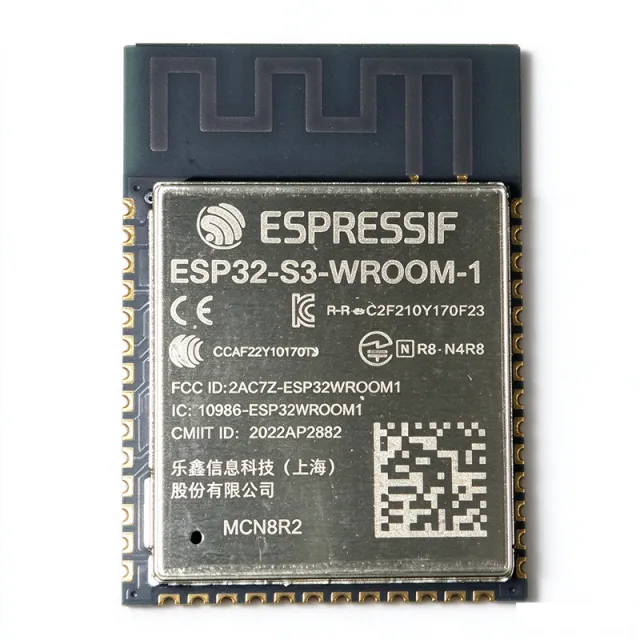
ESP32-S3-WROOM-1-N8 - WiFi/BLE5 MCU Module 8MB Flash | Espressif
Артикул: ESP32-S3-WROOM-1-N8 ✓ Активен| Кол-во | Цена за ед. | Итого |
|---|---|---|
| 1 | $4.9219 | $4,92 |
| 10 | $3.5547 | $35,55 |
| 100 | $3.1445 | $314,45 |
| 500 | $3.0078 | $1.503,90 |
| 1.000 | $2.8711 | $2.871,10 |
ESP32-S3-WROOM-1-N8 Обзор
A Wi-Fi/BLE MCU module integrates a microcontroller, radio, RF matching network, antenna, flash memory and crystal oscillator onto a single certified surface-mount assembly. In the system hierarchy it sits above the bare SoC (here the ESP32-S3 chip) and below finished boards such as development kits, serving as the compute-plus-connectivity engine of an IoT device.
Key differentiating features include a dual-core 32-bit LX7 processor that accelerates neural network computing and signal processing workloads, 8 MB of on-module SPI flash for code and assets, and Bluetooth 5 LE with long-range support. The module exposes a rich set of peripherals, making it suitable for designs that need both wireless connectivity and local AI inference such as wake word detection.
Architecturally, the ESP32-S3 SoC combines two processor cores with vector instructions for machine-learning workloads, integrated Wi-Fi and BLE radios, and peripherals including SPI, I2C, UART, I2S, and native USB. The on-module PCB antenna and RF front end remove the need for external RF design, while flash is connected over Quad SPI for fast code execution from cache.
Typical applications include AIoT devices performing wake word detection and speech command recognition, smart home and industrial IoT nodes, and human-interface products that leverage the ESP32-S3 USB and display-oriented peripherals. The 2.4 GHz radio and 8 MB flash cover the memory and connectivity needs of most connected-device firmware stacks.
Design considerations: verify memory-map configuration for Quad SPI flash, respect strapping-pin requirements at boot, and provide clean 3.3 V power with adequate decoupling for Wi-Fi transmit bursts.
This page adds value beyond the manufacturer datasheet by synthesizing distributor availability data, same-footprint memory variants for drop-in flexibility, comparison tables, and practical design notes in one place.
Аналоги без доработки для ESP32-S3-WROOM-1-N8 — тот же корпус, pin-to-pin совместимость. Компоненты в других корпусах, требующие переработки PCB, исключены.
Инструмент быстрого сравнения — выберите альтернативные компоненты для сравнения бок о бок:
ESP32-S3-WROOM-1-N16R8
✓ В наличии
$2.8711 / шт.
Открыть даташит →ESP32-S3-WROOM-1-N8R2
📋 Справочный аналог (нет в каталоге)
ESP32-S3-WROOM-1-N8R8
📋 Справочный аналог (нет в каталоге)
ESP32-S3-WROOM-1-N4
📋 Справочный аналог (нет в каталоге)
ESP32-S3-WROOM-1U-N8
📋 Справочный аналог (нет в каталоге)
ESP32-S3-WROOM-1-N8 Характеристики (опубликованы производителем)
| Module Family | ESP32-S3-WROOM-1 |
| Core SoC | ESP32-S3 (dual-core Xtensa LX7) |
| Flash Memory | 8 MB SPI flash |
| PSRAM | None (N8 variant) |
| Wi-Fi Standard | 802.11 a/b/g/n, 2.4 GHz |
| Bluetooth | Bluetooth v5.0 LE |
| Antenna Type | PCB trace antenna |
| Package Dimensions | 25.5 x 18 mm |
| Тип монтажа | Surface Mount (SMD) |
| Напряжение питания | 3.0 V to 3.6 V |
| Рабочая температура | -40C to +85C |
| Статус RoHS | Compliant |
| AI Acceleration | Neural network computing and signal processing acceleration |
| Peripherals | Rich peripheral set (SPI, I2C, UART, I2S, USB OTG) |
| Typical Applications | AIoT, wake word detection, speech command recognition |
Интерфейсы и разъемы ESP32-S3-WROOM-1-N8
ESP32-S3-WROOM-1-N8 имеет следующие интерфейсы и разъемы, опубликованные производителем: Беспроводная связь, Bluetooth, Входная мощность. Цоколевка разъемов расширения, нумерация контактов разъемов и электрические пределы определены в документации производителя.
| Беспроводная связь | 802.11 a/b/g/n, 2.4 GHz |
| Bluetooth | Bluetooth v5.0 LE |
| Входная мощность | 3.0 V to 3.6 V |
Обратитесь к документации производителя для полной распиновки разъёма расширения и нумерации контактов соединителя.
Мощностные и тепловые характеристики
| Входная мощность | 3.0 V to 3.6 V |
| Рабочая температура | -40C to +85C |
Параметры входной мощности и тепловые параметры для ESP32-S3-WROOM-1-N8, опубликованные производителем.
Типичное применение
ESP32-S3-WROOM-1-N8 подходит для 6 применениеs: AIoT Voice Devices, Smart Home Automation, Industrial IoT and Automation, Wearable and Portable Connected Devices, Smart Cameras and Vision Edge Nodes, Connected Audio and Music Interfaces.
AIoT Voice Devices
The ESP32-S3-WROOM-1-N8 fits AIoT voice products because the ESP32-S3 SoC provides dedicated acceleration for neural network computing and signal processing, enabling wake word detection and speech command recognition directly on the module without a cloud round-trip. The 8 MB flash stores acoustic models, firmware, and OTA images, while the 2.4 GHz 802.11 b/g/n radio uploads results or receives updates over Wi-Fi. In a typical design the module runs an I2S microphone interface for audio capture, executes a quantized neural network for keyword spotting, and uses Bluetooth 5 LE or Wi-Fi for control and telemetry. Designers should budget flash partitions for model storage and consider an R-series variant if PSRAM is needed for larger models.
Рекомендуется
Smart Home Automation
For smart home nodes such as switches, sensors, and appliance controllers, the ESP32-S3-WROOM-1-N8 combines Wi-Fi 802.11 b/g/n and Bluetooth v5.0 on a single certified module, allowing one radio path for cloud connectivity and another for local commissioning via BLE. The PCB trace antenna requires no external RF layout, keeping the end-product BOM simple, and the SMD footprint supports automated assembly. The 8 MB flash comfortably hosts Matter/HomeKit-style stacks with room for OTA dual-bank updates. Power design should target a stable 3.3 V rail capable of Wi-Fi TX burst currents, and deep-sleep strategies can reduce standby consumption for battery-powered sensors. The dual-core LX7 handles protocol stacks and application logic concurrently without radio timing violations.
Рекомендуется
Industrial IoT and Automation
In industrial environments, the ESP32-S3-WROOM-1-N8 serves as a wireless edge node bridging Modbus, CAN (via external transceiver), or sensor buses to Wi-Fi backhaul and BLE provisioning. Its -40C to +85C operating range per the datasheet covers enclosure temperatures common in control cabinets, and the SMD module format survives reflow assembly used in industrial PCB production. The dual-core architecture isolates time-critical polling on one core while Wi-Fi and MQTT run on the other, improving determinism. The 8 MB flash accommodates secure-boot and flash-encryption firmware plus logging buffers. Layout should keep the module antenna area clear of ground planes and metal chassis per Espressif hardware design guidelines, and an R-series variant suits applications buffering large sensor datasets in PSRAM.
Рекомендуется
Wearable and Portable Connected Devices
The compact 25.5 x 18 mm footprint and integrated PCB antenna let the ESP32-S3-WROOM-1-N8 fit into handheld and wearable form factors that need both Wi-Fi and BLE 5 connectivity. The ESP32-S3 USB-OTG peripheral enables direct USB HID connections for human-interface products, and the signal-processing acceleration supports on-device sensor fusion. Battery-powered designs benefit from modem-sleep and deep-sleep modes; the power budget should account for Wi-Fi TX bursts when sizing cells and regulators. Because the N8 variant lacks PSRAM, graphics-heavy wearable UIs using framebuffers should step up to the N8R8, which shares the identical footprint so the PCB does not change. Firmware should manage flash wear for frequently written telemetry using wear-levelled partitions.
Рекомендуется
Smart Cameras and Vision Edge Nodes
Vision-oriented edge nodes use the ESP32-S3-WROOM-1-N8 for Wi-Fi streaming and on-device inference, exploiting the SoC neural network acceleration for simple classification and motion detection tasks. The I2S, SPI, and parallel interfaces of the ESP32-S3 connect camera sensors, and the 8 MB flash stores firmware plus compressed image assets. For continuous frame buffering, the N8's lack of PSRAM is a genuine constraint; the pin-identical N8R8 (8 MB octal PSRAM) is the recommended companion variant and requires no PCB change, only a firmware memory-map adjustment. The PCB antenna performs well in plastic enclosures but should be oriented away from metal mounts; metal-housed products should instead use the ESP32-S3-WROOM-1U with an external antenna connector.
Рекомендуется
Connected Audio and Music Interfaces
Audio products such as network speakers, streaming adapters, and BLE MIDI controllers leverage the ESP32-S3-WROOM-1-N8's I2S peripheral and signal-processing acceleration for audio pipelining. The dual-core LX7 decodes streams on one core while the Wi-Fi radio maintains buffer levels on the other, and the 2.4 GHz 802.11 b/g/n link supports compressed-audio streaming. Bluetooth 5 LE enables BLE MIDI and app-based configuration without a separate radio. The 8 MB flash holds codec firmware, DSP coefficient sets, and OTA images with dual-bank margin. Design attention should focus on isolating the I2S clock domain from Wi-Fi interrupt jitter and providing clean 3.3 V with bulk capacitance to prevent audible dropouts during RF bursts; the pin-compatible N8R8 suits multi-room buffering scenarios.
Рекомендуется
Сводка рекомендуемых товаров
Справочные инженерные данные для ESP32-S3-WROOM-1-N8 — сравнение, рекомендации по проектированию и информация о соответствии.
Руководство по выбору
Сравнение с аналогами
| Параметр | Этот товар | ESP32-S3-WROOM-1-N8R2 | ESP32-S3-WROOM-1-N8R8 | ESP32-S3-WROOM-1-N16R8 | ESP32-S3-WROOM-1-N4 | ESP32-S3-WROOM-1U-N8 |
|---|---|---|---|---|---|---|
| Package | 25.5 x 18 mm SMD module, PCB antenna | 25.5 x 18 mm SMD module, PCB antenna - same | 25.5 x 18 mm SMD module, PCB antenna - same | 25.5 x 18 mm SMD module, PCB antenna - same | 25.5 x 18 mm SMD module, PCB antenna - same | 25.5 x 18 mm SMD module, external antenna connector |
| Brand | Espressif Systems | Espressif Systems | Espressif Systems | Espressif Systems | Espressif Systems | Espressif Systems |
| Flash Memory | 8 MB SPI flash | 8 MB | 8 MB | 16 MB | 4 MB | 8 MB |
| PSRAM | None | 2 MB | 8 MB | 8 MB | None | None |
| Wi-Fi | 802.11 a/b/g/n, 2.4 GHz | 802.11 a/b/g/n, 2.4 GHz | 802.11 a/b/g/n, 2.4 GHz | 802.11 a/b/g/n, 2.4 GHz | 802.11 a/b/g/n, 2.4 GHz | 802.11 a/b/g/n, 2.4 GHz |
| Bluetooth | Bluetooth v5.0 LE | Bluetooth v5.0 LE | Bluetooth v5.0 LE | Bluetooth v5.0 LE | Bluetooth v5.0 LE | Bluetooth v5.0 LE |
| Antenna | PCB trace | PCB trace | PCB trace | PCB trace | PCB trace | External antenna connector |
| Interchangeability with N8 | Reference | Yes if PSRAM unused (esp32.com forum) | Yes, firmware memory map update needed | Yes, firmware memory map update needed | Yes if flash fits in 4 MB | Yes, antenna keep-out layout changes |
Ключевые отличия
- Baseline memory configuration with lowest family cost (против ESP32-S3-WROOM-1-N8R8)
- Sufficient flash for OTA dual-bank designs (против ESP32-S3-WROOM-1-N4)
- PCB trace antenna removes RF design burden (против ESP32-S3-WROOM-1U-N8)
- No verified cross-brand pin-compatible substitute exists (против nRF52840-based Wi-Fi/BLE modules)
Заметки по проектированию
Size the 3.3 V supply for Wi-Fi transmit burst currents. Although the module datasheet governs exact peak figures, ESP32-S3 Wi-Fi TX bursts draw several hundred milliamps transiently; a regulator rated only for average current will cause brownout resets. Place at least a 10 uF low-ESR bulk capacitor directly at the module 3V3 pin plus 0.1 uF ceramics, and route the power trace wide (>=1 mm for 1 oz copper) to minimize IR drop during radio bursts.
Respect the antenna keep-out region around the module's PCB trace antenna. No copper (ground pour, traces, vias), mounting hardware, or battery should intrude into the antenna area specified in the Espressif hardware design guidelines; the module edge with the antenna should overhang the host PCB or sit above a clearance zone. Plastic enclosures are acceptable, but metal enclosures or metal-adjacent mounts detune the antenna and should use the ESP32-S3-WROOM-1U external-antenna variant instead.
Handle strapping pins correctly at reset. GPIO0, GPIO45, GPIO46, and GPIO3 determine boot mode and voltage settings on the ESP32-S3; pulling these incorrectly leaves the module in download mode or misconfigures flash voltage. Avoid attaching pull-ups/pull-downs that fight the required strap levels, and provide access to GPIO0 (or a reset+boot button pair) for serial flashing. Also configure the firmware memory map for Quad SPI flash before first boot - a wrong flash-mode setting bricks the boot log.
Информация о соответствии
RoHS compliance per DigiKey product listing. REACH, halogen-free, and conflict-minerals statements must be obtained from Espressif compliance documentation; not present in the verified web data.


