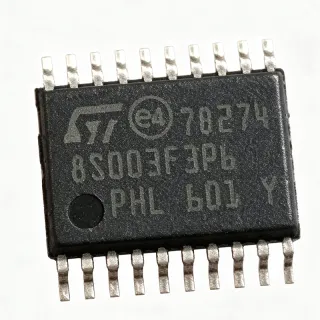
MC9S08SL16CTJ - 8-bit S08 MCU 16KB Flash 40MHz | NXP
Артикул: MC9S08SL16CTJ ✗ Снят с производства| Кол-во | Цена за ед. | Итого |
|---|---|---|
| 1 | $2.95 | $2,95 |
| 10 | $2.66 | $26,60 |
| 100 | $2.36 | $236,00 |
| 500 | $2.07 | $1.035,00 |
| 1.000 | $1.83 | $1.830,00 |
MC9S08SL16CTJ Обзор
An 8-bit microcontroller (MCU) is a single-chip computer that integrates a CPU core, program memory, data memory, and peripherals on one die, sitting at the low end of the embedded processor hierarchy (8-bit MCU -> 32-bit MCU -> application processor). The S08 (HCS08) family is Freescale's enhanced successor to the HC08, adding the BGND background-debug instruction while retaining HC08 instruction-set compatibility, which eases migration of legacy designs.
Key features of this part include the 40-MHz HCS08 CPU, an embedded Slave LIN Interface Controller (SLIC) that boosts LIN slave node performance and shortens development time, and up to 32 supported interrupt/reset sources. On-chip peripherals cover low-voltage detection (LVD), power-on reset (POR), PWM capability, and a watchdog timer (WDT), reducing external component count.
The SLIC module is the architectural differentiator: by handling LIN protocol framing in hardware, the CPU is freed for application code, making the device well suited to automotive and industrial LIN slave nodes such as window lifters, seat controllers, sensors, and small actuators. The dual 3.3V/5V supply capability allows direct interfacing with 5V automotive domains.
Typical applications include LIN-bus slave nodes in body electronics, motor control subassemblies, and industrial sensor endpoints.
Design consideration: as an original Freescale/NXP part now widely flagged obsolete, verify supply continuity early; the S08SG/SH siblings in the same TSSOP-20 footprint are the natural candidates for new layouts.
This page synthesizes distributor pricing, drop-in alternatives, and practical design notes not found in the manufacturer datasheet.
Аналоги без доработки для MC9S08SL16CTJ — тот же корпус, pin-to-pin совместимость. Компоненты в других корпусах, требующие переработки PCB, исключены.
Варианты в этой серии
Модели той же серии, совместимые без доработки с MC9S08SL16CTJ (тот же форм-фактор и посадочное место) — отличается по Package, RAM Size, Core Processor, Operating Temperature, Program Memory Size.
Инструмент быстрого сравнения — выберите альтернативные компоненты для сравнения бок о бок:
S9S08SG16E1MTJ
✅ Прямая замена📋 Справочный аналог (нет в каталоге)
MC9S08SH16MTJ
✅ Прямая замена✓ В наличии
$2.95 / шт.
Открыть даташит →MC9S08EL16CTJ
✅ Прямая замена✓ В наличии
$3.05 / шт.
Открыть даташит →MC9S08SG16CTJ
✅ Прямая замена ⚠️ Характеристики не проверены📋 Справочный аналог (нет в каталоге)
MC9S08SH4CTJR
✅ Прямая замена📋 Справочный аналог (нет в каталоге)
MC9S08SL16CTJ Максимальные параметры и электрические характеристики
| Core Processor | S08 (HCS08) |
| Core Size | 8-Bit |
| Maximum Clock Speed | 40 MHz |
| Program Memory Size | 16KB (16K x 8) |
| Program Memory Type | FLASH |
| EEPROM Size | 256 x 8 |
| Connectivity | I2C, LINbus, SCI, SPI |
| Peripherals | LVD, POR, PWM, WDT |
| Number of I/O | 16 |
| Interrupt/Reset Sources | Up to 32 |
| Напряжение питания | 3.3 V / 5 V |
| Тип монтажа | Surface Mount |
| Корпус | 20-TSSOP |
| Packaging | Tube |
| Special Module | Embedded Slave LIN Interface Controller (SLIC) |
| Instruction Set | HC08 compatible with added BGND instruction |
| Part Status | Obsolete |
Руководство по цоколевке MC9S08SL16CTJ в корпусе 20-tssop
Цоколевка для MC9S08SL16CTJ (корпус 20-tssop). Эта цифровая ИС включает выводы GPIO, интерфейсы связи (UART, SPI, I2C) и выводы питания. Обратитесь к техническому описанию производителя для альтернативных функций выводов и вариантов конфигурации. Необходимо для проектирования встраиваемых систем и трассировки печатных плат.

Нет подробных данных о распиновке для MC9S08SL16CTJ.
Обратитесь к даташиту для полной конфигурации выводов.
Типичное применение
MC9S08SL16CTJ подходит для 6 применениеs: Automotive LIN Slave Nodes, Industrial Sensor Endpoints, Small Motor and Actuator Control, Building Automation and HVAC Controls, Legacy Firmware Maintenance and Repair, Educational and HCS08 Reference Designs.
Automotive LIN Slave Nodes
The MC9S08SL16CTJ was designed primarily for LIN slave nodes in automotive body electronics: window lifters, seat adjusters, mirror controllers, and wiper subassemblies. Its embedded Slave LIN Interface Controller (SLIC) handles LIN 2.x frame synchronization, identifier filtering, and response framing in hardware, offloading the 40 MHz S08 CPU and guaranteeing bus timing even under interrupt load - a task that otherwise demands careful software scheduling on standard SCI-based MCUs. With 3.3V/5V operation, the device connects directly to a 5V logic domain beside a LIN transceiver such as the NXP MC33662. Typical node firmware fits comfortably in 16KB FLASH, and the 256-byte EEPROM stores node configuration, schedule tables, and calibration data through power cycles. Designers of new nodes should plan migration to NXP's active S08 families, but the SL16 remains a reference architecture for LIN slave firmware porting.
Рекомендуется
Industrial Sensor Endpoints
In industrial sensing nodes, the MC9S08SL16CTJ combines a 16-channel-capable analog environment via its 16 I/O lines, an SCI link for RS-485 style networks, and SPI/I2C for local ADC or sensor front-ends. The 40 MHz S08 core executes filtering and linearization math for low-bandwidth sensors (temperature, pressure, position), while LVD and POR peripherals ensure deterministic startup on unregulated 24V-derived 5V rails. The watchdog timer (WDT) provides fail-safe recovery in unattended installations. The 256 x 8 EEPROM retains sensor calibration coefficients, node address, and diagnostic counters, enabling field recalibration without external non-volatile memory. Because the part is obsolete, this application is most relevant to sustaining engineering on installed products; for new sensor endpoints, the S9S08SG16E1MTJ offers equivalent digital capability with active lifecycle status.
Рекомендуется
Small Motor and Actuator Control
For DC fan, pump, and small actuator control, the MC9S08SL16CTJ provides PWM output capability among its peripherals, 16 GPIO for H-bridge gating or discrete drive, and a 40 MHz core closed-loop speed regulation at kilohertz PWM rates. The S08 architecture's deterministic interrupt latency makes simple PI loops straightforward, while the watchdog timer enforces safe shutdown on firmware lock-up - important near motors. The 3.3V/5V flexibility matches both legacy 5V gate-driver thresholds and modern 3.3V logic. Feedback from Hall sensors or optocouplers enters through GPIO or timer input capture. The 16KB FLASH accommodates commutation tables and LIN or SCI command interfaces for higher-level control, and the SLIC module allows the actuator to act as a LIN slave in vehicle or building-automation networks. Verify drive-stage pairing and PWM frequency against the family reference manual electrical tables.
Рекомендуется
Building Automation and HVAC Controls
Room controllers, damper actuators, and HVAC valve interfaces commonly use 8-bit MCUs with a fieldbus. The MC9S08SL16CTJ serves such nodes through its I2C port for local sensors, SPI for display or EEPROM expansion, and SCI for RS-485 backbones; the SLIC LIN slave hardware can also participate in LIN-based building networks, which some HVAC subsystems use for low-cost actuator buses. Its 5V operation aligns with industrial 24V systems dropped through simple linear regulation, and LVD/POR give clean resets during brownouts common in large installations. The EEPROM retains setpoints, PID constants, and schedules. At 16KB FLASH, complete control firmware including a communication stack fits without memory banking. New building-automation designs should instead select an active S08 or ARM-based NXP MCU, but the SL16 illustrates a proven, minimal-component architecture for this class of node.
Рекомендуется
Legacy Firmware Maintenance and Repair
A significant ongoing use of the MC9S08SL16CTJ is last-time-buy stock consumption and repair of deployed products - vehicle control modules, industrial actuators, and appliance boards already programmed with SL16 firmware. The HC08-compatible instruction set with the added BGND background-debug instruction means existing HC08-era toolchains and Freescale background debug mode (BDM) probes remain usable for re-flashing and diagnostics. Stocked supply exists through Rochester Electronics and authorized-surplus channels (Wolfchip reported 6640 pcs as of June 2026), so repair operations can maintain a strategic buffer. Engineering teams sustaining such products should qualify the MC9S08SH16MTJ or S9S08SG16E1MTJ as migration targets now, verifying pinout and SLIC-dependent code, because broker supply of the SL16 is finite and pricing will rise as inventories deplete.
Рекомендуется
Educational and HCS08 Reference Designs
The S08SL16 family remains useful as a teaching and reference platform for 8-bit embedded fundamentals: the HC08-compatible instruction set is compact and fully documented in the 356-page family datasheet, background debug mode (BGND) enables non-intrusive debugging with simple low-cost probes, and the small peripheral set (SCI, SPI, I2C, PWM, WDT, LVD, POR) maps cleanly onto introductory embedded curricula. LIN via the SLIC module additionally demonstrates a real-world automotive fieldbus with hardware protocol assist - a topic otherwise hard to illustrate on commodity hobbyist boards. The 20-TSSOP package is hand-solderable on DIP-adapter breakout boards, and 3.3V/5V operation suits both breadboard-friendly 5V test rigs and modern 3.3V lab setups. Universities and training labs can still source the part through surplus channels for laboratory stock.
Рекомендуется
Сводка рекомендуемых товаров
Справочные инженерные данные для MC9S08SL16CTJ — сравнение, рекомендации по проектированию и информация о соответствии.
Руководство по выбору
Сравнение с аналогами
| Параметр | Этот товар | S9S08SG16E1MTJ | MC9S08SH16MTJ | MC9S08EL16CTJ | MC9S08SH4CTJR |
|---|---|---|---|---|---|
| Package | 20-TSSOP | 20-TSSOP - same | 20-TSSOP - same | 20-TSSOP - same | 20-TSSOP - same |
| Brand | NXP Semiconductors (Freescale) | NXP Semiconductors | NXP Semiconductors | NXP Semiconductors | NXP Semiconductors |
| Core / Speed | S08, 40 MHz | S08, 40 MHz | S08, 40 MHz | S08, 40 MHz | S08, 40 MHz |
| Program Memory | 16KB FLASH | 16KB FLASH | 16KB FLASH | 16KB FLASH | 4KB FLASH |
| Supply Voltage | 3.3 V / 5 V | 3.3 V / 5 V | 3.3 V / 5 V | 3.3 V / 5 V | 3.3 V / 5 V |
| Connectivity | I2C, LINbus, SCI, SPI | I2C, LINbus, SCI, SPI | I2C, SCI, SPI (LIN software) | I2C, LINbus, SCI, SPI | I2C, SCI, SPI |
Ключевые отличия
- Hardware LIN slave protocol engine (против S9S08SG16E1MTJ)
- HC08 instruction-set compatibility (против MC9S08SH16MTJ)
- Lifecycle status (negative differentiator) (против MC9S08EL16CTJ)
Заметки по проектированию
The MC9S08SL16CTJ is obsolete: distributor data (abc-semi listing) explicitly lists Part Status: Obsolete. Do not release it into new-production BOMs. For existing designs, execute a last-time-buy covering projected service life plus attrition, and qualify S9S08SG16E1MTJ or MC9S08SH16MTJ (same 20-TSSOP footprint) as the migration path. Broker-sourced parts carry counterfeit risk for 8-bit MCUs; purchase only from authorized or Rochester Electronics-type franchised sources with date-code traceability.
Pin functions on the SL16 differ from SG16/SH16 siblings at several TSSOP-20 positions because the SLIC LIN slave module claims multiplexed pins. Before swapping a footprint-compatible part, map every used peripheral pin against the SL16 pinout chapter of the MC9S08SL16 family datasheet (356-page document), not against generic S08 diagrams. Firmware using the SLIC hardware LIN framing must be re-authored on SCI-based alternatives, so budget firmware - not just hardware - in the replacement plan.
The device supports 3.3V/5V operation. In automotive LIN nodes powered from a 12V load-dump environment, protect the 5V rail with a series regulator plus TVS clamp and verify the low-voltage detection (LVD) threshold against your brownout profile - the S08 LVD will reset the core, and the watchdog (WDT) must be serviced early enough in main-loop code that LIN frame handling interrupts do not mask it. Estimated: keep LVD margin by placing the WDT service point after the SLIC interrupt service in the loop schedule.
Информация о соответствии
C suffix in MC9S08SL16CTJ denotes NXP RoHS-compliant lead-free TSSOP variant. REACH/halogen-free/conflict-minerals declarations for this obsolete part should be confirmed via the NXP product compliance portal.