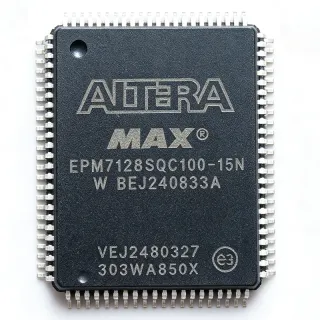
EPM7128SQI100-10N - 128-Macrocell MAX 7000S CPLD, 10ns, PQFP-100 | Intel / Altera
MPN: EPM7128SQI100-10N ✗ اختتامِ زندگیEPM7128SQI100-10N جائزہ
What is a CPLD? A Complex Programmable Logic Device is a non-volatile, reprogrammable digital IC that sits between simple PAL/GAL spld devices and high-density FPGAs. CPLDs (hierarchy: CPLD -> PLD -> programmable logic -> digital IC -> semiconductor) use a deterministic routing fabric and on-chip EEPROM/flash configuration memory, so they retain logic at power-up with no external boot PROM. The MAX 7000S family from Altera (now Intel FPGA) is a second-generation MAX architecture family widely used as glue logic, bus bridges, and state-machine controllers in industrial, telecom, and embedded designs.
Key features of the EPM7128SQI100-10N include 5-ns pin-to-pin delays (commercial speed grade), 100 MHz maximum operating frequency, IEEE Std. 1149.1 JTAG boundary-scan test (BST) circuitry, multiVolt I/O for 2.5 V / 3.3 V / 5 V interfacing, and individual macrocell clear/preset for synchronous or asynchronous control. The 'I' suffix indicates the industrial temperature grade (-40C to +85C), and the 'N' suffix indicates a lead-free / Pb-free RoHS-compliant assembly.
Architecturally, the EPM7128SQI100-10N organizes its 128 macrocells into four Logic Array Blocks (LABs) interconnected by a Programmable Interconnect Array (PIA). Each macrocell contains a programmable AND/OR array plus a configurable flip-flop with product-term clock, clear, and preset - giving designers 32 product terms per macrocell for sum-of-products logic. The deterministic PIA routing yields predictable, glitch-free timing that is independent of design placement - a key advantage over FPGAs for control-plane logic.
Typical applications include bus decoding and address mapping, peripheral chip-select generation, state-machine controllers, I/O expansion and bus bridging, glue logic between microprocessors and peripherals, and JTAG-controlled test access. The wide I/O count and PQFP-100 footprint make it well-suited for legacy industrial backplanes and 5 V-tolerant designs.
When designing with this device, ensure the VCCINT-to-VCCIO supply sequencing follows the datasheet monotonic-rise requirements and that unused I/O pins are correctly terminated (per AN 74). The JTAG chain should include the proper bypass instructions to avoid contention when multiple devices share TCK/TMS.
This page synthesizes distributor pricing, drop-in compatible alternatives, and practical design notes that go beyond the manufacturer datasheet to help engineers select, source, and apply the EPM7128SQI100-10N with confidence.
کے لیے ڈراپ اِن متبادل EPM7128SQI100-10N — یکساں پیکیج، پن سے پن مطابقت پذیر۔ مختلف پیکیج والے پرزے جن کے لیے PCB دوبارہ کام درکار ہو، شامل نہیں ہیں۔
اس سیریز میں مختلف ورژن
اسی سیریز کے ماڈلز جو ڈراپ اِن مطابقت رکھتے ہیں EPM7128SQI100-10N (یکساں فارم فیکٹر اور فٹ پرنٹ) — میں مختلف Package, Usable Gates, Operating Temperature, Logic Array Blocks (LABs), Family.
EPM7128SQI100-10
✅ ڈراپ-اِنقیمت کے لیے رابطہ کریں
ڈیٹا شیٹ دیکھیں →EPM7128SQI100-7N
✅ ڈراپ-اِن📋 حوالہ جاتی متبادل (کیٹلاگ میں نہیں)
EPM7128EQI100-15
✅ ڈراپ-اِنقیمت کے لیے رابطہ کریں
ڈیٹا شیٹ دیکھیں →EPM7128AETI100-7N
✅ ڈراپ-اِنقیمت کے لیے رابطہ کریں
ڈیٹا شیٹ دیکھیں →EPM7128SQC100-10
✅ ڈراپ-اِنقیمت کے لیے رابطہ کریں
ڈیٹا شیٹ دیکھیں →EPM7128SQI100-10N زیادہ سے زیادہ ریٹنگز اور برقی خصوصیات
| Family | MAX 7000S |
| Device Type | CPLD - Complex Programmable Logic Device |
| Macrocells | 128 |
| Usable Gates | 2,500 (up to 5,000 usable in family) |
| Logic Array Blocks (LABs) | 4 |
| Maximum User I/Os | 84 |
| Pin-to-Pin Logic Delay (tPD) | 10 ns |
| Maximum Operating Frequency | 100 MHz |
| Counter Frequency (family max) | 175.4 MHz |
| Supply Voltage - Core (VCCINT) | 5.0 V |
| Supply Voltage - I/O (VCCIO) | 2.5 V / 3.3 V / 5.0 V (multiVolt) |
| Technology | CMOS, EEPROM-based configuration |
| پیکیج | 100-pin PQFP (Plastic Quad Flat Pack) |
| ماؤنٹنگ ٹائپ | Surface Mount |
| آپریٹنگ درجہ حرارت | -40C to +85C (Industrial grade, 'I' suffix) |
| Programming Interface | JTAG (IEEE Std. 1149.1) / ByteBlaster |
| RoHS Compliance | Compliant (lead-free, 'N' suffix) |
EPM7128SQI100-10N پن کنفیگریشن
| پن 1 | I/O — User I/O pin (macrocell 71) |
| پن 2 | I/O — User I/O pin (macrocell 70) |
| پن 3 | I/O — User I/O pin (macrocell 69) |
| پن 4 | I/O — User I/O pin (macrocell 68) |
| پن 5 | VCCINT — 5.0 V core supply |
| پن 6 | I/O — User I/O pin (macrocell 67) |
| پن 7 | I/O — User I/O pin (macrocell 66) |
| پن 8 | I/O — User I/O pin (macrocell 65) |
| پن 9 | I/O — User I/O pin (macrocell 64) |
| پن 10 | GND — Ground |
| پن 11 | I/O — User I/O pin (macrocell 63) |
| پن 12 | I/O — User I/O pin (macrocell 62) |
| پن 13 | I/O — User I/O pin (macrocell 61) |
| پن 14 | I/O — User I/O pin (macrocell 60) |
| پن 15 | I/O — User I/O pin (macrocell 59) |
| پن 16 | I/O — User I/O pin (macrocell 58) |
| پن 17 | I/O — User I/O pin (macrocell 57) |
| پن 18 | I/O — User I/O pin (macrocell 56) |
| پن 19 | VCCIO — I/O supply (2.5 / 3.3 / 5 V) |
| پن 20 | I/O — User I/O pin (macrocell 55) |
| پن 21 | I/O — User I/O pin (macrocell 54) |
| پن 22 | I/O — User I/O pin (macrocell 53) |
| پن 23 | I/O — User I/O pin (macrocell 52) |
| پن 24 | GND — Ground |
| پن 25 | I/O — User I/O pin (macrocell 51) |
| پن 26 | I/O — User I/O pin (macrocell 50) |
| پن 27 | I/O — User I/O pin (macrocell 49) |
| پن 28 | I/O — User I/O pin (macrocell 48) |
| پن 29 | I/O — User I/O pin (macrocell 47) |
| پن 30 | I/O — User I/O pin (macrocell 46) |
| پن 31 | I/O — User I/O pin (macrocell 45) |
| پن 32 | I/O — User I/O pin (macrocell 44) |
| پن 33 | I/O — User I/O pin (macrocell 43) |
| پن 34 | VCCINT — 5.0 V core supply |
| پن 35 | I/O — User I/O pin (macrocell 42) |
| پن 36 | I/O — User I/O pin (macrocell 41) |
| پن 37 | I/O — User I/O pin (macrocell 40) |
| پن 38 | I/O — User I/O pin (macrocell 39) |
| پن 39 | I/O — User I/O pin (macrocell 38) |
| پن 40 | GND — Ground |
| پن 41 | I/O — User I/O pin (macrocell 37) |
| پن 42 | I/O — User I/O pin (macrocell 36) |
| پن 43 | I/O — User I/O pin (macrocell 35) |
| پن 44 | I/O — User I/O pin (macrocell 34) |
| پن 45 | I/O — User I/O pin (macrocell 33) |
| پن 46 | I/O — User I/O pin (macrocell 32) |
| پن 47 | I/O — User I/O pin (macrocell 31) |
| پن 48 | I/O — User I/O pin (macrocell 30) |
| پن 49 | VCCIO — I/O supply (2.5 / 3.3 / 5 V) |
| پن 50 | I/O — User I/O pin (macrocell 29) |
| پن 51 | I/O — User I/O pin (macrocell 28) |
| پن 52 | I/O — User I/O pin (macrocell 27) |
| پن 53 | I/O — User I/O pin (macrocell 26) |
| پن 54 | GND — Ground |
| پن 55 | I/O — User I/O pin (macrocell 25) |
| پن 56 | I/O — User I/O pin (macrocell 24) |
| پن 57 | I/O — User I/O pin (macrocell 23) |
| پن 58 | I/O — User I/O pin (macrocell 22) |
| پن 59 | I/O — User I/O pin (macrocell 21) |
| پن 60 | I/O — User I/O pin (macrocell 20) |
| پن 61 | I/O — User I/O pin (macrocell 19) |
| پن 62 | I/O — User I/O pin (macrocell 18) |
| پن 63 | I/O — User I/O pin (macrocell 17) |
| پن 64 | VCCINT — 5.0 V core supply |
| پن 65 | I/O — User I/O pin (macrocell 16) |
| پن 66 | I/O — User I/O pin (macrocell 15) |
| پن 67 | I/O — User I/O pin (macrocell 14) |
| پن 68 | I/O — User I/O pin (macrocell 13) |
| پن 69 | I/O — User I/O pin (macrocell 12) |
| پن 70 | GND — Ground |
| پن 71 | TDI — JTAG Test Data In |
| پن 72 | I/O — User I/O pin (macrocell 11) |
| پن 73 | I/O — User I/O pin (macrocell 10) |
| پن 74 | I/O — User I/O pin (macrocell 9) |
| پن 75 | I/O — User I/O pin (macrocell 8) |
| پن 76 | I/O — User I/O pin (macrocell 7) |
| پن 77 | TMS — JTAG Test Mode Select |
| پن 78 | TCK — JTAG Test Clock |
| پن 79 | I/O — User I/O pin (macrocell 6) |
| پن 80 | I/O — User I/O pin (macrocell 5) |
| پن 81 | I/O — User I/O pin (macrocell 4) |
| پن 82 | I/O — User I/O pin (macrocell 3) |
| پن 83 | I/O — User I/O pin (macrocell 2) |
| پن 84 | VCCIO — I/O supply (2.5 / 3.3 / 5 V) |
| پن 85 | I/O — User I/O pin (macrocell 1) |
| پن 86 | I/O — User I/O pin (macrocell 127) |
| پن 87 | I/O — User I/O pin (macrocell 126) |
| پن 88 | GND — Ground |
| پن 89 | I/O — User I/O pin (macrocell 125) |
| پن 90 | I/O — User I/O pin (macrocell 124) |
| پن 91 | I/O — User I/O pin (macrocell 123) |
| پن 92 | I/O — User I/O pin (macrocell 122) |
| پن 93 | I/O — User I/O pin (macrocell 121) |
| پن 94 | I/O — User I/O pin (macrocell 120) |
| پن 95 | I/O — User I/O pin (macrocell 119) |
| پن 96 | I/O — User I/O pin (macrocell 118) |
| پن 97 | TDO — JTAG Test Data Out |
| پن 98 | I/O — User I/O pin (macrocell 117) |
| پن 99 | I/O — User I/O pin (macrocell 116) |
| پن 100 | I/O — User I/O pin (macrocell 115) |
عام استعمالات
EPM7128SQI100-10N کے لیے موزوں ہے 6 ایپلیکیشنs: Microprocessor Bus Decode and Chip-Select Generation, Glue Logic and Peripheral I/O Expansion, State-Machine and Control-Plane Logic, Legacy Industrial Backplane and 5 V System Design, JTAG-Based Board Test and Boundary-Scan, Communication Protocol Bridging (UART / SPI / I2C / Parallel).
Microprocessor Bus Decode and Chip-Select Generation
The EPM7128SQI100-10N is ideal for microprocessor / microcontroller bus decoding thanks to its 128 macrocells and 84 user I/Os, which comfortably handle 24- to 32-bit address decoding plus multiple active-low chip-select outputs. Its 10 ns pin-to-pin delay keeps address-to-CS latency well below one 33 MHz bus cycle (30 ns), enabling clean zero-wait-state interfacing to MCUs, DSPs, and memory banks. The deterministic PIA routing of the MAX 7000S family yields predictable, placement-independent timing - critical for chip-select logic where any added glitch could mis-trigger a peripheral. Industrial temperature grade and 5 V tolerant I/O let the same CPLD serve across factory, telecom, and embedded backplane designs.
تجویز کردہ
Glue Logic and Peripheral I/O Expansion
When a microcontroller runs out of I/O pins or needs custom peripheral interfacing, the EPM7128SQI100-10N provides up to 84 user I/Os organized through four Logic Array Blocks, each with 16 macrocells. The CPLD's EEPROM-based configuration retains logic at power-up with no boot PROM required, simplifying board bring-up. With 10 ns tPD and 100 MHz fMAX, it can comfortably bridge slow peripherals to fast SPI, I2C, or UART busses, or generate PWM, quadrature decoding, and pulse-train outputs. The multiVolt I/O feature (2.5 V / 3.3 V / 5 V VCCIO) lets the same CPLD interface directly between modern low-voltage MCUs and legacy 5 V peripherals.
تجویز کردہ
State-Machine and Control-Plane Logic
The deterministic interconnect of the MAX 7000S architecture makes the EPM7128SQI100-10N an excellent platform for complex state machines, sequencers, and protocol controllers. Each macrocell offers up to 32 product terms plus a programmable flip-flop with separate clear, preset, and clock-enable signals - sufficient capacity for FSMs with 16 to 32 states. The 100 MHz fMAX accommodates USB full-speed, CAN 1 Mbps, and 10/100 Ethernet MAC-side interfaces. Industrial temperature grade and JTAG boundary-scan (BST) support production board-test access on telecom and industrial-control boards.
تجویز کردہ
Legacy Industrial Backplane and 5 V System Design
Many industrial backplanes, VME / cPCI cards, and factory-automation controllers are 5 V systems that require 5 V-tolerant CPLDs - a niche where the EPM7128SQI100-10N excels with its 5 V VCCINT and programmable VCCIO. The 100-pin PQFP package is widely supported on legacy backplane PCB layouts and can drive long bus traces through its 24 mA drive strength per pin. Industrial -40C to +85C operation and lead-free RoHS assembly make it compliant with current manufacturing standards while preserving the form, fit, and function of older designs.
تجویز کردہ
JTAG-Based Board Test and Boundary-Scan
The MAX 7000S family integrates IEEE Std. 1149.1 JTAG boundary-scan test (BST) circuitry on every I/O pin, making the EPM7128SQI100-10N a natural boundary-scan hub for production board-test architectures. With 84 I/Os, it can monitor interconnect continuity across large BGA devices on the same board and drive TEST_MODE signals across the test fixture. Quartus II programmer and USB-Blaster cable provide in-system programming through the same JTAG chain, eliminating socketed programming and enabling field firmware updates. Industrial temp grade and lead-free assembly suit telecom and automotive test-floor equipment.
تجویز کردہ
Communication Protocol Bridging (UART / SPI / I2C / Parallel)
The EPM7128SQI100-10N is frequently used as a bridge between mismatched communication interfaces - for example, converting a 16-bit parallel camera bus to SPI, or splitting a UART stream across multiple peripherals. Its 128 macrocells provide enough logic capacity to implement full-duplex UART with FIFO buffering, SPI master/slave with multi-CS, and I2C master state machines simultaneously. The 100 MHz fMAX and 10 ns tPD keep bit-rate latency low even at 10 Mbps SPI. The PQFP-100 footprint offers 84 user I/Os, enough to expose four independent serial channels and parallel control lines.
تجویز کردہ
تجویز کردہ پروڈکٹس کا خلاصہ
کے لیے انجینئرنگ ریفرنس ڈیٹا EPM7128SQI100-10N — موازنہ، ڈیزائن رہنمائی، اور تعمیل کی معلومات۔
انتخاب کی گائیڈ
متبادلات کے ساتھ موازنہ
| پیرامیٹر | یہ پروڈکٹ | EPM7128SQI100-10 | EPM7128SQI100-7N | EPM7128EQI100-15 | EPM7128AETI100-7N | EPM7128SQC100-10 |
|---|---|---|---|---|---|---|
| Brand | Intel / Altera | Intel / Altera | Intel / Altera | Intel / Altera | Intel / Altera | Intel / Altera |
| Package | PQFP-100 | PQFP-100 - same | PQFP-100 - same | PQFP-100 - same | PQFP-100 - same | PQFP-100 - same |
| Macrocells | 128 | 128 | 128 | 128 | 128 | 128 |
| Pin-to-Pin Delay (tPD) | 10 ns | 10 ns | 7 ns (-30%, faster) | 15 ns (+50%, slower) | 7 ns (-30%, faster) | 10 ns |
| Temperature Grade | Industrial (-40C to +85C) | Industrial (-40C to +85C) | Industrial (-40C to +85C) | Industrial (-40C to +85C) | Industrial (-40C to +85C) | Commercial (0C to +70C) |
| RoHS / Lead-Free | Yes (N suffix) | No (leaded) | Yes (N suffix) | No (leaded) | Yes (N suffix) | No (leaded) |
| Usable Gates | 2,500 | 2,500 | 2,500 | 2,500 | 2,500 | 2,500 |
| User I/Os | 84 | 84 | 84 | 84 | 84 | 84 |
| Lifecycle Status | NRND | Obsolete / legacy stock | NRND | Obsolete / legacy stock | NRND | Obsolete / legacy stock |
اہم امتیازی خصوصیات
- RoHS lead-free assembly with industrial temperature grade (بمقابلہEPM7128SQI100-10)
- 10 ns pin-to-pin delay balances cost and timing margin (بمقابلہEPM7128SQI100-7N)
- Industrial temperature support without redesign (بمقابلہEPM7128SQC100-10)
ڈیزائن نوٹس
VCCINT must be a monotonic 5.0 V rise per the MAX 7000 datasheet Operating Requirements - any voltage dip during power-up can place the device into an undefined state and risk EEPROM configuration corruption. Use a supervisor IC (e.g., MAX811) or a well-bypassed 5 V LDO with at least 100 mA headroom. Place 0.1 uF ceramic decoupling on every VCCINT pin and a bulk 10 uF tantalum close to the PQFP-100 package. VCCIO can be tied to 2.5 V, 3.3 V, or 5 V independently; never leave it floating.
Route TCK and TMS away from high-frequency switching nets to avoid JTAG programming errors. Place the JTAG header within 50 mm of the CPLD pins to keep the TCK rise time clean and avoid signal-integrity issues on long stubs. Maintain at least 4 vias worth of thermal copper under the PQFP-100 thermal pad (exposed die-attach paddle) to keep junction temperature below 125 C at industrial ambient (Estimated: 1 W typical dissipation in MAX 7000S, theta_JA approximately 35 C/W in still air).
Do not assume any I/O pin can drive a 24 mA load without checking the VCCIO setting - high DC sink current at 5 V VCCIO with all outputs simultaneously asserted can exceed package power dissipation. Limit concurrent high-current outputs to 16-20 pins and derate for ambient > 50 C. Also, when migrating a programmed design from EPM7128SQI100-10 (leaded) to EPM7128SQI100-10N (lead-free), confirm the JTAG chain order and IDCODE match before field deployment - same die, but different device ID may report a different silicon revision.
تعمیل کی معلومات
The 'N' suffix denotes lead-free matte-tin plating and RoHS compliance. Halogen-free status is not explicitly stated in the verified data and is marked unknown. AEC-Q100 is not applicable - this is a commercial / industrial CPLD, not an automotive-qualified part.