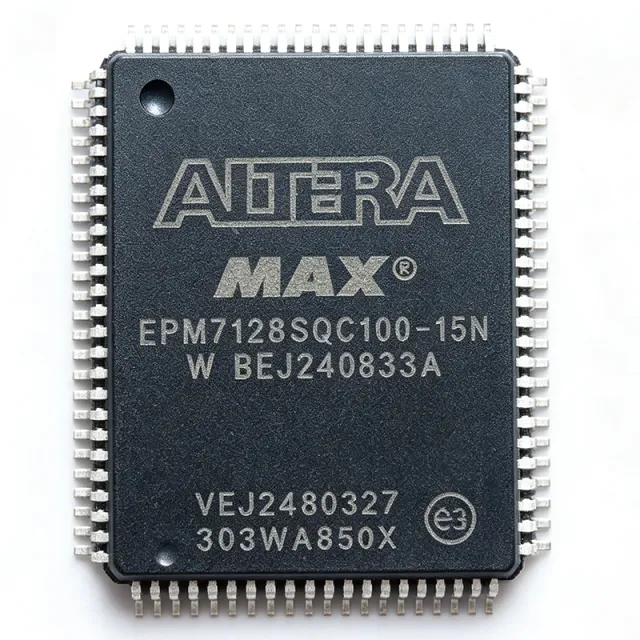
EPM7128SQC100-15 - MAX 7000 CPLD 128MC 15ns 5V | Altera/Intel
MPN: EPM7128SQC100-15 ⚠ آخری بار خریداری| مقدار | فی یونٹ قیمت | کل رقم |
|---|---|---|
| 1 | $14.5 | $14.50 |
| 10 | $12.85 | $128.50 |
| 100 | $10.95 | $1,095.00 |
| 500 | $9.4 | $4,700.00 |
| 1,000 | $8.2 | $8,200.00 |
EPM7128SQC100-15 جائزہ
A CPLD (Complex Programmable Logic Device) is a non-volatile programmable logic IC that combines multiple PAL-like macrocell arrays on a single die with a global interconnect fabric. The MAX 7000 family is Altera's second-generation EEPROM-based CPLD architecture, positioned between simple PLDs and FPGAs in the programmable logic hierarchy: PLD -> CPLD -> FPGA -> SoC FPGA. MAX 7000 parts retain configuration in on-chip EEPROM, so they boot instantly at power-up without an external configuration PROM - an advantage over SRAM-based FPGAs in deterministic-startup applications.
Key features of the EPM7128SQC100-15 include 128 macrocells organized into 4 Logic Array Blocks (LABs), a 2,500-gate typical density, 84 user I/O pins, programmable power management with macrocell-level slew-rate control, and a 15 ns tPD (worst-case pin-to-pin delay) suitable for 66 MHz operation. The device also provides 4 dedicated inputs, 6 to 10 product terms per macrocell, and a JTAG boundary-scan test interface compliant with IEEE 1149.1.
The architecture uses Altera's classic MAX (Multiple Array matriX) interconnect, with each LAB containing 16 macrocells feeding a Programmable Interconnect Array (PIA). This structure delivers fast, predictable combinational and registered logic delays that are independent of routing density - a key reason MAX 7000 CPLDs remain in long-life programs where deterministic timing matters more than raw density.
Typical applications include bus-interface glue logic, peripheral decoders and address mapping, state-machine control in industrial automation, board-level signal conditioning in telecom backplanes, and pin-compatible upgrades for legacy 5 V TTL/CMOS designs. The 5 V tolerance and PQFP-100 footprint also make it a common choice for maintenance of installed equipment in factory automation and aerospace ground systems.
When designing with this part, plan for an external 5 V regulator with at least 200 mA headroom and follow Altera's JTAG chain layout guidelines (TCK pull-down, TMS/TDI pull-ups) to avoid programming failures. Note that the EPM7128SQC100-15 is a mature / legacy product; verify lifecycle status before new designs.
This page synthesizes distributor pricing, drop-in same-package alternatives from the MAX 7000 / MAX 7000A families, and practical design notes not found in the manufacturer datasheet itself.
کے لیے ڈراپ اِن متبادل EPM7128SQC100-15 — یکساں پیکیج، پن سے پن مطابقت پذیر۔ مختلف پیکیج والے پرزے جن کے لیے PCB دوبارہ کام درکار ہو، شامل نہیں ہیں۔
اس سیریز میں مختلف ورژن
اسی سیریز کے ماڈلز جو ڈراپ اِن مطابقت رکھتے ہیں EPM7128SQC100-15 (یکساں فارم فیکٹر اور فٹ پرنٹ) — میں مختلف Package, Operating Temperature, Propagation Delay (tPD), RoHS Status, Usable Gates.
فوری موازنہ ٹول — ساتھ ساتھ موازنے کے لیے متبادل پرزے منتخب کریں:
EPM7128SQC100-10
قیمت کے لیے رابطہ کریں
ڈیٹا شیٹ دیکھیں →EPM7128SQC100-10N
قیمت کے لیے رابطہ کریں
ڈیٹا شیٹ دیکھیں →EPM7128EQC100-10
قیمت کے لیے رابطہ کریں
ڈیٹا شیٹ دیکھیں →EPM7128BTC100-10
قیمت کے لیے رابطہ کریں
ڈیٹا شیٹ دیکھیں →EPM7128SQC100-15N
📋 حوالہ جاتی متبادل (کیٹلاگ میں نہیں)
EPM7128SQC100-15FN
📋 حوالہ جاتی متبادل (کیٹلاگ میں نہیں)
EPM7128EQC100-15
📋 حوالہ جاتی متبادل (کیٹلاگ میں نہیں)
EPM7128SQC100-15 زیادہ سے زیادہ ریٹنگز اور برقی خصوصیات
| Family | MAX 7000 |
| Device Type | CPLD (Complex Programmable Logic Device) |
| Macrocells | 128 |
| Logic Array Blocks (LABs) | 4 (16 macrocells each) |
| User I/Os | 84 |
| Pin-to-Pin Delay (tPD) | 15 ns |
| Typical Gate Count | 2,500 gates |
| Supply Voltage (VCCINT) | 5 V (5% tolerance) |
| Programming Technology | EEPROM (in-system programmable via JTAG) |
| JTAG Interface | IEEE Std. 1149.1 compliant |
| پیکیج | 100-pin PQFP (Plastic Quad Flat Pack) |
| آپریٹنگ درجہ حرارت | 0C to +70C (Commercial) |
| ماؤنٹنگ ٹائپ | Surface Mount |
| MSL لیول | 3 (168 hours) |
| RoHS اسٹیٹس | Non-compliant (SnPb lead finish - legacy PQFP) |
EPM7128SQC100-15 پن کنفیگریشن
| پن 1 | I/O — User I/O pin (macrocell-driven bidirectional) |
| پن 2 | I/O — User I/O pin |
| پن 3 | I/O — User I/O pin |
| پن 4 | I/O — User I/O pin |
| پن 5 | I/O — User I/O pin |
| پن 6 | I/O — User I/O pin |
| پن 7 | I/O — User I/O pin |
| پن 8 | I/O — User I/O pin |
| پن 9 | I/O — User I/O pin |
| پن 10 | I/O — User I/O pin |
| پن 11 | GND — Ground |
| پن 12 | I/O — User I/O pin |
| پن 13 | I/O — User I/O pin |
| پن 14 | I/O — User I/O pin |
| پن 15 | I/O — User I/O pin |
| پن 16 | I/O — User I/O pin |
| پن 17 | I/O — User I/O pin |
| پن 18 | I/O — User I/O pin |
| پن 19 | I/O — User I/O pin |
| پن 20 | I/O — User I/O pin |
| پن 21 | GND — Ground |
| پن 22 | I/O — User I/O pin |
| پن 23 | I/O — User I/O pin |
| پن 24 | I/O — User I/O pin |
| پن 25 | I/O — User I/O pin |
| پن 26 | I/O — User I/O pin |
| پن 27 | I/O — User I/O pin |
| پن 28 | I/O — User I/O pin |
| پن 29 | I/O — User I/O pin |
| پن 30 | I/O — User I/O pin |
| پن 31 | GND — Ground |
| پن 32 | I/O — User I/O pin |
| پن 33 | I/O — User I/O pin |
| پن 34 | I/O — User I/O pin |
| پن 35 | I/O — User I/O pin |
| پن 36 | I/O — User I/O pin |
| پن 37 | I/O — User I/O pin |
| پن 38 | I/O — User I/O pin |
| پن 39 | I/O — User I/O pin |
| پن 40 | I/O — User I/O pin |
| پن 41 | GND — Ground |
| پن 42 | I/O — User I/O pin |
| پن 43 | I/O — User I/O pin |
| پن 44 | I/O — User I/O pin |
| پن 45 | I/O — User I/O pin |
| پن 46 | I/O — User I/O pin |
| پن 47 | I/O — User I/O pin |
| پن 48 | I/O — User I/O pin |
| پن 49 | I/O — User I/O pin |
| پن 50 | I/O — User I/O pin |
| پن 51 | GND — Ground |
| پن 52 | I/O — User I/O pin |
| پن 53 | I/O — User I/O pin |
| پن 54 | I/O — User I/O pin |
| پن 55 | I/O — User I/O pin |
| پن 56 | I/O — User I/O pin |
| پن 57 | I/O — User I/O pin |
| پن 58 | I/O — User I/O pin |
| پن 59 | I/O — User I/O pin |
| پن 60 | I/O — User I/O pin |
| پن 61 | GND — Ground |
| پن 62 | TDI — JTAG Test Data In |
| پن 63 | TMS — JTAG Test Mode Select |
| پن 64 | TCK — JTAG Test Clock |
| پن 65 | VCC — +5 V supply |
| پن 66 | I/O — User I/O pin |
| پن 67 | I/O — User I/O pin |
| پن 68 | I/O — User I/O pin |
| پن 69 | I/O — User I/O pin |
| پن 70 | I/O — User I/O pin |
| پن 71 | I/O — User I/O pin |
| پن 72 | GND — Ground |
| پن 73 | I/O — User I/O pin |
| پن 74 | I/O — User I/O pin |
| پن 75 | I/O — User I/O pin |
| پن 76 | I/O — User I/O pin |
| پن 77 | I/O — User I/O pin |
| پن 78 | I/O — User I/O pin |
| پن 79 | I/O — User I/O pin |
| پن 80 | I/O — User I/O pin |
| پن 81 | I/O — User I/O pin |
| پن 82 | GND — Ground |
| پن 83 | I/O — User I/O pin |
| پن 84 | I/O — User I/O pin |
| پن 85 | I/O — User I/O pin |
| پن 86 | I/O — User I/O pin |
| پن 87 | I/O — User I/O pin |
| پن 88 | I/O — User I/O pin |
| پن 89 | I/O — User I/O pin |
| پن 90 | I/O — User I/O pin |
| پن 91 | GND — Ground |
| پن 92 | INPUT/GCLK — Global Clock / dedicated input |
| پن 93 | INPUT/OE — Global Output Enable / dedicated input |
| پن 94 | INPUT/GCLRn — Global Clear / dedicated input |
| پن 95 | TDO — JTAG Test Data Out |
| پن 96 | I/O — User I/O pin |
| پن 97 | I/O — User I/O pin |
| پن 98 | I/O — User I/O pin |
| پن 99 | I/O — User I/O pin |
| پن 100 | VCC — +5 V supply |
عام استعمالات
EPM7128SQC100-15 کے لیے موزوں ہے 6 ایپلیکیشنs: Bus Interface Glue Logic, Industrial Automation and Control, Telecom Backplane Signal Conditioning, Legacy Aerospace Ground Systems, Medical Device Control Logic, Test & Measurement Instrumentation.
Bus Interface Glue Logic
The EPM7128SQC100-15 is widely used as bus-interface glue logic between microprocessors, memories, and peripherals in legacy 5 V systems. Its 128 macrocells and 84 user I/Os provide ample capacity for address decoding, wait-state generation, and chip-select logic across 16/32-bit bus architectures. The 15 ns tPD introduces minimal address-to-CS latency, while the 5 V tolerance allows direct connection to TTL buses without level shifters. Compared to discrete 74-series glue, a single EPM7128SQC100-15 replaces 5 to 15 standard logic packages, simplifying PCB layout and improving reliability in industrial backplanes, VME/PCI bridges, and embedded computing platforms.
تجویز کردہ
Industrial Automation and Control
In industrial control systems, the EPM7128SQC100-15 handles deterministic state machines, sensor multiplexing, and motor-drive enable sequencing where predictable timing is paramount. The MAX 7000 architecture delivers fixed propagation delays that are independent of routing density - critical for safety interlocks and deterministic PLC scan cycles. Its 5 V I/O tolerates noisy 24 V-conditioned industrial signals via simple resistor dividers. The 128 macrocells support multiple parallel state machines for conveyor control, robotic arm sequencing, and packaging machinery, while JTAG boundary scan simplifies in-field board test during commissioning.
تجویز کردہ
Telecom Backplane Signal Conditioning
The EPM7128SQC100-15 serves telecom backplanes by providing clock distribution, frame synchronization, and line-interface signal conditioning at 5 V TTL levels. Its 84 user I/Os can fan out to multiple line cards while macrocell flip-flops re-time recovered clocks with sub-15 ns jitter. EEPROM-based configuration means the CPLD is ready at power-on without an external configuration PROM - essential for telecom systems that must boot deterministically after a power glitch. Long-life support and PQFP-100 footprint make it a stable choice for maintaining installed T1/E1, SDH, and legacy ATM switch line cards.
تجویز کردہ
Legacy Aerospace Ground Systems
Aerospace ground-test equipment and avionics maintenance rigs often retain 5 V TTL logic for backward compatibility with fielded avionics LRUs. The EPM7128SQC100-15 provides configurable stimulus generation, MIL-STD-1553 / ARINC 429 interface glue, and parallel-to-serial conversion in these long-life programs. Its PQFP-100 commercial-temperature package suits ground-bench environments, and the MAX 7000 architecture has decades of field reliability data. Designers should still apply derating per MIL-HDBK-1547 and verify up-to-date obsolescence status before long-term programs.
تجویز کردہ
Medical Device Control Logic
The EPM7128SQC100-15 is used in medical device control boards for deterministic sequencing of sensor acquisition, alarm logic, and front-panel I/O in 5 V systems. Its instant-on (EEPROM) configuration is critical for patient-safety devices that must boot reliably after power interruption without relying on external PROMs or firmware. The 15 ns tPD supports real-time control loops in infusion pumps, patient monitors, and diagnostic analyzers. Designers should perform ISO 14971 risk assessment, document firmware lifecycle plans, and verify supply continuity given the part's last-time-buy status.
تجویز کردہ
Test & Measurement Instrumentation
The EPM7128SQC100-15 functions as the timing-and-control brain in legacy test and measurement instruments such as logic analyzers, protocol testers, and bench-top data-acquisition systems. Its 84 user I/Os multiplex stimulus channels and capture trigger logic, while macrocell flip-flops synchronize high-speed comparators and ADC sequencers. Deterministic 15 ns timing supports repeatable test sequences required by compliance test rigs (USB, Ethernet, MIL-STD). JTAG boundary scan aids fixture-level board test, and the 5 V tolerance interfaces directly to legacy bench instrumentation signal levels.
تجویز کردہ
تجویز کردہ پروڈکٹس کا خلاصہ
کے لیے انجینئرنگ ریفرنس ڈیٹا EPM7128SQC100-15 — موازنہ، ڈیزائن رہنمائی، اور تعمیل کی معلومات۔
انتخاب کی گائیڈ
متبادلات کے ساتھ موازنہ
| پیرامیٹر | یہ پروڈکٹ | EPM7128SQC100-10 | EPM7128SQC100-10N | EPM7128SQC100-15N | EPM7128SQC100-15FN | EPM7128EQC100-10 |
|---|---|---|---|---|---|---|
| Package | 100-pin PQFP (QC100) | 100-pin PQFP (QC100) - same | 100-pin PQFP (QC100) - same | 100-pin PQFP (QC100) - same | 100-pin PQFP (QC100) - same | 100-pin PQFP (QC100) - same |
| Brand | Altera (Intel) | Altera (Intel) | Altera (Intel) | Altera (Intel) | Altera (Intel) | Altera (Intel) |
| Family | MAX 7000S | MAX 7000S | MAX 7000S | MAX 7000S | MAX 7000S | MAX 7000E (enhanced) |
| Pin-to-Pin Delay (tPD) | 15 ns | 10 ns (33% faster) | 10 ns | 15 ns (identical) | 15 ns (identical) | 10 ns |
| Macrocells | 128 | 128 (identical) | 128 (identical) | 128 (identical) | 128 (identical) | 128 (identical) |
| User I/Os | 84 | 84 (identical) | 84 (identical) | 84 (identical) | 84 (identical) | 84 (identical) |
| Supply Voltage | 5 V | 5 V (identical) | 5 V (identical) | 5 V (identical) | 5 V (identical) | 5 V (identical) |
| RoHS / Lead-Free | Non-compliant (SnPb) | Non-compliant (SnPb) | Compliant (lead-free) | Compliant (lead-free) | Compliant (lead-free) | Non-compliant (SnPb) |
اہم امتیازی خصوصیات
- Same die across -15 / -10 / -10N / -15N speed grades (بمقابلہEPM7128SQC100-10)
- Lead-free RoHS variant available in same package (بمقابلہEPM7128SQC100-15N)
- Drop-in compatible with MAX 7000E family (بمقابلہEPM7128EQC100-10)
- 3.3 V core with 5 V-tolerant I/O option (بمقابلہEPM7128BTC100-10)
ڈیزائن نوٹس
The EPM7128SQC100-15 draws Icc in the range of approximately 100 to 300 mA depending on switching activity and output loading (per MAX 7000 datasheet power-estimation methodology). Estimated: at 5 V Vcc and 200 mA average, the part dissipates roughly 1 W; the PQFP-100 package has theta_JA around 35 C/W, producing a 35C junction rise above ambient at full activity. Provide a 5 V regulator with at least 400 mA capacity and a 1 uF decoupling cap on each Vcc pin pair (pins 65 and 100) placed within 5 mm of the package. Distribute GND (pins 11, 21, 31, 41, 51, 61, 72, 82, 91) across the PCB with a ground plane stitched directly under the device for thermal spreading.
PQFP-100 has a 0.65 mm lead pitch which is hand-solderable but not production-friendly. Use a stencil and reflow profile consistent with J-STD-020 (peak 235 C for SnPb or 245 C for lead-free). Keep all 9 GND pins connected to a single ground plane with multiple vias for low-impedance return paths. Place the JTAG chain header (TCK, TMS, TDI, TDO at pins 62-65 and 95) within 50 mm of the CPLD for reliable programming. If the design also uses an Altera configuration device, daisy-chain the JTAG signals so all devices are in one chain.
With 84 user I/Os at 5 V TTL levels, fan-out is generous (24 mA sink/source per pin on most macrocells), but parallel-bus designs should still use 33 ohm series damping resistors at outputs driving long traces (> 50 mm) to limit ringing. The 15 ns tPD means setup-time margins at clock frequencies above 33 MHz require careful tCO/tSU analysis - prefer the EPM7128SQC100-10 (10 ns) for designs above 40 MHz. Place a global clock input (pin 92 GCLK) where it sees the cleanest clock source and keep its trace length-matched with adjacent I/O to minimize skew across LAB boundaries.
Last-time-buy (LTB) status means factory stock is depleted and authorized distributors may show 0 inventory. Do not start new designs with this part without a qualified second source or design-life inventory purchase. The MAX 7000S toolchain is legacy MAX+PLUS II - if migrating to MAX 7000E (EPM7128EQC100-15), recompile in MAX+PLUS II as the libraries differ slightly. Verify all VCCINT and GND pin pairs are connected; missing a GND pin can cause erratic JTAG programming failures even though the device appears to function. Always pull TCK low through a 1 kohm resistor and TMS/TDI high through 10 kohm resistors when the JTAG header is unconnected, to prevent spurious JTAG state transitions during board reset.
تعمیل کی معلومات
Standard EPM7128SQC100-15 uses SnPb lead finish and is NOT RoHS compliant. Use the EPM7128SQC100-15N (lead-free) variant for RoHS-compliant builds. Commercial temperature grade (0C to +70C); industrial and military grades are not offered in this part number. Last-time-buy status means future supply is from remaining inventory only.
