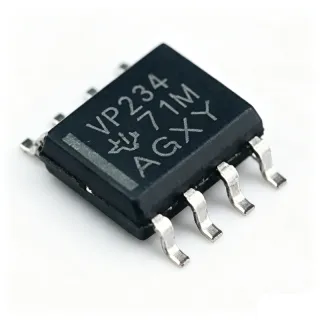
THS6072CD - Low-Power ADSL Differential Receiver, 175 MHz | Texas Instruments
MPN: THS6072CD ✓ فعالTHS6072CD جائزہ
A differential receiver is an interface IC that converts a small differential signal arriving over a twisted pair into a single-ended logic-level output suitable for an ADC, DSP, or codec. Within the broader hierarchy of semiconductor interfaces, the THS6072CD sits in the DSL line-receiver family: line receiver > differential receiver > interface IC > semiconductor. In an ADSL/POTS terminal it is the analog front end that recovers the modulated carrier band before digitization.
Key features include the low 3.4 mA per-channel quiescent current, which the manufacturer states cuts receiver power to roughly half that of competing ADSL receivers, making the device well suited to line cards where dozens of channels share one power supply. Input voltage noise of 10 nV/√Hz keeps the receiver's contribution well below the quantization floor of the downstream codec, and total harmonic distortion of -79 dBc at 1 MHz limits intermodulation products in the recovered spectrum. The 175 MHz -3 dB bandwidth provides headroom above the ADSL downstream band.
Architecturally the device is a low-noise differential input stage followed by a high-gain, high-speed output stage, with per-channel bias currents scaled so that the total supply draw stays near 6.8 mA for the dual version. Because the part is a receiver rather than a driver, it consumes no significant output drive current and can source only the CMOS-level loads expected of a following converter stage.
Typical applications include ADSL central-office line cards, remote terminal units, customer-premises equipment with integrated splitters, and upstream/downstream PONS-over-ADSL style transport gear. Because it is intended for pair-terminated copper lines, common-mode rejection and noise performance matter more than wide output swing.
When designing with the THS6072CD, place the input network so the differential pair sees matched impedances and identical trace lengths, and decouple the supply pins locally to keep switching-riser energy from folding into the input stage. Keep the analog path short and do not add extra gain ahead of the receiver, since that degrades the noise figure the part was designed to preserve.
This page consolidates distributor availability, same-footdrop alternatives, and practical layout guidance for the THS6072CD that is not reproduced on standard distributor listings.
کے لیے ڈراپ اِن متبادل THS6072CD — یکساں پیکیج، پن سے پن مطابقت پذیر۔ مختلف پیکیج والے پرزے جن کے لیے PCB دوبارہ کام درکار ہو، شامل نہیں ہیں۔
اس سیریز میں مختلف ورژن
اسی سیریز کے ماڈلز جو ڈراپ اِن مطابقت رکھتے ہیں THS6072CD (یکساں فارم فیکٹر اور فٹ پرنٹ) — میں مختلف Operating Temperature Range, Package, Total Harmonic Distortion.
THS6072
✅ ڈراپ-اِن ⚠️ تفصیلات غیر تصدیق شدہ📋 حوالہ جاتی متبادل (کیٹلاگ میں نہیں)
THS6072ID
✅ ڈراپ-اِن ⚠️ تفصیلات غیر تصدیق شدہقیمت کے لیے رابطہ کریں
ڈیٹا شیٹ دیکھیں →THS6072IDG4
✅ ڈراپ-اِن📋 حوالہ جاتی متبادل (کیٹلاگ میں نہیں)
THS6072IDRG4
✅ ڈراپ-اِن📋 حوالہ جاتی متبادل (کیٹلاگ میں نہیں)
THS6072CDG4
✅ ڈراپ-اِن ⚠️ تفصیلات غیر تصدیق شدہ📋 حوالہ جاتی متبادل (کیٹلاگ میں نہیں)
THS6072CD تفصیلات
| Device Type | Low-Power ADSL Differential Receiver |
| Number of Channels | 2 |
| Quiescent Current per Channel | 3.4 mA |
| Input Voltage Noise Density | 10 nV/√Hz |
| Small-Signal Bandwidth (-3 dB) | 175 MHz |
| Total Harmonic Distortion | -79 dBc at 1 MHz |
| پیکیج | SOIC-8 (D) |
| Number of Terminals | 8 |
| ماؤنٹنگ ٹائپ | Surface Mount |
| آپریٹنگ درجہ حرارت رینج | 0 °C to 70 °C (commercial grade) |
| Terminal Form | Gull wing |
| Package Shape | Rectangular |
| RoHS Compliance | unknown - G4 ordering suffix denotes the lead-free/RoHS-compliant variant |
| Primary Application | ADSL central office and remote terminal line cards |
THS6072CD rectangular پن کنفیگریشن گائیڈ
THS6072CD (rectangular پیکیج) کے لیے پن کنفیگریشن۔ پن نمبرنگ، فنکشنز اور کنکشن ڈایاگرامز مینوفیکچرر کے ڈیٹا شیٹ میں بیان کیے گئے ہیں۔ درست فٹ پرنٹ اور سولڈرنگ رہنما ہدایات کے لیے اسی سے رجوع کریں۔

کے لیے تفصیلی پن آؤٹ ڈیٹا دستیاب نہیں THS6072CD.
رجوع کریں ڈیٹا شیٹ مکمل پن کنفیگریشن کے لیے۔
عام استعمالات
THS6072CD کے لیے موزوں ہے 6 ایپلیکیشنs: ADSL Central Office Line Cards, ADSL Remote Terminal Units, ADSL Customer Premises Equipment with Splitters, Upstream and Downstream POTS/ADSL Transport Gear, Broadband Access Test and Measurement, Industrial Communication and Control Panels.
ADSL Central Office Line Cards
The THS6072CD suits central-office line cards where dozens of ADSL channels share a single power budget. Its 3.4 mA quiescent current per channel is roughly half that of competing ADSL receivers, so a 64-channel card using 32 dual devices draws only about 217 mA of receiver bias current, which directly shrinks the size of the card's supply and its thermal load. The 175 MHz -3 dB bandwidth gives margin above the ADSL downstream band, while 10 nV/√Hz input noise keeps the receiver contribution below the downstream ADC quantization floor. Place each receiver close to its line transformer and magnetics termination, and decouple locally so card-level switching converters do not inject differential noise into the input stage.
تجویز کردہ
ADSL Remote Terminal Units
In remote terminal units, the THS6072CD delivers the analog receive path from the twisted pair down to the modem codec. Because the same rail powers the radio, DSP and line drivers, receiver power draw is a meaningful share of the thermal envelope; at 3.4 mA per channel the dual part contributes about 6.8 mA, freeing budget for DSP and transmit stages. The low 10 nV/√Hz voltage noise and -79 dBc distortion at 1 MHz minimize both in-band SNR loss and intermodulation products that would otherwise degrade upstream burst-mode decoding. Keep the differential input traces matched and short, and avoid adding gain ahead of the receiver, which would degrade the noise floor the part was designed to preserve.
تجویز کردہ
ADSL Customer Premises Equipment with Splitters
The THS6072CD fits CPE designs that terminate both POTS and ADSL on the same pair, such as integrated splitter gateways. Its 175 MHz bandwidth comfortably passes the ADSL band while the low quiescent current keeps standby and always-on consumption low, which matters for CPE designs with strict power-consumption targets for home energy. The differential input structure naturally rejects the common-mode POTS voice-band energy that shares the line. Use it with a line filter and transformer network whose insertion loss is accounted for in the gain plan, and check that the receiver's supply sits where the datasheet allows, because supply noise on a low-noise receiver shows up directly as output noise.
تجویز کردہ
Upstream and Downstream POTS/ADSL Transport Gear
Transport and aggregation equipment at the edge of the access network uses the THS6072CD where a differential receive stage must sit between line magnetics and a high-speed converter. The 175 MHz -3 dB bandwidth means one receiver can serve both upstream and downstream band requirements in a shared magnetics path, reducing the number of analog front-end channels per line. At 3.4 mA per channel the thermal design stays simple, and the low-noise input stage preserves headroom for downstream digital filtering. Keep the analog and digital return currents separated on the board so the switching returns of downstream converters do not share the receiver ground reference.
تجویز کردہ
Broadband Access Test and Measurement
Test equipment that measures loop characteristics and receiver sensitivity benefits from a wideband, low-noise receive path, and the THS6072CD provides 175 MHz of bandwidth with a 10 nV/√Hz noise floor in a small 8-pin SOIC footprint. This leaves board area for instrumentation front ends and instrument-control interfaces. The wide bandwidth also allows the same receiver to observe harmonics and intermodulation products up to 1 MHz, and its -79 dBc distortion at 1 MHz is sufficient for loop-quality characterization. Provide a clean, low-impedance reference ground near the device and decouple the supply pins with short traces to keep measurement noise from dominating the result.
تجویز کردہ
Industrial Communication and Control Panels
Industrial panels that combine legacy copper lines with digital field buses can use the THS6072CD as the analog receive front end for a legacy differential pair while modern data is handled by lower-speed transceivers. Its commercial 0 °C to 70 °C rating covers indoor panels, and the SOIC-8 footprint is easy to hand-assemble and rework. Because it is a receiver, the part does not need output drive current, so it can be powered from a modest 5 V-style rail shared with logic if the data sheet's supply range allows. Review the maximum supply voltage and total quiescent draw against your rail budget, and avoid placing the device adjacent to switching regulators without an LC filter on its supply pin.
تجویز کردہ
تجویز کردہ پروڈکٹس کا خلاصہ
کے لیے انجینئرنگ ریفرنس ڈیٹا THS6072CD — موازنہ، ڈیزائن رہنمائی، اور تعمیل کی معلومات۔
انتخاب کی گائیڈ
متبادلات کے ساتھ موازنہ
| پیرامیٹر | یہ پروڈکٹ | THS6072 | THS6072ID | THS6072IDG4 | THS6072IDRG4 | THS6072CDG4 |
|---|---|---|---|---|---|---|
| Package | SOIC-8 (D) | SOIC-8 (D) - same | SOIC-8 (D) - same | SOIC-8 (D) - same | SOIC-8 (D) - same | SOIC-8 (D) - same |
| Brand | Texas Instruments | Texas Instruments | Texas Instruments | Texas Instruments | Texas Instruments | Texas Instruments |
| Device Type | Low-Power ADSL Differential Receiver | Low-Power ADSL Differential Receiver | Low-Power ADSL Differential Receiver | Low-Power ADSL Differential Receiver | Low-Power ADSL Differential Receiver | Low-Power ADSL Differential Receiver |
| Quiescent Current per Channel | 3.4 mA | 3.4 mA | 3.4 mA | 3.4 mA | 3.4 mA | 3.4 mA |
| Bandwidth (-3 dB) | 175 MHz | 175 MHz | 175 MHz | 175 MHz | 175 MHz | 175 MHz |
| Input Voltage Noise | 10 nV/√Hz | 10 nV/√Hz | 10 nV/√Hz | 10 nV/√Hz | 10 nV/√Hz | 10 nV/√Hz |
| Total Harmonic Distortion | -79 dBc at 1 MHz | -79 dBc at 1 MHz | -79 dBc at 1 MHz | -79 dBc at 1 MHz | -79 dBc at 1 MHz | -79 dBc at 1 MHz |
| Operating Temperature Range | 0 °C to 70 °C | 0 °C to 70 °C | -40 °C to 85 °C | -40 °C to 85 °C | -40 °C to 85 °C | 0 °C to 70 °C |
| RoHS / Lead-Free Marking | No G4 suffix on order code | No G4 suffix on order code | No G4 suffix on order code | G4 lead-free/RoHS marked | G4 lead-free/RoHS marked | G4 lead-free/RoHS marked |
اہم امتیازی خصوصیات
- Half the quiescent power of other ADSL receivers, per channel (بمقابلہTHS6072ID)
- Wide bandwidth headroom above the ADSL passband (بمقابلہTHS6072IDG4)
- Commercial grade availability with an industrial-footprint sibling for rugged builds (بمقابلہTHS6072IDRG4)
- Low noise floor combined with wide bandwidth in an 8-pin footprint (بمقابلہTHS6072CDG4)
ڈیزائن نوٹس
Treat the differential input path as a controlled-impedance pair. Route the two inputs with identical length, geometry, and reference plane so that common-mode noise and channel skew cancel in the receiver's differential stage. Terminate the line through the intended transformer or filter network directly at the input pins; every extra millimetre of trace adds parasitic inductance that interacts with the input capacitance and can degrade the 175 MHz response. Keep the analog ground reference for the receiver separate from the return currents of on-card switching converters by using a single-point or star connection at the supply entry.
The headline benefit of the THS6072CD is channel power density: at 3.4 mA per channel, a 64-channel ADSL line card consumes roughly 217 mA in receiver bias current, less than half of what competing ADSL receivers would draw. Use that budget headroom to specify local decoupling close to the supply pins rather than relying on bulk capacitance, and keep the supply rail itself clean. Because the input stage is low noise, supply ripple referenced through the device can dominate the noise floor, so an LC filter or separate regulator branch for the receiver section is justified on high-channel-count cards.
Do not place gain in front of the THS6072CD. The receiver is designed to present a low 10 nV/√Hz noise floor, and any pre-amplifier placed between the line and the receiver amplifies its own noise and adds distortion before the signal ever reaches the differential stage. A second common error is assuming the 175 MHz -3 dB figure applies to a closed-loop gain setting other than the datasheet condition; verify the gain and bandwidth combination in the typical performance curves before committing to a system bandwidth budget.
Because the receiver dissipates little power - roughly 6.8 mA of quiescent current across two channels at a typical 5 V-class supply - thermal design is rarely limiting for the device itself. It does matter at system level, because high channel counts concentrate heat into a small PCB area and raise the temperature of neighbouring magnetics and precision components. Space the SOIC-8 devices across the card rather than in a dense row, and check that the ambient rise does not push the receiver's case temperature above the 70 °C commercial limit of the CD grade; if it might, step up to the -40 °C to 85 °C THS6072ID ordering code.
تعمیل کی معلومات
The THS6072CD order code does not carry the TI 'G4' lead-free/RoHS suffix; lead-free G4 variants (THS6072CDG4, THS6072IDG4, THS6072IDRG4) exist in the same SOIC-8 (D) footprint and are the correct choice where RoHS-marked components are contractually required. AEC-Q100 does not apply to this commercial-grade communications interface IC.