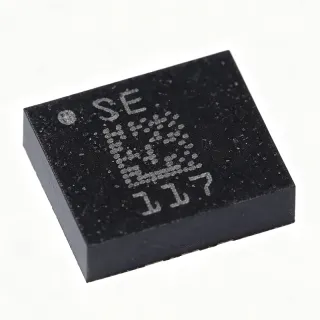
MMA1270KEG - ±2.5g Z-Axis Micromachined Accelerometer | NXP | SOIC-16
MPN: MMA1270KEG ✗ Cuối đờiMMA1270KEG Tóm tắt
An accelerometer is a micro-electromechanical (MEMS) sensor that measures proper acceleration along one or more axes, converting mechanical displacement of a proof mass into an electrical signal via capacitive sensing. Within the broader sensor taxonomy, the MMA1270KEG sits at: accelerometer -> MEMS sensor -> inertial sensor -> motion sensor. Its analog voltage output is proportional to acceleration, simplifying interface to microcontrollers, ADCs, or threshold comparators without requiring a digital protocol stack.
Key differentiating features include factory-trimmed offset and span (no external components required), a built-in two-pole low-pass filter that rejects high-frequency vibration and mechanical noise, on-chip temperature compensation that minimizes thermal drift, and a logic-level self-test pin. The 50 Hz filter bandwidth is well-matched to human-motion frequencies (vibration monitoring, tilt, inclination, and low-frequency shock capture), while the 5V supply rail and ratiometric analog output simplify integration with legacy 5V industrial and automotive systems.
Architecturally, the device uses a surface-micromachined capacitive sense element with a dedicated CMOS signal-conditioning ASIC on the same die. The ASIC contains a charge-pump, precision instrumentation amplifier, demodulator, and output buffer, producing a low-impedance ratiometric analog voltage directly proportional to applied acceleration along the Z (perpendicular) axis.
Typical applications include vibration monitoring in industrial equipment, tilt and inclination sensing, automotive motion detection, appliance balance and vibration feedback, security systems, and consumer devices requiring low-g single-axis motion detection with analog output.
When designing with this part, ensure the supply rail stays within 4.75V to 5.25V and that output loading does not exceed the source/sink capability. Decouple VDD with a 0.1 µF ceramic capacitor placed close to the supply pin. The self-test pin should be left open or driven low during normal operation.
This page synthesizes distributor pricing, drop-in NXP family alternatives, package-level pinout, and practical design notes not aggregated on a single manufacturer datasheet page.
Bộ thay thế dễ dàng lắp đặt cho MMA1270KEG — cùng gói, chân-to-chân tương thích. Các bộ phận yêu cầu hàn PCB bị loại trừ.
Các biến thể trong loạt này
Các mẫu cùng loạt có thể lắp đặt dễ dàng tương thích với MMA1270KEG (cùng hình factor và footprint) — khác nhau ở Output Type, Sensor Type, Technology, Temperature Compensation, Operating Temperature Range.
MMA1260KEG
✅ Drop-InLiên hệ để biết giá
Xem tài liệu →MMA1254KEG
✅ Drop-In📋 Tham chiếu thay thế (không có trong danh mục)
MMA1220KEG
✅ Drop-In📋 Tham chiếu thay thế (không có trong danh mục)
MMA1270KEG Tỷ lệ tối đa & tính chất điện
| Kiểu cảm biến | Accelerometer, single-axis (Z axis) |
| Khoảng đo | ±2.5 g |
| Kiểu đầu ra | Analog voltage (ratiometric) |
| Sensitivity | 712.5 mV/g to 787.5 mV/g |
| Supply Voltage (VDD) | 4.75 V to 5.25 V |
| Zero-g Output Voltage (typ) | 2.5 V at VDD = 5 V |
| Bandwidth (Low-Pass Filter) | 50 Hz (two-pole) |
| Self-Test Input | Yes (logic-level, active high) |
| Temperature Compensation | On-chip |
| Khoảng nhiệt độ hoạt động | -40 °C to +85 °C |
| Hộp / Vỏ | 16-pin SOIC (KEG suffix), tube |
| Kiểu lắp đặt | Surface Mount |
| Axis | Z-axis (perpendicular to PCB) |
| Technology | Capacitive MEMS, surface micromachined |
Cấu hình chân MMA1270KEG
| Chân 1 | NC — Not connected (per datasheet) |
| Chân 2 | NC — Not connected (per datasheet) |
| Chân 3 | NC — Not connected (per datasheet) |
| Chân 4 | VDD — Supply voltage (4.75V to 5.25V) |
| Chân 5 | GND — Ground |
| Chân 6 | NC — Not connected (per datasheet) |
| Chân 7 | NC — Not connected (per datasheet) |
| Chân 8 | ST — Self-test input (logic high activates electrostatic self-test) |
| Chân 9 | NC — Not connected (per datasheet) |
| Chân 10 | NC — Not connected (per datasheet) |
| Chân 11 | NC — Not connected (per datasheet) |
| Chân 12 | NC — Not connected (per datasheet) |
| Chân 13 | NC — Not connected (per datasheet) |
| Chân 14 | NC — Not connected (per datasheet) |
| Chân 15 | OUT — Analog ratiometric acceleration output |
| Chân 16 | NC — Not connected (per datasheet) |
Ứng dụng tiêu biểu
MMA1270KEG phù hợp cho 6 Áp dụngs: Industrial Vibration Monitoring, Tilt and Inclination Sensing, Appliance Load Balancing (washing machines, dryers), Security and Intrusion Detection, Automotive Non-Safety Motion Sensing, Consumer Electronics Motion Feedback.
Industrial Vibration Monitoring
The MMA1270KEG's ±2.5 g range and 50 Hz two-pole low-pass filter make it well-suited to vibration monitoring on rotating machinery such as pumps, motors, and HVAC fans. Z-axis mounting captures vertical shaft vibration, and the 750 mV/g sensitivity at 5 V gives a 3.75 V peak-to-peak signal at full scale, which ADC front-ends resolve easily. The on-chip temperature compensation holds zero-g drift within tight bounds across -40 °C to +85 °C, so outdoor and factory-floor cabinets do not require periodic recalibration.
Được đề xuất
Tilt and Inclination Sensing
When mounted with its Z-axis vertical, the MMA1270KEG measures the gravity component along that axis, producing a 2.5 V output at 0 g (horizontal) and shifting toward 4.375 V or 0.625 V as tilt angle increases. Its ±2.5 g range covers tilt angles up to ±90° without saturating, and the 750 mV/g sensitivity yields roughly 6.67 mV per degree, easy for an 8-bit ADC to resolve with 0.5° accuracy. Industrial solar trackers and construction equipment use this topology to maintain orientation knowledge without expensive MEMS IMUs.
Được đề xuất
Appliance Load Balancing (washing machines, dryers)
Front-loading washing machines use the MMA1270KEG to detect drum imbalance during the high-speed spin cycle; if unbalance exceeds a threshold, the controller reduces spin speed to prevent machine walk. The 50 Hz filter attenuates motor commutation noise and pump harmonics, leaving a clean 1-axis acceleration signal for the MCU's firmware-based unbalance algorithm. Its 5 V analog output interfaces directly to legacy 5 V microcontroller ADCs still common in major-appliance motor controllers.
Được đề xuất
Security and Intrusion Detection
Glass-break and shock sensors in commercial alarm systems use the MMA1270KEG's low-g analog output to detect percussive events. Mounted on the protected surface, the part converts impact acceleration into a voltage pulse that a comparator or ADC can threshold-detect. The self-test pin enables periodic diagnostic checks from the central panel, satisfying UL 1023 household-alarm requirements for end-of-line sensor validation. Its low power and stable baseline make it preferable to piezoelectric alternatives in long-life battery-powered panels.
Được đề xuất
Automotive Non-Safety Motion Sensing
Body-control and comfort modules - such as active headrest triggers, anti-pinch window controllers, and door-ajar detection - historically used the MMA1270KEG because it shares a 5 V analog rail with legacy automotive MCUs. Its -40 °C to +85 °C industrial range covers cabin (non-engine-bay) environments. Note: it is NOT AEC-Q100 qualified, so for safety-critical airbag or ESP applications, an automotive-qualified part such as the NXP FXLS8962AFR1 is required.
Được đề xuất
Consumer Electronics Motion Feedback
Game controllers, toy robots, and e-bike torque-assist modules use the MMA1270KEG for tap-detection and orientation feedback. Its single-axis analog output is easy to feed into the embedded MCU's ADC without I2C overhead, freeing firmware resources for the application logic. The KEG tube packaging suits low-volume through-hole-style reflow on hobbyist PCBs and small-batch production. Designers should still add ESD protection and mechanical isolation to survive drop tests.
Được đề xuất
Tóm tắt các sản phẩm được đề xuất
Dữ liệu tham khảo kỹ thuật cho MMA1270KEG — so sánh, hướng dẫn thiết kế và thông tin tuân thủ.
Hướng dẫn chọn lựa
So sánh với các sản phẩm thay thế
| Tham số | Sản phẩm này | MMA1260KEG | MMA1254KEG | MMA1220KEG |
|---|---|---|---|---|
| Brand | NXP Semiconductors | NXP Semiconductors | NXP Semiconductors | NXP Semiconductors |
| Package | SOIC-16 (KEG, tube) | SOIC-16 (KEG, tube) - same | SOIC-16 (KEG, tube) - same | SOIC-16 (KEG, tube) - same |
| Measurement Range | ±2.5 g | ±1.5 g | ±5 g | ±8 g |
| Axis | Z-axis | Z-axis | Z-axis | Z-axis |
| Supply Voltage | 4.75 V to 5.25 V | 4.75 V to 5.25 V | 4.75 V to 5.25 V | 4.75 V to 5.25 V |
| Self-Test | Yes (logic-level) | Yes | Yes | Yes |
Bảo phân biệt quan trọng
- Lowest full-scale range in the MMA12xx Z-axis family (vsMMA1254KEG)
- Better resolution than higher-g family members (vsMMA1220KEG)
- Factory-calibrated, no external components (vsMMA1254KEG)
Ghi chú thiết kế
Power the MMA1270KEG from a low-noise 5 V LDO (not a switching regulator) because its analog output is ratiometric to VDD; switching ripple will modulate the acceleration signal. Place a 0.1 µF ceramic decoupling capacitor within 5 mm of the VDD pin and a 10 µF bulk capacitor on the same rail. The internal charge pump draws brief current spikes during self-test - keep VDD impedance low to prevent supply sag.
Route the analog OUT trace away from switching nodes, motor drivers, and clock lines to prevent coupling. Use a ground guard or ground pour on both sides of the output trace. The SOIC-16 package's center paddle area (if present) should be soldered to a copper pour connected to GND for thermal dissipation; the part dissipates only milliwatts but the pour also reduces ground-bounce noise. The Z-axis is perpendicular to the package top, so orient the SOIC-16 to match the desired measurement direction.
Do not exceed 5.25 V on VDD; the MEMS cell and ASIC will latch up. Do not drive OUT with a low-impedance source - it is an output, not a bidirectional pin. Leave all NC pins floating; do not connect them to GND or VDD (some NC pins are internally bonded to the sense die and grounding them can affect offset). Self-test must be driven by a logic-level signal (CMOS/TTL), not a mechanical switch, to avoid injected noise.
For ADC sampling, add a 1 kHz first-order RC anti-aliasing filter (R = 1 kΩ, C = 100 nF) between OUT and the ADC input. This complements the internal 50 Hz two-pole filter, providing ~80 dB stop-band attenuation above 10 kHz. If driving long cables, add a unity-gain buffer (e.g., MAX4475) at the sensor end to prevent capacitive loading from distorting the 50 Hz filter response. Estimated: with 1 m of twisted-pair cable (~100 pF), unbuffered output impedance of ~5 kΩ yields a 32 kHz pole that shifts the filter cutoff noticeably.
Thông tin tuân thủ
Part is obsolete as of 2026-10-15. Originally a Freescale Semiconductor product; NXP absorbed Freescale in 2015. RoHS/REACH compliance not stated in retrieved data; consult NXP directly for legacy part compliance documentation. Industrial temperature grade only, not automotive qualified.