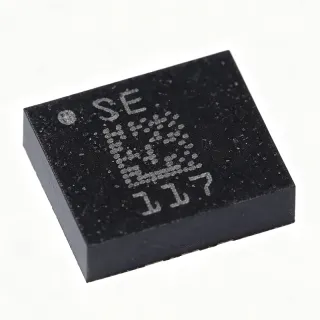
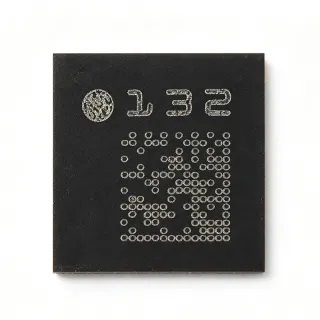
MMA1270KEG - ±2.5g Z-Axis Micromachined Accelerometer | NXP | SOIC-16
MPN: MMA1270KEG ✗ End of Life| Qty | Unit Price | Extended |
|---|---|---|
| 1 | $18.5 | $18.50 |
| 10 | $16.2 | $162.00 |
| 100 | $13.85 | $1,385.00 |
| 500 | $11.4 | $5,700.00 |
| 1,000 | $9.95 | $9,950.00 |
MMA1270KEG Overview
An accelerometer is a micro-electromechanical (MEMS) sensor that measures proper acceleration along one or more axes, converting mechanical displacement of a proof mass into an electrical signal via capacitive sensing. Within the broader sensor taxonomy, the MMA1270KEG sits at: accelerometer -> MEMS sensor -> inertial sensor -> motion sensor. Its analog voltage output is proportional to acceleration, simplifying interface to microcontrollers, ADCs, or threshold comparators without requiring a digital protocol stack.
Key differentiating features include factory-trimmed offset and span (no external components required), a built-in two-pole low-pass filter that rejects high-frequency vibration and mechanical noise, on-chip temperature compensation that minimizes thermal drift, and a logic-level self-test pin. The 50 Hz filter bandwidth is well-matched to human-motion frequencies (vibration monitoring, tilt, inclination, and low-frequency shock capture), while the 5V supply rail and ratiometric analog output simplify integration with legacy 5V industrial and automotive systems.
Architecturally, the device uses a surface-micromachined capacitive sense element with a dedicated CMOS signal-conditioning ASIC on the same die. The ASIC contains a charge-pump, precision instrumentation amplifier, demodulator, and output buffer, producing a low-impedance ratiometric analog voltage directly proportional to applied acceleration along the Z (perpendicular) axis.
Typical applications include vibration monitoring in industrial equipment, tilt and inclination sensing, automotive motion detection, appliance balance and vibration feedback, security systems, and consumer devices requiring low-g single-axis motion detection with analog output.
When designing with this part, ensure the supply rail stays within 4.75V to 5.25V and that output loading does not exceed the source/sink capability. Decouple VDD with a 0.1 µF ceramic capacitor placed close to the supply pin. The self-test pin should be left open or driven low during normal operation.
This page synthesizes distributor pricing, drop-in NXP family alternatives, package-level pinout, and practical design notes not aggregated on a single manufacturer datasheet page.
Drop-in alternatives for MMA1270KEG — same package, pin-to-pin compatible. Different-package parts requiring PCB rework are excluded.
Variants in this series
Same-series models that are drop-in compatible with MMA1270KEG (same form factor and footprint) — differing in Output Type, Sensor Type, Technology, Temperature Compensation, Operating Temperature Range.
Quick Comparison Tool — Select alternative parts for side-by-side comparison:
MMA1260KEG
✅ Drop-In✓ In Stock
$4.85 / Unit
View Datasheet →MMA1254KEG
✅ Drop-In📋 Reference alternative (not in catalog)
MMA1220KEG
✅ Drop-In📋 Reference alternative (not in catalog)
MMA1270KEG Maximum Ratings & Electrical Characteristics
| Sensor Type | Accelerometer, single-axis (Z axis) |
| Measurement Range | ±2.5 g |
| Output Type | Analog voltage (ratiometric) |
| Sensitivity | 712.5 mV/g to 787.5 mV/g |
| Supply Voltage (VDD) | 4.75 V to 5.25 V |
| Zero-g Output Voltage (typ) | 2.5 V at VDD = 5 V |
| Bandwidth (Low-Pass Filter) | 50 Hz (two-pole) |
| Self-Test Input | Yes (logic-level, active high) |
| Temperature Compensation | On-chip |
| Operating Temperature Range | -40 °C to +85 °C |
| Package / Case | 16-pin SOIC (KEG suffix), tube |
| Mounting Type | Surface Mount |
| Axis | Z-axis (perpendicular to PCB) |
| Technology | Capacitive MEMS, surface micromachined |
MMA1270KEG Pin Configuration
| Pin 1 | NC — Not connected (per datasheet) |
| Pin 2 | NC — Not connected (per datasheet) |
| Pin 3 | NC — Not connected (per datasheet) |
| Pin 4 | VDD — Supply voltage (4.75V to 5.25V) |
| Pin 5 | GND — Ground |
| Pin 6 | NC — Not connected (per datasheet) |
| Pin 7 | NC — Not connected (per datasheet) |
| Pin 8 | ST — Self-test input (logic high activates electrostatic self-test) |
| Pin 9 | NC — Not connected (per datasheet) |
| Pin 10 | NC — Not connected (per datasheet) |
| Pin 11 | NC — Not connected (per datasheet) |
| Pin 12 | NC — Not connected (per datasheet) |
| Pin 13 | NC — Not connected (per datasheet) |
| Pin 14 | NC — Not connected (per datasheet) |
| Pin 15 | OUT — Analog ratiometric acceleration output |
| Pin 16 | NC — Not connected (per datasheet) |
Typical Applications
MMA1270KEG is suitable for 6 applications: Industrial Vibration Monitoring, Tilt and Inclination Sensing, Appliance Load Balancing (washing machines, dryers), Security and Intrusion Detection, Automotive Non-Safety Motion Sensing, Consumer Electronics Motion Feedback.
Industrial Vibration Monitoring
The MMA1270KEG's ±2.5 g range and 50 Hz two-pole low-pass filter make it well-suited to vibration monitoring on rotating machinery such as pumps, motors, and HVAC fans. Z-axis mounting captures vertical shaft vibration, and the 750 mV/g sensitivity at 5 V gives a 3.75 V peak-to-peak signal at full scale, which ADC front-ends resolve easily. The on-chip temperature compensation holds zero-g drift within tight bounds across -40 °C to +85 °C, so outdoor and factory-floor cabinets do not require periodic recalibration.
Recommended
Tilt and Inclination Sensing
When mounted with its Z-axis vertical, the MMA1270KEG measures the gravity component along that axis, producing a 2.5 V output at 0 g (horizontal) and shifting toward 4.375 V or 0.625 V as tilt angle increases. Its ±2.5 g range covers tilt angles up to ±90° without saturating, and the 750 mV/g sensitivity yields roughly 6.67 mV per degree, easy for an 8-bit ADC to resolve with 0.5° accuracy. Industrial solar trackers and construction equipment use this topology to maintain orientation knowledge without expensive MEMS IMUs.
Recommended
Appliance Load Balancing (washing machines, dryers)
Front-loading washing machines use the MMA1270KEG to detect drum imbalance during the high-speed spin cycle; if unbalance exceeds a threshold, the controller reduces spin speed to prevent machine walk. The 50 Hz filter attenuates motor commutation noise and pump harmonics, leaving a clean 1-axis acceleration signal for the MCU's firmware-based unbalance algorithm. Its 5 V analog output interfaces directly to legacy 5 V microcontroller ADCs still common in major-appliance motor controllers.
Recommended
Security and Intrusion Detection
Glass-break and shock sensors in commercial alarm systems use the MMA1270KEG's low-g analog output to detect percussive events. Mounted on the protected surface, the part converts impact acceleration into a voltage pulse that a comparator or ADC can threshold-detect. The self-test pin enables periodic diagnostic checks from the central panel, satisfying UL 1023 household-alarm requirements for end-of-line sensor validation. Its low power and stable baseline make it preferable to piezoelectric alternatives in long-life battery-powered panels.
Recommended
Automotive Non-Safety Motion Sensing
Body-control and comfort modules - such as active headrest triggers, anti-pinch window controllers, and door-ajar detection - historically used the MMA1270KEG because it shares a 5 V analog rail with legacy automotive MCUs. Its -40 °C to +85 °C industrial range covers cabin (non-engine-bay) environments. Note: it is NOT AEC-Q100 qualified, so for safety-critical airbag or ESP applications, an automotive-qualified part such as the NXP FXLS8962AFR1 is required.
Recommended
Consumer Electronics Motion Feedback
Game controllers, toy robots, and e-bike torque-assist modules use the MMA1270KEG for tap-detection and orientation feedback. Its single-axis analog output is easy to feed into the embedded MCU's ADC without I2C overhead, freeing firmware resources for the application logic. The KEG tube packaging suits low-volume through-hole-style reflow on hobbyist PCBs and small-batch production. Designers should still add ESD protection and mechanical isolation to survive drop tests.
Recommended
Recommended Products Summary
Engineering reference data for MMA1270KEG — comparison, design guidance, and compliance information.
Selection Guide
Comparison with Alternatives
| Parameter | This Product | MMA1260KEG | MMA1254KEG | MMA1220KEG |
|---|---|---|---|---|
| Brand | NXP Semiconductors | NXP Semiconductors | NXP Semiconductors | NXP Semiconductors |
| Package | SOIC-16 (KEG, tube) | SOIC-16 (KEG, tube) - same | SOIC-16 (KEG, tube) - same | SOIC-16 (KEG, tube) - same |
| Measurement Range | ±2.5 g | ±1.5 g | ±5 g | ±8 g |
| Axis | Z-axis | Z-axis | Z-axis | Z-axis |
| Supply Voltage | 4.75 V to 5.25 V | 4.75 V to 5.25 V | 4.75 V to 5.25 V | 4.75 V to 5.25 V |
| Self-Test | Yes (logic-level) | Yes | Yes | Yes |
Key Differentiators
- Lowest full-scale range in the MMA12xx Z-axis family (vs MMA1254KEG)
- Better resolution than higher-g family members (vs MMA1220KEG)
- Factory-calibrated, no external components (vs MMA1254KEG)
Design Notes
Power the MMA1270KEG from a low-noise 5 V LDO (not a switching regulator) because its analog output is ratiometric to VDD; switching ripple will modulate the acceleration signal. Place a 0.1 µF ceramic decoupling capacitor within 5 mm of the VDD pin and a 10 µF bulk capacitor on the same rail. The internal charge pump draws brief current spikes during self-test - keep VDD impedance low to prevent supply sag.
Route the analog OUT trace away from switching nodes, motor drivers, and clock lines to prevent coupling. Use a ground guard or ground pour on both sides of the output trace. The SOIC-16 package's center paddle area (if present) should be soldered to a copper pour connected to GND for thermal dissipation; the part dissipates only milliwatts but the pour also reduces ground-bounce noise. The Z-axis is perpendicular to the package top, so orient the SOIC-16 to match the desired measurement direction.
Do not exceed 5.25 V on VDD; the MEMS cell and ASIC will latch up. Do not drive OUT with a low-impedance source - it is an output, not a bidirectional pin. Leave all NC pins floating; do not connect them to GND or VDD (some NC pins are internally bonded to the sense die and grounding them can affect offset). Self-test must be driven by a logic-level signal (CMOS/TTL), not a mechanical switch, to avoid injected noise.
For ADC sampling, add a 1 kHz first-order RC anti-aliasing filter (R = 1 kΩ, C = 100 nF) between OUT and the ADC input. This complements the internal 50 Hz two-pole filter, providing ~80 dB stop-band attenuation above 10 kHz. If driving long cables, add a unity-gain buffer (e.g., MAX4475) at the sensor end to prevent capacitive loading from distorting the 50 Hz filter response. Estimated: with 1 m of twisted-pair cable (~100 pF), unbuffered output impedance of ~5 kΩ yields a 32 kHz pole that shifts the filter cutoff noticeably.
Compliance Information
Part is obsolete as of 2026-10-15. Originally a Freescale Semiconductor product; NXP absorbed Freescale in 2015. RoHS/REACH compliance not stated in retrieved data; consult NXP directly for legacy part compliance documentation. Industrial temperature grade only, not automotive qualified.