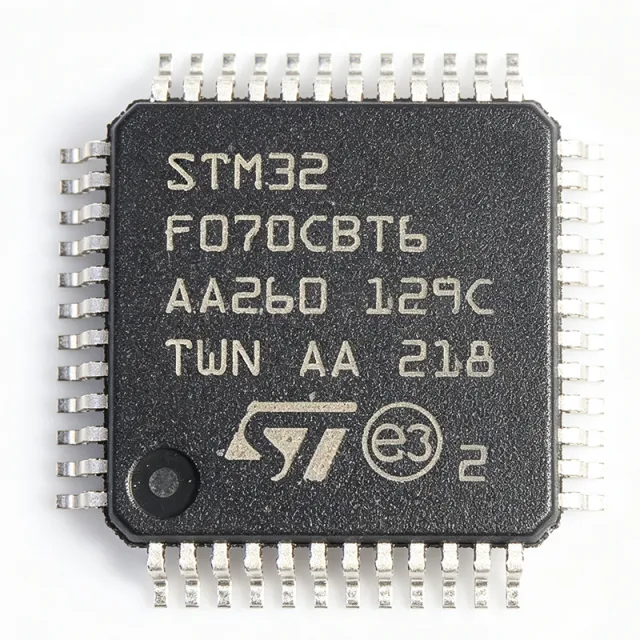
STM32F070CBT6 - ARM Cortex-M0 MCU 128KB Flash | STMicroelectronics
MPN: STM32F070CBT6 ✓ Hoạt độngSTM32F070CBT6 Tóm tắt
What is a microcontroller? A microcontroller (MCU) is a compact integrated circuit designed to govern a specific operation in an embedded system. It integrates a processor core, memory (Flash and SRAM), and programmable input/output peripherals on a single chip. The STM32F070CBT6 belongs to the STM32F0 series, which is part of the broader STM32 family of 32-bit ARM Cortex-M microcontrollers. This hierarchy places it within the ARM Cortex-M0 category, a low-power, entry-level core optimized for cost-sensitive applications.
Key features include a 12-bit ADC with up to 16 channels, multiple communication interfaces (I2C, SPI, USART), and a variety of timers including advanced-control timers. The device also includes a DMA controller, an RTC, and a CRC calculation unit. The LQFP-48 package provides a compact footprint suitable for space-constrained designs while offering sufficient I/O pins for peripheral connectivity.
The STM32F070CBT6 is built on a 32-bit ARM Cortex-M0 core with a Harvard architecture, achieving 1.25 DMIPS/MHz. It includes a nested vectored interrupt controller (NVIC) for efficient interrupt handling and supports both low-power modes (Sleep, Stop, Standby) to optimize energy consumption. The device is designed for a wide range of embedded applications requiring a balance of performance, power efficiency, and cost.
Typical applications include industrial control systems, consumer electronics, IoT devices, and home automation. Its rich peripheral set and low-power capabilities make it suitable for sensor interfacing, motor control, and communication protocols. The wide operating temperature range (-40°C to +85°C) ensures reliability in harsh environments.
When designing with this MCU, ensure proper decoupling of the power supply pins and consider the use of an external crystal for accurate timing. The device supports in-circuit programming and debugging via SWD, facilitating firmware development and updates.
This page synthesizes distributor pricing, drop-in alternatives, and practical design notes not found in the STMicroelectronics datasheet, providing engineers with a comprehensive resource for selection and implementation.
Bộ thay thế dễ dàng lắp đặt cho STM32F070CBT6 — cùng gói, chân-to-chân tương thích. Các bộ phận yêu cầu hàn PCB bị loại trừ.
Các biến thể trong loạt này
Các mẫu cùng loạt có thể lắp đặt dễ dàng tương thích với STM32F070CBT6 (cùng hình factor và footprint) — khác nhau ở ADC, Flash Memory, Package, SRAM.
STM32F071CBT6
Liên hệ để biết giá
Xem tài liệu →STM32F072CBT6
Liên hệ để biết giá
Xem tài liệu →STM32F078CBT6
📋 Tham chiếu thay thế (không có trong danh mục)
STM32F070CBT6 Tỷ lệ tối đa & tính chất điện
| Core | ARM Cortex-M0 |
| Core Frequency | 48 MHz |
| Flash Memory | 128 KB |
| SRAM | 16 KB |
| Điện áp cung cấp | 2.4 V to 3.6 V |
| Hộp | LQFP-48 |
| Nhiệt độ hoạt động | -40°C to +85°C |
| ADC | 12-bit, 16 channels |
| Communication Interfaces | I2C, SPI, USART |
| Timers | Advanced-control, general-purpose, basic |
| DMA | Yes, 5 channels |
| RTC | Yes |
| CRC | Yes |
| Low-Power Modes | Sleep, Stop, Standby |
| Debug Interface | SWD |
| Trạng thái RoHS | Compliant |
Cấu hình chân STM32F070CBT6
| Chân 1 | VBAT — Battery backup supply for RTC |
| Chân 2 | PC13 — GPIO / RTC tamper |
| Chân 3 | PC14 — GPIO / OSC32_IN |
| Chân 4 | PC15 — GPIO / OSC32_OUT |
| Chân 5 | PF0 — GPIO / OSC_IN |
| Chân 6 | PF1 — GPIO / OSC_OUT |
| Chân 7 | NRST — Reset (active low) |
| Chân 8 | VSSA — Analog ground |
| Chân 9 | VDDA — Analog power supply |
| Chân 10 | PA0 — GPIO / ADC_IN0 / USART2_CTS |
| Chân 11 | PA1 — GPIO / ADC_IN1 / USART2_RTS |
| Chân 12 | PA2 — GPIO / ADC_IN2 / USART2_TX |
| Chân 13 | PA3 — GPIO / ADC_IN3 / USART2_RX |
| Chân 14 | PA4 — GPIO / ADC_IN4 / SPI1_NSS |
| Chân 15 | PA5 — GPIO / ADC_IN5 / SPI1_SCK |
| Chân 16 | PA6 — GPIO / ADC_IN6 / SPI1_MISO |
| Chân 17 | PA7 — GPIO / ADC_IN7 / SPI1_MOSI |
| Chân 18 | PB0 — GPIO / ADC_IN8 / TIM3_CH3 |
| Chân 19 | PB1 — GPIO / ADC_IN9 / TIM3_CH4 |
| Chân 20 | PB2 — GPIO / BOOT1 |
| Chân 21 | PB10 — GPIO / I2C2_SCL / USART3_TX |
| Chân 22 | PB11 — GPIO / I2C2_SDA / USART3_RX |
| Chân 23 | PB12 — GPIO / SPI2_NSS / I2C2_SMBA |
| Chân 24 | PB13 — GPIO / SPI2_SCK / USART3_CTS |
| Chân 25 | PB14 — GPIO / SPI2_MISO / USART3_RTS |
| Chân 26 | PB15 — GPIO / SPI2_MOSI |
| Chân 27 | PC6 — GPIO / TIM3_CH1 |
| Chân 28 | PC7 — GPIO / TIM3_CH2 |
| Chân 29 | PC8 — GPIO / TIM3_CH3 |
| Chân 30 | PC9 — GPIO / TIM3_CH4 |
| Chân 31 | PA8 — GPIO / MCO / TIM1_CH1 |
| Chân 32 | PA9 — GPIO / USART1_TX / TIM1_CH2 |
| Chân 33 | PA10 — GPIO / USART1_RX / TIM1_CH3 |
| Chân 34 | PA11 — GPIO / USART1_CTS / CAN_RX |
| Chân 35 | PA12 — GPIO / USART1_RTS / CAN_TX |
| Chân 36 | PA13 — GPIO / SWDIO |
| Chân 37 | VSS — Ground |
| Chân 38 | VDD — Power supply |
| Chân 39 | PA14 — GPIO / SWCLK |
| Chân 40 | PA15 — GPIO / TIM2_CH1 / SPI1_NSS |
| Chân 41 | PB3 — GPIO / TIM2_CH2 / SPI1_SCK |
| Chân 42 | PB4 — GPIO / TIM3_CH1 / SPI1_MISO |
| Chân 43 | PB5 — GPIO / TIM3_CH2 / SPI1_MOSI |
| Chân 44 | PB6 — GPIO / I2C1_SCL / TIM1_CH3 |
| Chân 45 | PB7 — GPIO / I2C1_SDA / TIM1_CH4 |
| Chân 46 | BOOT0 — Boot mode selection |
| Chân 47 | PB8 — GPIO / I2C1_SCL / CAN_RX |
| Chân 48 | PB9 — GPIO / I2C1_SDA / CAN_TX |
Ứng dụng tiêu biểu
STM32F070CBT6 phù hợp cho 6 Áp dụngs: Industrial Control, Consumer Electronics, IoT Devices, Home Automation, Sensor Interfacing, Motor Control.
Industrial Control
The STM32F070CBT6 is well-suited for industrial control systems due to its robust peripheral set, including advanced timers for PWM generation, multiple USARTs for communication with PLCs, and a 12-bit ADC for sensor feedback. Its wide operating temperature range (-40°C to +85°C) ensures reliable operation in factory environments. In a typical motor control application, the MCU generates PWM signals to drive an H-bridge, reads current and position sensors via the ADC, and communicates status over RS-485. The 48 MHz Cortex-M0 core provides sufficient processing power for real-time control loops, while the DMA controller offloads data transfer to reduce CPU load. The low-power modes allow energy savings during idle periods, making it suitable for energy-efficient industrial equipment.
Được đề xuất
Consumer Electronics
In consumer electronics, the STM32F070CBT6 provides a cost-effective solution for devices like smart home controllers, remote controls, and small appliances. Its low power consumption and multiple communication interfaces (I2C, SPI, USART) enable seamless integration with sensors, displays, and wireless modules. For example, in a smart thermostat, the MCU reads temperature and humidity sensors via I2C, controls a relay for heating/cooling, and communicates with a Wi-Fi module over UART. The 128KB Flash is ample for firmware implementing user interfaces and connectivity protocols. The LQFP-48 package is compact enough for sleek product designs, and the wide supply voltage range (2.4V-3.6V) allows direct battery operation. The device's low-power modes extend battery life in portable consumer devices.
Được đề xuất
IoT Devices
The STM32F070CBT6 is an excellent choice for IoT edge nodes due to its balance of performance, power efficiency, and cost. It supports various communication protocols (UART, SPI, I2C) to interface with sensors and wireless transceivers. In a typical IoT sensor node, the MCU periodically wakes from Stop mode to read sensor data, process it, and transmit via a LoRa or BLE module. The 12-bit ADC with 16 channels allows multiple analog sensors to be connected directly. The DMA controller enables efficient data transfer without CPU intervention, reducing power consumption. The device's low-power Standby mode (1 µA typical) is critical for battery-powered deployments. With 128KB Flash, developers can implement robust firmware including over-the-air update capabilities.
Được đề xuất
Home Automation
The STM32F070CBT6 is ideal for home automation hubs and smart devices. Its multiple UARTs and I2C interfaces allow connection to various sensors and actuators, while its low-power modes enable always-on operation with minimal energy consumption. In a smart lighting system, the MCU controls LED drivers via PWM, reads ambient light sensors, and communicates with a central hub over Zigbee or Wi-Fi. The 48 MHz core handles protocol stacks efficiently, and the 128KB Flash accommodates complex automation logic. The device's wide operating temperature range ensures reliable operation in residential environments. The LQFP-48 package is suitable for compact wall-mounted modules, and the SWD debug interface simplifies firmware development and updates.
Được đề xuất
Sensor Interfacing
The STM32F070CBT6 excels in sensor interfacing applications due to its rich analog and digital peripherals. The 12-bit ADC with 16 channels can directly connect multiple analog sensors, while I2C and SPI interfaces support digital sensors. In a data acquisition system, the MCU samples temperature, pressure, and flow sensors, processes the data, and transmits it to a host via USART. The DMA controller allows continuous ADC sampling without CPU overhead, ensuring accurate data capture. The device's low-power modes are beneficial for remote sensor nodes powered by batteries. The 128KB Flash provides ample space for calibration tables and data logging. The wide supply voltage range accommodates various sensor supply requirements.
Được đề xuất
Motor Control
The STM32F070CBT6 is well-suited for motor control applications, particularly for brushless DC (BLDC) and stepper motors. Its advanced-control timers can generate complementary PWM signals with dead-time insertion, essential for driving H-bridges. The 12-bit ADC enables precise current sensing, and the DMA controller facilitates high-speed data transfer. In a BLDC motor controller, the MCU reads Hall sensor inputs, generates six-step commutation signals, and regulates speed via PID control. The 48 MHz core provides sufficient computational power for real-time control loops. The device's robust timer architecture and fault handling features ensure safe operation. The LQFP-48 package is compact enough for integrated motor drivers, and the wide temperature range supports industrial motor applications.
Được đề xuất
Tóm tắt các sản phẩm được đề xuất
Dữ liệu tham khảo kỹ thuật cho STM32F070CBT6 — so sánh, hướng dẫn thiết kế và thông tin tuân thủ.
Hướng dẫn chọn lựa
So sánh với các sản phẩm thay thế
| Tham số | Sản phẩm này | STM32F071CBT6 | STM32F072CBT6 | STM32F078CBT6 |
|---|---|---|---|---|
| Package | LQFP-48 | LQFP-48 - same | LQFP-48 - same | LQFP-48 - same |
| Core Frequency | 48 MHz | 48 MHz | 48 MHz | 48 MHz |
| Flash Memory | 128 KB | 128 KB | 128 KB | 128 KB |
| SRAM | 16 KB | 16 KB | 16 KB | 16 KB |
| USB | Yes (full-speed device) | Yes (full-speed device) | Yes (full-speed device) | Yes (full-speed device) |
| CAN | No | No | Yes | Yes |
| DAC | No | Yes (12-bit) | Yes (12-bit) | Yes (12-bit) |
| Comparator | No | Yes | Yes | Yes |
| Price (1k) | $2.20 | $2.40 | $2.60 | $2.80 |
Bảo phân biệt quan trọng
- USB full-speed device controller (vsSTM32F030CBT6)
- Lower cost than F071/F072 (vsSTM32F071CBT6)
- Pin-to-pin compatible with higher-feature siblings (vsSTM32F072CBT6)
Ghi chú thiết kế
Decouple the VDD and VDDA pins with 100nF ceramic capacitors placed as close to the pins as possible. Additionally, add a 4.7uF bulk capacitor on the main VDD rail. For VDDA, use a ferrite bead in series to filter high-frequency noise, improving ADC accuracy.
For the LQFP-48 package, ensure proper solder paste stencil design with 0.5mm pitch. Use a 4-layer PCB with a solid ground plane beneath the MCU to reduce EMI and improve thermal performance. Route high-speed signals (SPI, USART) with controlled impedance if possible.
Do not leave unused GPIO pins floating; configure them as outputs or enable internal pull-ups/pull-downs to avoid excessive current consumption. Also, ensure the BOOT0 pin is properly pulled low for normal boot from Flash. For low-power modes, disable unused peripherals and clocks to achieve specified current consumption.
Thông tin tuân thủ
RoHS and REACH compliant per STMicroelectronics. Not AEC-Q100 qualified; for automotive, consider STM32F0 series with AEC-Q100 option.


