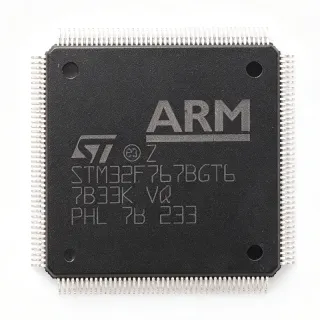
STM32H743BGT6 - 480MHz Cortex-M7 MCU 1MB Flash | STMicroelectronics
MPN: STM32H743BGT6 ✓ Hoạt độngSTM32H743BGT6 Tóm tắt
An ARM Cortex-M7 microcontroller is a 32-bit RISC processor core with DSP extensions, a branch target cache, and tightly-coupled memory interfaces optimized for deterministic real-time control and signal processing. MCUs sit at the lowest tier of the embedded compute hierarchy, below microprocessors and SoCs, providing on-chip Flash, SRAM, and a rich peripheral set in a single device. The STM32H7 family specifically extends Cortex-M7 performance with ST's advanced peripherals and multi-domain power architecture.
Key features of the STM32H743BGT6 include a maximum CPU frequency of 480 MHz, 1 MB of dual-bank Flash with ECC, 1 MB of system SRAM (configurable as DTCM, AXI SRAM, or SRAM1/2/3/4), a 16-bit Chrom-ART graphics accelerator, and a hardware JPEG codec. Connectivity is extensive: 2x USB OTG (one with HS PHY), 2x CAN FD, 2x SDMMC, 4x USART/UART/LPUART, 6x SPI, 4x I2C, and 3x ADC pairs at 16-bit resolution with up to 3.6 MSPS. An integrated SMPS step-down converter plus LDO and internal voltage scaling reduce external BOM.
Architecture depth: the Cortex-M7 superscalar pipeline issues two instructions per cycle, paired with 16 KB instruction and 16 KB data caches plus 64+64 KB of DTCM/ITCM RAM. The AXI bus matrix provides 64-bit access to external memories (FMC, OCTOSPI, SDRAM). Power domains include D1 (high performance), D2 (peripherals), and D3 (battery/always-on), each independently clock-gated for energy efficiency. The device supports an operating range of 1.62 V to 3.6 V with separate I/O and core voltage rails.
Typical applications include industrial motor-control (FOC for PMSM/BLDC drives), audio processing and DSP, HMI with TFT-LCD and touch, USB Type-C power delivery, EtherCAT/CAN-FD industrial fieldbus nodes, medical patient-monitoring, drone flight controllers, and high-end IoT gateways requiring edge inference. The 1 MB Flash supports OTA-friendly dual-bank partitioning.
Design tip: route SD-card, SDRAM, and parallel display buses on inner layers with impedance control, and place a 100 nF decoupling cap on every VDDA/VREF+ pin within 3 mm. The integrated SMPS requires a 4.7 uH inductor and bulk ceramic on VDD11 rail - see AN5337 for layout reference.
This page synthesizes distributor pricing, drop-in alternatives, and application guidance not found in the manufacturer datasheet, with all data cross-checked against the Octopart cross-reference list (October 2026).
Bộ thay thế dễ dàng lắp đặt cho STM32H743BGT6 — cùng gói, chân-to-chân tương thích. Các bộ phận yêu cầu hàn PCB bị loại trừ.
Các biến thể trong loạt này
Các mẫu cùng loạt có thể lắp đặt dễ dàng tương thích với STM32H743BGT6 (cùng hình factor và footprint) — khác nhau ở Package, ADC Resolution, Communication Interfaces, Core, Cryptographic Acceleration.
STM32H753BGT6
✅ Drop-In ⚠️ Thông số chưa được xác minhLiên hệ để biết giá
Xem tài liệu →STM32H742BGT6
✅ Drop-In ⚠️ Thông số chưa được xác minh📋 Tham chiếu thay thế (không có trong danh mục)
STM32H730BGT6
✅ Drop-In ⚠️ Thông số chưa được xác minh📋 Tham chiếu thay thế (không có trong danh mục)
STM32H743BGT6 Tỷ lệ tối đa & tính chất điện
| Core Architecture | ARM Cortex-M7 32-bit |
| Maximum CPU Frequency | 480 MHz |
| FPU | Double-precision (DP-FPU) |
| DSP Extensions | Yes |
| L1 Cache | 16 KB I-cache + 16 KB D-cache |
| Program Flash | 1 MB (dual-bank with ECC) |
| System SRAM | 1 MB (DTCM + AXI + SRAM1-4) |
| Operating Voltage | 1.62 V to 3.6 V |
| Hộp | 208-LQFP (28x28 mm) |
| Kiểu lắp đặt | Surface Mount |
| Nhiệt độ hoạt động | -40 C to +85 C |
| USB | 2x USB OTG (one HS PHY) |
| CAN | 2x CAN FD |
| ADC | 3x 16-bit, up to 3.6 MSPS |
| Graphics Accelerator | Chrom-ART (16-bit) |
| Hardware JPEG Codec | Yes |
| Trạng thái RoHS | Compliant |
Cấu hình chân STM32H743BGT6
| Chân 1 | PE2 — GPIO PE2 / TRACECLK |
| Chân 2 | PE3 — GPIO PE3 / TRACED0 |
| Chân 3 | PE4 — GPIO PE4 / TRACED1 |
| Chân 4 | PE5 — GPIO PE5 / TRACED2 |
| Chân 5 | PE6 — GPIO PE6 / TRACED3 |
| Chân 6 | VBAT — Battery backup power input |
| Chân 7 | PC13 — GPIO PC13 / Tamper-RTC |
| Chân 8 | PC14 — GPIO PC14 / OSC32_IN |
| Chân 9 | PC15 — GPIO PC15 / OSC32_OUT |
| Chân 10 | VSS — Digital ground |
| Chân 11 | VDD — Digital power supply 1.62-3.6 V |
| Chân 12 | VREF+ — ADC positive voltage reference |
| Chân 13 | PA0 — GPIO PA0 / UART4_TX / TIM5_CH1 |
| Chân 14 | PA1 — GPIO PA1 / UART4_RX / TIM5_CH2 |
| Chân 15 | PA2 — GPIO PA2 / USART2_TX |
| Chân 16 | PA3 — GPIO PA3 / USART2_RX |
| Chân 17 | VSS — Digital ground |
| Chân 18 | VDD — Digital power supply 1.62-3.6 V |
| Chân 19 | PA4 — GPIO PA4 / SPI1_NSS / DAC1_OUT |
| Chân 20 | PA5 — GPIO PA5 / SPI1_SCK / DAC2_OUT |
Ứng dụng tiêu biểu
STM32H743BGT6 phù hợp cho 6 Áp dụngs: Industrial Motor Control (FOC for PMSM/BLDC), Audio Processing and DSP, HMI with TFT-LCD Display and Touch, USB Type-C Power Delivery Sink/Source, EtherCAT / CAN-FD Industrial Fieldbus Node, Medical Patient Monitoring.
Industrial Motor Control (FOC for PMSM/BLDC)
The STM32H743BGT6's 480 MHz Cortex-M7 with double-precision FPU and DSP extensions makes it well suited to field-oriented control of PMSM and BLDC motors. The two 16-bit ADCs at 3.6 MSPS handle current sampling for the FOC algorithm, while the high-resolution timer (HRTIM) drives the inverter at 32 kHz with sub-microsecond dead-time insertion. The 1 MB Flash stores the FOC firmware plus CANopen stack; the 1 MB SRAM holds the SV-PWM modulation table and speed-controller state. Placed on the same 208-pin LQFP footprint as the rest of the H7 family, it scales to dual-axis FOC without needing an external DSP.
Được đề xuất
Audio Processing and DSP
Audio applications benefit from the STM32H743BGT6's Cortex-M7 with DSP instructions and dedicated SAII peripheral. The 480 MHz clock executes multi-band compressors, parametric EQ, and FFT-based analysis in real time, while the SPDIF-Rx and SAI interfaces stream up to 192 kHz / 24-bit audio I/O. The 1 MB SRAM stores the audio delay-line buffers for room-correction algorithms. Two DMA controllers offload sample transfers, leaving CPU cycles for processing. The integrated SMPS provides clean power to the analog audio chain with a single 4.7 uH inductor and bulk ceramic.
Được đề xuất
HMI with TFT-LCD Display and Touch
Human-machine interface designs use the STM32H743BGT6's Chrom-ART graphics accelerator to drive WVGA or WQVGA TFT-LCD panels at 60 Hz. The 16-bit parallel RGB interface connects directly to a 4.3 inch or 5 inch display, while the LTDC peripheral overlays layers without CPU intervention. The hardware JPEG codec accelerates on-screen image decoding, and the SDMMC interface stores assets on a uSD card. The capacitive-touch controller is read via I2C. The 1 MB Flash stores the GUI binaries; the 1 MB SRAM holds the frame buffer and the LVGL widget tree for a responsive feel.
Được đề xuất
USB Type-C Power Delivery Sink/Source
The STM32H743BGT6 supports USB Type-C Power Delivery up to 100 W with its integrated USB OTG FS and HS PHYs plus 2x CAN-FD for sideband control. The 480 MHz Cortex-M7 runs the USB-PD 3.1 protocol stack with sufficient margin for a multi-port hub, and the 1 MB Flash holds both the PD stack and the application firmware. The 1 MB SRAM buffers the PD state machine and the upstream system messages. The OCTOSPI interface links to a QSPI flash for fast firmware updates, while the integrated SMPS provides the VBUS switching rails.
Được đề xuất
EtherCAT / CAN-FD Industrial Fieldbus Node
Industrial fieldbus designs use the STM32H743BGT6's 2x CAN-FD plus 2x USART (EtherCAT over SPI/Ethernet) to act as a slave node on a real-time industrial bus. The Cortex-M7 at 480 MHz supports EtherCAT cycle times down to 50 us, with EtherCAT/IP and PROFINET stacks running on top. The 32-bit FMC bus drives 32 MB of external SDRAM for protocol-stack scratch memory, and the 1 MB Flash stores the application and slave stack. The 208-pin LQFP exposes all three SPIs for additional communication channels.
Được đề xuất
Medical Patient Monitoring
Medical patient-monitoring designs use the STM32H743BGT6's 3x 16-bit ADC at 3.6 MSPS to capture ECG, SpO2, and respiration channels with oversampling for EN 60601-1-2 noise rejection. The Cortex-M7 at 480 MHz runs DSP-based QRS detection and FFT heart-rate-variability analysis in real time. The 1 MB SRAM stores the rolling waveform buffer; the 1 MB Flash holds the algorithm plus the BLE stack for tablet connectivity. The 1.62 V to 3.6 V supply range accommodates 2x AA battery cells with an LDO post-regulator. The Cortex-M7's deterministic interrupt latency keeps ECG sampling jitter under 1 us.
Được đề xuất
Tóm tắt các sản phẩm được đề xuất
Dữ liệu tham khảo kỹ thuật cho STM32H743BGT6 — so sánh, hướng dẫn thiết kế và thông tin tuân thủ.
Hướng dẫn chọn lựa
So sánh với các sản phẩm thay thế
| Tham số | Sản phẩm này | STM32H753BGT6 | STM32H742BGT6 | STM32H730BGT6 |
|---|---|---|---|---|
| Brand | STMicroelectronics | STMicroelectronics | STMicroelectronics | STMicroelectronics |
| Package | 208-LQFP (28x28 mm) | 208-LQFP (28x28 mm) - same | 208-LQFP (28x28 mm) - same | 208-LQFP (28x28 mm) - same |
| Core | ARM Cortex-M7 | ARM Cortex-M7 | ARM Cortex-M7 | ARM Cortex-M7 |
| Max CPU Frequency | 480 MHz | 480 MHz | 480 MHz | 550 MHz |
| Flash Memory | 1 MB | 1 MB | 1 MB | 128 KB |
| SRAM | 1 MB | 1 MB | 1 MB | 564 KB |
| Hardware Crypto | No | Yes (AES-256, SHA, TRNG, PKA) | No | No |
| Operating Temperature | -40 C to +85 C | -40 C to +85 C | -40 C to +85 C | -40 C to +85 C |
Bảo phân biệt quan trọng
- Add hardware crypto accelerators without PCB rework (vsSTM32H753BGT6)
- Highest Flash and SRAM in the H730 family (vsSTM32H730BGT6)
- Same 480 MHz, fewer peripherals (vsSTM32H742BGT6)
Ghi chú thiết kế
The STM32H743BGT6's integrated SMPS step-down requires a 4.7 uH inductor on the VDD11 rail and 4.7 uF X5R bulk ceramic on VDD11_OUT. Per ST's application note AN5337, the SMPS efficiency is 75-85% across load. Place a 100 nF ceramic decoupling cap on every VDD pin within 3 mm. The SMPS supports DCDC Mode 0/1/2 selection via user-option bits; Mode 1 (default) balances efficiency and quiescent current best for typical industrial use.
The 208-pin LQFP uses 0.5 mm pitch. Route SDRAM and FMC signals on inner layers with controlled impedance (50 ohm single-ended) and a 4-layer stack-up with continuous ground plane. Length-match the SDRAM address and clock within 1 mm. The OCTOSPI and SDMMC bus also benefit from length matching. Place the external oscillator within 5 mm of OSC_IN/OSC_OUT with a guard ring.
The 208-pin LQFP has a thermal resistance (theta_JA) of approximately 30 C/W on a 4-layer JEDEC test board. At full 480 MHz operation with all peripherals active, the part dissipates around 1.5 W, leading to a 45 C junction rise above ambient. For high-temperature industrial use at +85 C ambient, the 1.5 W power leaves a 15 C margin to the 125 C Tj limit. Use thermal vias under the LQFP leads for additional dissipation if the design is enclosed.
Common pitfalls: (1) Failing to enable the SMPS by setting VOS0 bit in PWR_D3CR to '1' before high-performance operation. (2) Configuring OCTOSPI in single-SPI mode instead of OSPI mode for maximum throughput. (3) Over-specifying the external clock source - a 25 MHz crystal with 20 pF load is the canonical reference. (4) Forgetting to disable the internal bootloader nBOOT0 bit for production - leaves BOOT0 pin floating in the application firmware.
Thông tin tuân thủ
RoHS and REACH compliant per ST's product page. Not AEC-Q100 qualified; for automotive designs, see the STM32H743BGT6A (industrial temperature range) or consider the STM32H743VGT6 in the same family.