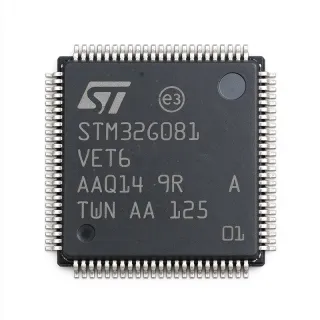
STM32L471VGT6 - 80MHz Cortex-M4 1MB MCU | STMicroelectronics
MPN: STM32L471VGT6 ✓ Hoạt độngSTM32L471VGT6 Tóm tắt
An ultra-low-power microcontroller is a semiconductor device optimized to perform control, measurement, communications, and data-processing tasks while minimizing energy consumption. The STM32L471 belongs to STMicroelectronics’ STM32L4 family, combining the Arm Cortex-M4 processor hierarchy with energy-efficient embedded control, analog peripherals, digital interfaces, and memory in one integrated device. Its architecture is suitable for designs that must balance processing capability, peripheral integration, board area, and power efficiency.
The STM32L471VGT6 combines an 80 MHz Arm Cortex-M4 core with 1 MB of Flash and a single-precision floating-point unit. The Cortex-M4 processor supports the standard Arm single-precision data-processing instructions and a complete set of DSP instructions. This combination gives embedded developers a compact platform for control loops, signal processing, protocol handling, and floating-point calculations without requiring a separate DSP or math coprocessor.
The device also includes digital and analog resources suited to mixed-signal embedded products. Its broad peripheral integration can reduce the number of discrete components on a compact PCB. The manufacturer’s STM32L471xx documentation identifies the family as an ultra-low-power Cortex-M4 MCU platform and confirms the 80 MHz maximum operating frequency and single-precision FPU architecture used by this ordering code.
Typical applications include industrial sensor controllers, low-power data loggers, medical monitoring equipment, building controls, communication modules, compact motor-control systems, and battery-powered IoT devices. The 100-pin LQFP package provides ample external connectivity for mixed-signal boards, while the 1 MB Flash capacity provides room for larger firmware images, boot routines, diagnostics, and application logic.
Designers should preserve the voltage and decoupling requirements specified in the manufacturer datasheet, place decoupling capacitors close to the supply pins, and maintain clear separation between sensitive analog inputs, high-speed digital signals, and switching-power circuitry. Firmware compatibility between related STM32L4 devices should be verified rather than assumed, particularly when changing memory configuration, peripheral availability, or boot behavior.
This page organizes the STM32L471VGT6’s core identifiers, package information, sourcing path, and engineering guidance with practical context for PCB integration. It also distinguishes exact device attributes from data that must be confirmed in the manufacturer’s pin table and electrical-characteristics documentation before a new board is released to production.
Bộ thay thế dễ dàng lắp đặt cho STM32L471VGT6 — cùng gói, chân-to-chân tương thích. Các bộ phận yêu cầu hàn PCB bị loại trừ.
Các biến thể trong loạt này
Các mẫu cùng loạt có thể lắp đặt dễ dàng tương thích với STM32L471VGT6 (cùng hình factor và footprint) — khác nhau ở Package, Flash Memory, ADC, CAN, DAC.
STM32L475VGT6
✅ Drop-In✗ Hết hàng
$5.2 / Đơn vị
Xem tài liệu →STM32L471VGT6 Tỷ lệ tối đa & tính chất điện
| Product Type | Ultra-low-power 32-bit microcontroller |
| Processor Core | Arm Cortex-M4 32-bit RISC |
| Maximum CPU Frequency | 80 MHz |
| Flash Memory | 1 MB (1M x 8) |
| Floating-Point Unit | Single precision |
| DSP Instruction Support | Complete set of Cortex-M4 DSP instructions |
| Program Memory Type | Flash |
| Điện áp cung cấp | 2.5 V or 3.3 V |
| Hộp | 100-pin LQFP |
| Package Dimensions | 14 x 14 mm |
| Kiểu lắp đặt | Surface mount |
| Shipping Package | Tray |
| Bề rộng đường dữ liệu | 32 bit |
| DFSDM Interface | Supported |
Hướng dẫn cấu hình chân STM32L471VGT6 tray
Cấu hình chân cho STM32L471VGT6 (tray gói). IC số này bao gồm chân GPIO, giao diện truyền thông (UART, SPI, I2C) và chân nguồn. Tham khảo tài liệu thông số kỹ thuật của nhà sản xuất để biết các chức năng chân thay thế và tùy chọn cấu hình. Cực kỳ quan trọng cho thiết kế hệ thống tích hợp và lập trình PCB.

Không có dữ liệu chân cụ thể sẵn có cho STM32L471VGT6.
Tham khảo: tài liệu kỹ thuật cho cấu hình chân đầy đủ.
Ứng dụng tiêu biểu
STM32L471VGT6 phù hợp cho 6 Áp dụngs: Industrial Sensor Controller, Battery-Powered IoT Sensor Node, Medical Monitoring Device, Compact Motor-Control System, Building and HVAC Controller, Low-Power Data Logger.
Industrial Sensor Controller
The STM32L471VGT6 fits industrial sensor controllers that require an 80 MHz Arm Cortex-M4 processor, 1 MB of Flash, and a generous 100-pin package for mixed-signal connectivity. The single-precision FPU and DSP instruction support can accelerate filtering, calibration, and transform-related calculations, while the LQFP footprint exposes more I/O than a compact 32-pin design. Place analog inputs according to the manufacturer pin table and keep the MCU’s supply decoupling close to the device. Validate the controller across supply variation, sensor-signal ranges, and environmental conditions before deployment.
Được đề xuất
Battery-Powered IoT Sensor Node
The STM32L471VGT6 is appropriate for battery-powered IoT sensor nodes because it combines an 80 MHz Cortex-M4 core with the low-power positioning of the STM32L471xx family. Its 1 MB Flash provides room for application firmware, local data processing, protocol stacks, and diagnostics without forcing an immediate move to a larger memory device. Energy optimization should be based on the duty cycle and measured current in each operating mode. Use the low-power modes, wake-up sources, and peripheral clock configuration described in the manufacturer documentation rather than leaving the processor continuously active.
Được đề xuất
Medical Monitoring Device
The STM32L471VGT6 can serve as the central controller in a medical monitoring system where signal processing, local data handling, and low-power operation are important. The Cortex-M4 DSP instructions and single-precision FPU support useful control and numerical tasks, while 1 MB of Flash accommodates application code and test algorithms. Its 100-pin package provides access to digital interfaces and analog-capable I/O, but each pin assignment must be checked against the exact STM32L471VGT6 pin table. Medical designs should also follow applicable risk-management, electrical-safety, and validation requirements for the finished product.
Được đề xuất
Compact Motor-Control System
The STM32L471VGT6 is suitable for compact motor-control and actuator systems that require more I/O and timer connectivity than a small microcontroller package offers. Its 80 MHz Cortex-M4 core can execute motor algorithms, while the DSP instructions and single-precision FPU support calculations commonly used in control loops. The 100-pin LQFP also provides a practical route to external gate drivers, position sensors, current sensing, and communications. Timing, break inputs, emergency-stop behavior, and fault handling must be designed to the specific peripheral capabilities listed in the manufacturer documentation.
Được đề xuất
Building and HVAC Controller
The STM32L471VGT6 fits building-control and HVAC equipment where one controller must combine sensor acquisition, actuator control, communications, and local logic. Its 1 MB Flash supports a substantial embedded application, and the 100-pin LQFP allows direct connection to sensors, relays, communication transceivers, and status indicators. Low-power characteristics can benefit systems that spend substantial time idle, but the energy budget must include sensor and actuator loads that dominate many HVAC nodes. Use the manufacturer’s pin multiplexing and electrical requirements to avoid conflicts between analog inputs, timers, and serial interfaces.
Được đề xuất
Low-Power Data Logger
The STM32L471VGT6 is a practical fit for low-power data loggers that sample sensors, store information locally, and transmit it periodically. The Cortex-M4 processor can handle filtering and protocol work at up to 80 MHz, while 1 MB of Flash provides room for buffering logic, a bootloader, and diagnostic routines. The STM32L471xx family’s low-power orientation supports duty-cycled operation, provided the design explicitly controls clocks, peripherals, and wake-up behavior. For removable media or external storage, account for the data bus, write timing, and level compatibility in the system architecture.
Được đề xuất
Tóm tắt các sản phẩm được đề xuất
Dữ liệu tham khảo kỹ thuật cho STM32L471VGT6 — so sánh, hướng dẫn thiết kế và thông tin tuân thủ.
Hướng dẫn chọn lựa
So sánh với các sản phẩm thay thế
| Tham số | Sản phẩm này | STM32L475VGT6 |
|---|---|---|
| Package | 100-pin LQFP (14 x 14 mm) | 100-pin LQFP |
| Brand | STMicroelectronics | STMicroelectronics |
| Maximum CPU Frequency | 80 MHz | 80 MHz |
| Flash Memory | 1 MB | 1 MB |
| Program Memory Type | Flash | Flash |
| Firmware Compatibility | Targeted for STM32L471VG | Related STM32L4 device; rebuild and validate required |
Bảo phân biệt quan trọng
- Large 1 MB Flash configuration in a 100-pin low-power MCU (vsSTM32L475VGT6)
- 80 MHz Cortex-M4 processing with single-precision FPU (vsSTM32L475VGT6)
- 100-pin mixed-signal integration (vsSTM32L475VGT6)
Ghi chú thiết kế
Assign every net from the STM32L471VGT6 pin-description table rather than from the broader STM32L471 family outline. The 100-pin LQFP provides many multiplexed functions, and an incorrect alternate-function choice can alter timer channels, serial interfaces, debug access, or analog assignments. Keep decoupling capacitors close to the relevant supply pins and route sensitive analog inputs away from switching nodes. Confirm the manufacturer land pattern and paste mask because LQFP lead geometry, pin pitch, and courtyard requirements must match the selected footprint.
Build the power tree around the manufacturer’s recommended 2.5 V or 3.3 V operating arrangement and verify startup, reset, and brownout behavior for the exact board configuration. Do not infer analog-supply or internal-regulator requirements from the headline supply listing; confirm them in the electrical-characteristics tables. Place bulk and high-frequency decoupling at the MCU supply pins and keep return paths short. The MCU’s operating current is only one part of the system budget, so include sensors, transceivers, LEDs, regulators, and any externally powered peripherals in the total thermal and battery analysis.
Do not treat a shared package as proof that firmware, peripherals, and electrical behavior are identical. Before substituting the STM32L475VGT6, compare the complete pin table, device identifier, clock tree, power behavior, memory organization, peripheral availability, and startup code. Rebuild for the final device where possible, then test reset, bootloader, interrupt priorities, analog channels, timers, communication peripherals, and low-power wake-up paths. This prevents a mechanically compatible replacement from creating a firmware-dependent field failure.
Use the 100-pin LQFP footprint with attention to fanout between fine-pitch leads and escape routing. Place the oscillator and supporting components, reset circuitry, programming/debug access, and decoupling according to the manufacturer reference layout. Separate analog inputs from digital clocks and switching-power traces, and provide adequate return copper under signal paths where the board stack-up permits. Review all pins used for SWD debugging so programming and fault analysis remain accessible after assembly.
Thông tin tuân thủ
Compliance attributes were not explicitly stated in the manufacturer or distributor information. Verify the current declarations for the exact ordering code and package.